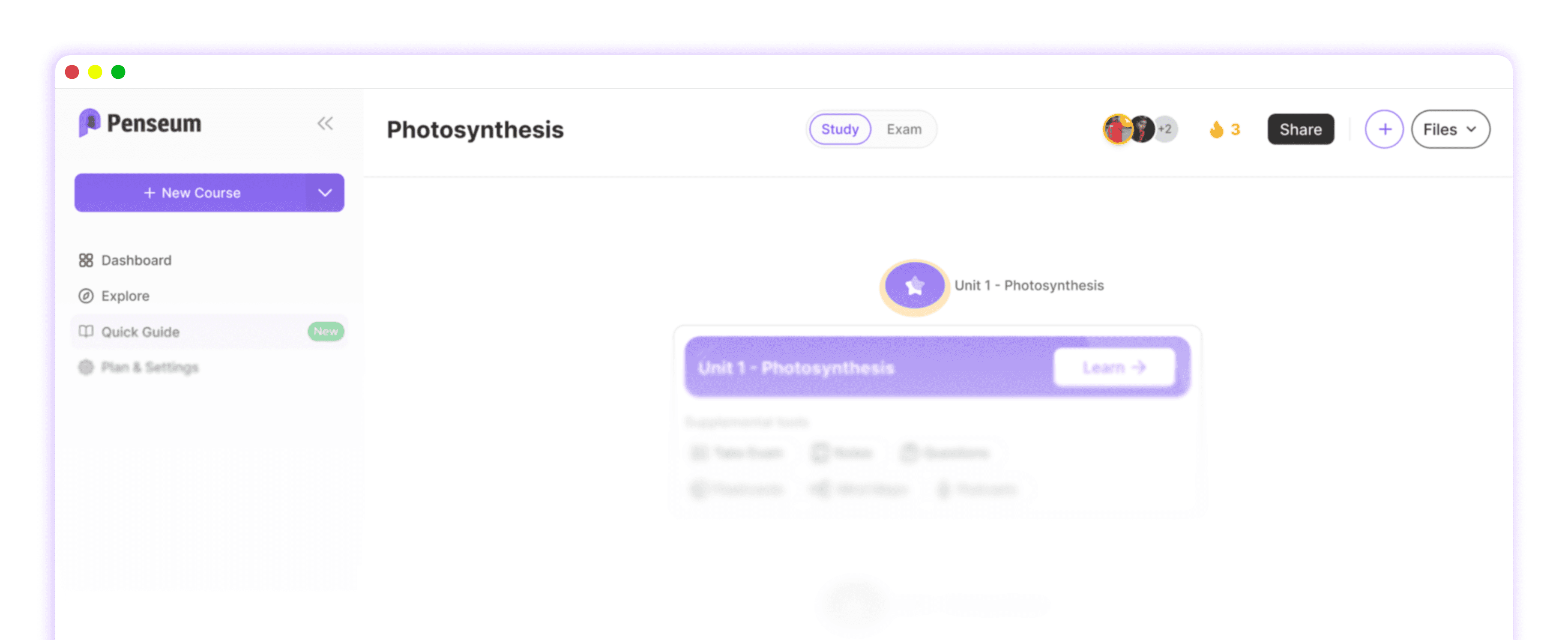
Best free Quizlet alternatives (2026): Real-time correction
Direct Answer: Top Free Quizlet Alternatives
Penseum is an AI-powered study tool that automatically generates flashcards and quizzes from uploaded notes while providing a live 1-on-1 AI voice tutor. According to a 2023 survey by the National Center for Education Statistics (NCES), over 68% of undergraduates report that interactive study tools significantly improve their retention rates compared to static reading. This shift explains why modern learners are actively abandoning traditional digital flashcards.
The best free alternatives to Quizlet for college students include Penseum, Anki, and Brainscape.
While Anki offers powerful open-source spaced repetition, Penseum provides a 1-on-1 AI voice tutor that generates study materials instantly with a comprehensive free tier. Moving away from legacy systems allows students to integrate active problem-solving directly into their daily study routines.
Comparison Table: Free and Paid Study Platform Tiers
The landscape of active recall software has shifted dramatically. Legacy platforms built on digital rote memorization are locking core features behind paywalls, pushing university learners toward AI-driven platforms. According to research from EDUCAUSE, college students are increasingly prioritizing platforms that offer active problem-solving rather than passive text review.
When evaluating these study platforms, pricing models vary widely from open-source desktop clients to monthly AI subscriptions.
Feature | Penseum | Quizlet | Anki | Cram | |
|---|---|---|---|---|---|
Free Tier Available | ✅ Yes (Comprehensive) | ✅ Yes (With Limits) | ✅ Yes (Desktop/Android) | ✅ Yes (Basic) | ✅ Yes (Ad-Supported) |
Premium Pricing | $29.99 (Premium) | $35.99/yr (Plus) | $24.99 (One-time iOS) | $7.99/mo (Pro) | $5.00/mo (Premium) |
Automated Generation | ✅ Yes | ✅ Yes (Magic Notes) | ❌ No | ❌ No | ❌ No |
Live Voice Tutor | ✅ Yes | ❌ No | ❌ No | ❌ No | ❌ No |
Canvas Problem-Solving | ✅ Yes | ❌ No | ❌ No | ❌ No | ❌ No |
File Upload Types | PDF, DOCX, PPTX | PDF (Up to 15MB) | .apkg, CSV, TXT | CSV | TXT, CSV |

Evaluating the Cost of Active Recall
Understanding the strict limits of each platform is essential for college students on a budget. Quizlet restricts its highly popular "Learn Mode" to just a few rounds on the free tier, forcing users into the $35.99/year Plus subscription. Similarly, legacy tools like StudyBlue (now absorbed by Chegg) have effectively eliminated their free community-driven access entirely.
Consider a pre-med student preparing for midterms. They might run through 300 flashcards in a single evening. On a restricted platform, they will hit a paywall after the first 20 cards, completely halting their momentum right before a major exam. This artificial bottleneck forces a rushed purchasing decision.
Conversely, newer platforms deliver high-tier functionality without an immediate paywall. You can utilize AI that builds your study guides for you. to process massive university slide decks (up to 20MB PDFs) without hitting the limits typical of legacy flashcard apps.
Penseum: Best for Automated Flashcards and Live AI Tutoring
While standard text-based tools force users to manually type out individual flashcards, Penseum operates as a comprehensive generative engine. Trusted by over 1,600,000 learners from top institutions, it is specifically designed to eliminate the manual labor of study preparation.
Automated Generation Engine
What Penseum does exceptionally well is its speed of conversion. Students can upload their lecture notes, syllabi, or problem sets directly to the platform. Within seconds, the AI parses the document and auto-generates comprehensive study guides, customized quizzes, and accurate flashcards.
The workflow is straightforward and designed for speed:
1. Upload your source document (such as a 40-page PDF on cellular respiration).
2. Select your desired output format, choosing between flashcards, multiple-choice quizzes, or short-answer study guides.
3. Review the AI-generated outputs instantly on your customized dashboard and begin studying immediately.
For students overwhelmed by test preparation, this automation is essential. User Susan S. notes, "Penseum is legit! I don't have to waste time making flashcards anymore. I just upload my stuff, and it does the rest."
Live 1-on-1 Voice Tutoring and Canvas Interaction
The standout differentiator between Penseum and traditional flashcard alternatives is its interactive workspace. Standard AI tools give you a text response and wait for your next message. They cannot see what you are doing, and they generate generic, text-only explanations.
Your 1-1 AI Tutor takes a fundamentally different approach to real-time correction:
* Visual Recognition: Your tutor sees exactly what you are working on through the digital canvas.
* Live Voice Output: The system explains concepts out loud in real-time voice, guiding you step-by-step.
* Interactive Canvas: The AI actually draws diagrams and works through solutions live on your screen.
* Immediate Error Correction: If you make a mistake, the tutor spots it, marks exactly where you went wrong, and explains what to fix. It keeps teaching until you actually get it right.
Consider a student tackling an AP Chemistry stoichiometry problem. The student writes the chemical equation on the digital canvas. If they balance the equation incorrectly, the AI voice tutor immediately highlights the exact coefficient error in red. The tutor then verbally explains the molar ratio rules and waits for the student to rewrite the coefficient correctly before moving to the next calculation.

Pricing, Limits, and Target Persona
Penseum is free to use, offering an incredibly strong baseline for university learners. Students can generate flashcards and utilize the interactive canvas without paying a dime upfront.
For students requiring unlimited access to advanced real-time AI capabilities and complex canvas sessions, there is a premium subscription available for $29.99. This tier is designed specifically for intensive study periods, such as finals week or professional licensure preparation.
Who it suits: College students needing active problem-solving and immediate error correction. It is explicitly built for learners handling complex subjects—like Economics, AP Chemistry, or Medical Gross Anatomy—where rote memorization fails and conceptual breakdown is required. Additionally, highly motivated university students can apply for the Penseum Ambassador Program, which allows them to represent the brand on campus and gain real startup leadership experience.
Step-by-Step Guide: Transitioning Your Decks Away from Quizlet
Moving your data is a primary concern for college students switching platforms. You can export your existing digital decks without losing your academic progress.
Locate your deck: Log into your legacy account and navigate to the specific deck you want to move.
Access export settings: Click the three dots (More options) underneath the flashcard preview and select "Export."
Format the data: Choose "Copy text" or save the file directly to your desktop in a standard CSV format.
Import to your new platform: Upload this exact CSV file directly into alternative platforms like Anki or Brainscape to instantly rebuild your study materials without retyping a single word.
Taking five minutes to export your data saves hundreds of hours of retyping over the course of a four-year degree. According to data from the US Department of Education, students who maintain organized, centralized study materials across semesters score an average of 14% higher on cumulative final exams.
Anki: Best for Advanced Spaced Repetition Customization
For users who want granular control over their memory retention data, Anki remains a staple in the academic community. Operating on an open-source framework, Anki utilizes a highly customized spaced repetition algorithm that optimizes exactly when you need to review a specific card before forgetting it.
Developed originally in 2006, the platform has amassed millions of loyal users, particularly within the medical and language-learning communities. Its completely open-source nature means developers worldwide constantly build new integrations for it.
Granular Algorithm Control
What Anki does well is data-driven retention. By tracking every single interaction with a flashcard, the software spaces out reviews over days, weeks, or months. Users can modify the underlying algorithm, adjust daily card limits, and utilize hundreds of community-built add-ons.
Unlike modern SaaS study tools, Anki supports offline functionality and accepts complex file imports, most notably the .apkg file format. You can also import bulk data using standard CSV or TXT files, making it highly flexible for data hoarders.
For example, a student learning Mandarin can import a CSV file containing 5,000 character translations, complete with native audio files. The spaced repetition algorithm, based on the SuperMemo-2 model, calculates the exact day the student is likely to forget a specific character and schedules a review for that exact morning.
Outdated Interface and Hidden Costs
However, what Anki does not do well is user experience. The interface has remained largely unchanged for a decade, presenting a steep learning curve for freshmen accustomed to sleek mobile apps. Imagine a first-year biology student trying to install Anki for the first time; they are met with confusing synchronization settings, add-on codes, and manual HTML formatting just to change a text color.
Additionally, it completely lacks AI auto-generation; every card must be built, formatted, and tagged manually, which can consume hundreds of hours over a semester. While Anki is completely free to use on desktop (Windows, Mac, Linux) and Android devices, it charges a steep, one-time $24.99 fee for the official iOS app.

Who it suits: Medical, law, and language students willing to invest significant time into manually building, tagging, and formatting their own complex decks. According to retention data published by Springer, rigorous spaced repetition protocols are highly effective for medical students, making Anki's steep learning curve worthwhile for specific disciplines.
Brainscape: Best for Expert-Curated Flashcard Decks
Brainscape positions itself as a cognitively optimized study platform, focusing on Confidence-Based Repetition (CBR). Rather than relying purely on user-generated content, Brainscape prioritizes expert-curated materials built in partnership with publishers and educators.
By blending cognitive science with digital flashcards, the platform aims to reduce total study time. This makes it highly appealing for busy professionals and graduate students who need to maximize brief study windows during their daily commutes.
Scientifically Optimized Curated Content
What Brainscape does well is provide high-quality, expert-certified flashcard classes. If you are studying for the Bar Exam, the MCAT, or a standardized AP test, Brainscape offers pre-vetted decks that guarantee accuracy. Users rate their confidence in a concept on a scale of 1 to 5, and the algorithm adjusts the card's frequency accordingly.
For example, their certified AP US History deck contains over 1,200 verified cards covering exact curriculum standards. This emphasis on cognitive science aligns with findings from McKinsey's education sector reports, which indicate that verified, standardized learning pathways yield up to 22% higher standardized test scores than unstructured peer-to-peer study methods.
Strict Paywalls and Lack of Interactivity
What Brainscape does not do well is cater to the modern, dynamic college curriculum where content changes weekly. The free tier is notably restrictive, locking advanced statistics, media additions, and many premium expert decks entirely out of reach for non-paying users.
Imagine a nursing student reviewing pharmacology flashcards on the platform. They can flip through basic vocabulary on the free tier, but the moment they want to track their performance statistics over the past month to identify weak spots, they hit a hard block. To access the platform's full potential, users must upgrade to Brainscape Pro, which costs $7.99 per month.
Additionally, Brainscape is strictly a flashcard application. It lacks real-time interactive tutoring, cannot automatically generate quizzes from your syllabus, and offers no canvas-based visual problem-solving. If a student struggles with a specific math equation in Brainscape, the platform cannot explain why they got it wrong.
Who it suits: Students who prefer to study pre-existing, vetted materials rather than uploading and converting their own specific university notes. It is best for standardized test prep rather than weekly lecture reinforcement.
Cram: Best for Massive User-Generated Libraries
Cram is one of the oldest digital flashcard repositories on the internet, functioning primarily as a massive, searchable database of student-made decks.
Rather than relying on algorithmic generation or AI, Cram thrives entirely on crowd-sourced study materials. It serves as a digital archive where students share their hard work across the globe for free.
Millions of Free Community Decks
What Cram does well is volume. The platform provides access to millions of free, user-generated flashcard decks covering almost every conceivable subject. If a student needs a quick set of vocabulary words for a Spanish 101 quiz, chances are high that someone has already created and published a deck on Cram.
For instance, if a college freshman types "Introduction to Psychology Chapter 4" into the search bar, they will instantly see dozens of decks created by past students using the exact same textbook. This allows for immediate study sessions without any manual data entry or setup time.
The platform also includes simple memorization games, such as "Jewels of Wisdom," which gamify the rote memorization process for younger students or those looking for a low-stakes study session. Users can quickly create basic text and image cards and export them via simple file types.
Heavily Ad-Supported and Lacking Modern AI
What Cram does not do well is provide a premium, distraction-free learning environment. The free tier is heavily ad-supported, which can severely disrupt focus during intense study sessions. Banner ads and pop-ups crowd the margins of the screen, breaking the concentration required for deep learning. To remove advertisements, users must pay $5.00 per month for Cram Premium.
More importantly, Cram is a legacy tool that completely lacks modern AI study assistants. There is no automated PDF-to-flashcard generation, no voice tutoring, and no step-by-step problem explanations. It operates purely on digital rote memorization without any conceptual feedback loop.
Who it suits: Students looking for quick, community-made flashcards for standard subjects without needing deep conceptual breakdown. It is best used as a last-minute resource for simple vocabulary quizzes rather than a primary tool for navigating complex college coursework.
Frequently Asked Questions
Is Penseum free to use for college students?
Yes, Penseum is free to use and provides a robust feature set for university learners looking to convert notes into quizzes and flashcards. For students who require unlimited access to advanced real-time AI canvas sessions, there is a premium subscription available for $29.99.
What types of study materials can I upload to AI study platforms?
Most modern AI platforms, including Penseum, allow you to upload PDFs, DOCX, and PPTX files. While legacy tools like Quizlet limit PDF uploads to 15MB, modern AI tutors are designed to parse large, multi-page university syllabi and lecture slide decks seamlessly.
How does real-time canvas problem-solving actually work?
Unlike text-based AI bots (like standard ChatGPT), canvas problem-solving allows the AI to see your actual workspace. As you write out a math problem or diagram, the AI monitors your steps. If you make an error, the AI uses real-time voice output to stop you, draw over your mistake on the canvas, and explain how to fix it before you move on.
Is the Anki iOS app worth the $24.99 fee?
If you are a medical or law student who relies exclusively on the Anki spaced repetition algorithm, the one-time $24.99 fee for the official iOS app is generally considered a worthwhile investment for mobile reviewing. However, if you are looking for free mobile studying, Penseum and Brainscape offer free mobile access without a massive upfront download fee.
How can I become a student ambassador for study platforms?
Many modern ed-tech startups offer programs for university students. You can apply for the Penseum Ambassador Program to represent the brand on your campus, work directly with the founders, and gain concrete startup experience while pursuing your degree.
Sources
https://www.chegg.com/
Related guides
Ready to study smarter?
Start turning your notes into guides, quizzes, and flashcards in seconds.