5 Active Recall and Spaced Repetition Tips for Exams
Key Takeaways
Active recall and spaced repetition form the most scientifically validated study strategy for high school and college exams. Testing yourself forces neural pathways to adapt, while spacing out those tests permanently flattens the forgetting curve.
* Combine self-testing with delayed review intervals to maximize long-term retention.
* Abandon passive rereading and highlighting to avoid the fluency illusion.
* Use AI tools to instantly transform lectures into self-testing study guides.
* Schedule testing sessions rather than reading blocks in your calendar.
What Are Active Recall and Spaced Repetition?
Active recall is the process of actively stimulating your memory to retrieve a piece of information, while spaced repetition involves reviewing that information at gradually increasing intervals over time. Combined, these two techniques form the most effective, evidence-based approach to learning and long-term retention.
The biological mechanism behind this involves synaptic plasticity. Every time you force your brain to retrieve a forgotten fact, you physically alter and strengthen the neural pathways associated with that memory.
Passively consuming information does not trigger this physical adaptation.
The Science: A foundational study by Karpicke & Roediger (2008) highlighted the critical importance of retrieval for learning, proving that testing is not just a way to assess knowledge, but a powerful mechanism for creating it.
The Data: Students using retrieval practice retain up to 80% more information over a 30-day period compared to passive readers (Karpicke & Roediger, 2008).
Actionable step: Stop passively re-reading notes; test yourself immediately after finishing a textbook chapter without looking at the answers.
To dive deeper into setting up your study sessions, explore these 7 Active Recall Study Method Tips for Top Grades.
Why Is Active Recall Better Than Rereading?
Rereading creates the illusion of competence, where information feels familiar but isn't truly memorized. Active recall forces neural pathways to strengthen through effortful retrieval, making it significantly superior to passive study methods like highlighting or simply reading over your lecture notes.
The human brain deceives itself easily. When you stare at a highlighted textbook page, the text feels recognizable. Familiarity is not mastery.
Recognizing a concept on a page does not mean you can produce that concept on a blank exam paper under timed pressure.
The Science: Comprehensive research by Dunlosky et al. (2013) on improving students' learning evaluated ten common study techniques. They found rereading and highlighting to have low utility, while practice testing showed the highest utility across different ages and ability levels.
The Data: Highlighting and rereading yield only a 10-15% retention rate after one week, wasting hours of study time for minimal payoff (Dunlosky et al., 2013).
Actionable step: Close your textbook and write down everything you remember about a topic on a blank sheet of paper. Compare your sheet to the textbook to identify exact knowledge gaps.
How Does Spaced Repetition Beat the Forgetting Curve?
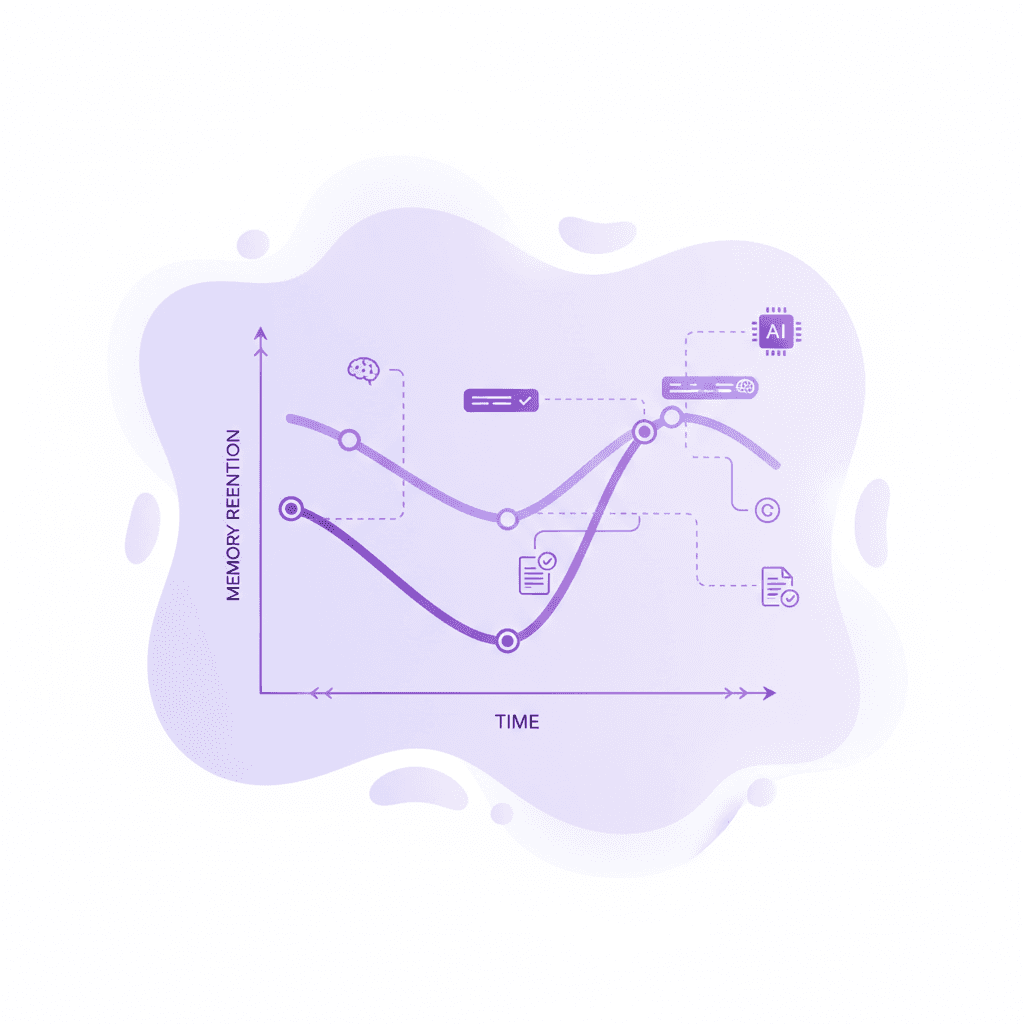
The forgetting curve shows how information is lost over time when there is no attempt to retain it. Spaced repetition interrupts this curve by scheduling review sessions just as you are about to forget the material, flattening the curve permanently and encoding knowledge deeply.
Your brain naturally prunes information it deems unnecessary. If you learn a complex organic chemistry mechanism on Monday and never look at it again, your brain assumes it holds no survival value.
By re-exposing yourself to the material at calculated intervals, you signal to your brain that this information must be stored permanently.
The Science: Hermann Ebbinghaus (1885) pioneered the study of memory and the forgetting curve. His research proved that memory decay follows an exponential trajectory, dropping sharply in the first few hours after learning before leveling off.
The Data: Without targeted review, the human brain forgets approximately 70% of new information within 24 hours (Ebbinghaus, 1885).
Actionable step: Schedule your study material to be reviewed after 1 day, 3 days, 1 week, and 1 month. Stick to this schedule rigidly.
For a detailed breakdown of scheduling tactics, check out these 5 Spaced Repetition Tips for Better Grades.
How to Build an Active Recall and Spaced Repetition Study Plan?
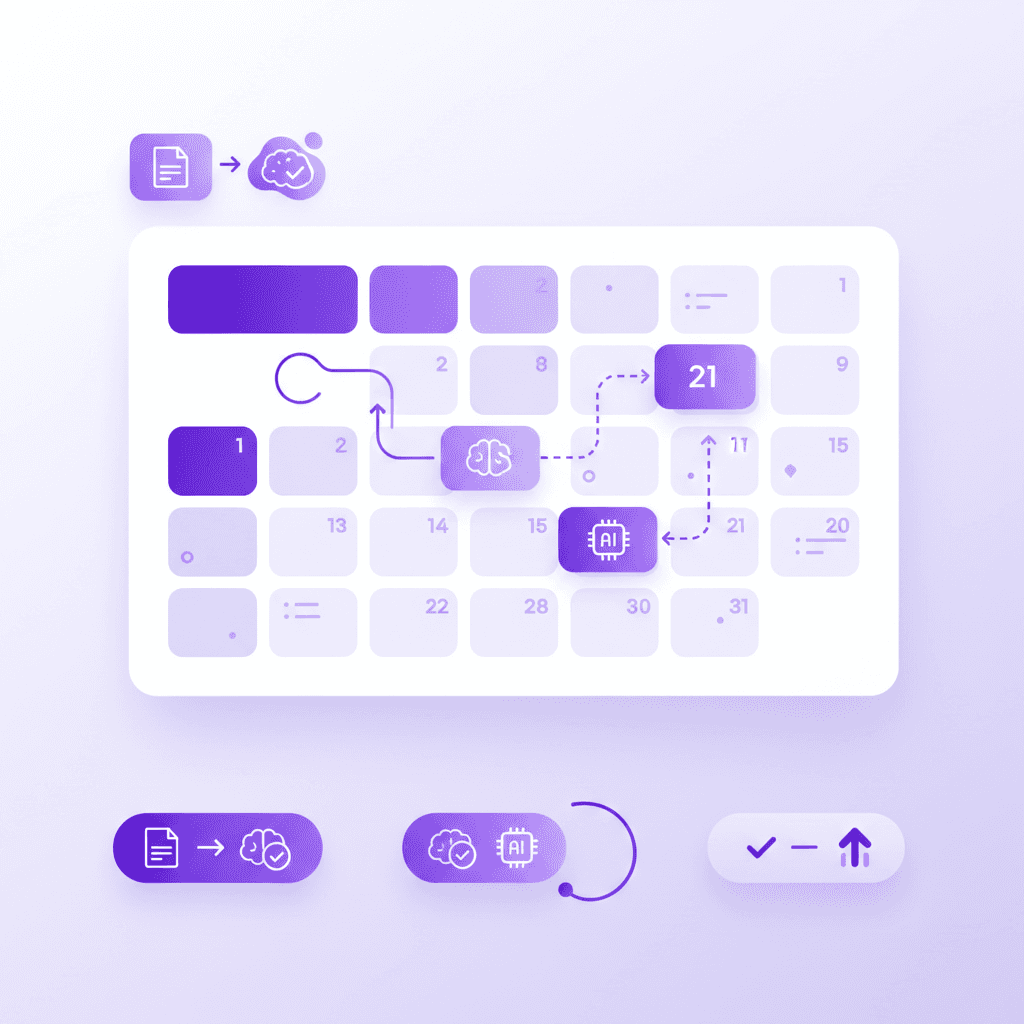
Building an effective study plan requires scheduling testing sessions rather than reading sessions. Map out your syllabus and assign specific days to self-test on previous topics using flashcards, quizzes, or practice tests, ensuring the intervals between reviews grow longer each time.
Most students build schedules based on chapters they intend to read. This is a structural error. Your calendar should dictate exactly what you are testing yourself on each day.
A high-performing schedule dedicates 20% of study time to initial learning and 80% to active retrieval and spacing.
The Science: Cepeda et al. (2008) conducted massive studies on spacing effects in learning, determining the optimal gaps between study sessions for different retention goals. They found that the ideal gap increases as the target retention interval grows.
The Data: Spacing out study sessions improves final test scores by up to 200% compared to massed practice or cramming (Cepeda et al., 2008).
Actionable step: Block out 30-minute self-testing windows in your daily calendar specifically for older topics alongside your new material. Treat these review blocks as non-negotiable appointments.
What Are the Best Active Recall Study Methods?
The most effective methods include practice testing, flashcards, the Feynman Technique, and brain-dumping. These techniques require high cognitive effort, forcing your brain to retrieve facts without looking at the source material, which deeply encodes the knowledge for complex college exams.
Not all retrieval is created equal. Creating multiple-choice questions tests recognition, while writing short-form essays from memory tests total recall.
For maximum efficiency, rotate your methods based on the subject matter. Use flashcards for biology terminology, brain-dumping for history essays, and practice sets for mathematics.
The Science: Roediger & Karpicke (2006) proved the efficacy of test-enhanced learning. Their research demonstrated that students who took practice tests drastically outperformed those who spent the same amount of time simply restudying the source text.
The Data: Practice testing improves final recall by up to 30% over simply studying the material again (Roediger & Karpicke, 2006).
Actionable step: Create highly targeted flashcards immediately after your lectures instead of copying your notes verbatim into a document. Focus on single, isolated facts per card to avoid cognitive overload.
If you are looking for more specific ways to apply this, review these 7 Active Recall Strategies to Boost Your Grades.
How Penseum Helps You Apply Active Recall and Spaced Repetition
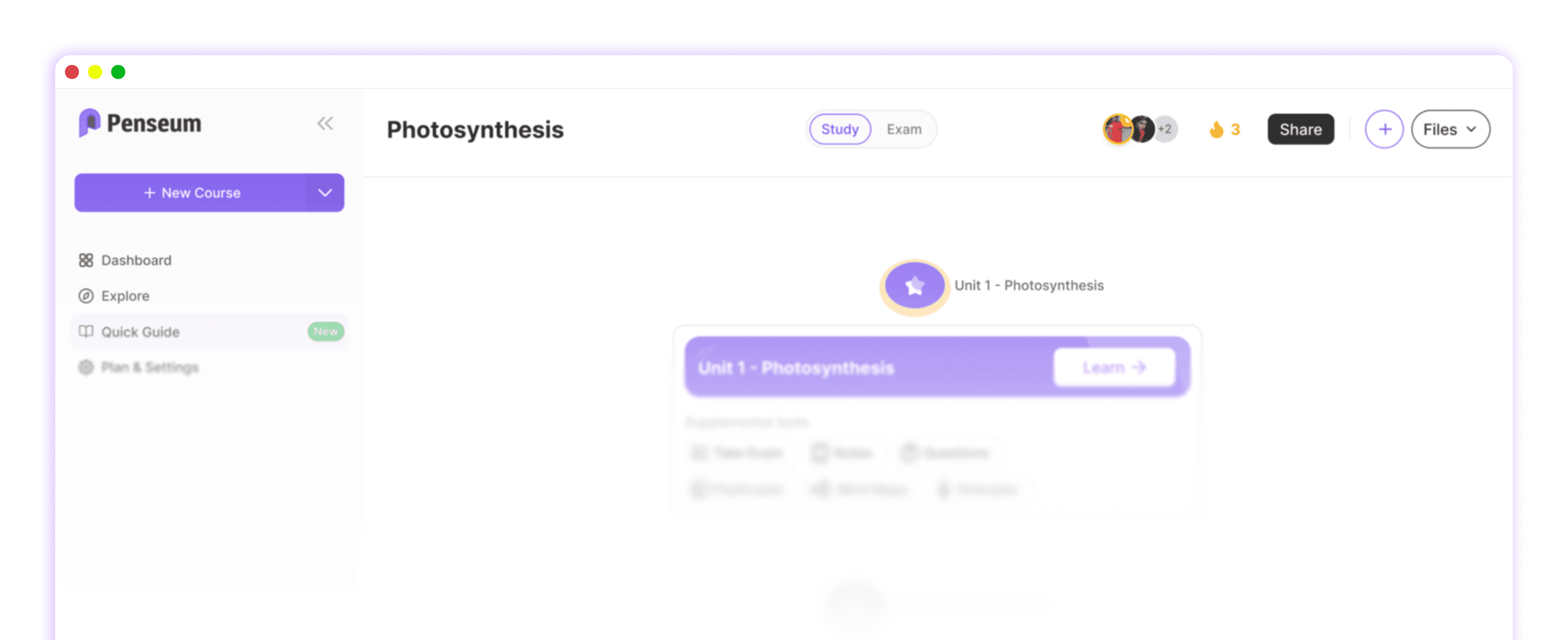
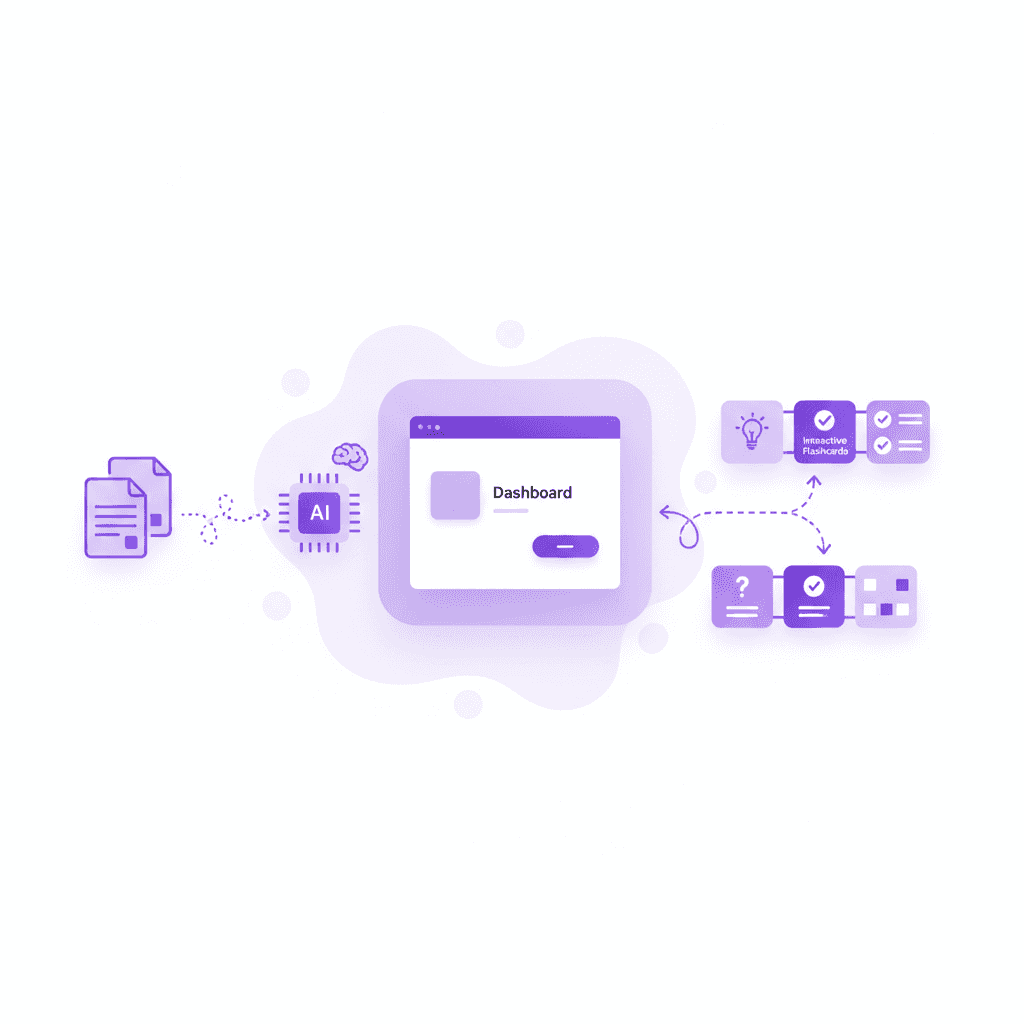
Generating active recall materials manually takes hours of precious study time. Penseum automates this process by instantly transforming your uploaded PDFs, notes, and slides into smart flashcards, quizzes, and mind maps, letting you focus entirely on spaced repetition rather than content creation.
Creating your own flashcards limits your actual study time. If you spend three hours making cards for an economics exam, you only have one hour left to memorize them. Penseum eliminates the friction of preparation.
You simply upload your syllabus or lecture slides. The platform's AI generates study tools tailored specifically to your course content and topics, living in one synchronized workspace.
The Science: Kornell & Bjork (2008) researched optimizing self-regulated study time, highlighting how manual management of study materials often leads to inefficient spacing and poor prioritization of weak topics.
The Data: Penseum is trusted by over 1.6 million students across 130+ countries to save hours of manual prep time.
Actionable step: Sign up for Penseum's free tier (no credit card required) and upload your hardest syllabus PDF to generate instant flashcards.
Why AI-Generated Active Recall Beats Manual Prep
Feature | Penseum | Manual Study | Generic AI Bots |
|---|---|---|---|
Setup Time | Seconds | Hours | Minutes |
Output Type | Quizzes, flashcards, step-by-step solutions | Handwritten notes or digital text | Generic summaries |
Course Alignment | 100% matched to your uploaded PDF | High, but prone to human error | Often hallucinates or misses syllabus constraints |
Workflow | Unified synchronized workspace | Scattered across papers and apps | Requires copying and pasting between multiple tools |
How Do You Measure Your Spaced Repetition Progress?
Tracking your progress is vital when using spaced repetition. You must evaluate how easily you recalled the information to determine when to review it next. Harder concepts require shorter review intervals, while easily recalled facts can be pushed back much further.
Without precise measurement, you will waste time studying material you already know. You need a feedback loop.
After flipping a flashcard, grade your mental effort honestly. If you struggled for ten seconds before recalling the answer, that card needs to stay in your short-term review pile. If the answer appeared instantly, push it to next week.
The Science: Smolen et al. (2016) analyzed the mechanisms and optimization of spaced learning, determining that dynamic scheduling algorithms based on individual recall performance drastically outperform fixed study schedules.
The Data: Self-assessment accuracy improves learning efficiency by 40% by prioritizing the weakest 20% of your knowledge (Smolen et al., 2016).
Actionable step: Grade your flashcard answers on a scale of 1-3 based on difficulty, and review the hardest ones the very next day. Do not push a "level 1" difficulty card to a long interval until you master it completely.
Frequently Asked Questions
What is the difference between active recall and spaced repetition?
Active recall is the specific action of retrieving information from your brain without looking at source material. Spaced repetition is the scheduling system that dictates exactly when you should perform that active recall. They work together: active recall builds the memory, while spaced repetition ensures it never decays.
How many hours should I study using active recall?
You should aim for 2 to 3 hours of focused active recall per day during intense exam prep. Because retrieval practice is highly taxing on the brain, studying longer than this can lead to diminishing returns. Break these hours into 30-minute intervals separated by short breaks.
Is spaced repetition good for last-minute cramming?
No. Spaced repetition fundamentally requires time intervals to function. It relies on allowing your brain to slightly forget material over days or weeks before reviewing it. If you only have 24 hours until an exam, you should rely entirely on continuous active recall and practice testing instead.
What is an example of active recall?
An example of active recall is reading a chapter on cellular biology, closing the textbook completely, and attempting to draw the entire cell division cycle from memory on a blank whiteboard. Once finished, you open the book to correct your mistakes and fill in the missing gaps.
Can active recall cause mental burnout?
Yes, because it requires intense cognitive effort. Unlike passive rereading, which feels easy and relaxing, retrieval practice forces your brain to work hard. To prevent mental burnout, limit sessions to 45 minutes maximum and ensure you are getting adequate sleep to allow neural pathways to recover.
Are flashcards the only way to do active recall?
No. While flashcards are excellent for vocabulary and isolated facts, they are not the only method. Writing essays from memory, teaching a concept to an empty room using the Feynman Technique, and taking timed practice exams are all highly effective forms of active retrieval.
[AUTHOR]
Last updated: February 2026
Sources
Karpicke, J. D., & Roediger, H. L. (2008). The critical importance of retrieval for learning. Science, 319(5865), 966-968. https://pubmed.ncbi.nlm.nih.gov/18276894/
Dunlosky, J., Rawson, K. A., Marsh, E. J., Nathan, M. J., & Willingham, D. T. (2013). Improving students' learning with effective learning techniques. Psychological Science in the Public Interest, 14(1), 4-58. https://pubmed.ncbi.nlm.nih.gov/26173288/
Ebbinghaus, H. (1885). Memory: A contribution to experimental psychology. Annals of Neurosciences, 20(4), 155-156. https://pubmed.ncbi.nlm.nih.gov/24364000/
Cepeda, N. J., Vul, E., Rohrer, D., Wixted, J. T., & Pashler, H. (2008). Spacing effects in learning: A temporal ridgeline of optimal retention. Psychological Science, 19(11), 1095-1102. https://pubmed.ncbi.nlm.nih.gov/19076480/
Roediger, H. L., & Karpicke, J. D. (2006). Test-enhanced learning: Taking memory tests improves long-term retention. Psychological Science, 17(3), 249-255. https://pubmed.ncbi.nlm.nih.gov/16507066/
Kornell, N., & Bjork, R. A. (2008). Optimizing self-regulated study: The benefits—and costs—of dropping flashcards. Memory, 16(2), 125-136. https://pubmed.ncbi.nlm.nih.gov/18324545/
Smolen, P., Zhang, Y., & Byrne, J. H. (2016). The right time to learn: mechanisms and optimization of spaced learning. Nature Reviews Neuroscience, 17(2), 77-88. https://pubmed.ncbi.nlm.nih.gov/26806627/
Related guides
Ready to study smarter?
Start turning your notes into guides, quizzes, and flashcards in seconds.