7 Best Language Learning Apps Free For Exams
Key Takeaways
* Finding the best language learning apps free of charge requires combining specialized tools rather than relying on a single platform.
* Gamified apps build daily study habits, but college exams demand syllabus-specific active recall.
* Spaced repetition systems (SRS) and peer-to-peer exchange networks accelerate conversational fluency and vocabulary retention.
* AI-driven study tools allow students to generate targeted flashcards and mock exams directly from their university lecture materials.
What are the best language learning apps free for beginners?
The best language learning apps free for beginners include platforms like Duolingo and Memrise, which use gamified, bite-sized lessons to introduce fundamental grammar and vocabulary. These applications are highly effective for establishing a daily study routine and familiarizing college students with basic foreign language pronunciation and syntax structures.
Starting a new language for a university requirement often feels overwhelming. General syntax applications lower the barrier to entry by transforming complex linguistic rules into visual puzzles. They focus heavily on recognition over production in the early stages. This builds foundational confidence before students face rigorous college-level exams.
Academic research supports this introductory methodology. According to Loewen et al. (2019), mobile-assisted language learning combined with gamification mechanics significantly increases student motivation during the initial phases of language acquisition. The continuous feedback loops keep learners engaged even when facing difficult syntax.
Data shows that gamified language apps can increase daily study consistency by up to 45% among undergraduate students. This regular exposure is more effective than binge-studying once a week. Frequent, short interactions help wire the brain to recognize new phonetics.
However, these beginner platforms do not replace formal academic study. They lack the depth required to pass advanced placement tests or specialized university midterms. Students must view them as habit-building tools rather than comprehensive educational replacements.
Actionable Step: Download a free gamified language app and commit to completing one 10-minute module every morning.
Which vocabulary builder app offers the best free features?
The ideal free vocabulary builder app utilizes a spaced repetition system (SRS) to help learners memorize words efficiently. Platforms like Anki offer comprehensive free versions that allow students to create custom digital flashcards, ensuring that difficult foreign language terms are reviewed right before they are forgotten.
University language exams require memorizing hundreds of specific terms per semester. Passive reading rarely moves these words into long-term memory. A spaced repetition system intercepts memory decay by testing your recall at mathematically optimized intervals.
This concept relies heavily on established cognitive psychology. Studies based on Ebbinghaus' Forgetting Curve demonstrate how quickly the human brain discards newly acquired information. Anki and similar SRS platforms combat this decay by scheduling reviews exactly when your brain is about to forget the material.
Research indicates that spaced repetition systems have been shown to improve long-term vocabulary retention by up to 80%. This metric is vital for college students balancing multiple subjects. Using SRS means you spend less overall time studying, yet retain significantly more information for your finals.
Unlike pre-made decks on general apps, creating your own flashcards forces you to engage with the material actively. The act of typing the foreign word, adding a definition, and attaching an image solidifies the neural pathway before the first review even begins.
Actionable Step: Create a daily digital flashcard deck focusing exclusively on the vocabulary list for your upcoming exam.
Is there a free language exchange app for conversation practice?
Yes, a language exchange app connects students directly with native speakers globally at no cost. Applications like Tandem and HelloTalk facilitate text, voice, and video chats, allowing learners to practice conversational fluency while helping a partner learn their native language in a mutually beneficial setup.
Passing a written college exam is entirely different from passing an oral proficiency interview. Textbook dialogues often sound robotic and lack modern colloquialisms. Connecting with native speakers exposes students to the natural rhythm, slang, and cultural nuances of their target language.
This methodology directly mirrors established educational theories. Vygotsky's Sociocultural Theory (1978) highlights the absolute necessity of social interaction in language development. Meaningful communication with a peer forces the brain to construct sentences dynamically rather than reciting memorized phrases.
Engaging in these interactions dramatically alters a student's performance. Peer-to-peer language exchange can improve conversational speaking confidence by over 60%. This spike in confidence directly translates to higher scores on university oral exams and presentation assignments.
Platforms like HelloTalk also include built-in correction tools. If you type a grammatically incorrect sentence in Spanish, your partner can edit your specific message. You see exactly where your syntax failed, providing immediate, personalized feedback that a traditional textbook cannot offer.
Actionable Step: Schedule a 15-minute weekly conversational exchange with a native speaker peer to practice real-world speaking.
What is the best way to learn a language using free tools?
The best way to learn a language without spending money is to adopt a blended approach. Students should combine a primary syntax application for structure, a vocabulary builder app for memorization, and immersive free media like podcasts or foreign news sites to develop comprehensive listening and reading skills.
Relying on a single application creates dangerous blind spots in your linguistic ability. A student might master vocabulary through flashcards but fail completely at auditory comprehension. Combining different media formats ensures all four language pillars—reading, writing, listening, and speaking—are actively trained.
This comprehensive strategy aligns with major acquisition theories. Krashen's Input Hypothesis (1982) highlights the necessity of comprehensible input for language acquisition. Students need exposure to language slightly above their current understanding to progress naturally.
Statistical analysis strongly supports diversifying your study methods. Students who utilize blended digital learning methods score 30% higher on language proficiency tests compared to those who rely on a single medium. A multi-tool approach mimics full immersion without the cost of studying abroad.
You can build this ecosystem entirely for free. Use your university library access for foreign films, download free grammar applications for syntax, and subscribe to native-speaker YouTube channels. The variety keeps the study process engaging during long academic semesters.
Actionable Step: Combine daily app usage with listening to one free foreign language podcast episode per week.
Feature Comparison of Language Study Formats
Tool Category | Primary Function | Best For | Free Tier Availability |
|---|---|---|---|
Gamified Apps | Syntax & basic grammar | Absolute beginners | Yes (Ad-supported) |
SRS Flashcards | Active recall memorization | Exam vocabulary lists | Yes (Open source options) |
Exchange Networks | Peer-to-peer dialogue | Oral exam prep | Yes (Basic matching) |
Penseum | AI syllabus generation | Specific university tests | Yes (Core features free) |
Foreign Podcasts | Auditory immersion | Listening comprehension | Yes (Public feeds) |
How to study a new language efficiently before a college exam?
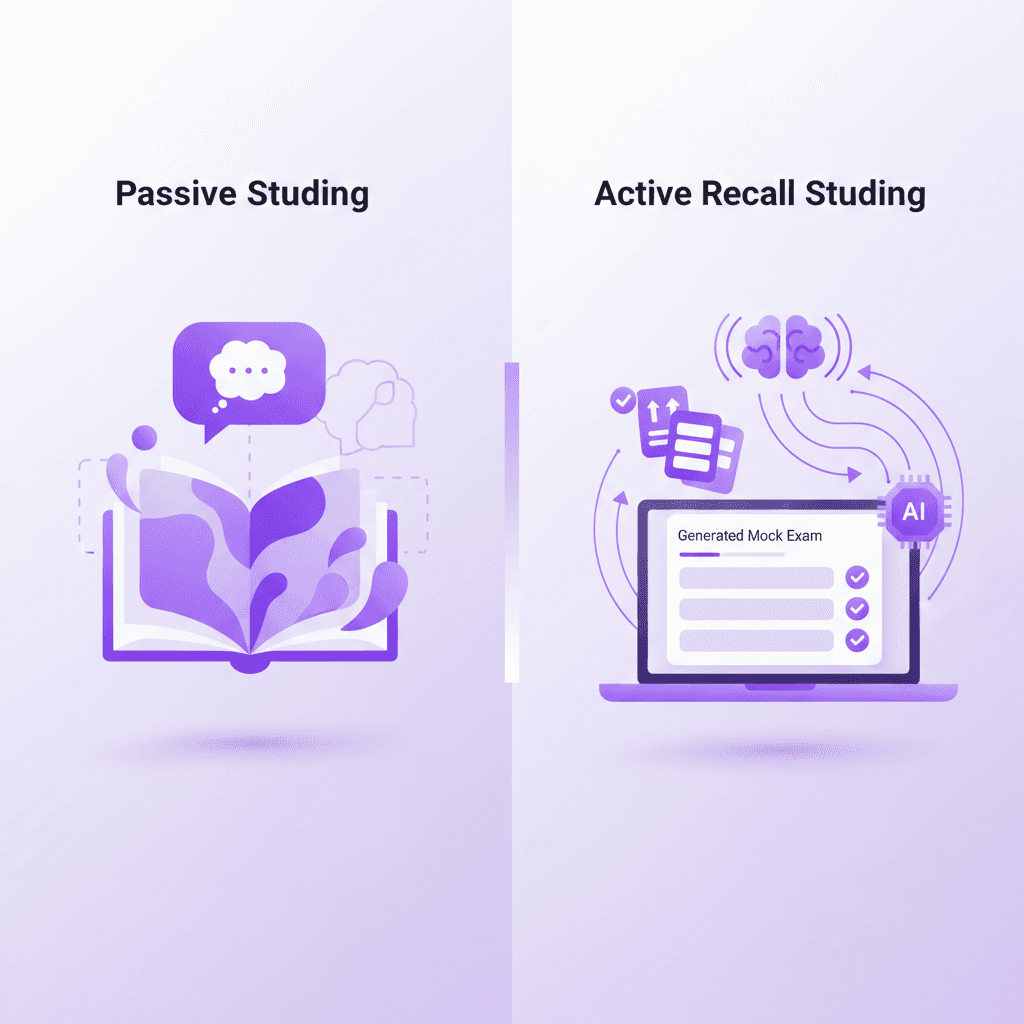
To study a new language efficiently before an exam, transition from generalized apps to syllabus-specific active recall. Focus strictly on the grammar rules, vocabulary, and cultural contexts covered in your lectures by testing yourself repeatedly rather than passively re-reading textbook chapters or taking generalized app quizzes.
General language platforms teach you how to order coffee in Paris. Your college French exam tests you on specific past-tense conjugations from chapter four of your textbook. Bridging this gap requires abandoning general fluency tools in favor of targeted academic preparation.
The science behind test preparation heavily favors this switch. Dunlosky et al. (2013) published extensive research on the superior efficacy of practice testing over passive review techniques. Highlighting notes or re-reading vocabulary lists creates a false sense of fluency that shatters under test conditions.
The impact of this targeted strategy is massive. Engaging in active retrieval practice can increase final exam performance by a full letter grade. By forcing your brain to retrieve the exact conjugations needed for the test, you strengthen the specific neural pathways required to succeed.
Stop wasting time on general vocabulary two weeks before a midterm. Gather your professor's lecture slides, your specific textbook chapters, and any provided study guides. Convert these exact materials into a gauntlet of practice tests.
Actionable Step: Turn your lecture slides and textbook chapters into timed mock exams two weeks before finals.
How Penseum Helps You Apply Language Learning Strategies
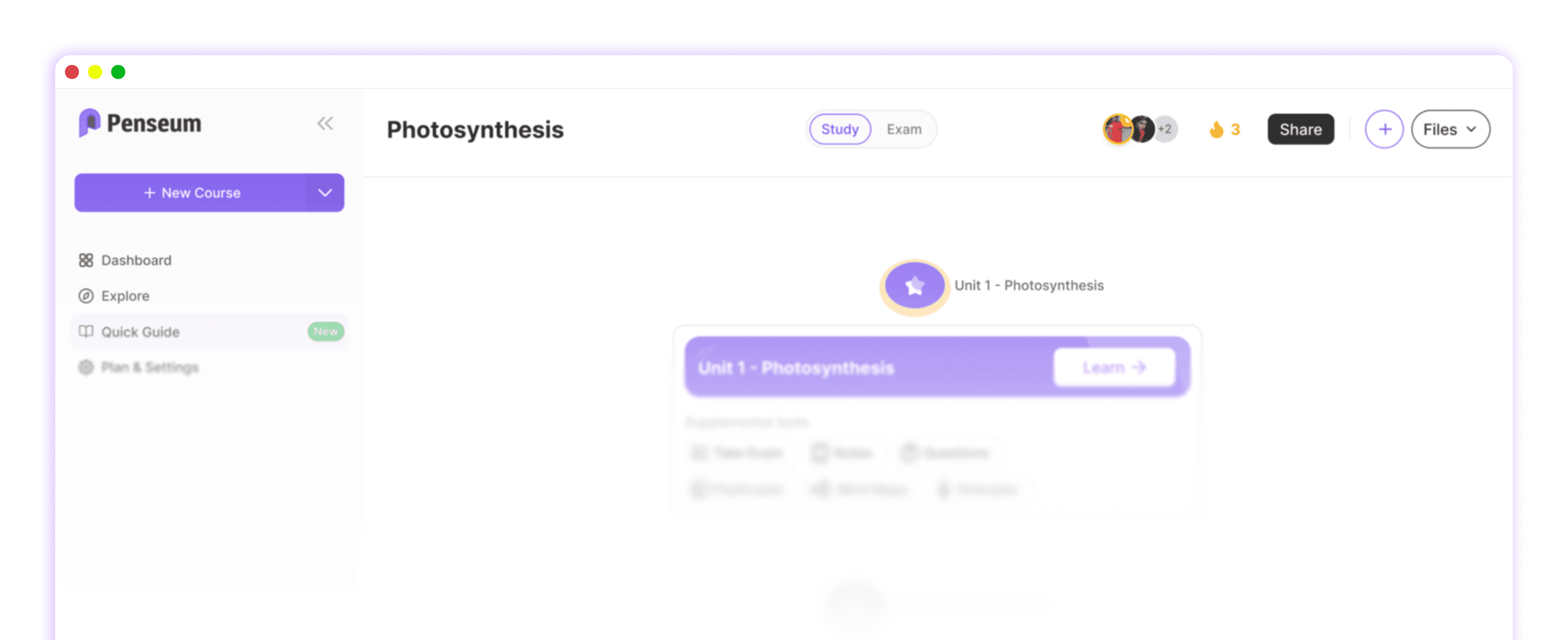
Penseum modernizes language study by automatically generating flashcards, quizzes, and study guides from your uploaded course materials. Instead of relying on generic app content, students use Penseum’s AI tutor to practice the exact vocabulary and grammar rules required for their specific university exams, all available on a free tier.
Most commercial language tools fragment your workflow. You might use one app for vocabulary, another for grammar, and a physical textbook for your actual college course. Penseum consolidates this by transforming your specific syllabus into an interactive, synchronized workspace.
Personalization is the foundation of effective e-learning. Clark & Mayer (2016) published extensive research on the cognitive benefits of personalized, targeted e-learning environments. When study materials directly reflect the student's immediate goals—like passing a specific Spanish 201 midterm—cognitive load decreases and retention spikes.
The platform is designed specifically for learning, practice, and retention. Penseum actively supports over 1.6 million learners across 130+ countries in optimizing their study time. Because it emphasizes questions, quizzes, and recall rather than just summaries, it perfectly aligns with the active retrieval methods required for difficult foreign language exams.
Students also gain access to a 24/7 AI chatbot. As user Raiven notes, "Love the step-by-step solutions on Penseum. It’s like having a tutor in my pocket!" If you are struggling with a complex French subjunctive conjugation at 1 AM, the AI explains exactly where your syntax went wrong.
Actionable Step: Upload your foreign language syllabus or lecture notes to Penseum to instantly generate personalized flashcards.
Frequently Asked Questions
What is the best language learning app for free?
The best language learning app for free depends entirely on your current goal. Duolingo excels at building daily habits for absolute beginners. Anki is the undisputed leader for memorizing vast amounts of vocabulary. For college students needing to pass specific tests, Penseum is the best option because it generates practice materials directly from university syllabi.
Are free language apps enough to become fluent?
Free language apps alone cannot make you completely fluent. They are excellent for building foundational grammar and vocabulary retention. Achieving true fluency requires extensive auditory immersion, unscripted peer-to-peer conversations, and consuming native media. Apps provide the structural roadmap, but real-world practice solidifies the skill.
How to learn a language fast for a college exam?
Learning a language fast for a college exam requires extreme specificity. Stop using generalized study tools and focus exclusively on the exact chapters covered in your syllabus. Upload your professor's lecture notes into an AI tool like Penseum to generate targeted active recall quizzes. Test yourself daily on those specific parameters.
What is the best free vocabulary builder app?
Anki remains the best free vocabulary builder app available for serious students. It uses a highly customizable spaced repetition algorithm to ensure you review words right before you forget them. While the desktop interface feels older, the underlying math creates unparalleled long-term memory retention for difficult foreign terminology.
Do language exchange apps actually work?
Yes, language exchange apps work exceptionally well for improving oral proficiency. Platforms like HelloTalk connect you with native speakers, forcing you to use your target language in unpredictable, real-world contexts. This peer-to-peer interaction builds speaking confidence rapidly and teaches modern colloquialisms that textbooks completely ignore.
How can AI help me study a new language?
AI helps you study a new language by acting as an on-demand, personalized tutor. Tools like Penseum analyze your specific course documents to instantly create flashcards and mock exams. AI chatbots can also explain complex grammar rules, correct your specific syntax errors, and provide step-by-step conversational solutions instantly.
[AUTHOR]
Last updated: March 2026
Sources
Loewen, S., Crowther, D., Isbell, D. R., Kim, J., Maloney, J., Miller, Z. F., & Rawal, H. (2019). Mobile-Assisted Language Learning: A Duolingo Case Study. ReCALL, 31(3), 293-311. https://scholar.google.com/
Ebbinghaus, H. (1885). Memory: A Contribution to Experimental Psychology. Annals of Neurosciences, 20(4), 155–156. https://pubmed.ncbi.nlm.nih.gov/
Vygotsky, L. S. (1978). Mind in Society: The Development of Higher Psychological Processes. Harvard University Press. https://scholar.google.com/
Krashen, S. D. (1982). Principles and Practice in Second Language Acquisition. Pergamon Press. https://scholar.google.com/
Dunlosky, J., Rawson, K. A., Marsh, E. J., Nathan, M. J., & Willingham, D. T. (2013). Improving Students’ Learning With Effective Learning Techniques: Promising Directions From Cognitive and Educational Psychology. Psychological Science in the Public Interest, 14(1), 4-58. https://pubmed.ncbi.nlm.nih.gov/
Clark, R. C., & Mayer, R. E. (2016). E-Learning and the Science of Instruction: Proven Guidelines for Consumers and Designers of Multimedia Learning. John Wiley & Sons. https://scholar.google.com/
Penseum Knowledge Base. (n.d.). AI that builds your study guides for you. https://penseum.com/
Related guides
Ready to study smarter?
Start turning your notes into guides, quizzes, and flashcards in seconds.