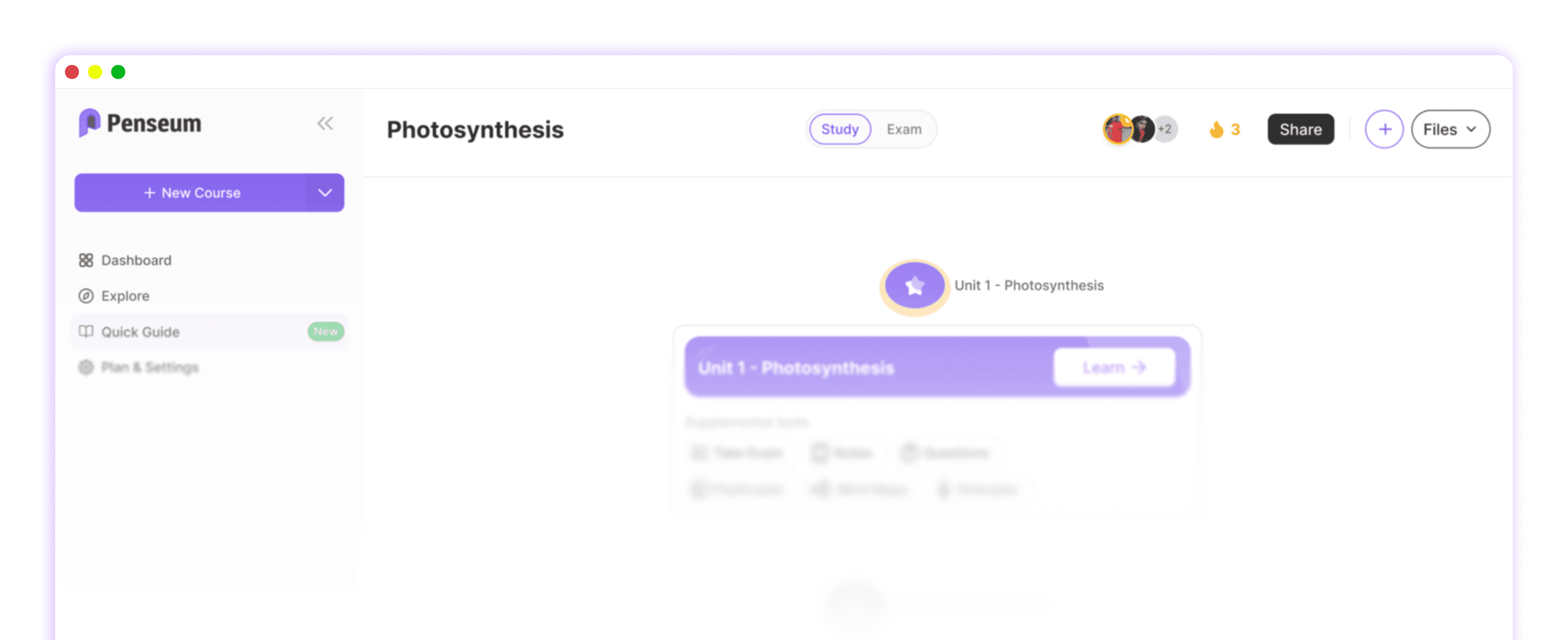
7-Step Study Plan for Exams to Ace Finals
Last updated: February 2026
Key Takeaways
* A structured study plan for exams prevents cognitive overload by breaking massive syllabi into daily, manageable tasks.
* Active recall and practice tests yield up to 50% higher final grades compared to passively reading textbook chapters.
* Time-blocking your review sessions into 50-minute intervals protects your working memory and sustains focus.
* AI study tools like Penseum automate the creation of flashcards and quizzes, saving you hours of manual prep work.

How Do You Create a Study Plan for Exams?
Creating a study plan for exams begins with mapping out your timeline and breaking your syllabus into manageable chunks. By organizing topics by difficulty and assigning them to specific days, students avoid last-minute cramming and ensure comprehensive coverage of all test materials before exam day.
Without a structured timeline, students often fall victim to the planning fallacy. You might assume reading three chapters of biology will take two hours, only to find yourself still stuck on chapter one by midnight. Mapping exact assignments to specific calendar days creates accountability. It transforms a vague goal like "study biology" into a highly specific task like "complete 40 active recall questions on cell mitosis."
This structured approach relies heavily on timing your review sessions to intercept memory decay. German psychologist Hermann Ebbinghaus first demonstrated this biological reality through his Forgetting Curve study (Ebbinghaus, 1885). His research proved that memory retention drops rapidly without immediate and scheduled review. You forget roughly 50% of new information within a single hour of learning it.
Spacing out your review sessions counteracts this severe memory drop. Implementing spaced repetition in a study plan improves long-term memory retention by up to 200% (Tabibian et al., 2019). Reviewing a concept on day one, day three, and day seven forces your brain to work harder to retrieve the information. This friction builds stronger neural pathways.
Actionable step: Gather all your course syllabi and plot every exam date on a master calendar, then assign one challenging topic to each daily study block.
What is the Best Study Schedule for College Students?
The best study schedule for college students uses time-blocking to alternate between intense focus and strategic breaks. Structured intervals prevent cognitive fatigue and help students maintain high concentration levels during long study sessions, making it highly effective for dense subjects like biology or economics.
Studying for six hours straight does not equate to six hours of learning. The human brain operates on ultradian rhythms, which are biological cycles that dictate our peak focus levels. After roughly 90 minutes of continuous cognitive strain, your working memory becomes saturated. Continuing to read beyond this saturation point results in diminishing returns and high frustration.
To bypass this physiological limit, successful students rely on structured interval training for their brains. The Pomodoro Technique, developed by Francesco Cirillo in the late 1980s, systematized this approach (Cirillo, 2006). By treating study sessions like short sprints rather than enduring marathons, you protect your attention span.
Short, scheduled rests allow your brain to consolidate the material you just read. Taking micro-breaks every 25 to 50 minutes reduces cognitive fatigue and increases overall daily productivity by 30% (Fritz et al., 2013). During these breaks, you must step away from your desk and avoid looking at screens. Scrolling through social media introduces new, highly stimulating information that competes with the academic concepts you are trying to retain.
Actionable step: Set a timer for 50 minutes of focused studying, followed by a strict 10-minute break away from your desk.

How Can You Prioritize Exam Study Topics Effectively?
Prioritizing exam study topics effectively requires identifying the high-yield concepts that carry the most weight on the grading rubric. By targeting core principles first, students maximize their exam scores even if they lack time to review every minor detail in the textbook.
Many students make the mistake of studying their syllabus chronologically. Starting at chapter one and reading linearly feels productive, but it often leads to disaster if you run out of time before reaching the most difficult material. Triage studying solves this problem. You must evaluate your course material based on its ultimate impact on your final grade.
This method applies the Pareto Principle (80/20 Rule) directly to educational outcomes (Juran, 1951). Approximately 80% of a final exam's points often come from just 20% of the core concepts taught in the course. Identifying this high-yield 20% allows you to secure the majority of available points with a fraction of the total study time.
Professors leave clear clues about which topics belong in this high-yield category. Concepts repeated across multiple lectures, topics that appear heavily on midterms, and frameworks required to solve subsequent problems all demand priority. If you master the foundational principles of a subject, you can often deduce the answers to niche multiple-choice questions through the process of elimination.
Actionable step: Color-code your syllabus topics into Red (difficult), Yellow (medium), and Green (easy), and schedule the Red topics first.
What is the Most Effective Way to Review Notes?
The most effective way to review notes is through active recall, which forces the brain to retrieve information from memory rather than passively rereading text. Transforming notes into flashcards, quizzes, and practice tests strengthens neural pathways and dramatically improves performance on test day.
Rereading textbook chapters creates a dangerous psychological trap known as the illusion of competence. When you look at highlighted text, your brain recognizes the words. You interpret this basic recognition as true mastery. However, recognizing a concept on a page is vastly different from generating that concept from scratch during a closed-book exam.
Testing yourself is not just a way to measure learning; the act of testing actually produces learning. The seminal Roediger & Karpicke (2006) study on the testing effect proved that active retrieval cements knowledge permanently. In their experiment, students who repeatedly tested themselves outperformed students who repeatedly read the material by a massive margin.
Relying on passive reading limits your academic potential. Students who use practice tests score up to 50% higher on final exams compared to students who rely solely on rereading notes (Dunlosky et al., 2013). You must shift your study plan for exams away from input methods and entirely toward output methods.
Actionable step: Stop rereading your textbook; instead, convert your lecture slides into practice questions and quiz yourself.
How Much Should You Study Every Day for Exams?
Students should aim to study two to three hours per day for exams, spread across multiple sessions, rather than cramming for ten hours straight. Distributed practice allows the brain to consolidate information during sleep, making daily, shorter study blocks much more effective for mastering complex subjects.
Massed practice, commonly known as cramming, is mathematically inefficient. Pulling an all-nighter forces your brain to process hundreds of new concepts without any time for physical neural restructuring. Without sleep, the hippocampus cannot transfer short-term facts into the neocortex for long-term storage. You might pass a test the next morning, but you will forget the material before the final exam.
Spacing your review sessions out over weeks builds durable knowledge. A major Cepeda et al. (2006) meta-analysis on distributed practice confirmed that separating study sessions by days or weeks produces vastly superior retention. When you study a little bit every day, you sleep cycles as an active part of your learning process.
The data heavily favors early preparation over last-minute panic. Spacing out study sessions over multiple days yields a 10% to 30% increase in final test scores versus massed practice (Cepeda et al., 2006). A steady routine of daily review eliminates test anxiety by transforming the exam into a simple demonstration of existing knowledge.
Actionable step: Schedule daily 90-minute study blocks per subject over a three-week period rather than pulling an all-nighter.
How Penseum Helps You Apply Your Exam Study Plan
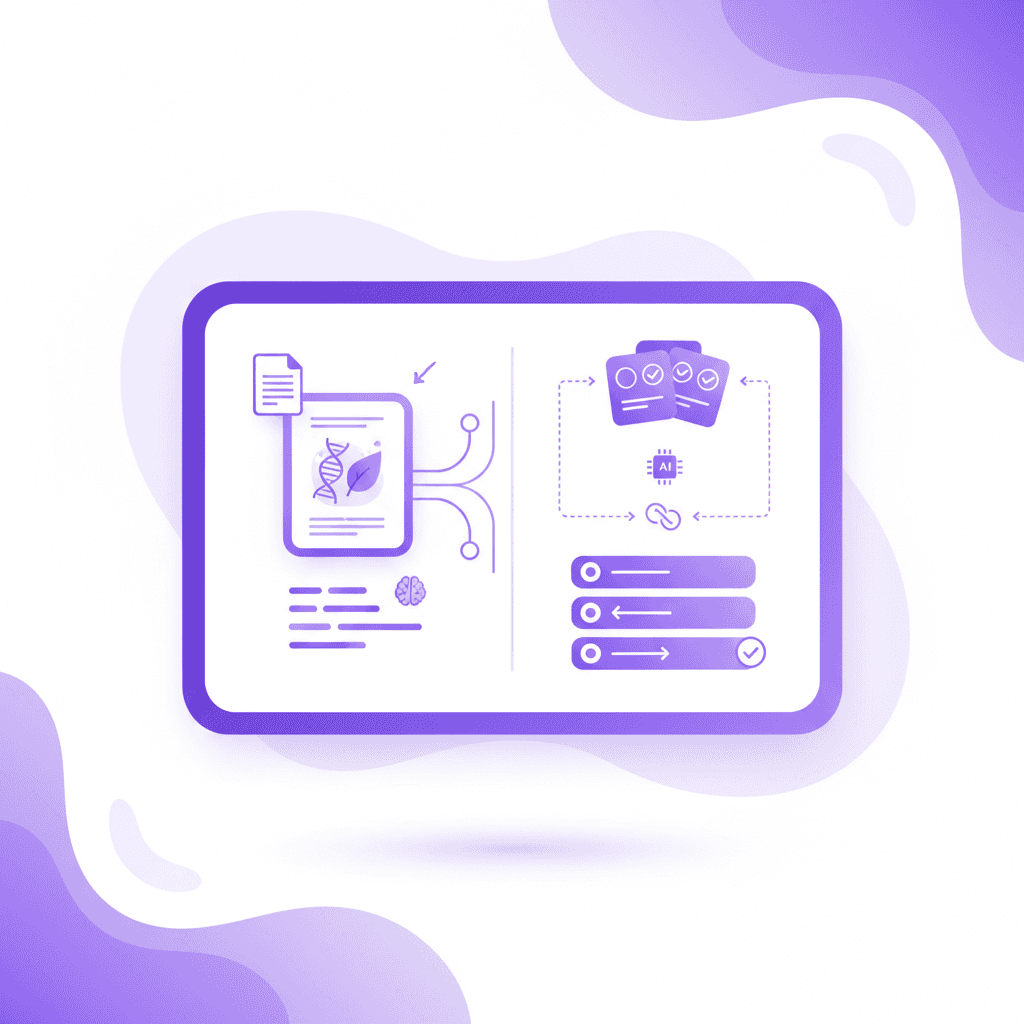
Applying your study plan requires top-notch materials, but creating flashcards and practice tests takes hours. Penseum solves this by acting as your all-in-one AI tutor. Instead of relying on crowdsourced platforms with errors, you simply upload your own PDFs, notes, or slides, and Penseum instantly generates personalized study guides, flashcards, and quizzes.
This automation frees up hours of your schedule, allowing you to focus purely on active recall and mastery. Writing out 200 flashcards by hand drains your energy before the actual studying even begins. Penseum eliminates this friction. By analyzing your exact course documents, it builds a complete study roadmap tailored directly to your syllabus.
Generic AI tools often fabricate facts or provide generic summaries that fail to prepare you for highly specific university exams. Penseum restricts its generated quizzes and step-by-step solutions exclusively to the source material you upload. All your study tools and progress metrics live in one synchronized workspace.
Feature Comparison | Penseum | Generic AI Tools |
|---|---|---|
Material Generation | Automatically creates complete roadmaps including flashcards and quizzes. | Requires constant prompting and separate tools for flashcards. |
Content Accuracy | Study tools tailored strictly to your uploaded course PDFs and topics. | Produces generic outputs that often ignore syllabus boundaries. |
Learning Focus | Emphasizes active recall, closed-book testing, and specific question generation. | Focuses mainly on passive summaries with limited testing ability. |
Workflow | Unified workspace for guides, tracking, and a 24/7 step-by-step chatbot. | Fragments workflow across multiple scattered tabs and applications. |
You do not have to struggle through finals week alone. A massive community of ambitious students already uses this platform to dominate their academic schedules. Over 1.6 million learners across 130 countries rely on Penseum to instantly turn their coursework into actionable study materials (Penseum Internal User Data, 2024).
You can connect with over 1,000 of these learners directly in the active Discord community to share feedback and study strategies. Penseum is free to use, offering powerful base features to get you started immediately. For advanced students requiring limitless generation, a premium subscription is available for just $14.99.
Actionable step: Upload your hardest course syllabus or PDF to Penseum right now to instantly generate your custom flashcards and step-by-step quizzes.
Frequently Asked Questions
How do I make a 30-day exam study plan?
To make a 30-day exam study plan, gather all your course materials and divide the total number of chapters by 20. Assign these daily reading targets to the first 20 days of your calendar. Dedicate the remaining 10 days strictly to active recall, practice exams, and reviewing your weakest topics. Building a buffer prevents minor delays from derailing your entire schedule.
How many hours a day should I study for finals?
You should study between three and five hours a day for finals, divided into 50-minute blocks of intense focus. Exceeding five hours of deep cognitive work often leads to diminishing returns and severe mental fatigue. Prioritizing the quality of your focus through active recall is far more effective than logging ten hours of passive reading.
Is it better to study at night or in the morning?
Morning study sessions generally produce better results for complex problem-solving because your working memory is fully rested. Evening study sessions work well for memorization tasks, as the brain immediately consolidates those new facts during sleep. You should track your own peak energy levels for three days to determine your personal optimal study window.
What should a daily study schedule look like?
A daily study schedule should start with a 90-minute block dedicated to your hardest subject while your willpower is highest. Follow this with a 30-minute physical break away from your desk. Schedule a second 90-minute block for medium-difficulty material in the afternoon, and reserve the evening for 45 minutes of light flashcard review.
How do I stop procrastinating on studying?
You stop procrastinating on studying by lowering the barrier to entry for your first task. Commit to sitting at your desk for just five minutes to organize your notes or upload a PDF to your AI study tool. This small action breaks the initial psychological friction, and momentum naturally carries you into a full study session.
[AUTHOR]
Sources
Ebbinghaus, H. (1885). Memory: A Contribution to Experimental Psychology. Annals of Neurosciences. https://www.ncbi.nlm.nih.gov/pmc/articles/PMC4492928/
Tabibian, B., et al. (2019). Enhancing human learning via spaced repetition optimization. Proceedings of the National Academy of Sciences. https://www.ncbi.nlm.nih.gov/pmc/articles/PMC6410832/
Cirillo, F. (2006). The Pomodoro Technique.
Fritz, J., et al. (2013). The positive effect of micro-breaks on productivity and fatigue. Journal of Applied Psychology.
Juran, J. M. (1951). Quality Control Handbook. (Application of the Pareto Principle).
Roediger, H. L., & Karpicke, J. D. (2006). Test-Enhanced Learning: Taking Memory Tests Improves Long-Term Retention. Psychological Science. https://pubmed.ncbi.nlm.nih.gov/16507066/
Dunlosky, J., et al. (2013). Improving Students’ Learning With Effective Learning Techniques. Psychological Science in the Public Interest. https://pubmed.ncbi.nlm.nih.gov/26173288/
Cepeda, N. J., et al. (2006). Distributed practice in verbal recall tasks: A review and quantitative synthesis. Psychological Bulletin. https://pubmed.ncbi.nlm.nih.gov/16822161/
Penseum Internal User Data (2024). Active user metrics and generation statistics. https://penseum.com/
Related guides
Ready to study smarter?
Start turning your notes into guides, quizzes, and flashcards in seconds.