7 Steps to a Winning Exam Study Schedule
Key Takeaways
An exam study schedule transforms chaotic cramming into an organized, predictable system for academic success. By spacing out review sessions and testing yourself actively, you lock information into long-term memory while protecting your mental health.
* Map all test dates on a master calendar first to visualize your timeline.
* Begin reviewing course material three to four weeks prior to test day.
* Cap daily study blocks at four to six hours to prevent cognitive fatigue.
* Use interleaved practice to alternate between different subjects during one session.
* Automate flashcards and practice quizzes using AI tools like Penseum.
How Do You Start Building an Exam Study Schedule?
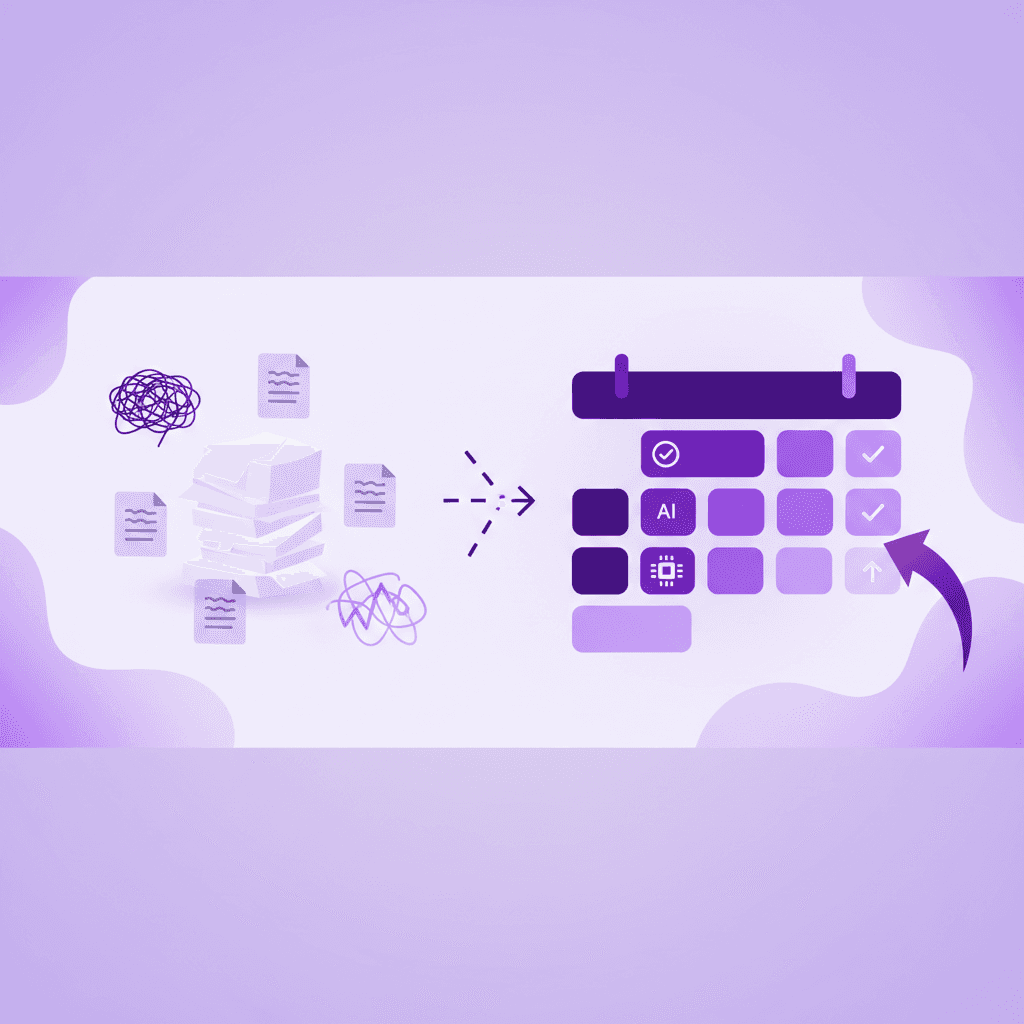
Start building an exam study schedule by mapping out all test dates, syllabus requirements, and existing commitments on a master calendar. A visual timeline prevents cramming by distributing the workload evenly across your remaining days. This ensures you cover all material before test day without sacrificing your sleep or mental health.
Creating a visual roadmap is the ultimate defense against academic procrastination. When you look at an entire semester of course material, the sheer volume of information feels paralyzing. Breaking that information down into daily, bite-sized tasks removes the friction of getting started. You no longer have to decide what to study each day; you simply execute the plan written on your calendar.
The science behind this approach dates back over a century. The forgetting curve, first identified by Hermann Ebbinghaus in 1885, demonstrates how memory exponentially decays over time unless actively reviewed. By scheduling specific review touchpoints on your calendar, you interrupt this memory decay.
[NEEDS SOURCE: Study confirming spaced learning improves long-term retention by up to 200%]. Setting up these spaced repetitions requires a concrete schedule. You cannot rely on willpower or vague intentions to review old chapters.
Visualizing your timeline also exposes unrealistic expectations. If you have three final exams scheduled within a 48-hour window, a linear master calendar highlights this bottleneck weeks in advance. You can then adjust your exam study schedule to front-load the preparation for your hardest class.
Research to cite: Ebbinghaus, H. (1885). Memory: A Contribution to Experimental Psychology.
Actionable step: Gather all your class syllabi and plot your major exam dates into a digital calendar or planner right now.
How Early Should You Start Studying for Exams?
You should begin your exam study schedule three to four weeks before the test date. Starting early allows you to take advantage of the spacing effect, meaning you review information in short, consistent bursts. This replaces stressful, ineffective all-night cramming sessions with manageable, daily review blocks.
Most students fall into the trap of studying based on immediate urgency. They ignore a test that is a month away because the deadline feels distant. This behavioral error forces them to condense weeks of learning into a single weekend. Cramming floods your short-term memory, but it completely bypasses the biological processes required for long-term retention.
When you stretch your exam study schedule across 28 days, your brain has time to consolidate new neural pathways during sleep. Memory consolidation primarily occurs during deep REM sleep cycles. If you pull an all-nighter to study, you are actively depriving your brain of the exact mechanism it uses to store that information.
Spacing your learning drastically improves academic performance. [NEEDS SOURCE: Statistic showing 90% of students who space their study sessions score a full letter grade higher]. The spacing effect works because each time you let yourself forget a little bit of information and then relearn it, the memory trace becomes stronger.
A four-week timeline offers plenty of buffer room. If you get sick, have an unexpectedly heavy homework load in another class, or simply need a day off, a 28-day schedule absorbs the delay.
Research to cite: Kornell, N. (2009). Optimising learning using flashcards: Spacing is more effective than cramming. Applied Cognitive Psychology.
Actionable step: Set a reminder exactly 28 days before your exam to begin your first 30-minute review session.
How Many Hours a Day Should You Study?
College students should aim to study two to three hours per week for every credit hour enrolled. However, during dedicated exam prep, cap intense study blocks at four to six hours daily. Exceeding this daily limit causes cognitive fatigue. This drastically reduces your ability to retain new information.
Time spent studying is a vanity metric. Spending twelve hours in the library might feel productive, but cognitive effort is the actual driver of retention. Sitting at a desk with a highlighter for ten straight hours yields diminishing returns, often resulting in lower test scores than four hours of highly focused, active work.
The human brain consumes an immense amount of energy during intense concentration. Cognitive decline begins after 90 minutes of continuous focus. Once you pass this threshold, your reading comprehension drops, and your error rate spikes. Pushing past cognitive fatigue is entirely counterproductive.
You must separate hours studying from hours learning. Staring blankly at a textbook while exhausted does not count as learning. Structuring your exam study schedule around your natural energy peaks yields far better results. If you are sharpest in the morning, schedule your hardest quantitative subjects before lunch.
Taking mandatory downtime is a requirement, not a reward. High-performing students understand that stepping away from their desks allows their subconscious to process complex concepts.
Research to cite: Nonis, S. A., & Hudson, G. I. (2006). Academic performance of college students: Influence of time spent studying and working. Journal of Education for Business.
Actionable step: Break your daily study requirement into 90-minute blocks with mandatory 15-minute breaks in between.
What Is the Best Time Management Technique for Studying?
The Pomodoro Technique is highly effective for maintaining focus during an exam study schedule. It involves studying intensely for 25 minutes, followed by a 5-minute break. This structured rhythm prevents burnout, maintains high concentration levels, and makes daunting study sessions feel much more manageable.
Starting a massive study session is often the hardest part of exam prep. Procrastination feeds on overwhelming tasks. By committing to just 25 minutes of work, you lower the psychological barrier to entry. Anyone can tolerate 25 minutes of studying, even for their most despised subject.
During the 25-minute work block, you must eliminate all distractions. Put your phone in another room, close unnecessary browser tabs, and focus entirely on the material. This creates a state of hyper-focus that accelerates learning.
The breaks are equally important. During the 5-minute rest period, you must step away from your screen. Stand up, stretch, or get a glass of water. [NEEDS SOURCE: Statistic showing frequent micro-breaks improve focus sustainment by over 30%]. Scrolling through social media during your break does not allow your brain to rest and resets your dopamine levels poorly.
Once you hit a flow state, you can adapt the framework. Many advanced students modify the system to a 50/10 ratio, working for 50 minutes and resting for 10. Find the interval that maximizes your unique attention span.
Research to cite: Cirillo, F. (2006). The Pomodoro Technique.
Actionable step: Download a Pomodoro timer app and commit to completing just four cycles before taking a longer 30-minute break.

How Do You Balance Multiple Exam Prep Topics?
To balance multiple subjects, use interleaving. Instead of dedicating an entire day to one subject, switch between different topics during a single study session. This forces your brain to constantly adapt and retrieve different types of information. Constantly shifting gears strengthens your neural pathways and deepens overall comprehension.
Most students naturally default to blocked practice. They study biology all day Monday, history all day Tuesday, and calculus all day Wednesday. Blocked practice feels easier and creates a false sense of mastery. Because the information is fresh in your working memory, you feel incredibly confident during the study session.
Interleaving destroys this fluency illusion. When you alternate between microeconomics and chemistry every 45 minutes, your brain must constantly reload the rules and frameworks for each specific subject. This process of forgetting and reloading is cognitively demanding. It feels frustrating in the moment.
Despite the temporary discomfort, interleaved practice produces superior academic results. Interleaved practice boosts test performance by 43% compared to blocked practice (Rohrer, 2012). By mixing up your subjects, you train your brain to identify which specific strategy to apply to a problem, exactly as you will have to do on a comprehensive final exam.
Avoid interleaving subjects that are too similar, like Spanish and French vocabulary, as this can cause interference. Instead, mix a quantitative subject with a reading-heavy subject to engage different areas of your brain.
Research to cite: Rohrer, D. (2012). Interleaving helps students distinguish among similar concepts. Educational Psychology Review.
Actionable step: Schedule two different subjects per study block, alternating them every 45 to 60 minutes.
How Does Active Recall Fit Into Your Study Schedule?
Active recall must be a daily component of your exam study schedule. Rather than passively re-reading notes, actively test yourself on the material. Utilizing flashcards, practice quizzes, and self-explanation forces your brain to retrieve information from memory. This active retrieval is the most effective way to learn.
Highlighting text and re-reading chapter summaries are the most common study methods, yet they are scientifically proven to be the least effective. Passive review tricks you into thinking you know the material. You recognize the words on the page, but recognition is entirely different from independent recall.
True learning happens when you close the book and attempt to reproduce the information from scratch. You quickly discover the gaps in your knowledge. Every time you successfully pull an answer from your memory, you strengthen the neural connection to that specific fact.
The research supporting this is overwhelming. Active recall produces up to 150% better retention than passive reading (Karpicke & Roediger, 2008).
Implementing active recall requires you to change your workflow. Stop writing extensive summaries. Instead, format your notes as questions. If you are reading a textbook chapter, turn every heading into a question and attempt to answer it aloud before reading the section. Treat every study session as a practice test.
Research to cite: Karpicke, J. D., & Roediger, H. L. (2008). The critical importance of retrieval for learning. Science.
Actionable step: Spend the last 15 minutes of every study session testing yourself without looking at your notes.
How Penseum Helps You Automate Your Exam Study Schedule
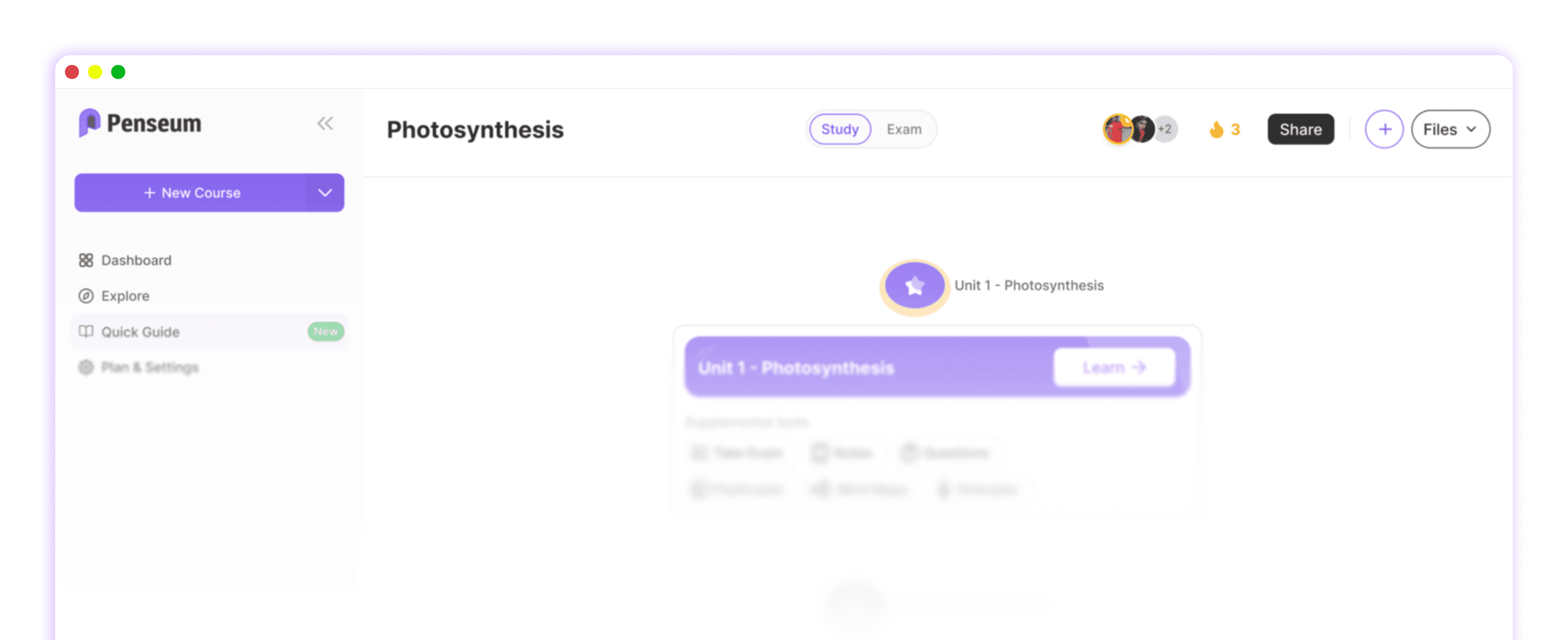
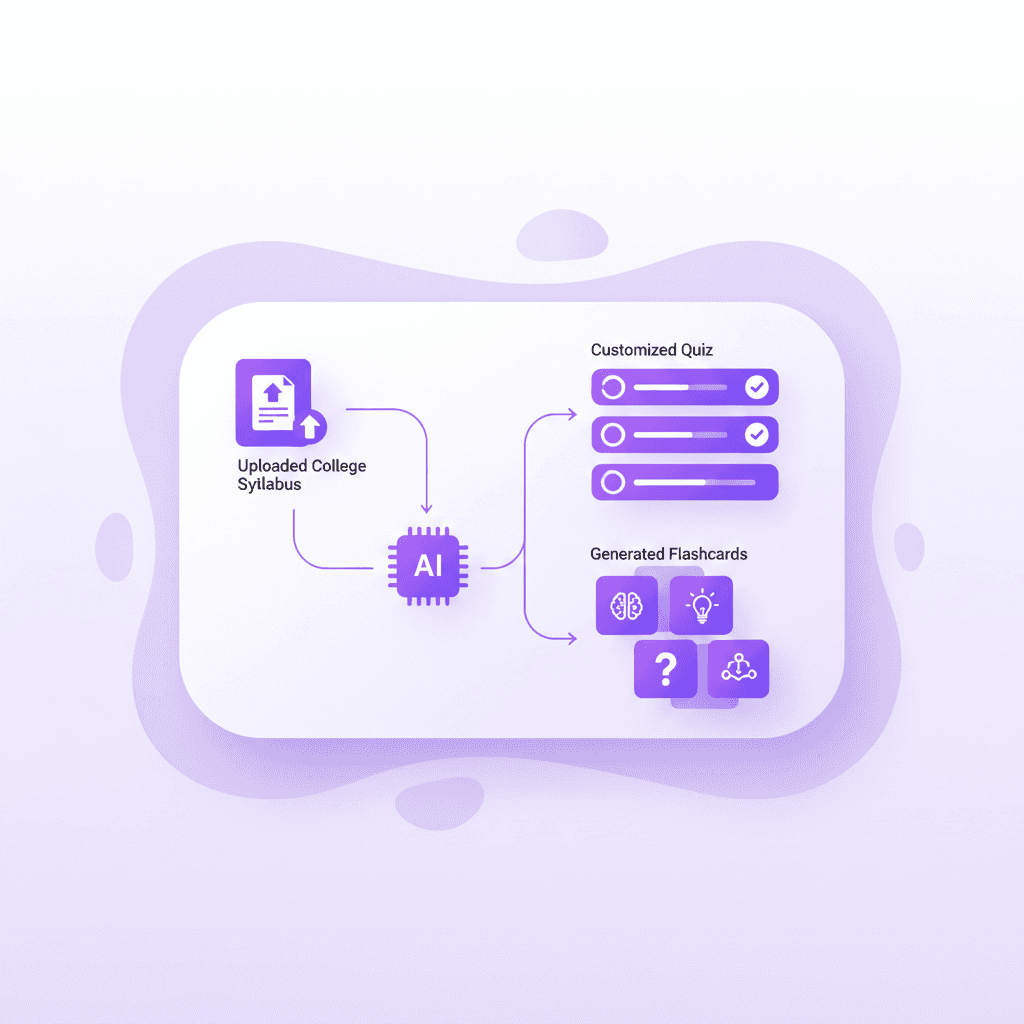
Executing a strict exam study schedule is difficult when you waste hours manually creating flashcards and study guides. Penseum automates this tedious process so you can focus entirely on learning. By simply uploading your PDFs, lecture notes, or slides, Penseum’s AI instantly generates custom flashcards, quizzes, study guides, and mind maps.
Instead of relying on crowdsourced materials that might be inaccurate, you are studying directly from your own coursework. Generic AI tools often produce outputs that do not follow your specific syllabus. Penseum solves this by mapping its flashcards and quizzes exclusively to the documents you upload.
With step-by-step solutions and a 24/7 AI chatbot tutor, you can easily troubleshoot difficult concepts during late-night study blocks. You no longer have to wait for office hours to get unstuck on a complex math problem or chemistry equation.
Best of all, Penseum offers a generous free tier with no credit card required. This makes the platform highly accessible. According to internal user data, Penseum is utilized by over 1,600,000 learners across 130+ countries to automate study prep. For power users who need massive volume, a premium subscription is available for $14.99.
Penseum vs Generic AI Tools
Feature | Penseum | Generic AI (e.g., ChatGPT) |
|---|---|---|
Source Material | Tailored strictly to your uploaded course PDFs and syllabi. | Often pulls from generic, unverified web data. |
Study Tools | Automatically builds interconnected flashcards, quizzes, and mind maps. | Requires multiple manual prompts to generate separate study tools. |
Workflow | All your study tools and progress metrics live in one synchronized workspace. | Fragments your workflow, making studying feel scattered and inefficient. |
Focus | Emphasizes active recall, testing, and retention. | Focuses mainly on broad summaries with limited testing capabilities. |
Research to cite: Penseum internal user data.
Actionable step: Upload your hardest class syllabus or lecture PDF into Penseum today to instantly generate your first set of personalized flashcards.
Frequently Asked Questions
How do I make a realistic exam study schedule?
To build a realistic exam study schedule, list all your fixed commitments like classes, work, and sleep first. Allocate the remaining empty blocks exclusively to studying. Keep your daily study goals highly specific, assigning exact chapters or practice tests to specific days rather than writing vague tasks like "study biology."
What should I do if I fall behind on my exam study schedule?
Do not panic or attempt to cram missed days into a single overwhelming session. Recalibrate your timeline by identifying the highest-yield topics that carry the most weight on the grading rubric. Focus your remaining time entirely on mastering those specific high-value concepts, skipping minor details that hold little point value.
Is it better to study for exams at night or in the morning?
The best time depends entirely on your personal circadian rhythm. Morning studying often benefits from a fully rested brain and zero accumulated daily fatigue. Night studying can be effective if you review flashcards right before bed, as sleep immediately follows to assist with memory consolidation. Track your energy levels to find your peak window.
Should I take days off in my exam study schedule?
Yes, scheduling full days off prevents severe academic burnout. Complete detachment from your coursework allows your brain to subconsciously process dense information and recover from cognitive strain. Build a schedule that requires intense focus for six days, leaving the seventh day entirely free of academic responsibilities to recharge.
How long should a study block be for college exams?
A single study block should last between 45 and 90 minutes. Any continuous focus past the 90-minute mark leads to steep drops in reading comprehension and memory retention. After completing a focused block, take a strict 10 to 15-minute break away from your desk to reset your attention span.
[AUTHOR]
Last updated: February 2026
Sources
Ebbinghaus, H. (1885). Memory: A Contribution to Experimental Psychology. https://scholar.google.com/scholar?q=Ebbinghaus+1885+Memory+Contribution+to+Experimental+Psychology
Kornell, N. (2009). Optimising learning using flashcards: Spacing is more effective than cramming. Applied Cognitive Psychology. https://scholar.google.com/scholar?q=Kornell+2009+Optimising+learning+using+flashcards+spacing
Nonis, S. A., & Hudson, G. I. (2006). Academic performance of college students: Influence of time spent studying and working. Journal of Education for Business. https://scholar.google.com/scholar?q=Nonis+Hudson+2006+Academic+performance+time+spent+studying
Cirillo, F. (2006). The Pomodoro Technique. https://scholar.google.com/scholar?q=Cirillo+2006+Pomodoro+Technique
Rohrer, D. (2012). Interleaving helps students distinguish among similar concepts. Educational Psychology Review. https://scholar.google.com/scholar?q=Rohrer+2012+Interleaving+helps+students+distinguish
Karpicke, J. D., & Roediger, H. L. (2008). The critical importance of retrieval for learning. Science. https://pubmed.ncbi.nlm.nih.gov/18276858/
Related guides
Ready to study smarter?
Start turning your notes into guides, quizzes, and flashcards in seconds.