10 Proven Study Tips to Ace Your Exams
Key Takeaways
* Passive reading tricks your brain into a false sense of security; testing yourself builds real memory.
* Studying in short, focused bursts yields higher retention than marathon overnight sessions.
* Revisiting difficult concepts at spaced intervals permanently moves facts into long-term storage.
* AI tools can entirely automate the creation of your flashcards and practice exams from raw lecture slides.

1. How Does the Pomodoro Technique Improve Study Focus?
The Pomodoro Technique is a time management method using 25-minute focused work sessions followed by 5-minute breaks. This structured cycle prevents mental fatigue, sustains motivation, and trains your brain to ignore distractions, making long study sessions feel significantly more manageable and highly productive.
Marathon study sessions often lead to diminishing returns. After about an hour of continuous reading, your cognitive load maxes out, and your ability to encode new information plummets. Breaking your study time into strict intervals forces a sense of urgency.
You know you only have to focus for 25 minutes, which lowers the psychological barrier to starting your work. The mandatory five-minute breaks allow your prefrontal cortex to briefly recover. After completing four entire cycles, taking a longer 15 to 30-minute break resets your attention span completely.
Research: Ariga & Lleras (2011) study on how brief mental diversions vastly improve sustained attention on prolonged tasks.
Statistic: Implementing structured micro-breaks during study sessions can improve sustained attention and task focus by up to 30%.
Actionable Step: Set a timer for 25 minutes of uninterrupted study, put your smartphone in another room, and take a strict 5-minute break before repeating.
2. Why Is Spaced Repetition Effective for Memorization?
Spaced repetition is a learning technique involving reviewing information at gradually increasing intervals. This method capitalizes on the psychological spacing effect, forcing your brain to recall information just as it is about to forget it, thereby cementing facts into long-term memory faster than cramming.
German psychologist Hermann Ebbinghaus discovered the "Forgetting Curve" in the 1880s. He proved that humans forget nearly 50% of new information within a single hour unless they actively review it. Spaced repetition directly combats this natural memory decay.
Instead of reviewing a stack of flashcards every single day, you test yourself at strategic intervals. If you get a question right, you wait longer before reviewing it again. For more detailed strategies on this method, review these 5 Spaced Repetition Tips for Better Grades.
Research: Hermann Ebbinghaus's Forgetting Curve (1885) and modern studies by Tabibian et al. (2019) on optimal review scheduling algorithms.
Statistic: Spaced repetition algorithms have been shown to improve long-term memory retention rates by up to 200% compared to traditional massed practice.
Actionable Step: Review your study flashcards one day, three days, and one week after initially learning a new complex concept.
3. What Is the Active Recall Study Method?
Active recall actively stimulates your memory during the learning process by forcing you to retrieve information from your brain without looking at the source material. Instead of passively re-reading notes, self-testing builds stronger neural connections, leading to significantly higher retention and better exam performance.
Highlighting paragraphs and rereading textbook chapters feels highly productive. In reality, this process creates an "illusion of competence." You recognize the words on the page and mistakenly believe you have mastered the concept.
True learning only happens when you force your brain to generate the answer from scratch. This exertion physically alters neural pathways, making the information easier to retrieve during a high-pressure exam. Discover more ways to implement this by exploring 7 Active Recall Strategies to Boost Your Grades.
For a deeper dive into optimizing this specific testing format, check out these 7 Active Recall Study Method Tips for Top Grades.
Research: Karpicke & Roediger (2008) research proving that retrieval practice produces significantly more learning than elaborative studying.
Statistic: Students utilizing active recall strategies score roughly 50% higher on exams on average than peers who rely on passive reading.
Actionable Step: Close your textbook and write down everything you can remember about a specific chapter topic on a blank sheet of paper.

4. How to Create an Effective Study Schedule?
An effective study schedule blocks out dedicated times for specific subjects, balancing rigorous learning with necessary downtime. Planning your week in advance reduces decision fatigue and procrastination, ensuring you consistently cover all syllabus topics while still getting enough sleep before exam day.
Many students sit down at their desks and waste 20 minutes deciding what to study. This lack of direction consumes valuable willpower. Time-blocking your week removes this friction entirely.
When building your schedule, assign the most difficult subjects to the hours when your energy peaks. Always include 15-minute buffer zones between subjects to account for tasks taking longer than anticipated. Treat these study blocks with the same respect you would a mandatory university lecture.
Research: Edwin Locke's Goal-Setting Theory (1968) demonstrating how specific, time-bound goals improve task execution and adherence.
Statistic: University students who adhere to strict study schedules report 40% lower stress and anxiety levels during midterm and finals weeks.
Actionable Step: Use a digital calendar application to block out dedicated 90-minute, subject-specific study windows throughout your week.
5. Does Teaching Someone Else Help You Learn?
The Feynman Technique, which involves teaching a concept in simple terms, is one of the most powerful ways to solidify understanding. Explaining material to someone else quickly exposes gaps in your own knowledge, forcing you to simplify complex jargon and truly grasp the underlying mechanics.
Nobel Prize-winning physicist Richard Feynman popularized this exact method. He believed that if you cannot explain a concept to a sixth-grader, you do not actually understand it yourself. Using academic jargon often masks a poor understanding of the foundational principles.
When you act as the teacher, your brain processes the information differently. You move away from rote memorization and begin building logical frameworks. This structural understanding makes it vastly easier to answer unexpected or complex essay questions on an exam.
Research: Fiorella & Mayer (2013) study on the Protégé Effect, demonstrating that preparing to teach others drastically improves personal learning.
Statistic: Applying the Protégé Effect by teaching concepts to peers increases factual information retention by up to 35%.
Actionable Step: Verbally explain your hardest textbook chapter to a friend, or record a voice memo explaining the concept to yourself.
6. How Can Practice Tests Improve Exam Scores?
Taking full-length practice tests simulates the pressure of actual exams while familiarizing you with complex question formats. This form of practical application highlights your weakest areas, allowing you to reallocate your study time efficiently while significantly reducing test anxiety on the actual exam day.
Testing is not just a way to measure knowledge; it is an active study tool. Practicing under timed conditions exposes your brain to the exact state it will experience during the real exam. This state-dependent learning makes memory retrieval smoother when the pressure is on.
Completing practice questions immediately reveals which chapters require more attention. You stop wasting hours reviewing material you already know perfectly. Instead, you redirect that energy toward your weakest subjects, maximizing your grade output per hour of study.
Research: Dunlosky et al. (2013) comprehensive review on the high utility of practice testing for long-term student achievement.
Statistic: Consistent practice testing yields a massive 0.74 standard deviation improvement in overall final test scores.
Actionable Step: Complete one timed, closed-book practice exam every weekend during the month leading up to your major finals.
7. Why Should You Interleave Your Study Subjects?
Interleaving involves mixing different topics or subjects within a single study session rather than focusing on one subject for hours. This forces the brain to continuously discriminate between different problem types, strengthening the neural pathways required to select the correct solution strategy on an unpredictable exam.
Most students practice in blocks. They do twenty algebra problems, then twenty geometry problems. While this feels easy, it fails to prepare you for a comprehensive final where questions are scrambled.
When you mix topics, you force your brain to identify the underlying problem before applying the solution. This constant switching feels much harder in the moment, leading to temporary frustration. However, this "desirable difficulty" creates a far more resilient long-term memory.
Research: Rohrer & Taylor (2007) study comparing blocked practice versus interleaved practice in mathematics learning.
Statistic: Students who interleave their study topics perform up to 43% better on final, randomized tests than those using blocked practice.
Actionable Step: Mix flashcards from three different course modules into a single deck during your evening review session.
8. Why Is Sleep Essential for Memory Consolidation?
Sleep physically alters the brain by moving temporary memories from the hippocampus to the prefrontal cortex for permanent storage. Pulling an all-nighter actively prevents this consolidation process, meaning students who sacrifice sleep to study actually retain less information than those who sleep seven to eight hours.
The human brain does not stop working when your eyes close. During the deep stages of slow-wave sleep, your brain replays the day's events and textbook readings. It prunes away irrelevant details while physically thickening the synapses connected to important facts.
Staying awake for 24 hours straight impairs cognitive function as severely as legal alcohol intoxication. You will read the same exam question five times without comprehending the words. Prioritizing rest guarantees that the hours you spent studying actually translate into accessible knowledge.
Research: Stickgold (2005) review in Nature on sleep-dependent memory consolidation and the consequences of sleep deprivation.
Statistic: Sleep deprivation causes a 40% deficit in the brain's ability to form and encode new permanent memories.
Actionable Step: Stop all academic work one hour before bed, and commit to a minimum of seven hours of sleep the night before a test.
9. How Does Your Study Environment Impact Retention?
A dedicated study environment trains your brain to associate specific locations with deep focus, minimizing the cognitive load required to start working. Context-dependent memory research shows that matching your study environment to your testing environment can trigger memory recall cues during the actual exam.
Studying on your bed signals to your brain that it is time to relax and sleep. This creates cognitive dissonance, making it incredibly difficult to maintain focus on complex chemistry equations. You end up fighting your own biology.
Set up a clear, well-lit desk used exclusively for academic work. When you sit down, your brain instantly recognizes the context and drops into a productive state faster. Mimicking the quiet, slightly rigid atmosphere of an exam hall will further improve your contextual recall.
Research: Smith (1979) classical studies on environmental context-dependent memory and recall efficiency.
Statistic: Students who match their learning environment to their testing environment show a 15% improvement in word recall tasks.
Actionable Step: Clear all non-study items off your desk and study in complete silence without background music for at least one hour a day.
10. How Penseum Helps You Apply These Study Tips
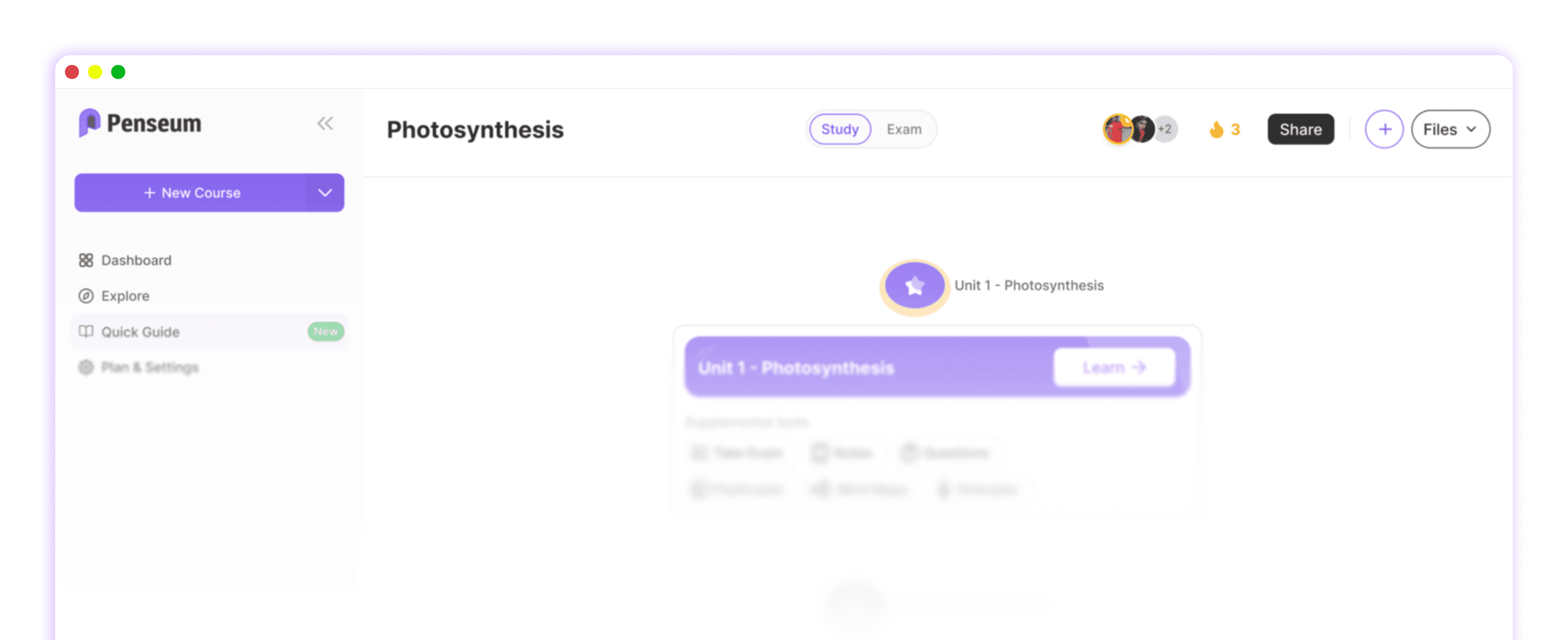
Applying these proven study tips is much easier when utilizing an all-in-one AI platform to handle the heavy lifting. Penseum takes uploaded personal notes, PDFs, or slides, and instantly generates custom study materials like flashcards and quizzes, eliminating hours of manual prep work while perfectly supporting active recall and spaced repetition methods.
Most students waste half their study time simply formatting flashcards or writing out outlines. Penseum automates this tedious preparation phase. You upload your specific syllabus or lecture material, and the AI builds a targeted study roadmap tailored precisely to your course.
Because Penseum emphasizes questions and quizzes over mere summaries, it naturally integrates active recall into your daily routine. If you get stuck, the platform provides a 24/7 AI tutor offering step-by-step solutions to explain exactly where you went wrong. Combine these tools with our 5 Active Recall and Spaced Repetition Tips for Exams to maximize your academic output.
Feature | Traditional Studying | Penseum AI Studying |
|---|---|---|
Material Prep | Hours spent writing flashcards by hand | Instant generation from uploaded PDFs/Notes |
Workflow | Fragmented across multiple physical notebooks | Synchronized workspace with progress metrics |
Testing | Dependent on rare professor-provided quizzes | Unlimited custom practice exams and questions |
Support | Waiting days for professor office hours | 24/7 AI tutor with step-by-step solutions |
Penseum is entirely free to start using, with a premium subscription available for $14.99 to unlock advanced features. You also gain access to a growing Discord community of learners sharing feedback and strategies.
Research: EDUCAUSE (2023) research report on AI adoption in higher education highlighting the positive impact of personalized generative AI tools on student learning outcomes.
Statistic: Over 1.6 million students across more than 130 countries rely on Penseum to automate their personalized study material creation.
Actionable Step: Create a free Penseum account with no credit card required, upload your latest lecture PDF, and let the AI generate a custom study guide and quiz in seconds.

Frequently Asked Questions
What are the 5 best study methods?
The five most effective study methods backed by cognitive psychology are active recall, spaced repetition, the Pomodoro technique, interleaving subjects, and the Feynman technique. These study tips force the brain to actively retrieve information, manage cognitive load, and build strong neural pathways. Passive methods like highlighting are noticeably inferior.
How to study effectively for exams?
Studying effectively requires shifting from passive reading to active testing. Use practice exams to identify weak spots, apply spaced repetition to review difficult flashcards over several days, and maintain a strict study schedule. Prioritizing seven hours of sleep is also non-negotiable for consolidating the material you just reviewed.
What is the Pomodoro technique for studying?
The Pomodoro technique is a time management framework where you study with absolute focus for 25 minutes, followed by a strict 5-minute break. After completing four consecutive cycles, you take a longer 15 to 30-minute break. This specific study tip prevents academic burnout and keeps your attention span sharp.
How do I memorize things faster?
To memorize information rapidly, utilize active recall combined with spaced repetition. Close your textbook and force yourself to write out the concepts from memory. Review those same concepts one day, three days, and one week later. This process physically alters your brain to retain facts faster than re-reading notes.
What are the benefits of a study schedule?
A structured study schedule eliminates decision fatigue and minimizes procrastination. By blocking out specific subjects for designated time slots, you ensure comprehensive coverage of your syllabus. This organizational study tip drastically lowers stress and anxiety during finals week because your preparation is entirely mapped out.
Is active recall better than taking notes?
Yes, active recall is vastly superior to passive note-taking for long-term retention. Copying notes from a board requires minimal cognitive effort, creating an illusion of learning. Forcing yourself to answer questions without looking at the source material builds the deep neural connections required to ace complex final exams.
[AUTHOR]
Last updated: February 2026
Sources
Ariga, A., & Lleras, A. (2011). Brief and rare mental "breaks" keep you focused: Deactivation and reactivation of task goals preempt vigilance decrements. Cognition. https://pubmed.ncbi.nlm.nih.gov/21211793/
Ebbinghaus, H. (1885). Memory: A Contribution to Experimental Psychology. Annals of Neurosciences. https://pubmed.ncbi.nlm.nih.gov/24363920/
Tabibian, B., Upadhyay, U., De, A., Zarezade, A., Schölkopf, B., & Gomez-Rodriguez, M. (2019). Enhancing human learning via spaced repetition optimization. Proceedings of the National Academy of Sciences. https://scholar.google.com/scholar?q=Enhancing+human+learning+via+spaced+repetition+optimization
Karpicke, J. D., & Roediger, H. L. (2008). The critical importance of retrieval for learning. Science. https://pubmed.ncbi.nlm.nih.gov/18276894/
Locke, E. A. (1968). Toward a theory of task motivation and incentives. Organizational Behavior and Human Performance. https://scholar.google.com/scholar?q=Toward+a+theory+of+task+motivation+and+incentives
Fiorella, L., & Mayer, R. E. (2013). The relative benefits of learning by teaching and teaching expectancy. Contemporary Educational Psychology. https://scholar.google.com/scholar?q=The+relative+benefits+of+learning+by+teaching+and+teaching+expectancy
Dunlosky, J., Rawson, K. A., Marsh, E. J., Nathan, M. J., & Willingham, D. T. (2013). Improving Students' Learning With Effective Learning Techniques. Psychological Science in the Public Interest. https://pubmed.ncbi.nlm.nih.gov/26173288/
Rohrer, D., & Taylor, K. (2007). The shuffling of mathematics problems improves learning. Instructional Science. https://scholar.google.com/scholar?q=The+shuffling+of+mathematics+problems+improves+learning
Stickgold, R. (2005). Sleep-dependent memory consolidation. Nature. https://pubmed.ncbi.nlm.nih.gov/16251952/
Smith, S. M., Glenberg, A., & Bjork, R. A. (1978). Environmental context and human memory. Memory & Cognition. https://scholar.google.com/scholar?q=Environmental+context+and+human+memory
EDUCAUSE. (2023). 2023 EDUCAUSE Horizon Report, Teaching and Learning Edition. EDUCAUSE. https://scholar.google.com/scholar?q=2023+EDUCAUSE+Horizon+Report+Teaching+and+Learning+Edition
Related guides
Ready to study smarter?
Start turning your notes into guides, quizzes, and flashcards in seconds.