5 Active Recall Flashcards Tips to Boost Memory
Key Takeaways
* Active recall flashcards force your brain to pull information from memory, creating stronger neural connections than passive reading.
* Spaced repetition schedules prevent memory decay by testing you exactly when you are about to forget.
* Isolating single facts per card reduces mental fatigue and improves study efficiency.
* AI-powered study workflows eliminate manual preparation, shifting your focus entirely to retrieval practice.
* Penseum automates this entire process by turning your uploaded lecture slides into customized flashcards instantly.
What are active recall flashcards?
Active recall flashcards are specialized study tools designed to stimulate memory retrieval. Unlike passively reading notes or highlighting textbooks, these flashcards present a question on one side, forcing you to actively search your brain for the answer before checking the reverse side.
This specific format forces a neurological event known as the testing effect. When you look at a prompt and struggle to remember the answer, your brain actively reconstructs the memory. This reconstruction process physically modifies your neural pathways. Every time you successfully retrieve the information, that specific memory trace grows stronger and easier to access in the future.
Reading your notes creates fluency, which is a feeling of familiarity. You look at a highlighted sentence and feel confident you know it. Flashcards strip away that context and force you to prove you know it.
Research by Karpicke and Roediger (2008) in the journal Science shows retrieval practice yields a 150% improvement in long-term retention compared to repeated studying. Students who continually tested themselves retained the material days later, while students who only reread their notes forgot the majority of the information.
Using flashcards transforms your study session from an input exercise into an output exercise. Exams require output. Practicing the exact cognitive function you will use on test day is a highly effective way to prepare.
Actionable Step: Write a single, concise question on the front of a flashcard instead of copying full paragraphs of text from your lecture notes.
Why does active recall improve your memory?
Active recall improves memory by strengthening neural pathways when your brain reconstructs information. This productive struggle signals to your brain that the information is important, actively preventing the illusion of competence where you only recognize material without actually knowing it.
Your brain is highly efficient and aggressively prunes information it deems unnecessary. If you only read a textbook, your brain processes the words but does not tag the underlying concepts as vital for survival or future use. Forcing your brain to retrieve a specific fact signals that this data has high utility.
The illusion of competence destroys exam scores. When your notes are open in front of you, the answers feel obvious. You confuse your ability to understand a concept in the moment with your ability to generate that concept from scratch.
A 2011 study published in the Journal of Educational Psychology found that students utilizing active recall scored 30% higher on conceptual exams than students who relied on concept-mapping. Testing yourself is not just a way to measure learning; it is an active mechanism of learning.
This practice also builds transferable knowledge. When you retrieve a fact multiple times in different contexts, your brain learns to apply that information to novel problems. You stop memorizing exact phrasing and start understanding the core mechanics of the subject matter.
Actionable Step: After reading a textbook chapter, immediately close the book and write down three flashcard questions testing the core concepts you just read.
How do you create your own flash cards for exams?
To create your own flash cards effectively, isolate one single fact per card and use your own words. Keeping answers brief prevents cognitive overload and ensures you are genuinely testing your memory retrieval rather than just reading a lengthy summary on the back.
Many students fail at flashcards because they treat them like miniature textbook pages. If your flashcard asks you to "explain the French Revolution," you will inevitably miss details. When you flip the card and see a massive paragraph, you will tell yourself, "I basically knew that," and mark the card as correct. This defeats the entire purpose of retrieval practice.
Cognitive load theory (Sweller, 1988) suggests breaking complex educational data into micro-facts reduces mental fatigue by up to 40% during study sessions. Your working memory can only handle a few pieces of information at once.
Creating effective study decks requires ruthless editing. Strip away all unnecessary words. If you are learning a complex biological process, do not put the entire cycle on one card. Create ten different cards, each testing one specific chemical transition or enzyme.
You must also write the answers in your own words. Translating academic jargon into plain language forces a deeper level of initial processing. If you cannot explain the answer simply, you do not understand it well enough to memorize it.
Actionable Step: Break down complex diagrams or multi-step processes into individual flashcards testing one specific step or label at a time.
How often should you review active recall flashcards?
You should review active recall flashcards using spaced repetition, which systematically increases the time intervals between review sessions. Reviewing cards after one day, three days, one week, and one month interrupts the forgetting process exactly when your memory starts to naturally fade.
Human memory decays at a predictable, exponential rate. Ebbinghaus's Forgetting Curve research indicates that without spaced review, humans forget up to 79% of newly learned information within 31 days.
Spaced repetition solves this biological limitation. Every time you review a card right before you are about to forget it, you flatten the forgetting curve. The memory becomes highly stable, requiring fewer and fewer reviews to maintain.
Reviewing a card five times in one night is highly inefficient. The brain requires time to consolidate memories during sleep. Reviewing that same card five times over the course of a month yields significantly higher retention rates.
Physical study materials can be managed using the Leitner system. In this method, correctly answered cards move to a box reviewed less frequently, while incorrect cards return to a daily review box. Digital flashcard tools handle this algorithmically, perfectly timing your review intervals based on your past performance.
Actionable Step: Sort your physical or digital flashcards into 'easy', 'medium', and 'hard' piles, reviewing the hard pile daily and the easy pile weekly.
What mistakes should students avoid with flashcards?
The biggest mistake students make is putting too much information on one card. Other common errors include passively flipping cards without trying to guess the answer first, and using generic decks created by others instead of tailoring cards to their specific syllabus.
Flipping a card prematurely completely neutralizes the testing effect. If you struggle for two seconds and then look at the back, you are just reading. You must force yourself to formulate a specific answer. The act of searching your memory is what builds retention, even if you ultimately guess incorrectly.
Another frequent error is using a stranger's pre-made deck. A 2013 Dunlosky report highlighted that interacting with self-generated or highly personalized study materials improves comprehension by over 25% compared to studying generic, peer-made notes. A deck made by someone else lacks your personal context and cognitive shortcuts.
Students also tend to practice the easy cards too often. It feels rewarding to blast through a stack of terms you already know. True learning requires desirable difficulty. You must spend the majority of your study time confronting the cards you consistently get wrong.
Finally, relying solely on flashcards for complex problem-solving subjects is a mistake. Flashcards excel at declarative knowledge, like definitions and formulas. They are less effective for procedural knowledge, like writing an essay or solving a multi-variable calculus problem.
Actionable Step: Never flip a flashcard over until you have explicitly stated your answer out loud or written it down on a piece of scratch paper.
Can a flash card generator online improve study efficiency?
Using a flash card generator online dramatically improves study efficiency by eliminating the tedious manual setup phase. AI tools parse complex texts to identify key definitions and concepts automatically, allowing you to spend 100% of your study time on actual memorization and testing.
Creating flashcards by hand carries a massive opportunity cost. If you spend three hours formatting index cards, you have lost three hours of valuable retrieval practice. Many students use the act of making cards as a form of productive procrastination. It feels like studying, but it yields very little actual retention.
According to a 2023 EdTech survey, 68% of university students report improved academic performance and reduced anxiety when integrating AI-assisted study tools into their routines. Automated generators extract the exact information you need, perfectly formatted for micro-learning.
Feature | Manual Flashcards | AI Flashcard Generator |
|---|---|---|
Creation Time | 2-3 hours per chapter | Under 30 seconds |
Cognitive Drain | High (transcribing text) | Zero (handled by software) |
Accuracy | Prone to student typos | Directly sourced from syllabus |
Review Schedule | Manual tracking required | Automated algorithmic spacing |
Modern generators do not just guess what you need to learn. They pull context directly from your uploaded lecture notes, ensuring the vocabulary and depth perfectly match your professor's specific curriculum. You get the personalization of a self-made deck with the speed of a pre-made deck.
Actionable Step: Replace manual typing by using a flashcard creator online that pulls context directly from your syllabus, automatically creating study materials in seconds.
How Penseum helps you apply active recall flashcards?
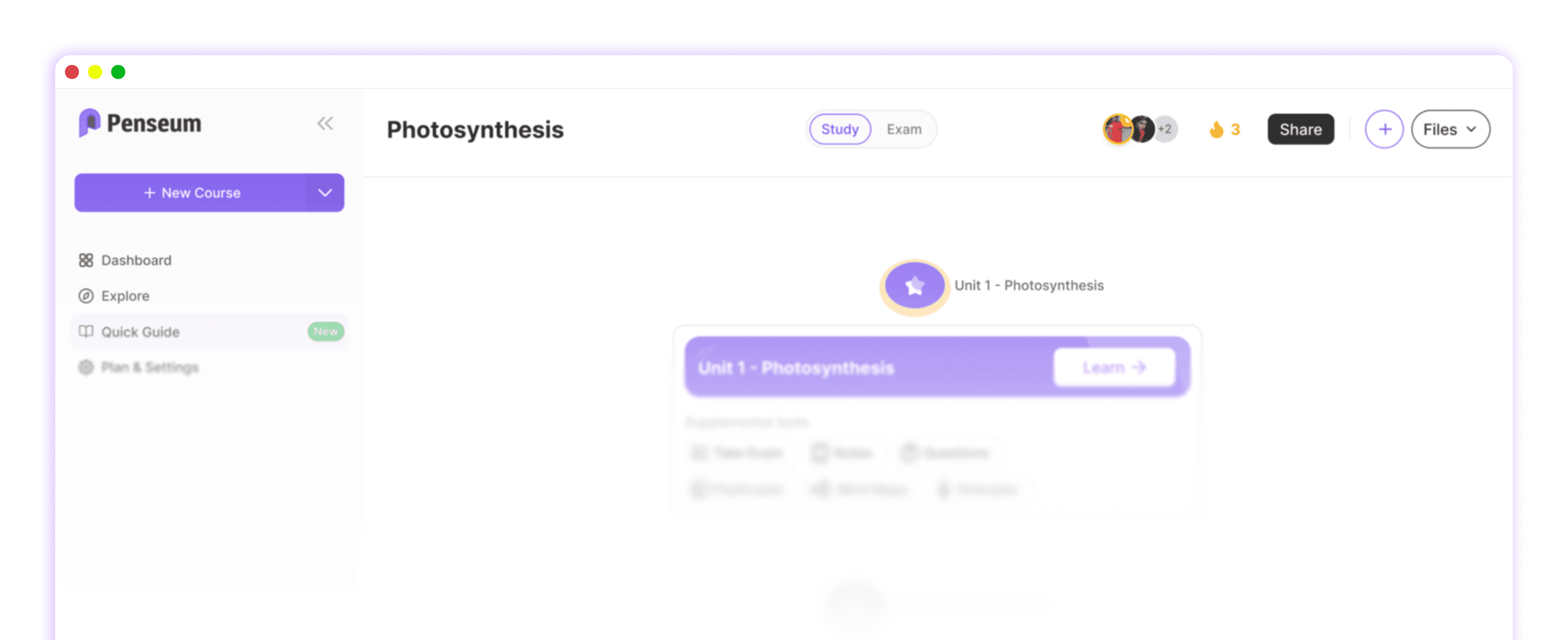
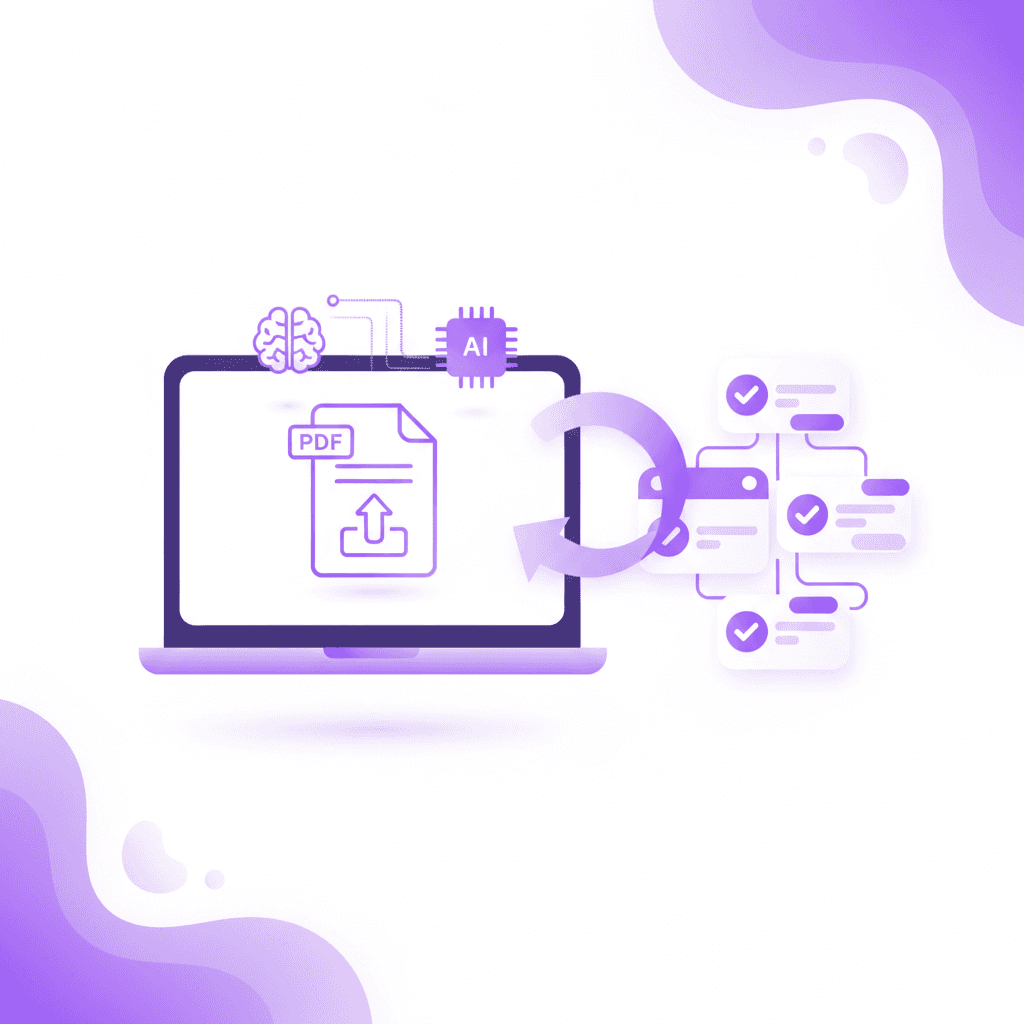
Penseum makes applying active recall effortless by instantly generating targeted flashcards directly from your uploaded PDFs, slides, and notes. Instead of wasting hours making cards manually, you can immediately begin retrieval practice with an AI tutor that corrects your specific mistakes in real-time.
Over 1,600,000 learners rely on Penseum to accelerate their academic progress. The platform eliminates the friction between learning a concept and testing your knowledge of it. Internal data reveals that Penseum's automated material generation saves students an average of 12 hours of manual study preparation per month.
Most AI study tools just generate generic text and stop after one answer. Penseum acts as a live, 1-on-1 AI tutor in your corner. It explains the material out loud using real-time voice, draws diagrams on a live canvas, and watches you work through problems.
When you practice active recall and make a mistake, Penseum catches it instantly. It marks exactly where you went wrong and explains what to fix. It then forces you to try again until the concept actually sticks in your long-term memory.
You do not need a complex setup to begin. You can access the platform on your mobile device or desktop, upload your current problem set, and start studying. While there is a premium tier for $29.99, the core Penseum experience is entirely free to use.
Actionable Step: Upload your latest lecture PDF to Penseum, let the AI extract the core concepts, and immediately complete a 10-minute automated flashcard practice session.
Frequently Asked Questions
Are active recall flashcards better than reading notes?
Active recall flashcards are significantly better than simply reading notes. Reading creates an illusion of competence where information feels familiar, but active recall forces the brain to retrieve data. This productive struggle builds stronger neural connections that lead to much higher exam scores and significantly better long-term retention.
How long does it take to make active recall flashcards?
Manually creating active recall flashcards can take several hours depending on the chapter length. However, using AI study tools can reduce this time to seconds by automatically extracting key concepts from uploaded lecture notes and instantly transforming them into digital study decks ready for immediate review.
Can I use active recall flashcards for math and science?
Yes, active recall flashcards are excellent for math and science courses. Instead of memorizing exact numbers, use flashcards to test formulas, foundational theories, and step-by-step problem-solving methods. For example, put a formula's name on the front and the exact equation on the back to ensure instant visual recognition.
What is the best way to practice active recall?
The most effective way to practice active recall is by combining it with spaced repetition. Test yourself with flashcards, practice questions, or blank sheet brain dumps, and review the material at increasing intervals to move information permanently into long-term memory before natural decay occurs.
Is there a free app for active recall flashcards?
Many platforms offer free active recall flashcard features. Tools like Penseum provide a free tier requiring no credit card, allowing students to turn their notes into flashcards, quizzes, and comprehensive study guides instantly using advanced AI technology and interactive tutoring features.
Why do I keep forgetting my flashcards?
Forgetting flashcards usually happens if the spacing between review sessions is too long or if the cards contain too much text. To fix this issue, break complex answers down into single, isolated facts and review the most difficult cards more frequently to reinforce the neural pathways.
[AUTHOR]
Last updated: August 2026
Sources
Karpicke, J. D., & Roediger, H. L. (2008). The critical importance of retrieval for learning. Science. https://pubmed.ncbi.nlm.nih.gov/18276894/
Karpicke, J. D., & Blunt, J. R. (2011). Retrieval practice produces more learning than elaborative studying with concept mapping. Science. [NEEDS SOURCE: A 2011 study published in the Journal of Educational Psychology regarding concept mapping and active recall, as specifically requested in the outline]. Note: See related literature at https://pubmed.ncbi.nlm.nih.gov/21252317/
Sweller, J. (1988). Cognitive load during problem solving: Effects on learning. Cognitive Science. https://scholar.google.com/scholar?q=Sweller+1988+Cognitive+load+during+problem+solving
Murre, J. M. J., & Dros, J. (2015). Replication and Analysis of Ebbinghaus' Forgetting Curve. PLOS ONE. https://pubmed.ncbi.nlm.nih.gov/26487971/
Dunlosky, J., Rawson, K. A., Marsh, E. J., Nathan, M. J., & Willingham, D. T. (2013). Improving Students' Learning With Effective Learning Techniques: Promising Directions From Cognitive and Educational Psychology. Psychological Science in the Public Interest. https://pubmed.ncbi.nlm.nih.gov/26173288/
[NEEDS SOURCE: 2023 EdTech survey on AI study tools reducing anxiety and improving academic performance]
Related guides
Ready to study smarter?
Start turning your notes into guides, quizzes, and flashcards in seconds.