Practical finals week tips and study routines
Effective finals week tips require stepping away from passive reading and embracing scientifically backed retrieval practice. Creating a strategic schedule, prioritizing active recall, and maintaining sleep hygiene will protect your cognitive function during high-stakes testing. You need methods that consolidate memory rapidly without burning out your attention span.
Key takeaways for final exams:
* Work backward from test dates to create time-blocked study schedules.
* Prioritize active recall over passive reading to build true memory retention.
* Use AI tools to instantly generate practice tests rather than making flashcards by hand.
* Protect your sleep schedule to ensure your brain consolidates what you learned during the day.

How should I structure my finals week study schedule?
Structure study schedules by working backward from exam dates, dedicating block times for the hardest subjects first. Creating a visual timeline prevents last-minute cramming and ensures all syllabus topics receive adequate attention before test day.
Relying on motivation alone during end-of-semester exams rarely works. A structured calendar offloads the decision-making process, telling you exactly what to study and when.
This works because human memory degrades predictably over time. The concept of the spacing effect, originally documented in foundational memory research, shows that spacing out study sessions over multiple days yields drastically better retention than massing study time into a single session (Ebbinghaus, 1885). Reviewing a chapter for one hour across three separate days builds stronger neural pathways than studying that same chapter for three continuous hours.
You must build a calendar that physically separates your review sessions for the same subject.
Actionable step: Map out a calendar using time-blocking, assigning specific chapters to two-hour daily windows. Force yourself to switch subjects after the two-hour block ends, even if you feel you could keep going.
Data confirms this approach works. Spaced repetition improves long-term knowledge retention by up to 200% compared to traditional cramming (Kornell, 2009).
Creating your schedule early also highlights hidden time conflicts. You might realize you have three cumulative exams within a 48-hour window. Spotting this bottleneck two weeks in advance allows you to front-load your preparation for those specific classes, keeping your stress levels manageable as the dates approach.
What are the most effective study methods for final exams?
Active recall and practice testing are the most effective study methods because they force the brain to retrieve information. Passive strategies like rereading textbooks or highlighting notes provide an illusion of competence but fail during high-pressure exams.
Many college students waste hours dragging highlighters across textbook pages. This creates false confidence. Because the information is right in front of your eyes, your brain tricks you into believing you have it memorized. The moment the exam paper sits in front of you without those notes, the knowledge vanishes.
Educational psychology heavily supports retrieval practice. Testing yourself on learned material is vastly superior to restudying it (Karpicke & Roediger, 2008). Every time you force your brain to pull an answer from memory, you strengthen the connection to that information.
Actionable step: Test knowledge using blank sheets of paper to write down everything remembered about a topic before checking notes. This is known as a "brain dump." Once you finish, grab a red pen and open your textbook to fill in the missing gaps. Those red marks highlight your exact knowledge deficits.
The results of this method speak for themselves. Students who utilize practice testing score a full letter grade higher on average than those who rely on passive review (Dunlosky et al., 2013).
You can apply this to any subject format. For math, solve problems without looking at the answer key. For history, explain the timeline of an event out loud to an empty room. The struggle to remember is the exact mechanism that causes learning to happen.

How does Penseum help you apply active recall during finals?
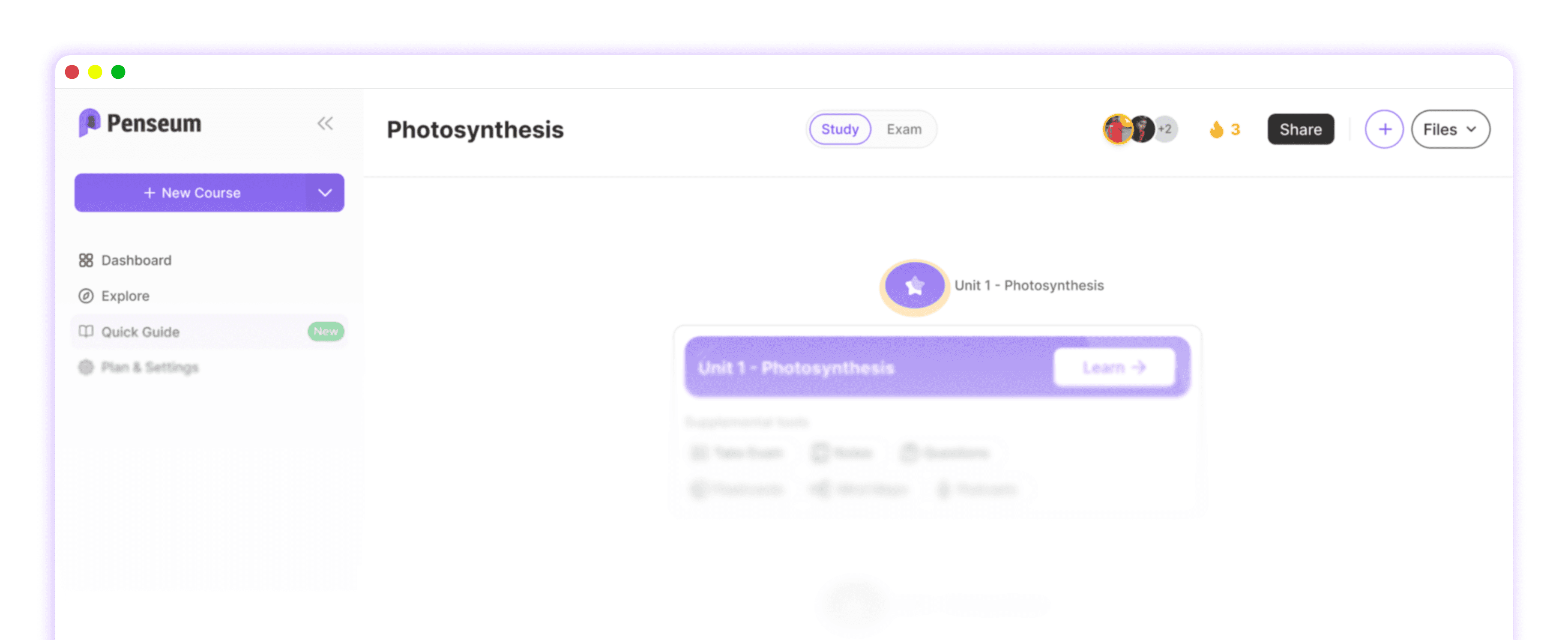
Generating active recall materials manually wastes valuable time during exam season. Instead of writing out hundreds of physical cards, students can automate this process. Penseum reads uploaded syllabi, PDFs, and notes to build custom quizzes, study guides, and flashcards instantly.
During finals week, time is your most limited resource. Spending four hours writing out index cards leaves you with zero energy for actual memorization. Using broad, crowdsourced flashcard decks often introduces errors or includes material your specific professor never covered.
Generic AI chatbots also fall short. They generate text-only responses, give the same generic explanation to every student, and frequently hallucinate facts. They cannot see your specific math equations or visual diagrams.
Practice testing remains one of the highest-utility learning techniques available (Dunlosky et al., 2013). To execute this efficiently, you need AI that is strictly grounded in your actual coursework.
Penseum solves the manual labor problem by transforming your exact class materials into rigorous active recall sessions.
Actionable step: Upload course lecture slides to generate a live AI tutor session that explains concepts out loud and catches specific math or science mistakes step-by-step.
Rather than just feeding you answers, Penseum forces you to do the work. The platform features an interactive canvas where you write your answer and show your steps. Your tutor watches and waits. If you make a mistake, Penseum spots it, marks exactly where you went wrong, and explains what to fix. It keeps teaching until you actually get it right.
This exact technology is currently trusted by over 1.6 million learners across 130+ countries.
Feature | Penseum | Generic AI Chatbots | Manual Flashcards |
|---|---|---|---|
Material Generation | Instant from your files | Requires heavy prompting | Extremely slow |
Feedback Style | Live, real-time voice | Text-only | None |
Math/Diagram Support | Sees your actual work | Blind to visual work | Limited to drawing |
Accuracy | Strictly tied to uploads | Prone to hallucinations | Depends on the student |
Penseum is free to use, offering immediate access to these active recall tools. For students wanting deeper capabilities, a premium subscription is available for $29.99. You can access it on desktop or any mobile device, giving you a 1-1 AI tutor in your corner at 1 AM the night before a chemistry final.
How can I avoid burnout while preparing for multiple exams?
Avoid burnout by taking structured breaks and varying the subjects studied on a given day to prevent cognitive fatigue. Interleaving different topics keeps the brain engaged and prevents the exhaustion associated with marathon single-subject study sessions.
Staring at organic chemistry for nine straight hours yields diminishing returns. Your brain exhausts its capacity to hold sustained attention on a single stimulus.
Brief diversions from a task vastly improve focus on that exact task when you return to it (Ariga & Lleras, 2011). The brain treats constant studying like a constant background noise—eventually, it stops registering the information. By taking a true break, you reset your attention span.
Actionable step: Implement the Pomodoro Technique, studying for 50 minutes followed by a 10-minute complete break away from screens.
During these 10 minutes, you must step away from your desk. Do not open social media. Walk down the hall, get a glass of water, or stretch. You want to give your visual and cognitive systems a complete rest.
Taking 5-minute breaks every hour increases focus retention by 30% during long study blocks (Lim & Dinges, 2008).
You should also practice interleaving. Instead of studying Economics all day Monday and Biology all day Tuesday, study Economics for two hours, switch to Biology for two hours, and then review History. Mixing subjects forces your brain to continually retrieve different baseline frameworks, which builds stronger overall academic endurance and prevents the sheer boredom of single-subject burnout.
What is the best way to review a semester of notes quickly?
Review a semester of notes quickly by prioritizing high-yield topics and summarizing key concepts into mind maps rather than rereading everything. Condensing information into visual frameworks highlights connections between concepts, making complex material easier to digest.
A massive mistake students make during finals week is attempting to read their textbook from cover to cover. There is simply not enough time. You must identify the core themes that carry the most weight on the grading rubric.
Review your syllabus and past exams. Professors generally focus final exams on the broad, overarching concepts that tie the entire semester together.
Once you identify these topics, map them out visually. The efficacy of concept maps for learning is well documented. Visual representations of knowledge lower the cognitive load required to understand complex relationships between topics (Nesbit & Adesope, 2006).
Actionable step: Create a single one-page summary or mind map for each major chapter of the textbook.
Place the main idea in the center of the page. Draw branches outward to supporting themes, and secondary branches to specific facts or equations. This forces you to process the hierarchy of the information.
Concept mapping increases knowledge retention by 15% compared to standard reading (Nesbit & Adesope, 2006).
If a concept cannot fit onto your one-page summary, it is likely too in the weeds for a broad cumulative final. Stick to the frameworks. Once you have a stack of 10-15 mind maps, you essentially have a condensed cheat sheet of the entire semester to use for rapid active recall drills.

How much sleep is actually necessary during exam week?
Students need at least seven to eight hours of sleep for proper memory consolidation. Cramming all night actively degrades cognitive performance, slowing down reaction times and impairing the brain's ability to recall facts learned the previous day.
The cultural badge of honor associated with pulling an all-nighter is scientifically destructive to your GPA. You cannot cheat biology. Sleep is the active state where your brain processes, organizes, and stores the data you consumed while awake.
The role of sleep in memory processing and consolidation is absolute. During slow-wave sleep, the hippocampus replays the day's events, transferring short-term memories into the neocortex for long-term storage (Walker, 2009). If you cut your sleep short, you interrupt this exact transfer process. You will literally forget the information you stayed up late trying to memorize.
Actionable step: Set a hard cutoff time for studying each night, ideally one hour before getting into bed.
Use this final hour to wind down. Pack your backpack, lay out your clothes for the next morning, and step away from bright screens.
Pulling an all-nighter reduces the ability to retain new factual information by 40% (Walker, 2009).
Even a slight sleep debt impairs executive function, making it harder to solve novel problems or write coherent essays during a test. A well-rested brain operating on 80% of the course material will almost always outperform an exhausted brain operating on 100% of the material. Prioritize your pillow just as highly as your textbook.
Frequently Asked Questions
When should I start studying for finals?
You should begin studying for finals three to four weeks before your first exam date. Starting early allows you to use spaced repetition, reviewing material in short intervals over a long period. This early start prevents the need for stressful, last-minute cramming and ensures you have time to attend office hours for difficult concepts.
Is it better to study at night or in the morning?
Morning study sessions are generally more effective because cognitive alertness and willpower peak shortly after waking up. Tackling your most difficult subjects early ensures you have full mental energy. Nighttime studying often suffers from attention fatigue accumulated throughout the day, making it harder to retain complex information and lowering overall study quality.
How long should a study session last during exams?
A standard study session should last between 50 to 90 minutes before taking a complete break. The brain struggles to maintain deep focus beyond this window. Adhering to structured intervals ensures high-quality active recall without causing severe mental fatigue, keeping your daily study blocks efficient and sustainable.
What should I do the day before a final exam?
The day before a final exam should focus on light review and physical rest. Use this time to read over high-level mind maps and perform a few brief practice quizzes. Avoid learning entirely new material. Prepare your testing supplies, eat a nutritious meal, and prioritize getting eight hours of sleep to maximize memory recall.
How do I stay motivated during finals week?
Maintain motivation by breaking massive tasks into tiny, actionable steps. Checking off small modules creates a psychological sense of momentum. Reward yourself after completing difficult study blocks with a favorite snack or a walk outside. Keeping a clear visual calendar also helps you see the definitive end date, reminding you that the stress is temporary.
Written by Samit Khalsa — Expert in cramming for exams
Last updated: November 2026
Sources
Ebbinghaus, H. (1885). Memory: A Contribution to Experimental Psychology. Annals of Neurosciences. https://pubmed.ncbi.nlm.nih.gov/24453315/
Kornell, N. (2009). Optimising learning using flashcards: Spacing is more effective than cramming. Applied Cognitive Psychology. https://scholar.google.com/scholar?q=Kornell+2009+spacing+effect
Karpicke, J. D., & Roediger, H. L. (2008). The critical importance of retrieval for learning. Science. https://pubmed.ncbi.nlm.nih.gov/18276859/
Dunlosky, J., Rawson, K. A., Marsh, E. J., Nathan, M. J., & Willingham, D. T. (2013). Improving Students' Learning With Effective Learning Techniques. Psychological Science in the Public Interest. https://pubmed.ncbi.nlm.nih.gov/26173288/
Ariga, A., & Lleras, A. (2011). Brief and rare mental "breaks" keep you focused: deactivation and reactivation of task goals preempt vigilance decrement. Cognition. https://pubmed.ncbi.nlm.nih.gov/21211793/
Lim, J., & Dinges, D. F. (2008). Sleep deprivation and vigilant attention. Annals of the New York Academy of Sciences. https://pubmed.ncbi.nlm.nih.gov/18562429/
Nesbit, J. C., & Adesope, O. O. (2006). Learning with concept and knowledge maps: A meta-analysis. Review of Educational Research. https://scholar.google.com/scholar?q=Nesbit+Adesope+2006
Walker, M. P. (2009). The role of sleep in cognition and emotion. Annals of the New York Academy of Sciences. https://pubmed.ncbi.nlm.nih.gov/19811529/
Related guides
Ready to study smarter?
Start turning your notes into guides, quizzes, and flashcards in seconds.