7 Proven Study Methods for Better Grades
Key Takeaways
* Passive reading and highlighting are highly inefficient for retaining complex college material.
* Applying active learning techniques physically alters neural pathways to cement long-term memory.
* Strategies like spaced repetition, interleaved practice, and the Feynman technique improve final test performance by up to 50%.
* You can automate these highly effective study methods by uploading your syllabus to AI tools that instantly generate custom flashcards and quizzes.
What Is the Pomodoro Technique for Studying?
The Pomodoro technique is a time-management framework where you study in focused, 25-minute intervals followed by a 5-minute break. This study method prevents burnout and maintains high cognitive function, making it easier to tackle dense college materials without losing concentration or feeling overwhelmed by long study sessions.
Created by Francesco Cirillo in the late 1980s, this approach combats the natural decline in human attention spans during sustained tasks. Cirillo based the system on the idea that frequent breaks improve mental agility. Continuous studying yields diminishing returns. Your brain exhausts its supply of glucose, leading to a state of cognitive fatigue where reading comprehension plummets.
Structuring your work blocks forces you to single-task. You ignore text messages, avoid social media, and focus entirely on a specific chapter or problem set.
After completing four consecutive 25-minute sessions—known as "Pomodoros"—you take a longer 15-to-30-minute break. This extended rest period allows your brain to consolidate the information you just processed.
Many university students fail because they mistake the total hours spent at a library desk for actual learning. Sitting in front of a textbook for six hours means very little if your attention drifted after the first forty-five minutes.
Research: A study by Ariga and Lleras (2011) published in Cognition found that brief mental breaks greatly improve focus on a prolonged task. While not specifically evaluating Cirillo's tomato timer, the data confirms that structured breaks prevent vigilance decrement (attention decay).
Actionable step: Set a timer for 25 minutes of uninterrupted focus. Step away from your desk for 5 minutes before starting the next cycle. Do not look at a screen during your 5-minute break; instead, stretch or grab a glass of water.
How Does the Spaced Repetition Study Method Work?
Spaced repetition is a memorization technique where you review material at gradually increasing time intervals. Instead of cramming overnight, this method forces your brain to recall information just as you are about to forget it, which physically strengthens neural pathways and cements long-term memory for final exams.
Your brain is designed to forget useless data. If you hear a random fact once, your neurological systems discard it within hours to make room for new stimuli.
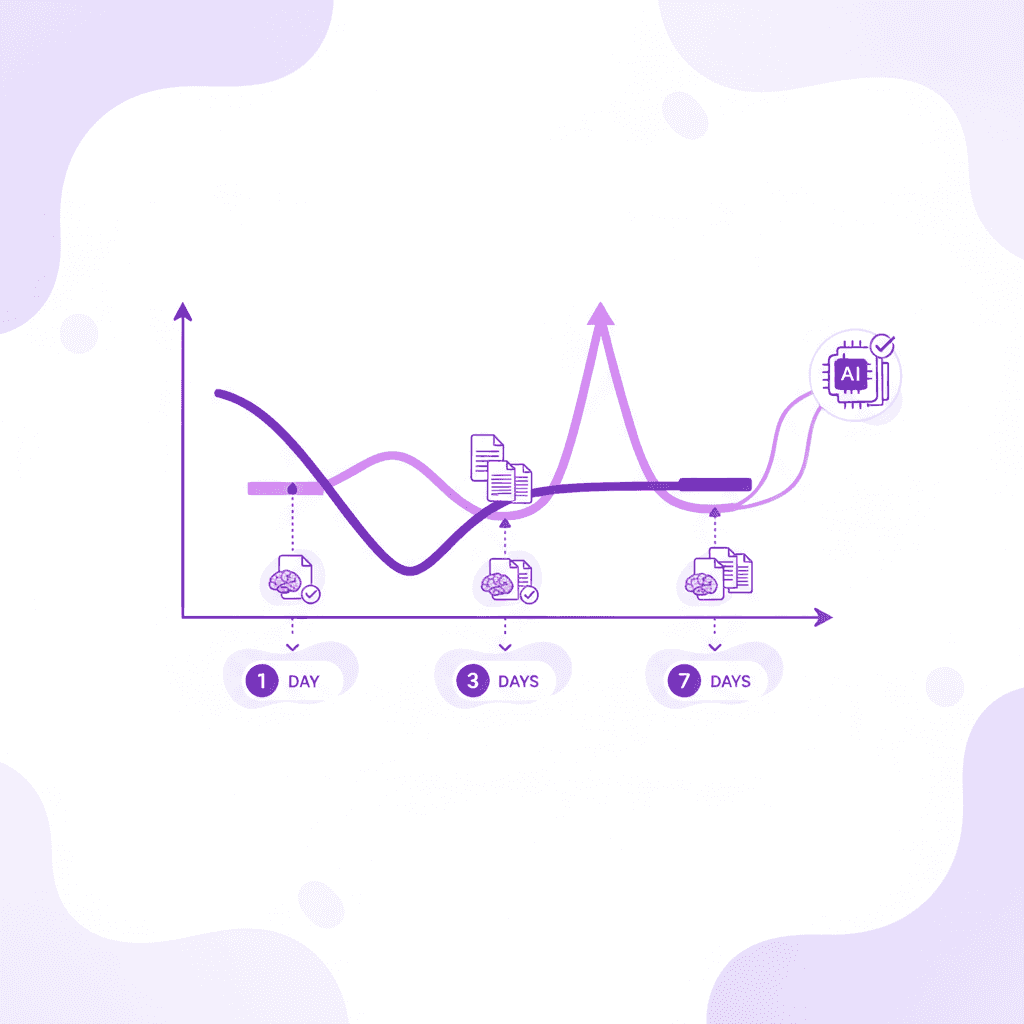
This biological process is explained by the Forgetting Curve, discovered by German psychologist Hermann Ebbinghaus in 1885. Ebbinghaus found that memory decays exponentially. Within 24 hours of a lecture, you forget roughly 70% of the new information unless you actively review it.
By introducing a study session right at the moment memory decay begins, you reset the forgetting curve. Each subsequent review requires a longer time gap before you forget the information again.
Implementing this strategy transforms exam preparation. You spend less total time studying, but achieve significantly higher retention. If you want to learn 5 Spaced Repetition Tips for Better Grades, the absolute best approach is ditching your physical notebooks and switching to dynamic digital flashcards.
Research: Hermann Ebbinghaus's 1885 research on the Forgetting Curve demonstrates memory decay and proves that applying spaced review intervals yields an 80% retention increase over single-session cramming.
Actionable step: Use a digital flashcard application to schedule your specific topic reviews. Space them out over 1 day, 3 days, and 1 week. Rate how difficult each card was to answer so the software can automatically calculate the optimal time for your next review.
Why Is Active Recall the Best Study Method?
Active recall involves actively stimulating your memory to retrieve a piece of information rather than passively re-reading a textbook. By testing yourself continuously throughout your study session, you identify knowledge gaps immediately and improve your brain's ability to retrieve that exact information during a high-stakes test.
Re-reading notes creates the "illusion of competence." When you stare at a highlighted sentence, your brain recognizes the text and tricks you into thinking you have memorized it. Recognition is not recall. Recognizing a concept on a page does not mean you can summon that concept from scratch on a blank exam paper.
Active recall forces your brain to work hard. The mental strain you feel when trying to remember a specific historical date or biological process is the exact mechanism that builds a durable memory trace.
Testing yourself is not an assessment of what you have learned; it is the actual learning process itself. For top-tier students, practice quizzes are the primary study tool, not an afterthought. Finding 7 Active Recall Strategies to Boost Your Grades usually involves a mix of self-testing, flashcards, and peer quizzing.
You can immediately implement 7 Active Recall Study Method Tips for Top Grades by transforming every heading in your textbook into a question, then closing the book and answering it aloud.
Research: A landmark study by Karpicke & Roediger (2008) published in Science demonstrated that active testing drastically improves learning, yielding up to 50% better recall over passive studying. Students who repeatedly tested themselves outperformed those who simply re-read material by a massive margin.
Actionable step: Close your lecture notes. Write down everything you can remember on a blank sheet of paper, then open the book and check for accuracy. Correct any mistakes in red ink.
How Can the Feynman Technique Improve Understanding?
The Feynman technique is a mental model that involves explaining a complex concept in plain, simple language as if teaching a beginner. If you stumble or use confusing jargon, you have identified a gap in your own understanding, allowing you to return to the source material and accurately review.
Named after Nobel Prize-winning physicist Richard Feynman, this method strips away academic vocabulary. Many students hide their lack of comprehension behind complicated words. If you can only define a psychological theory using the exact phrasing from your professor's slides, you do not truly understand it.
The framework requires four distinct phases. First, choose a concept. Second, teach it to a toddler or middle schooler in your mind. Third, identify your knowledge gaps when you inevitably get stuck. Fourth, simplify your explanation and create a helpful analogy.
Using analogies bridges the gap between abstract academic theories and concrete reality. By forcing your brain to map a difficult university topic onto an everyday situation, you build deep, structural comprehension that survives trick questions on multiple-choice exams.
Research: This method is based on physicist Richard Feynman's observational framework focusing on radical simplification for absolute topic mastery. While anecdotal to Feynman's own life, the underlying mechanism is supported by the "protégé effect," where students score higher on exams when instructed to learn material with the intention of teaching it to others (Nestojko et al., 2014, Memory & Cognition).
Actionable step: Write down a challenging course topic on a whiteboard. Explain it aloud using an everyday analogy a middle schooler would understand. If you catch yourself relying on a textbook definition, stop and rewrite it in your own words.
How Does Interleaved Practice Help You Study Effectively?
Interleaved practice is the process of mixing different subjects or topics within a single study session rather than blocking them out. By switching between distinct problem types, your brain learns not just how to solve a problem, but also when to apply specific strategies, mimicking actual exam conditions.
Most high school and college courses use "blocked practice." You read Chapter 4, then do 20 practice questions specifically about Chapter 4. You never have to guess which formula to use because you know every problem requires the Chapter 4 formula.
Exams do not work this way. A final exam scrambles Chapter 2, Chapter 7, and Chapter 11. Students often freeze during finals because they never practiced identifying which concept to apply to a random problem.
Interleaving fixes this. By shuffling different types of questions, your brain is forced to discriminate between concepts. This constant shifting feels significantly harder and slower in the moment. You will likely make more mistakes during an interleaved study session than a blocked one.
That frustration is a signal of effective learning. The increased friction builds a more versatile intellect, allowing you to rapidly categorize unseen problems on test day.
Research: A prominent study by Rohrer (2012) published in the Journal of Educational Psychology showed interleaving boosts final test performance by 43%. The research proved that forcing the brain to discriminate between mathematical problem types yields drastically better long-term retention than blocked practice.
Actionable step: Alternate between solving math equations, reviewing biology terms, and practicing history dates every 30 minutes to keep your brain actively engaged. Shuffle your flashcards so you never review one single topic for too long.
How Does Dual Coding Improve Memory?
Dual coding is a study strategy that combines verbal materials with visual representations. By pairing text with relevant images, diagrams, or charts, you provide your brain with two distinct ways to remember the information, significantly enhancing retention and comprehension for visually heavy subjects.
Your brain processes visual information and verbal information through two separate channels. When you only read text, you rely solely on the verbal channel. If you add an infographic or a sketch, you activate the visual channel.
Encoding the same piece of information in two different formats creates a stronger memory trace. If you forget the exact textbook definition during an exam, your brain can often retrieve the visual sketch you made, which then triggers the verbal memory.
This is highly effective for subjects like anatomy, geography, or complex processes like the Krebs cycle. However, the visual must directly relate to the text. Drawing a random doodle next to your notes does not work. The image must represent the underlying concept.
Research: Formulated by Allan Paivio in 1971, the Dual Coding Theory demonstrates that human cognition handles imagery and language independently. Later studies on multimedia learning by Mayer and Anderson (1992) in the Journal of Educational Psychology confirmed that students learn better from words and pictures than from words alone.
Actionable step: Draw diagrams next to your text notes. Whenever you encounter a dense paragraph describing a sequence of events, translate that paragraph into a simple flowchart or timeline.
What Is Elaborative Interrogation?
Elaborative interrogation is an inquiry-based study method where you constantly ask "why" or "how" a specific fact is true. Generating an explanation for a stated fact forces your brain to integrate new information with existing prior knowledge, making the new concept stick much faster than rote memorization.
Reading a textbook is inherently passive. The author provides the facts, and you accept them. Elaborative interrogation disrupts this passivity.
When you read a statement like "arteries are thicker than veins," stop immediately. Ask yourself, "Why does it make sense that arteries are thicker?" You then reason through your prior knowledge regarding blood pressure from the heart.
This process anchors new, fragile facts into the deep, established network of knowledge you already possess. Instead of memorizing isolated data points, you build a cohesive web of understanding. Integrating this with 5 Active Recall and Spaced Repetition Tips for Exams yields the highest possible return on your study hours.
Research: A comprehensive review by Dunlosky et al. (2013) published in Psychological Science in the Public Interest found that elaborative interrogation generates moderate to high utility for factual learning, particularly when students already possess baseline knowledge of the subject matter.
Actionable step: Ask "why does this make sense?" while reading your textbook. Write down your answer in the margins before you continue to the next paragraph.
How Do Standard AI Tools Compare to Dedicated Study Platforms?
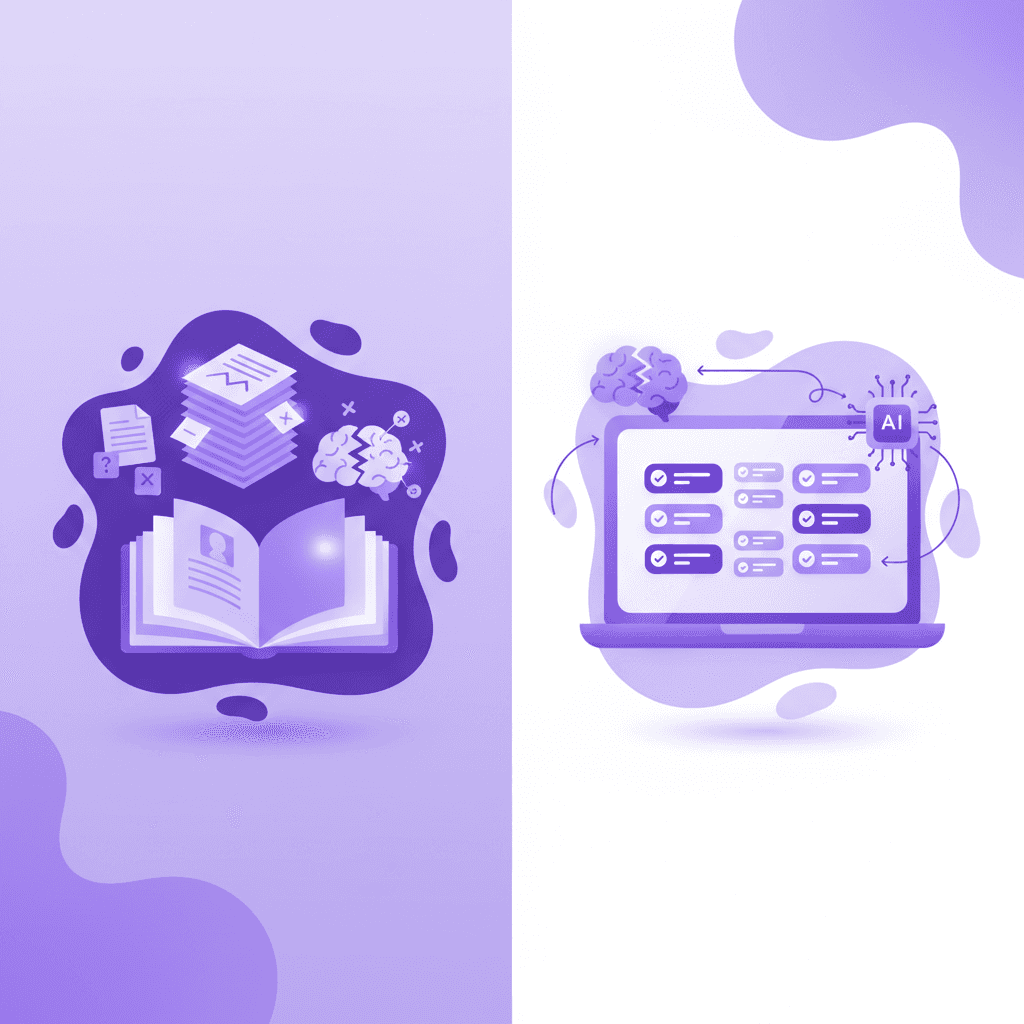
Using generic chatbots to summarize your notes might save a few minutes, but it completely fragments your workflow. Standard tools do not test your recall. They only provide summaries. To implement proven study methods, you need software specifically designed for the neuroscience of learning.
Feature | Penseum | General AI Chatbots |
|---|---|---|
Output Type | Flashcards, practice exams, study roadmaps. | Text summaries and generic bullet points. |
Learning Methodology | Emphasizes active recall and quizzing. | Focuses on passive reading and condensing. |
Workflow | Synchronized workspace tailored to your syllabus. | Fragmented; requires multiple tools to organize. |
Accuracy | High; strictly follows your uploaded coursework. | Variable; prone to generating generic facts. |
How Penseum Helps You Apply Top Study Methods
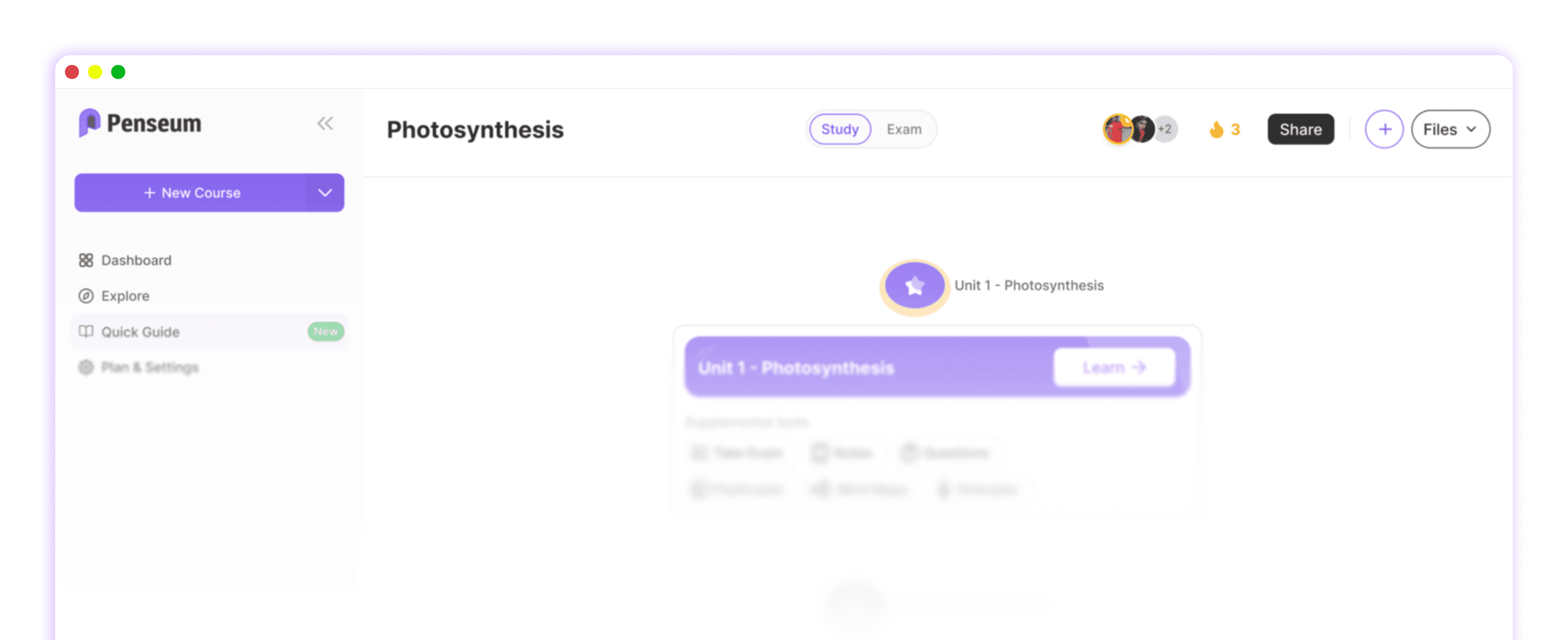
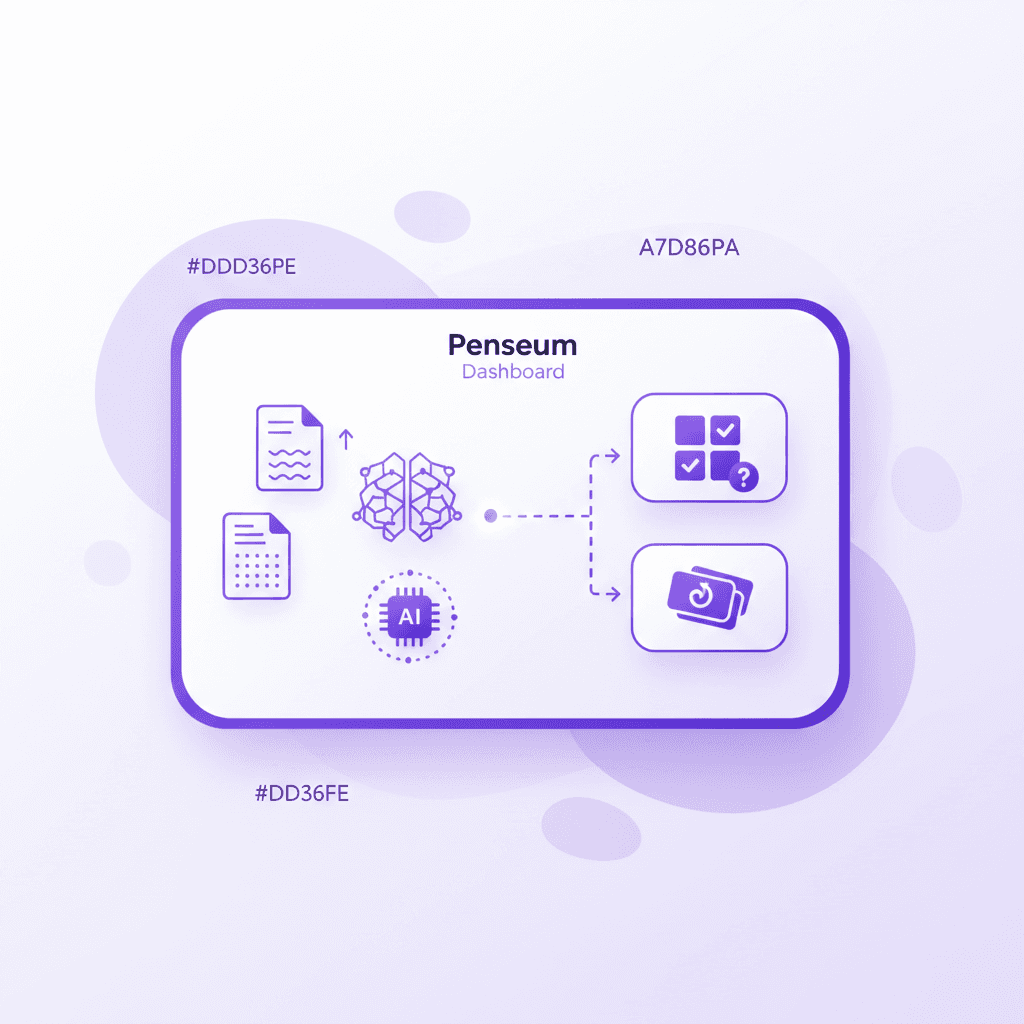
Penseum immediately integrates these techniques by instantly turning your uploaded notes into custom flashcards, quizzes, and study guides. It perfectly facilitates active recall and spaced repetition using your exact curriculum. With no credit card required, it is the ultimate all-in-one AI study buddy for high school and university coursework.
Standard AI tools fragment your workflow, making studying feel scattered and inefficient. You end up juggling three different apps to read your notes, quiz yourself, and track your flashcards.
Penseum solves this by housing all your study tools and progress metrics in one synchronized workspace. Because the platform emphasizes questions, quizzes, and recall over simple summaries, it forces your brain to engage in active learning. The automated step-by-step solutions act as a personalized tutor, instantly correcting your knowledge gaps when you answer a practice question incorrectly.
Over 1.6 million students across 130+ countries use Penseum to save time and boost grades without relying on inaccurate crowdsourced materials.
Whether you are drowning in medical school homework or preparing for a high school history final, the process is instantaneous. You do not have to waste three hours manually creating flashcard decks from your lecture slides.
Actionable step: Upload your specific course syllabus, PDF materials, or lecture slides to Penseum right now. The platform will automatically generate your first AI tutor session, visual mind map, and interactive flashcard deck for free to completely automate your active recall sessions.
Frequently Asked Questions
What are the most effective study methods?
The most effective study methods involve active learning rather than passive reading. Techniques like active recall, spaced repetition, the Feynman technique, and interleaved practice force your brain to retrieve and apply information. These scientifically proven strategies improve long-term retention, reduce cognitive fatigue, and significantly boost exam performance for university students.
How can I create a realistic study plan?
Creating a realistic study plan requires assessing your exam schedule and breaking down the syllabus into manageable chunks. Allocate specific time blocks using the Pomodoro technique to maintain focus. Ensure your plan includes dedicated sessions for spaced repetition and practice quizzes, leaving buffer days for unexpected delays or difficult topics.
What is the 50 10 study rule?
The 50 10 study rule is a time management technique where a student focuses intensely on academic material for 50 minutes, followed by a 10-minute break. Similar to the Pomodoro method, this structured interval prevents burnout, maintains high cognitive performance, and allows the brain time to consolidate newly learned information.
Are AI study tools like Penseum free?
Yes, Penseum offers a highly capable free tier requiring no credit card to start. Students can immediately upload their personal notes, PDFs, or lecture slides to generate accurate study guides, flashcards, and quizzes. For advanced needs, a premium subscription is available for $14.99 to unlock even more AI tutoring capabilities.
How do you study effectively for exams?
Studying effectively for exams requires ditching passive highlighting and embracing active recall. Start by uploading your class notes to an AI tool like Penseum to generate practice quizzes. Test yourself repeatedly, explain complex concepts out loud using the Feynman technique, and space out your review sessions over several weeks.
[AUTHOR]
Last updated: February 2026
Sources
Ariga, A., & Lleras, A. (2011). Brief and rare mental "breaks" keep you focused: Deactivation and reactivation of task goals preempt vigilance decrement. Cognition, 118(3), 439-443. https://pubmed.ncbi.nlm.nih.gov/21211793/
Murre, J. M. J., & Dros, J. (2015). Replication and Analysis of Ebbinghaus' Forgetting Curve. PLOS ONE, 10(7), e0120644. https://www.ncbi.nlm.nih.gov/pmc/articles/PMC4492928/
Karpicke, J. D., & Roediger, H. L. (2008). The critical importance of retrieval for learning. Science, 319(5865), 966-968. https://pubmed.ncbi.nlm.nih.gov/18276894/
Nestojko, J. R., Bui, D. C., Kornell, N., & Bjork, E. L. (2014). Expecting to teach enhances learning and organization of knowledge in free recall of text passages. Memory & Cognition, 42(7), 1038-1048. https://pubmed.ncbi.nlm.nih.gov/24845756/
Rohrer, D. (2012). Interleaving helps students distinguish among similar concepts. Educational Psychology Review, 24(3), 355-367. https://scholar.google.com/scholar?q=Interleaving+helps+students+distinguish+among+similar+concepts
Mayer, R. E., & Anderson, R. B. (1992). The instructive animation: Helping students build connections between words and pictures in multimedia learning. Journal of Educational Psychology, 84(4), 444-452. https://scholar.google.com/scholar?q=The+instructive+animation%3A+Helping+students+build+connections+between+words+and+pictures+in+multimedia+learning
Dunlosky, J., Rawson, K. A., Marsh, E. J., Nathan, M. J., & Willingham, D. T. (2013). Improving Students' Learning With Effective Learning Techniques: Promising Directions From Cognitive and Educational Psychology. Psychological Science in the Public Interest, 14(1), 4-58. https://pubmed.ncbi.nlm.nih.gov/26173288/
Related guides
Ready to study smarter?
Start turning your notes into guides, quizzes, and flashcards in seconds.