7 Steps to a Study Plan That Boosts Grades
Key Takeaways
* A formal study plan organizes academic workloads into manageable, scheduled blocks to prevent cramming.
* Tracking your time in 30-minute increments reveals hidden windows for review sessions.
* Defining specific, measurable objectives for every session prevents procrastination and wasted effort.
* Integrating active recall techniques yields higher test scores than passive reading.
* AI tools automate the creation of study materials, saving hours of preparation time.
What Is a Study Plan and Why Is It Important?
A study plan is a structured schedule that dedicates specific times and methods to learning. It organizes your academic workload into manageable blocks, preventing last-minute cramming and reducing test anxiety. This formal approach ensures you cover all necessary materials before exams while maintaining a healthy life balance.
Research by Kornell (2009) demonstrates that spacing out study sessions is significantly more effective than massed practice (cramming). Students who distribute their learning retain information longer and perform much better on final assessments. Cramming creates a dangerous illusion of competence. You recognize the material the night before the test, but the information vanishes from your memory days later. A formal revision schedule breaks this cycle entirely.
By mapping out exactly what to read and review on specific days, you remove the daily decision fatigue of figuring out what to do. You simply open your calendar and execute the plan. Write down all upcoming exams, paper deadlines, and project milestones on a single master calendar to visualize your entire semester.

This visual representation of your academic timeline allows you to work backwards from test dates. If you have a midterm in three weeks, your plan dictates that you start reviewing week one material today. Planning prevents the panic of realizing you have ten chapters to read in a single evening.
How Do You Assess Your Current Schedule?
Assessing your schedule requires tracking your daily activities to find hidden pockets of free time. By mapping out classes, work, and sleep, you can identify exactly how many realistic hours you have available for studying. This baseline reality check prevents you from overcommitting to an impossible academic calendar.
According to a 2021 National Survey of Student Engagement (NSSE) report, the average college student studies about 15 hours per week. Finding those 15 hours means knowing exactly where your time currently goes. You cannot schedule effective review blocks if you do not know your true availability.
Log your time in 30-minute increments for 48 hours to find wasted time slots that could be used for review. Many students discover they spend hours scrolling through their phones between classes. These 45-minute gaps are perfect for reviewing flashcards or reading a single chapter. Use a basic spreadsheet or a time-tracking application to audit your week.
Categorize your activities into fixed commitments and variable time. Fixed commitments include lectures, lab sessions, part-time jobs, and commuting. Variable time includes meals, transit, recreation, and socializing. Subtract your fixed commitments from your 168-hour week, making sure to reserve at least 56 hours for sleep. The remaining balance dictates the physical limits of your curriculum mapping. Do not schedule 30 hours of study time if your audit proves you only have 18 free hours available.
How Do You Set Realistic Study Goals?
Setting realistic goals involves breaking broad subjects into specific, measurable tasks. Instead of planning to simply study biology, you should schedule a session to memorize chapter four cell division, giving you a clear endpoint. This exactness removes ambiguity and prevents procrastination during your dedicated review sessions.
Locke's Goal-Setting Theory (1968) highlights that specific and challenging goals lead to higher performance than vague goals. Vague objectives breed distraction. If your scheduled task is "work on history paper," you will likely stare at a blank screen for twenty minutes before checking social media. You lack a defined starting line.
Use the SMART framework (Specific, Measurable, Achievable, Relevant, Time-bound) to define your objectives for every single study block. Change that history task to "draft 500 words on the causes of the French Revolution by 4:00 PM." This provides a definitive finish line. You know exactly when the task is complete.
Apply this same logic to reading assignments and problem sets. Assign exact page counts to specific hours rather than just planning to read. Say "complete odd-numbered calculus problems 1 through 15 in forty minutes." Creating these definitive targets aligns perfectly with these 10 Proven Study Tips to Ace Your Exams. Setting hard boundaries forces you to work efficiently rather than letting a simple task expand to fill your entire afternoon.
Which Study Methods Belong in Your Plan?
The most effective schedules incorporate evidence-based study methods like spaced repetition and active recall. These techniques force your brain to actively retrieve information, making your dedicated study blocks significantly more productive than passive reading. Active methods transform your timetable from a reading list into a testing system.
Roediger and Karpicke (2006) proved that the testing effect produces significantly better long-term retention than repeated reading. Students who tested themselves retained 61% of the material a week later, compared to 40% for those who only reread their notes. Rereading feels highly productive because the text looks familiar, but familiarity does not equal comprehension.
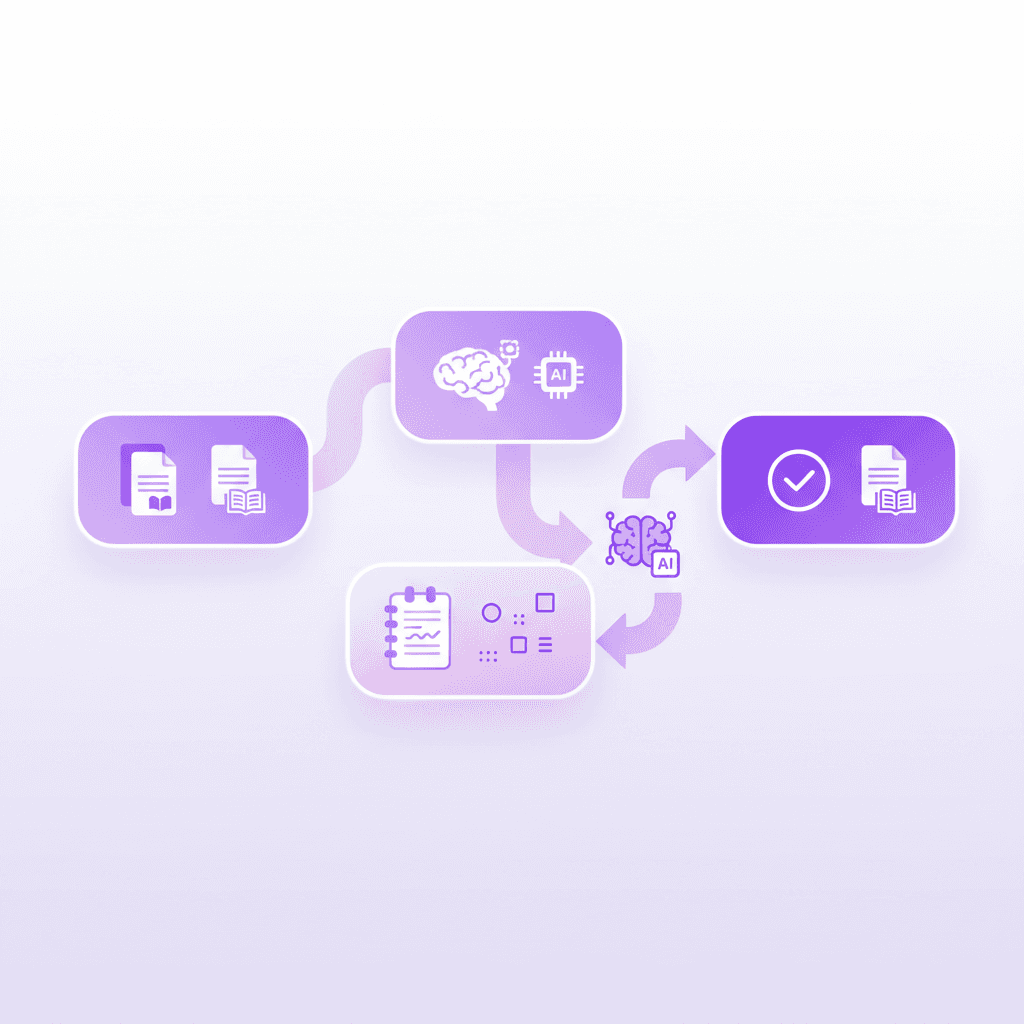
Replace passive highlighting with active testing by generating quizzes and flashcards for your daily review sessions. To truly grasp complex topics, you must force your brain to struggle with retrieval. Testing yourself identifies exact knowledge gaps immediately, allowing you to adjust your learning routine.
This is why 7 Active Recall Strategies to Boost Your Grades and 5 Spaced Repetition Tips for Better Grades emphasize self-testing over underlining text. Building a schedule around these techniques ensures your time spent studying translates directly into higher test scores. For deeper implementation strategies on formatting your notes for self-testing, check out these 7 Active Recall Study Method Tips for Top Grades.
How Do You Build a Daily Study Routine?
A daily routine is built by dedicating consistent time slots to studying, ideally using interval training like the Pomodoro technique. Consistency trains your brain to focus automatically when your scheduled study block begins. Random study times require intense willpower, which depletes rapidly throughout the day.
Research by Lally (2010) indicates that it takes an average of 66 days to form a new automatic habit. Sticking to the exact same study hours daily reduces the mental friction of starting. If you know that 3:00 PM to 5:00 PM is always reserved for academic work, you stop debating whether or not to open your laptop.
Schedule your hardest and most complex subjects during your peak biological energy hours, usually in the morning. Tackle difficult calculus problems at 9:00 AM rather than 10:00 PM when your cognitive resources are drained. Leave lighter tasks, like organizing notes or formatting citations, for your low-energy afternoon slumps.
Break your sessions into 25-minute focus intervals followed by 5-minute breaks. This structure prevents mental fatigue and keeps you moving forward through dense material. Use physical timers to enforce these boundaries strictly. When the timer rings, you must stop working and step away from your desk to rest your eyes.
How Do You Optimize Your Learning Environment?
Optimizing your learning environment means eliminating digital and physical distractions before your study block begins. A dedicated, quiet space signals to your brain that it is time to work. Studying in bed or in noisy cafeterias forces your brain to process background interruptions instead of academic material.
A study by Ophir et al. (2009) at Stanford University revealed that heavy media multitaskers performed worse on cognitive control tasks than light multitaskers. Your brain cannot process a dense lecture video and a group text message simultaneously. Attempting to do so simply fractures your attention and doubles the time it takes to finish an assignment.
Block distracting websites using software limiters during your scheduled study hours. Put your phone in another room entirely. Out of sight means out of mind. Clear your desk of everything except the specific syllabus, notebook, and pens needed for your current task.
A clean workspace reduces visual clutter and helps maintain intense focus on the immediate assignment. If you must study in public areas like a library, use noise-canceling headphones playing brown noise to block erratic background conversations. For more ways to maintain focus during long sessions, review these 7 Proven Study Methods for Better Grades and 5 Active Recall and Spaced Repetition Tips for Exams.
How Do You Stick to Your Study Schedule?
Sticking to your schedule requires flexibility, self-compassion, and built-in buffer times. If you miss a block, a buffer allows you to catch up without abandoning the entire plan, preventing the all-or-nothing mentality. Leaving designated blank spaces protects your academic timeline from unexpected daily emergencies.
A 2022 American College Health Association assessment found that nearly 48% of college students reported moderate to high levels of academic burnout. Overly rigid schedules accelerate this exhaustion. Planning every minute of your day leaves zero room for error.
Leave Sunday afternoons completely blank on your calendar as a designated buffer zone to catch up on missed tasks. Life happens. You will get sick, assignments will take three hours instead of one, and family emergencies will arise. Without a buffer zone, one missed Tuesday session ruins the rest of your week, often leading students to scrap the entire schedule in frustration.
With a buffer zone, you simply push the missed task to Sunday. You maintain control of your workload without sacrificing sleep. If you finish everything on time during the week, that Sunday buffer becomes free time, rewarding your consistency and discipline.
How Penseum Supercharges Your Study Plan
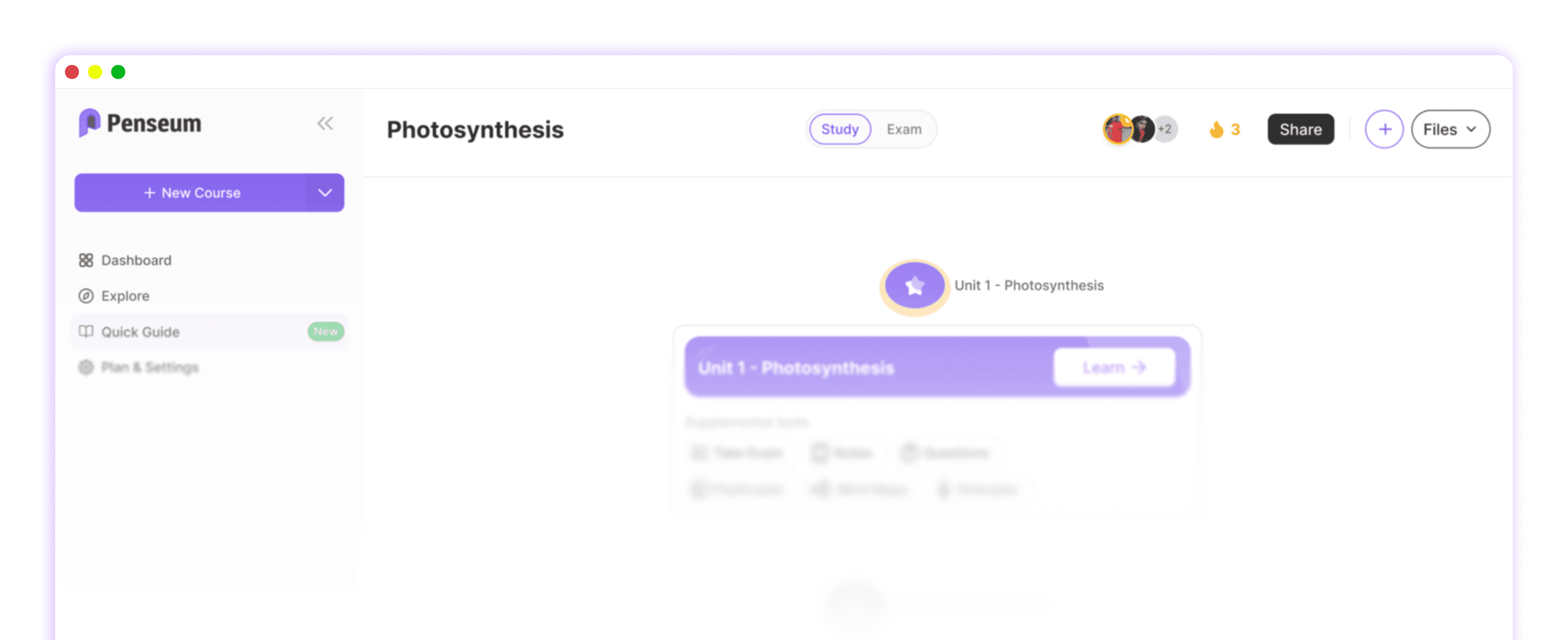
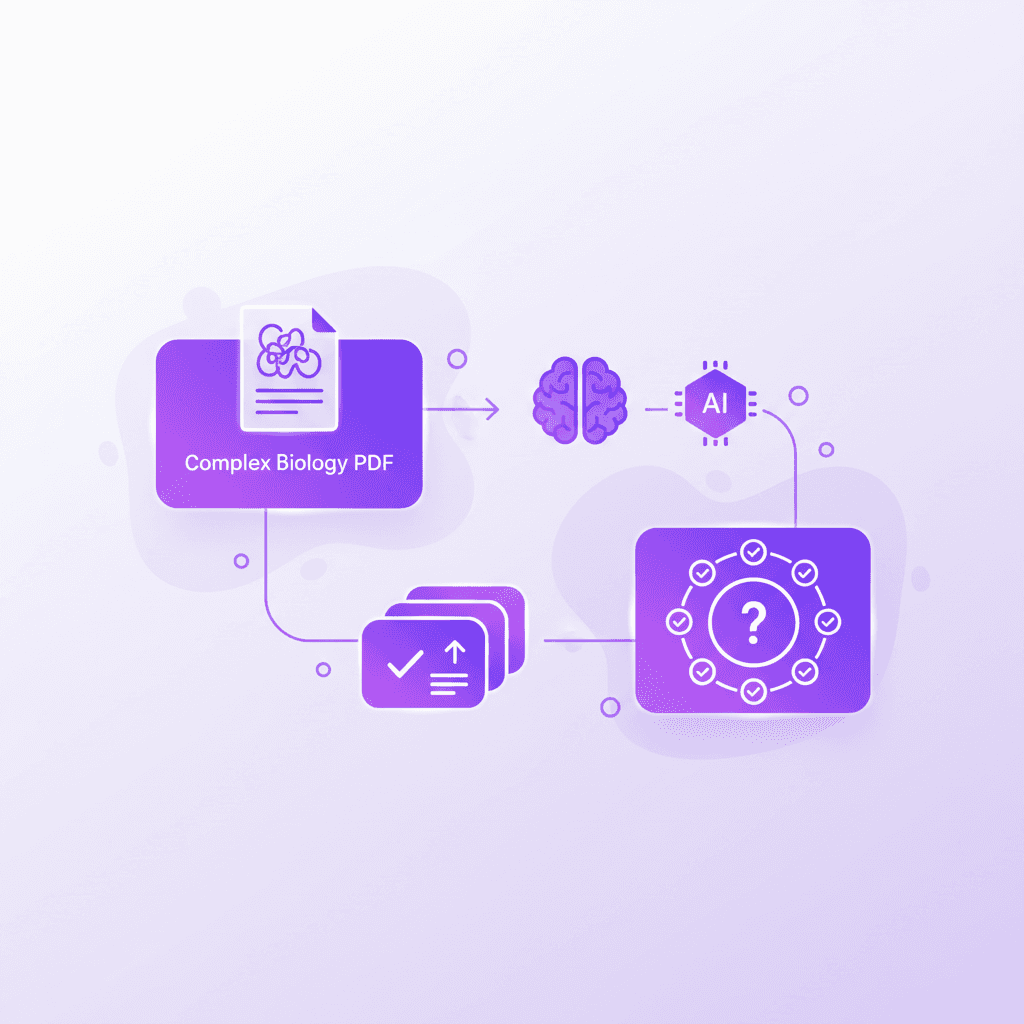
Penseum optimizes your study plan by instantly transforming your uploaded notes, PDFs, and slides into comprehensive study materials. Instead of wasting scheduled hours creating resources, you jump straight into high-yield active learning with an AI tutor. Most students spend 70% of their study time making flashcards and only 30% actually memorizing them. Penseum flips this ratio, maximizing your interval study sessions.
Penseum is trusted by over 1,000,000 learners across 130+ countries to streamline their exam preparation. The platform specifically builds study tools tailored to your course content, emphasizing questions, quizzes, and recall rather than just passive summaries.
Other AI tools fragment your workflow, requiring multiple apps to cover notes, quizzes, and flashcards separately. They are designed for general use, producing generic outputs that ignore the specifics of your syllabus. Penseum keeps all your study tools, chat assistance, and progress metrics in one synchronized workspace. You get answers to your questions anytime, complete with step-by-step solutions that act like a tutor in your pocket.
Feature | Penseum | Generic AI Tools |
|---|---|---|
Material Generation | Creates flashcards, quizzes, and guides from your exact syllabus. | Produces generic summaries that often hallucinate facts. |
Workflow | Unified workspace for testing, reading, and progress tracking. | Fragmented workflow requiring multiple tabs and apps. |
Learning Focus | Emphasizes active recall, testing, and step-by-step solutions. | Focuses mainly on passive reading and text summarization. |
Sign up for the free tier (no credit card required) and upload your heaviest syllabus to automatically generate your flashcards, quizzes, and mind maps. Penseum is free to use, with an optional premium subscription available for $14.99 if you require advanced capabilities. Start turning your notes into guides, quizzes, and flashcards in seconds to reclaim your schedule.
Frequently Asked Questions
How many hours a day should a student study?
A college student should aim to study two to three hours per credit hour each week. For a standard 15-credit semester, this equals 30 to 45 hours weekly, or about four to six hours daily. Distribute these hours evenly across the week to avoid fatigue and improve long-term retention.
What is the best study plan for exams?
The best study plan for exams begins three to four weeks before the test date. It divides the total material into daily review blocks and uses active recall techniques like practice tests. This plan must include designated buffer days to catch up on missed reviews and prevent pre-test cramming.
How do I make a study plan template?
You can make a study plan template using a spreadsheet or calendar application. Create columns for the days of the week and rows for hourly time blocks. Block out fixed commitments like classes and work first, then assign specific subjects and tasks to the remaining empty blocks.
When is the best time of day to study?
The best time of day to study depends on your individual circadian rhythm. Most students experience peak cognitive alertness mid-morning between 9:00 AM and 11:00 AM. Schedule your most difficult subjects during your highest energy periods and save lighter administrative tasks for afternoon slumps.
How can I stick to my study schedule without getting distracted?
You can stick to your study schedule by using physical and digital environmental controls. Turn your phone off and place it in another room. Use website blockers to restrict access to social media during your scheduled blocks. Work in short 25-minute intervals to maintain focus without burning out.
[AUTHOR]
Last updated: February 2026
Sources
Kornell, N. (2009). Optimising learning using flashcards: Spacing is more effective than cramming. Applied Cognitive Psychology. https://scholar.google.com/scholar?q=Optimising+learning+using+flashcards:+Spacing+is+more+effective+than+cramming
National Survey of Student Engagement. (2021). Engagement Insights: Survey Findings on the Quality of Undergraduate Education. https://nsse.indiana.edu/research/annual-results/index.html
Locke, E. A. (1968). Toward a theory of task motivation and incentives. Organizational Behavior and Human Performance. https://scholar.google.com/scholar?q=Toward+a+theory+of+task+motivation+and+incentives
Roediger, H. L., & Karpicke, J. D. (2006). Test-Enhanced Learning: Taking Memory Tests Improves Long-Term Retention. Psychological Science. https://pubmed.ncbi.nlm.nih.gov/16507066/
Lally, P., van Jaarsveld, C. H. M., Potts, H. W. W., & Wardle, J. (2010). How are habits formed: Modelling habit formation in the real world. European Journal of Social Psychology. https://scholar.google.com/scholar?q=How+are+habits+formed:+Modelling+habit+formation+in+the+real+world
Ophir, E., Nass, C., & Wagner, A. D. (2009). Cognitive control in media multitaskers. Proceedings of the National Academy of Sciences. https://pubmed.ncbi.nlm.nih.gov/19706386/
American College Health Association. (2022). National College Health Assessment. https://www.acha.org/NCHA/
Related guides
Ready to study smarter?
Start turning your notes into guides, quizzes, and flashcards in seconds.