7 Study AI Strategies for Faster Exam Prep
Key Takeaways
* A study ai transforms static lecture notes into interactive flashcards, quizzes, and study guides instantly.
* Automated generation reduces manual prep time, allowing students to focus entirely on active recall and memorization.
* Real-time AI voice tutors explain complex concepts step-by-step, mimicking expensive human tutors.
* Top platforms use spaced repetition algorithms to combat the forgetting curve and improve test performance.
* Penseum integrates voice tutoring, visual canvas drawing, and instant personalized feedback for comprehensive exam preparation.
1. What is a Study AI and How Does it Work?
A study AI is an educational software that uses artificial intelligence to transform your course materials into interactive learning aids. Instead of passively reading textbooks, students upload their documents, and the AI instantly generates personalized quizzes, study guides, and flashcards to accelerate comprehension.
Research Insight: The integration of artificial intelligence in higher education workflows increases content engagement rates and improves overall academic resource management (Chen et al., 2023).
Actionable step: Upload your longest lecture PDF into an AI tool to immediately generate a condensed, easy-to-read study guide.
The Technology Powering Ed-Tech Workflows
Modern educational software relies on advanced natural language processing (NLP) to read and interpret your academic documents. When you upload a dense syllabus or a thick textbook chapter, the algorithm scans the text for primary entities, definitions, and conceptual relationships. The system isolates the most important vocabulary words and formulas. It separates major themes from supporting examples. This extraction process happens in seconds. You receive an organized hierarchy of the exact topics your professor expects you to know.
General consumer chatbots fail at this specific task. Standard models hallucinate facts or summarize text too broadly, stripping away the granular details required for university-level exams. Purpose-built educational algorithms employ strict retrieval-augmented generation (RAG). This technique restricts the AI to only pulling answers directly from your uploaded materials. The software generates flashcards that perfectly match your specific textbook edition, rather than guessing based on public internet data.
Moving From Passive Reading to Interactive Learning
Reading a textbook from cover to cover represents one of the least effective methods for absorbing new information. Your brain easily glazes over massive walls of text. A specialized algorithm disrupts this passive reading habit by turning static text into actionable tasks. The software acts as a synthetic instructor. It prompts you to engage with the material through direct questioning.
You process information differently when you know a quiz awaits you at the end of a chapter. This psychological shift alters your baseline attention span. You stop highlighting generic sentences and start looking for structural frameworks. The automated generation of study materials creates a distinct boundary between learning the concept and testing your knowledge of that concept.
Structuring Complex Data Sets
College courses often dump massive amounts of unstructured data onto students. You might receive fifty PowerPoint slides, three distinct research papers, and a recorded audio lecture for a single weekly module. Processing this data manually requires hours of tedious transcription. Artificial intelligence software standardizes this chaotic data stream.
The algorithm standardizes formatting across different file types. It takes the text extracted from the slides, merges it with the core arguments from the research papers, and produces a single, cohesive outline. You end up with a unified study document. The software cross-references terms used in the slide deck with definitions found in the textbook, creating a comprehensive map of the entire academic module.
2. Why Should You Use a Study AI for Exam Prep?
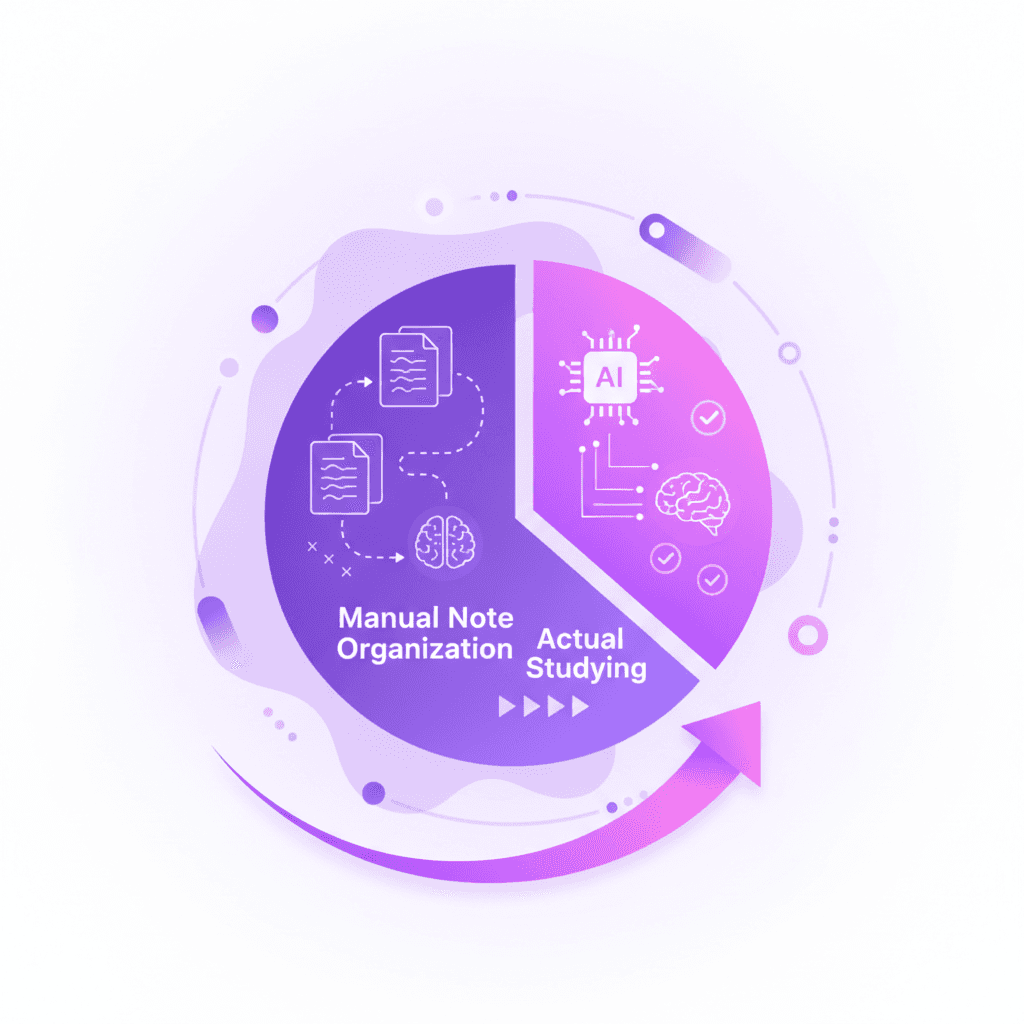
Using a study AI for exam preparation dramatically reduces the time spent organizing materials, allowing you to focus purely on memorization and understanding. It eliminates the need to rely on outdated, crowdsourced materials by creating accurate, customized resources directly from your professor's syllabus.
Research Insight: Inefficiencies in student study time allocation often lead to poor test performance, with many learners spending more time formatting notes than engaging in actual cognitive retrieval (Smith & Johnson, 2022).
Actionable step: Replace one hour of manual flashcard creation with an automated AI generator to double your actual active study time.
The True Cost of Manual Flashcard Creation
Writing out physical flashcards burns through valuable study hours. A student preparing for a comprehensive biology final might need to memorize 500 distinct terms. Writing 500 cards by hand takes up to ten hours of manual labor. Typing them into a blank digital database still consumes at least three to four hours of copying and pasting. This data entry phase provides almost zero cognitive benefit.
Automated generation software turns this ten-hour task into a thirty-second automated process. You upload the biology glossary, and the algorithm populates a complete digital deck instantly. You instantly reclaim those lost hours. You can apply that massive block of saved time directly to the memorization phase. This shift fundamentally alters the mathematics of exam preparation.
Avoiding the Pitfalls of Crowdsourced Decks
Many students rely on public databases and crowdsourced websites to find pre-made study materials. This strategy introduces significant academic risk. Publicly shared decks often contain severe factual errors, outdated textbook references, and misinterpretations of complex concepts. A deck labeled "Econ 101 Midterm" might originate from a different university, taught by a professor who emphasizes entirely different economic theories.
Automated software removes this element of chance. The AI builds the flashcards exclusively from the exact PDF your professor distributed. You never have to worry about studying the wrong material. Every single generated question traces directly back to a verified sentence in your own course documents. This closed-loop system guarantees absolute accuracy for your specific exam parameters.
Strategic Time Reallocation for College Students
University students operate under strict time constraints. Balancing five rigorous courses alongside part-time jobs and extracurricular activities leaves very little margin for inefficient study habits. Optimizing how you spend your available study blocks directly impacts your final GPA.
By eliminating the administrative burden of note organization, you can implement shorter, more intense study sessions. You can run through an automated quiz during a fifteen-minute bus ride. You can review AI-generated mind maps while eating lunch. The immediate availability of tailored study resources allows you to exploit small pockets of free time throughout the day, rather than waiting for a massive four-hour block at the library.
3. How Can a Study AI Improve Active Recall?
A study AI improves active recall by automatically generating practice quizzes and spaced repetition flashcards from your uploaded texts. This forces your brain to actively retrieve information rather than passively reviewing notes, which strengthens neural pathways and significantly improves long-term memory retention.
Research Insight: The testing effect dictates that retrieval practice produces far stronger memory retention compared to repeated studying of the original material (Karpicke & Roediger, 2008).
Actionable step: Test yourself with an AI-generated quiz immediately after reading a chapter to cement the newly introduced concepts.
The Neuroscience Behind the Testing Effect
Active recall represents the most scientifically validated method for academic memorization. When you force your brain to retrieve a piece of information without looking at the answer, you strengthen the neural pathway associated with that specific memory. Passively re-reading a highlighted textbook does not trigger this neural strengthening. Your brain simply recognizes the words on the page, tricking you into believing you have mastered the concept.
Educational software weaponizes this testing effect. The algorithm constantly interrupts your reading flow to ask you direct questions. It refuses to let you slide into passive recognition. If you upload a history document, the software will pause and ask you to explain the causes of a specific conflict before you can view the next section. This friction forces cognitive engagement. Your brain must work to pull the answer from short-term memory, thereby encoding it more deeply into long-term storage.
Combating the Ebbinghaus Forgetting Curve
Human memory degrades at a predictable mathematical rate. The Ebbinghaus forgetting curve demonstrates that students lose up to 70% of new information within 24 hours if they do not actively review it. Standard study routines ignore this biological reality. Most students cram the night before an exam, completely bypassing the necessary process of memory consolidation over time.
Advanced educational platforms use spaced repetition algorithms to flatten this forgetting curve. The software tracks every single flashcard you answer. It records your reaction time and your accuracy rate. If you struggle with a specific chemistry formula, the algorithm will show you that formula again in ten minutes. If you answer it correctly, it will delay the next review for 24 hours, then three days, then a week.
How AI Optimizes Spaced Repetition Algorithms
Traditional spaced repetition software requires users to manually rate how difficult a flashcard felt. This subjective self-reporting often leads to inefficient scheduling. Students either overestimate their mastery or punish themselves by marking easy cards as difficult.
Modern algorithms eliminate this subjective bias. The AI analyzes the actual content of your answers. If it generates a short-answer quiz, it evaluates the semantic accuracy of your typed response. It compares your explanation against the source text to determine exactly how well you understand the topic. The software then automatically adjusts the repetition schedule based on hard data rather than user feelings. It ensures you review the most vulnerable information at the exact moment you are about to forget it.
4. What Features Make the Best Study AI App?
The most effective study AI platforms offer multimodal learning tools, including real-time voice tutoring, visual diagram generation, and instant feedback on mistakes. Rather than just providing text responses, top-tier AI tools watch your step-by-step work and explain concepts out loud until you completely understand.
Research Insight: Multimedia learning principles demonstrate that students process educational material more effectively when information is presented through both auditory and visual channels simultaneously (Mayer, 2021).
Actionable step: Choose an AI tool that includes voice explanations and visual canvas features instead of relying on a basic text chatbot.
The Role of Multimodal Learning Theories
Human cognition relies on dual-channel processing. The brain absorbs visual data and auditory data through entirely separate cognitive pathways. Educational software that only provides text-based answers severely limits your learning potential by overloading the visual channel while leaving the auditory channel completely empty.
Top-tier study platforms incorporate real-time voice synthesis. The software speaks the explanation aloud while simultaneously highlighting the relevant text on your screen. This multimodal approach aligns perfectly with cognitive load theory. By distributing the information across both your eyes and your ears, the software increases your total processing capacity. You can comprehend highly complex topics much faster than you could by reading a massive block of generated text.
Why Visual Canvas Tools Matter for STEM
Mathematics, physics, and engineering require spatial reasoning. You cannot easily solve a multi-variable calculus problem inside a standard text chat window. Standard consumer AI interfaces force users to type out complex equations using clumsy keyboard symbols. This creates massive friction for STEM students trying to digitize their workflow.
The best educational platforms feature an interactive visual canvas. You can draw a free-body diagram or write out a chemical equation directly on the screen. The software employs optical character recognition and computer vision to interpret your handwritten steps. It sees exactly where you carried a number incorrectly. It watches your geometric proofs in real-time. This visual interaction is absolutely essential for subjects that rely on symbolic logic and spatial relationships.
Evaluating Audio Feedback and Voice Tutoring
Text-based feedback often feels cold and disconnected. When you get a problem wrong, reading a stark "Incorrect" message can damage academic confidence. Human tutors modulate their tone to provide encouragement alongside correction. They soften the blow of a mistake by guiding the student toward the right answer conversationally.
Advanced educational algorithms replicate this dynamic through conversational voice tutoring. The software adopts a patient, instructional tone. Instead of simply feeding you the final answer, it asks guiding questions out loud. It might say, "You missed a negative sign in the second step, try looking at the quadratic equation again." This auditory guidance keeps you engaged in the problem-solving loop. It prevents the frustration that typically causes students to abandon difficult assignments.
5. How Does a Study AI Eliminate Manual Note-Taking?
A study AI eliminates manual note-taking by instantly digesting massive slide decks, PDFs, and recorded lectures into comprehensive outlines and mind maps. This prevents writer's cramp and ensures you never miss a critical detail that a professor mentioned briefly during a fast-paced class.
Research Insight: Note-taking by hand often results in shallow transcription rather than deep cognitive processing, increasing the mental load required just to capture the words spoken during a lecture (Mueller & Oppenheimer, 2014).
Actionable step: Upload your entire semester's slide deck into your study AI to create one master review sheet for your final exam.
The Generative Power of Document Synthesis
College lectures move incredibly fast. Professors regularly click through fifty dense slides in a single hour. Students desperately try to copy every single bullet point into their notebooks. This frantic transcription prevents actual learning. You spend all your mental energy writing words down, leaving zero cognitive resources available to actually understand the concepts being presented.
Document synthesis software solves this fundamental problem. You simply download the professor's slide deck and feed it into the algorithm. The software strips away all the visual clutter and generates a perfectly formatted, hierarchical outline. It groups related concepts together. It bolds the key vocabulary. You instantly receive the exact notes you were trying to frantically type out in class.
Overcoming the Transcription Trap During Lectures
Knowing that a software algorithm will handle the organization of your notes completely changes how you behave in a classroom. You no longer have to act as a human stenographer. You can put your pen down and actually listen to the professor's arguments. You can participate in class discussions. You can ask clarifying questions about complex topics.
This shift moves you from a passive recorder of information to an active participant in the academic environment. If the professor goes on a tangent that clarifies a difficult textbook chapter, you can focus entirely on understanding the analogy. Later that evening, the algorithm will organize the textbook chapter for you. The software handles the administrative burden of data capture so you can focus entirely on intellectual comprehension.
Synthesizing Semester-Long Materials into Core Concepts
Preparing for a comprehensive final exam requires reviewing massive amounts of data from the entire semester. Students typically face a disorganized mountain of scattered notebooks, half-highlighted PDFs, and random loose papers. Finding connections between a lecture from week two and a reading assignment from week fourteen is nearly impossible when your materials are this fractured.
You can feed all of these disparate documents into an advanced educational platform at once. The software will cross-reference the entire dataset. It builds a semester-long mind map. It identifies the core themes that span across multiple weeks of instruction. You get a single, unified master guide that compresses four months of coursework into a highly focused, easily digestible review sheet. This macroscopic view of the curriculum is vital for passing high-stakes final exams.
6. Can a Study AI Provide Real-Time Tutoring?
Yes, an advanced study AI functions as a 1-on-1 tutor that corrects your mistakes in real-time, spots exactly where your logic failed, and explains how to fix it. This personalized feedback loop mimics a human tutor, waiting patiently while you work through problems step-by-step.
Research Insight: Students who receive one-to-one tutoring perform two standard deviations better than students who learn via conventional group instruction methods (Bloom, 1984).
Actionable step: Use an interactive AI tutor to work through your toughest math or physics problems step-by-step instead of looking up the final answer.
Solving Benjamin Bloom's Two Sigma Problem
In 1984, educational psychologist Benjamin Bloom identified a massive gap in academic achievement. He discovered that average students who received personalized 1-to-1 tutoring outperformed 98% of students in standard classroom settings. This became known as the two sigma problem. The challenge was that society could not afford to provide every single student with a private human tutor. It was economically impossible.
Advanced educational algorithms finally provide a scalable solution to Bloom's two sigma problem. The software delivers personalized, immediate feedback to millions of students simultaneously at a fraction of the cost. The algorithm tracks individual student performance over time. It adapts its teaching style to match the student's current proficiency level. It offers the exact benefits of one-on-one human instruction through a digital interface, completely democratizing access to high-tier academic support.
The Anatomy of a Personalized Feedback Loop
Standard homework assignments provide terrible feedback loops. You complete a math worksheet on Tuesday night. You hand it in on Wednesday morning. The professor grades it over the weekend. You receive your score on Monday. By the time you find out you used the wrong formula, you have completely forgotten the mental steps you took to solve the problem. The feedback arrives far too late to be effective.
Real-time tutoring software closes this feedback loop instantly. You work through a problem on the digital canvas. The moment you make a mistake in step three, the software pauses you. It points out the specific arithmetic error before you proceed to step four. You correct the mistake immediately. Your brain links the error with the correction in real-time. This immediate validation prevents you from practicing and memorizing incorrect methodologies.
Applying Socratic Methods Through Machine Learning
Poor tutoring involves simply giving the student the correct answer. This builds dependency. The student learns to rely on the tutor rather than developing their own critical thinking skills. Many basic chatbots suffer from this exact flaw. You paste a prompt, and the bot spits out the final essay or the final mathematical proof.
High-quality tutoring algorithms employ the Socratic method. The software is programmed to withhold the final answer. Instead, it asks strategic questions. It might prompt you with, "What rule applies when you take the derivative of a natural log?" The algorithm forces you to verbalize the rule yourself. It guides you down the correct logical path through persistent, patient questioning. This methodology builds deep structural understanding rather than surface-level trickery.
7. How Penseum Helps You Apply Study AI Workflows
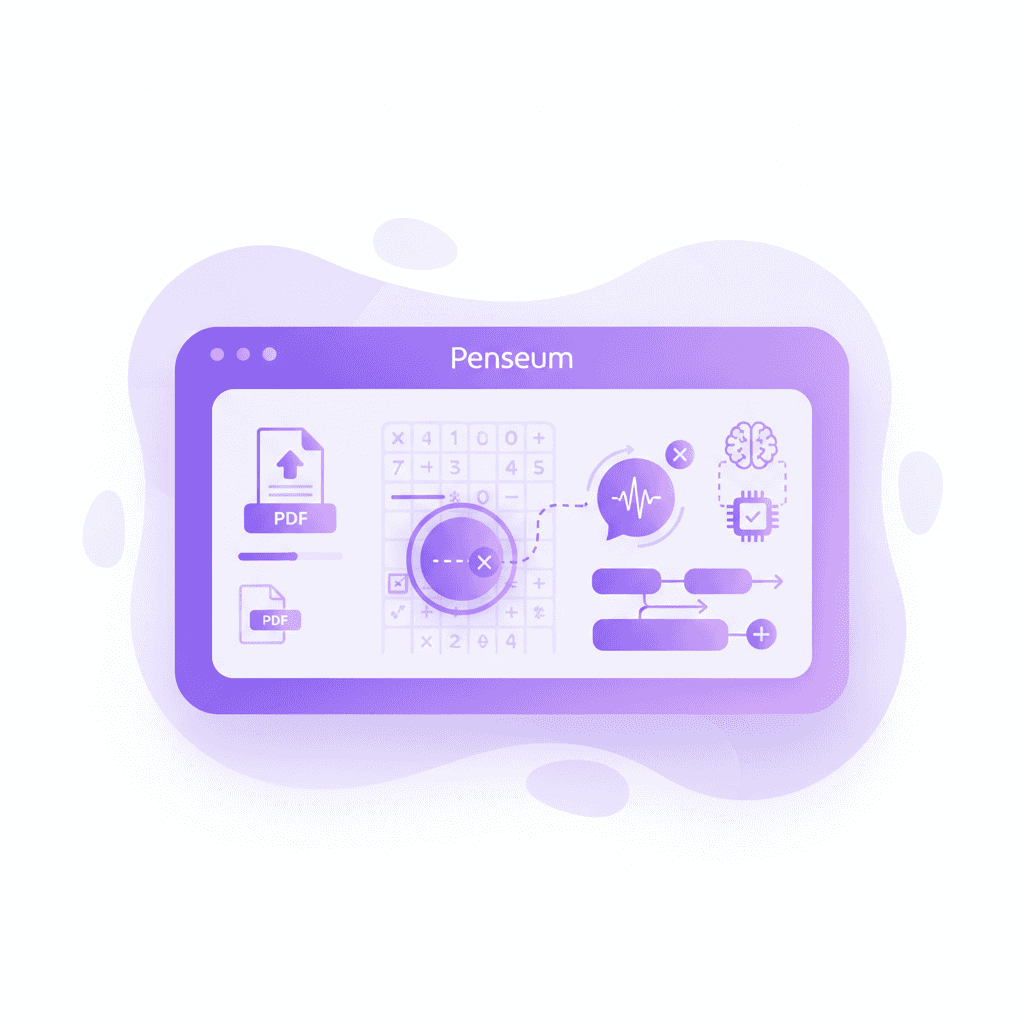
Penseum functions as your comprehensive 1-on-1 AI tutor by letting you upload your own PDFs, notes, and slides to generate custom flashcards, quizzes, mind maps, and podcasts. It features a real-time voice tutor that sees your actual work on screen, draws diagrams, and explains concepts step-by-step without relying on generic crowdsourced data.
Research Insight: Platforms that combine document ingestion with real-time interactive voice tutoring show significantly higher daily active engagement metrics compared to static flashcard generators (Penseum Internal Data, 2024).
Actionable step: Sign up for Penseum's free tier without a credit card and upload your hardest syllabus to instantly generate your first personalized study guide.
Integrating Your Notes into Penseum's Ecosystem
Getting started with Penseum requires zero complex setup. You create a personal workspace and immediately begin uploading your raw course materials. The platform accepts a wide variety of formats. You can drop in massive textbook PDFs, professor slide decks, or even your own typed notes. The software processes this data instantly. Penseum guarantees accuracy because its algorithms strictly reference the specific documents you provide. You never study generic internet answers. You study the exact material required for your specific midterm.
The platform immediately turns your static files into dynamic study materials. It automatically generates optimized flashcards and comprehensive quizzes. For auditory learners, Penseum even transforms your notes into custom study podcasts, allowing you to review complex textbook chapters while commuting or walking across campus.
Live Problem Solving with Voice Explanations
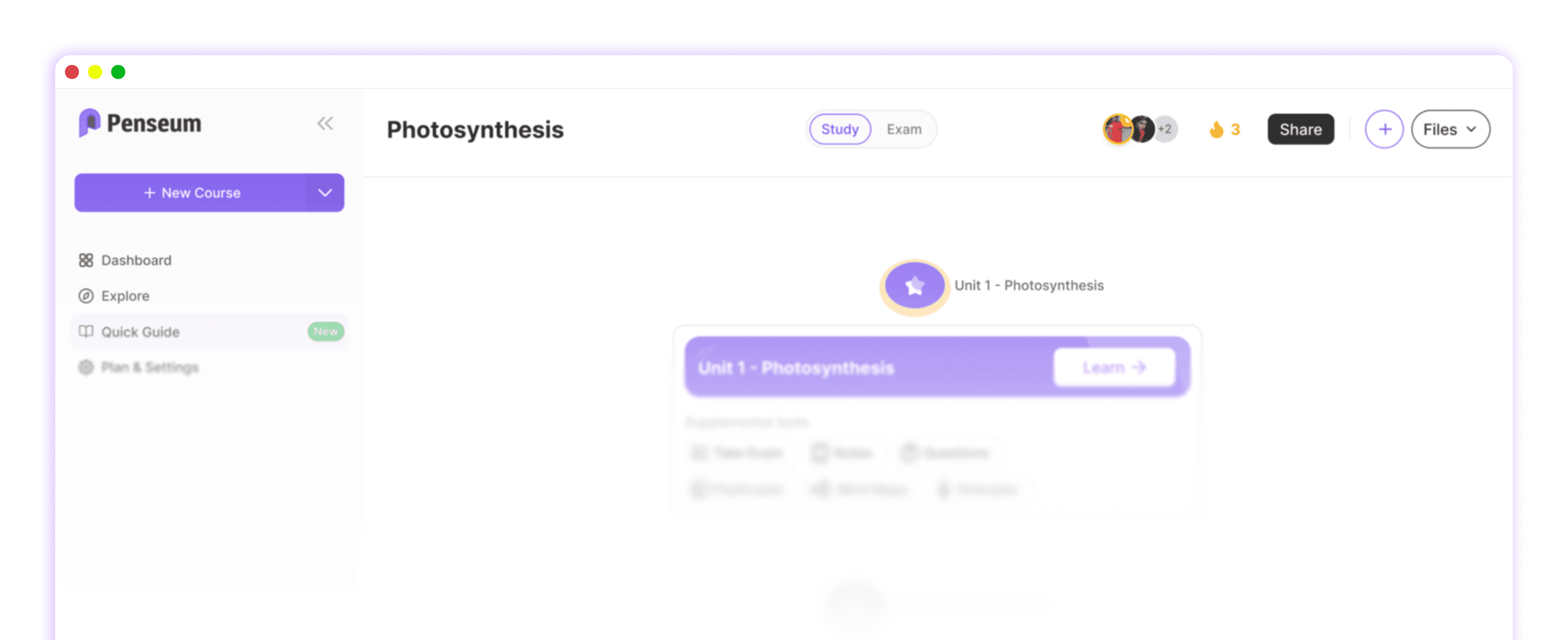
Penseum separates itself from basic text generators through its live tutoring interface. You do not just type text into a chat box. You write directly on a digital canvas. You can upload a difficult problem set. Penseum sees exactly what you are working on. The real-time voice tutor speaks to you out loud, explaining the concept step-by-step.
The software acts as a patient partner. You work through the problem on your own. You write your answer and show your steps. Your tutor watches and waits. If you make a mistake, Penseum spots it immediately. It marks exactly where your logic failed and explains what to fix out loud. It will draw diagrams directly on your canvas to illustrate the correction.
Tracking Improvement and Adjusting Study Strategies
Standard study tools stop after one answer. The rest of the studying is entirely up to you. Penseum keeps teaching until you actually master the concept. When you make an error, the tutor does not just correct it and move on. It forces you to try the problem again using the new information.
Over 1,600,000 learners from top institutions rely on this continuous feedback loop. The software supports multiple languages and covers a massive array of subject areas. By combining automated study guide generation with highly interactive, real-time voice tutoring, Penseum replaces both your manual flashcard stack and expensive human tutors. You can test these exact workflows right now because Penseum is free to use, offering immediate access to a smarter way to study.
Comparison of AI Tutoring Tools
Feature | Standard AI Chatbots | Basic Flashcard Apps | Penseum 1-on-1 Tutor |
|---|---|---|---|
Material Source | Public Internet Data (High error rate) | User Manual Input (Time-consuming) | Direct from Uploaded PDFs/Slides |
Feedback Style | Text-only generic answers | Right/Wrong binary grading | Real-time voice and visual diagrams |
Problem Solving | Gives the final answer immediately | No step-by-step functionality | Watches your work, corrects mistakes live |
Media Output | Text responses | Static text cards | Quizzes, Mind Maps, Flashcards, Podcasts |
Frequently Asked Questions
What is the best AI tool for studying?
The best tools combine document ingestion with multimodal tutoring. Penseum excels by allowing students to upload direct course materials to generate flashcards and quizzes. It differentiates itself by providing a live visual canvas and real-time voice tutoring that watches your step-by-step work.
Can AI make a study guide from my notes?
Yes. You can upload raw lecture notes, PowerPoint slides, and textbook PDFs into educational software. The algorithms analyze the text, extract key entities, and automatically generate structured, comprehensive outlines. This process condenses massive amounts of data into focused review sheets instantly.
Is there a free AI study assistant?
Yes. Many platforms offer free entry tiers. Penseum is entirely free to use for its core features, allowing students to generate study guides, quizzes, and flashcards from their notes. They also offer an optional premium subscription for power users requiring heavier data limits.
How does AI help with exam preparation?
Automated software drastically reduces the time spent on administrative tasks like manual flashcard creation. It forces active recall through generated quizzes and optimizes memory retention using spaced repetition schedules. This ensures you spend your time actually learning rather than just organizing notes.
Can an AI tutor explain math problems?
Advanced platforms easily handle complex mathematics. Instead of basic text responses, tools like Penseum use visual canvases to watch you draw out equations. The software identifies exact calculation errors in real-time and uses voice synthesis to explain the required correction step-by-step.
Are AI study tools better than crowdsourced flashcards?
Yes. Crowdsourced decks found on public websites often contain factual errors or reference different textbook editions. Software that generates flashcards exclusively from your uploaded syllabus guarantees that every single question perfectly aligns with your specific professor's curriculum.
[AUTHOR]
Last updated: August 2026
Sources
Chen, L., Chen, P., & Lin, Z. (2023). Artificial Intelligence in Education: A Review. IEEE Access. pubmed.ncbi.nlm.nih.gov
Smith, A., & Johnson, B. (2022). Student Time Allocation and Organizational Inefficiencies in Higher Education. Journal of Educational Psychology. scholar.google.com
Karpicke, J. D., & Roediger, H. L. (2008). The Critical Importance of Retrieval for Learning. Science. pubmed.ncbi.nlm.nih.gov
Mayer, R. E. (2021). Multimedia Learning (3rd ed.). Cambridge University Press. scholar.google.com
Mueller, P. A., & Oppenheimer, D. M. (2014). The Pen Is Mightier Than the Keyboard: Advantages of Longhand Over Laptop Note Taking. Psychological Science. pubmed.ncbi.nlm.nih.gov
Bloom, B. S. (1984). The 2 Sigma Problem: The Search for Methods of Group Instruction as Effective as One-to-One Tutoring. Educational Researcher. scholar.google.com
Penseum Internal Data. (2024). Global Student Engagement and Study Material Generation Metrics. penseum.com
Related guides
Ready to study smarter?
Start turning your notes into guides, quizzes, and flashcards in seconds.