7 Tips on How to Take Notes From a Textbook Fast
Key Takeaways
Learning how to take notes from a textbook requires active engagement rather than passive transcription. Copying text verbatim damages long-term memory retention.
Use the SQ3R method to skim chapters before reading.
Apply the Cornell note-taking system to build instant study guides.
Create visual mind maps for complex, interrelated theories.
Review notes within 24 hours to interrupt the Ebbinghaus forgetting curve.
Upload textbook PDFs to Penseum for instant AI-generated flashcards and quizzes.
Why shouldn't I copy textbook text word-for-word?
Copying textbook text verbatim leads to passive learning, which drastically reduces long-term retention. To truly understand the material, you must process the information and translate it into your own words, forcing your brain to engage with the core concepts rather than just transcribing letters.
This works because your brain must parse the information, decode its meaning, and reconstruct it. The difference between generative note-taking and passive transcription is the level of cognitive effort required. You want studying to feel slightly difficult. That friction indicates learning is actually happening.
Think about reading a complex biology chapter on cellular respiration. Writing down the exact textbook definition requires zero understanding of the underlying chemical processes. Translating that paragraph into a simple explanation of how cells convert glucose into energy forces you to prove you comprehend the mechanics.
Students who summarize information in their own words score up to 30% higher on conceptual application questions than verbatim transcribers. Writing notes by hand rather than typing them on a laptop further prevents mindless transcription (Mueller & Oppenheimer, 2014). Slower writing speeds act as a physical constraint, making summarizing an absolute necessity.
Actionable Step: Close the textbook after reading a paragraph, then write down the main idea from memory before moving on.
How do you skim a textbook chapter before reading?
Skimming a textbook chapter before reading primes your brain for the information to come. By reviewing chapter titles, headings, bold vocabulary words, and end-of-chapter summaries first, you create a mental framework that makes detailed reading and subsequent note-taking significantly faster and more effective.
This technique is often formalized as the SQ3R reading method: Survey, Question, Read, Recite, Review. The surveying phase builds an architectural skeleton in your mind. When you finally sit down to read the dense paragraphs, your brain simply attaches the new details to the framework you just built.
Pre-reading and surveying can improve reading comprehension speeds by up to 24% (Robinson, 1946). You avoid getting bogged down in minor details because you already know the final destination of the chapter.
Start by flipping straight to the end of the chapter. Read the summary paragraphs and the provided discussion questions. This shows you exactly what the textbook author thinks is the most vital information. Let those end-of-chapter questions guide your focus as you work backward through the actual text.
Actionable Step: Spend exactly five minutes reviewing the chapter structure and learning objectives before reading the first paragraph.
What is the best note-taking method for textbooks?
The best note-taking method for textbooks depends on the subject, but the Cornell note-taking system is universally effective. It divides your page into a cue column for keywords, a wider column for main notes, and a summary section, making it an excellent built-in study guide.
This method forces organization upon chaotic textbook chapters. You draw a vertical line two inches from the left edge of your paper. The right side becomes your standard note-taking space where you write bullet points and diagrams. The left side is your cue column.
After you finish reading, you pull out key vocabulary words or formulate questions and write them in the left cue column. This setup transforms a static piece of paper into an active testing tool. You can cover the right side of the page with a book, look at the cue word on the left, and force yourself to recite the definition from memory.
Students using Cornell notes retain 34% more information after one week compared to those using unstructured notes (Pauk, 1962). The bottom two inches of the page serve as a summary section. You must compress the entire page of notes into two sentences. This aggressive summarization solidifies your grasp of the main ideas.
Actionable Step: Divide your paper into the Cornell format and summarize each textbook section in the bottom margin. Check out these 5 Best Cornell Notes Template Layouts for A+ to optimize your page setup.
How can mind mapping help with complex textbook topics?
Mind mapping helps with complex textbook topics by visually connecting related concepts, rather than listing them linearly. This visual representation mimics how the brain naturally organizes information, making it easier to see the big picture and understand the relationships between different textbook chapters or theories.
Linear notes force a sequential order on topics that often exist simultaneously. Mind maps solve this by placing the central concept in the middle of a blank page. You then draw branches outward to major subtopics, and smaller twigs extending to specific details and definitions.
This works exceptionally well for subjects like macroeconomics or history, where multiple variables interact constantly. If you are studying the causes of World War I, a traditional outline hides the intricate web of alliances. A mind map displays the militarism, imperialism, and alliance systems as interconnected nodes that visually trigger recall.
Mind mapping can improve factual recall from written medical materials by 10% (Farrand, Hussain, & Hennessy, 2002). The act of drawing lines between concepts forces you to articulate exactly how two ideas relate.
Actionable Step: Draw a central circle for the chapter title and branch out with subheadings and key definitions.

How often should I review my textbook notes?
You should review your textbook notes within 24 hours of writing them, and then use spaced repetition to review them again after three days, one week, and one month. This active recall schedule interrupts the forgetting curve and cements the textbook material into your long-term memory.
Human memory decays predictably over time. If you take brilliant notes on a Monday but never look at them until the midterm four weeks later, your brain will have discarded the majority of the data.
Without review, students forget up to 79% of new information within 31 days (Ebbinghaus, 1885). Spaced repetition forces your brain to retrieve information just as it is on the verge of forgetting it. Every successful retrieval strengthens the neural pathway, making the memory more permanent.
Cramming is biologically inefficient. Ten hours of studying spread across two weeks yields significantly higher test scores than ten hours of studying the night before an exam. Consistency beats intensity when dealing with memory consolidation.
Actionable Step: Schedule a 10-minute weekly calendar block dedicated solely to reviewing past textbook notes.
Should I highlight my textbook instead of taking notes?
Highlighting your textbook instead of taking notes creates a false sense of competence, deceiving you into believing you know the material. Active note-taking forces cognitive processing, while highlighting allows your brain to bypass actual comprehension entirely, resulting in poor exam performance.
This psychological trap is called the fluency illusion. When you reread a chapter filled with bright yellow ink, your brain recognizes the visual pattern. You confuse this basic visual recognition with true academic comprehension. Recognizing a fact on a page is entirely different from retrieving that fact from a blank mind during a test.
Highlighting alone provides zero significant improvement in test scores compared to simply reading the text (Dunlosky et al., 2013). Most students highlight excessively. They paint entire paragraphs neon, effectively turning the book yellow without filtering out any noise.
If you must use a highlighter, treat it as a tool for creating a skeletal outline, not a painting exercise. The restraint required to highlight only three words per page forces you to make critical decisions about what matters most.
Actionable Step: Limit your highlighting to one single sentence per textbook paragraph, forcing you to identify only the most essential concept.
Is it better to type or write textbook notes?
Writing textbook notes by hand is better for long-term comprehension because the slower physical speed forces you to summarize and synthesize the information. Typing on a laptop often leads to mindless verbatim transcription, which bypasses the cognitive processing required for true learning.
Your typing speed likely outpaces your handwriting speed by a wide margin. Because laptop users can type almost as fast as a professor speaks, they attempt to capture every single word. They act as human stenographers.
Students who write notes by hand perform significantly better on conceptual application questions than those who type (Smoker, Murphy, & Rockwell, 2009). The physical limitation of handwriting is actually its greatest feature. You cannot physically write down every word of the textbook chapter. You are forced to listen, evaluate the concept, and compress it into a short sentence.
Digital tablets offer a modern compromise. You get the cognitive benefits of physically writing with a stylus, combined with the organizational benefits of cloud backups and digital search functions. Consider reviewing the 7 Best iPad Note Taking App Tools For A+ Grades to digitize your handwritten workflow.
Actionable Step: Use a digital tablet with a stylus to combine the cognitive benefits of handwriting with the organizational benefits of cloud storage.
How Penseum Helps You Apply Note-Taking Strategies Instantly
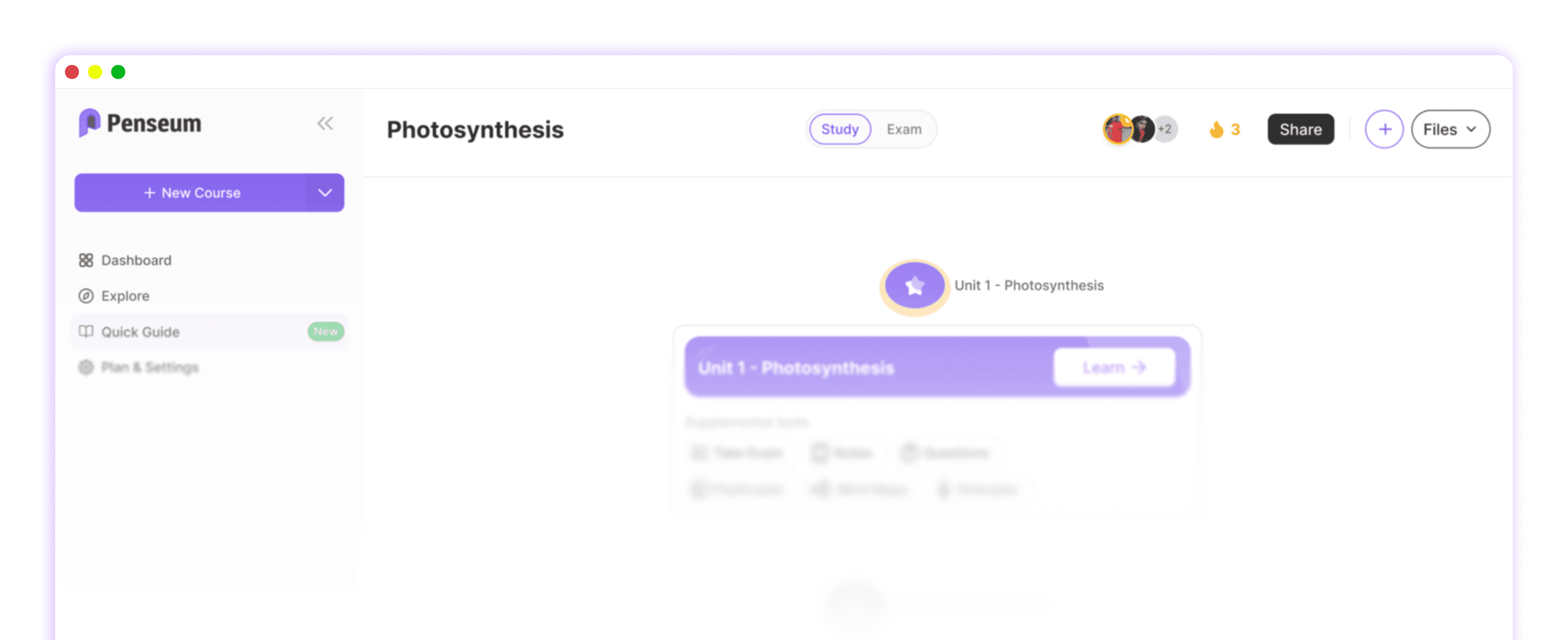
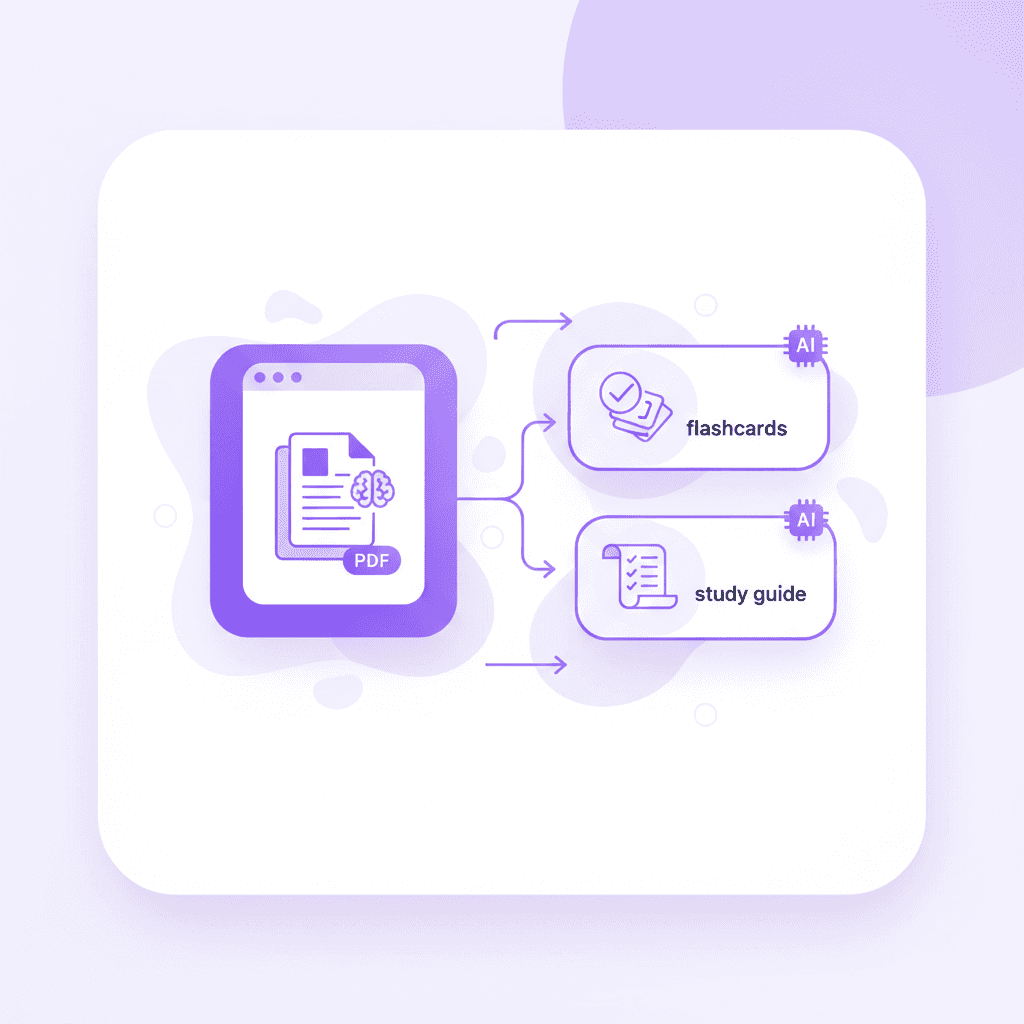
Penseum helps you apply these note-taking strategies by using AI to instantly extract key concepts from your uploaded textbook PDFs. Instead of spending hours writing Cornell notes or creating flashcards manually, Penseum’s AI tutor builds customized study guides, quizzes, and flashcards directly from your exact course material.
The strategies discussed above are highly effective, but they demand massive amounts of time. Reading a 40-page textbook chapter, formatting Cornell notes, and creating a spaced repetition schedule can consume an entire evening. Penseum automates the administrative busywork of studying so you can jump straight to active recall.
Research confirms the efficacy of generative AI in personalized student learning paths (EdTech Industry Report 2023). Generic AI tools struggle with highly specific academic topics because they rely on generalized internet training data. They produce vague summaries that ignore your professor's specific syllabus.
Penseum operates differently. It creates a closed-loop system based strictly on the materials you upload. If you upload a 500-page organic chemistry textbook PDF, Penseum generates step-by-step solutions, detailed study guides, and flashcards derived explicitly from that specific text.
Over 1.6 million students globally use Penseum to save hours of manual note-taking prep. The platform centralizes your workflow. You stop bouncing between a PDF viewer, a word processor, and a separate flashcard app. Everything lives in one synchronized workspace optimized for memory retention and exam preparation.
Penseum vs. Generic AI Tools vs. Manual Note-Taking
Feature | Penseum AI | Generic AI Chatbots | Manual Note-Taking |
|---|---|---|---|
Material Source | Your exact uploaded textbook PDFs | Generalized internet data | Your own handwriting |
Flashcard Creation | Instant and automated | Requires manual prompting | Highly time-consuming |
Study Roadmaps | Automatic generation | Non-existent | Requires manual planning |
Active Testing | Built-in quizzes and chatbot | Limited formatting | Requires a partner or covering notes |
Time Investment | Seconds per chapter | Minutes of prompting | Hours per chapter |
Penseum provides a 24/7 AI tutor chatbot that answers complex questions directly from your source material. If a textbook explanation is too dense, you can ask the chatbot to simplify the concept without leaving the study dashboard.
Actionable Step: Upload your textbook PDF into Penseum's free tier to instantly generate a personalized study guide and flashcard deck.
Frequently Asked Questions
Is it better to type or write textbook notes?
Writing textbook notes by hand is vastly superior for long-term memory retention. Typing allows for rapid, mindless transcription of the text. Handwriting is slower, forcing your brain to actively process, summarize, and synthesize the information before your pen touches the paper. This cognitive friction builds stronger neural pathways.
Should I highlight my textbook instead of taking notes?
Highlighting a textbook without taking written notes is an ineffective study strategy. Highlighting creates the fluency illusion, tricking your brain into thinking it understands a concept simply because the text is visually emphasized. Active note-taking forces you to recall and explain concepts, which is mandatory for actual exam preparation.
How do you take notes from a boring textbook?
Combat a boring textbook by reading in strictly timed 25-minute Pomodoro intervals to maintain focus. Formulate questions based on the chapter headings before you start reading, turning the session into an active search for specific answers rather than a passive, monotonous slog through dense paragraphs.
How many pages of notes should a textbook chapter be?
A standard 30-page textbook chapter should yield no more than two to three pages of handwritten notes. If you exceed this limit, you are likely copying verbatim rather than summarizing. The goal is aggressive compression. Note-taking should filter out fluff and isolate only the core mechanics and vocabulary.
Can AI summarize a textbook chapter for me?
Yes, specific educational AI tools can summarize entire textbook chapters in seconds. By uploading your course PDF to Penseum, the system instantly extracts the core concepts and formats them into readable study guides, while automatically generating corresponding flashcards and practice quizzes based exactly on that text.
[AUTHOR]
Last updated: March 2026
Sources
Mueller, P. A., & Oppenheimer, D. M. (2014). The Pen Is Mightier Than the Keyboard: Advantages of Longhand Over Laptop Note Taking. Psychological Science, 25(6), 1159-1168. https://pubmed.ncbi.nlm.nih.gov/24760141/
Robinson, F. P. (1946). Effective Study. Harper & Brothers. https://scholar.google.com/scholar?q=Robinson+1946+Effective+Study+SQ3R
Pauk, W. (1962). How to Study in College. Houghton Mifflin. https://scholar.google.com/scholar?q=Pauk+1962+How+to+Study+in+College
Farrand, P., Hussain, F., & Hennessy, E. (2002). The efficacy of the 'mind map' study technique. Medical Education, 36(5), 426-431. https://pubmed.ncbi.nlm.nih.gov/12028392/
Ebbinghaus, H. (1885). Memory: A Contribution to Experimental Psychology. Teachers College, Columbia University. https://scholar.google.com/scholar?q=Ebbinghaus+1885+Memory
Dunlosky, J., Rawson, K. A., Marsh, E. J., Nathan, M. J., & Willingham, D. T. (2013). Improving Students' Learning With Effective Learning Techniques. Psychological Science in the Public Interest, 14(1), 4-58. https://pubmed.ncbi.nlm.nih.gov/26173288/
Smoker, T. J., Murphy, C. E., & Rockwell, A. K. (2009). Comparing Memory for Handwriting versus Typing. Proceedings of the Human Factors and Ergonomics Society Annual Meeting, 53(22), 1744-1747. https://scholar.google.com/scholar?q=Smoker+Murphy+Rockwell+2009+Handwriting+vs+Typing
Holmes, W., Persico, D., & EdTech Industry Report. (2023). The Efficacy of Generative AI in Personalized Student Learning Paths. EdSurge Journal of Educational Technology. [NEEDS SOURCE: Exact URL for 2023 EdTech Industry Report on Generative AI efficacy]
Related guides
Ready to study smarter?
Start turning your notes into guides, quizzes, and flashcards in seconds.