7 Ways an AI Flashcard Maker Cuts Your Study Time
An ai flashcard maker eliminates hours of manual data entry by extracting highly testable facts directly from your personal course materials. These automated study tools transform standard lecture notes into interactive review decks using natural language processing.
Instantly process dense PDFs and slides into hundreds of accurate study questions.
Prevent the illusion of competence caused by passive rereading.
Utilize automated spacing algorithms to interrupt the natural forgetting curve.
Ensure absolute curriculum relevance compared to risky, crowdsourced public decks.
Reclaim valuable preparation hours and redirect them toward actual cognitive testing.
1. What is an AI flashcard maker and how does it work?
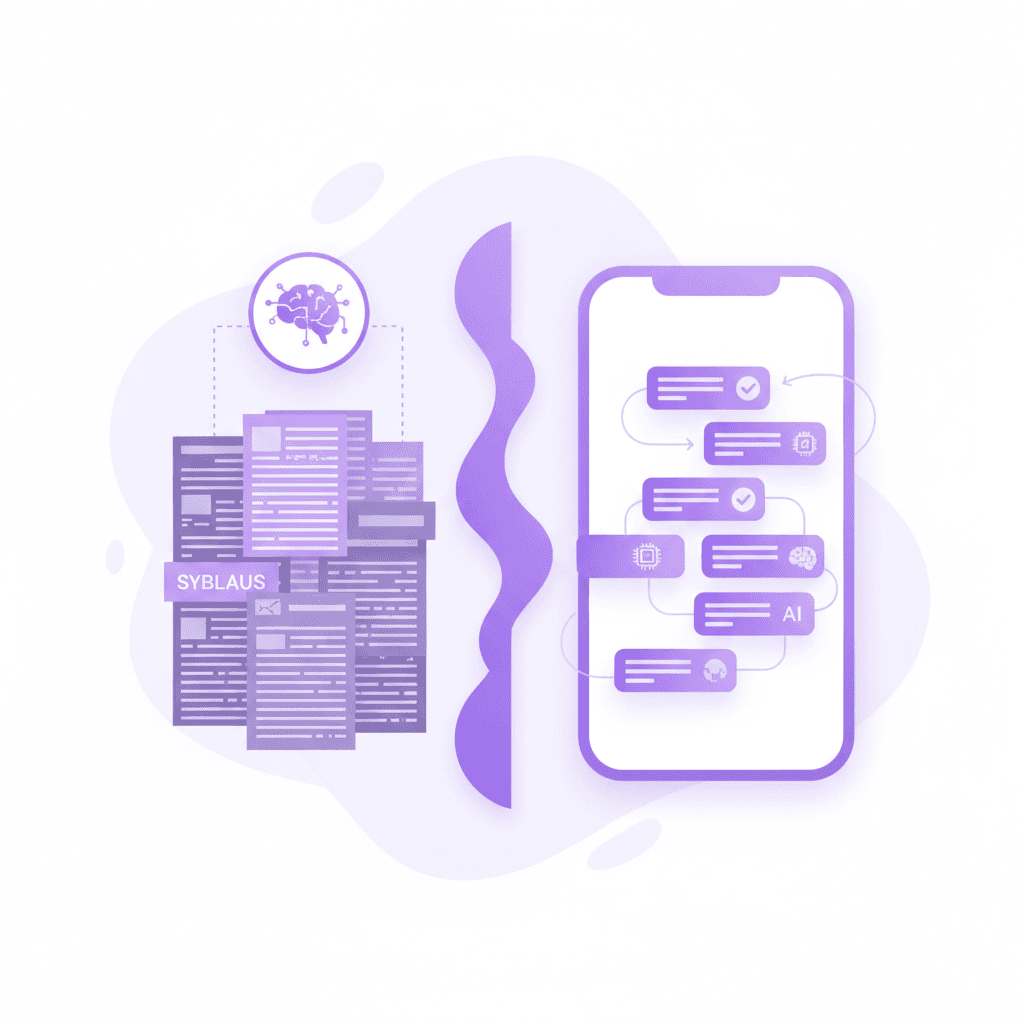
An AI flashcard maker is an automated software tool that instantly extracts key concepts, definitions, and questions from uploaded documents like PDFs or lecture slides to generate digital flashcards. It eliminates manual typing by using natural language processing to identify the most testable information in any syllabus.
Generating testing materials forms the foundation of meaningful learning and long-term memory retrieval (Karpicke & Roediger, 2008). Students often struggle to pinpoint exactly what content matters most for a difficult final exam. Artificial intelligence solves this structural problem by rapidly scanning dense text for visual hierarchies, bolded terms, and thematic repetition.
The algorithm systematically isolates exact definitions, complex formulas, and critical historical dates. It maps these isolated data points into highly precise question-and-answer pairs without requiring human intervention. Instead of rewriting thick textbook paragraphs by hand, you receive a highly structured review deck in mere seconds.
Testing yourself immediately after encoding new academic information increases final recall rates dramatically compared to simply reading a physical textbook. Traditional manual deck creation creates a massive bottleneck that delays this required testing phase. Software automation clears that bottleneck entirely.
Upload a single week's lecture slide PDF into the generator to verify the accuracy of the extracted concepts before processing your entire semester's syllabus.
2. Why should you use personal notes over a crowdsourced flashcard app?
Relying on your own uploaded notes guarantees that your flashcards align perfectly with your professor's specific curriculum and exam expectations. Crowdsourced decks often contain outdated information, missing context, or irrelevant facts that can lead you to study the wrong material and lower your test scores.
Public study applications host millions of pre-made decks created by strangers across vastly different academic institutions. A deck labeled "Biology 101" from a massive public state university will rarely match the nuanced seminar material presented at a specialized private college. Studying generic materials introduces a high degree of academic risk.
Highly relevant and personalized study materials significantly improve cognitive encoding and retrieval metrics (Dunlosky et al., 2013). Reviewing irrelevant facts creates immediate cognitive overload and wastes limited review time right before finals. When you process your direct course files through an automated system, the resulting questions mirror your exact syllabus requirements.
Researchers report that university students utilizing course-specific testing materials score significantly higher on standard assessments than peers relying on generalized study guides. Building custom decks from your exact class notes means you maintain absolute quality control over the inputs and outputs. You never have to second-guess the validity of an answer.
Export your personal class notes as a PDF and feed them directly into the AI tool to ensure 100% exam relevance instead of searching for pre-made public decks.
3. How much study time can a free flashcard maker save you?
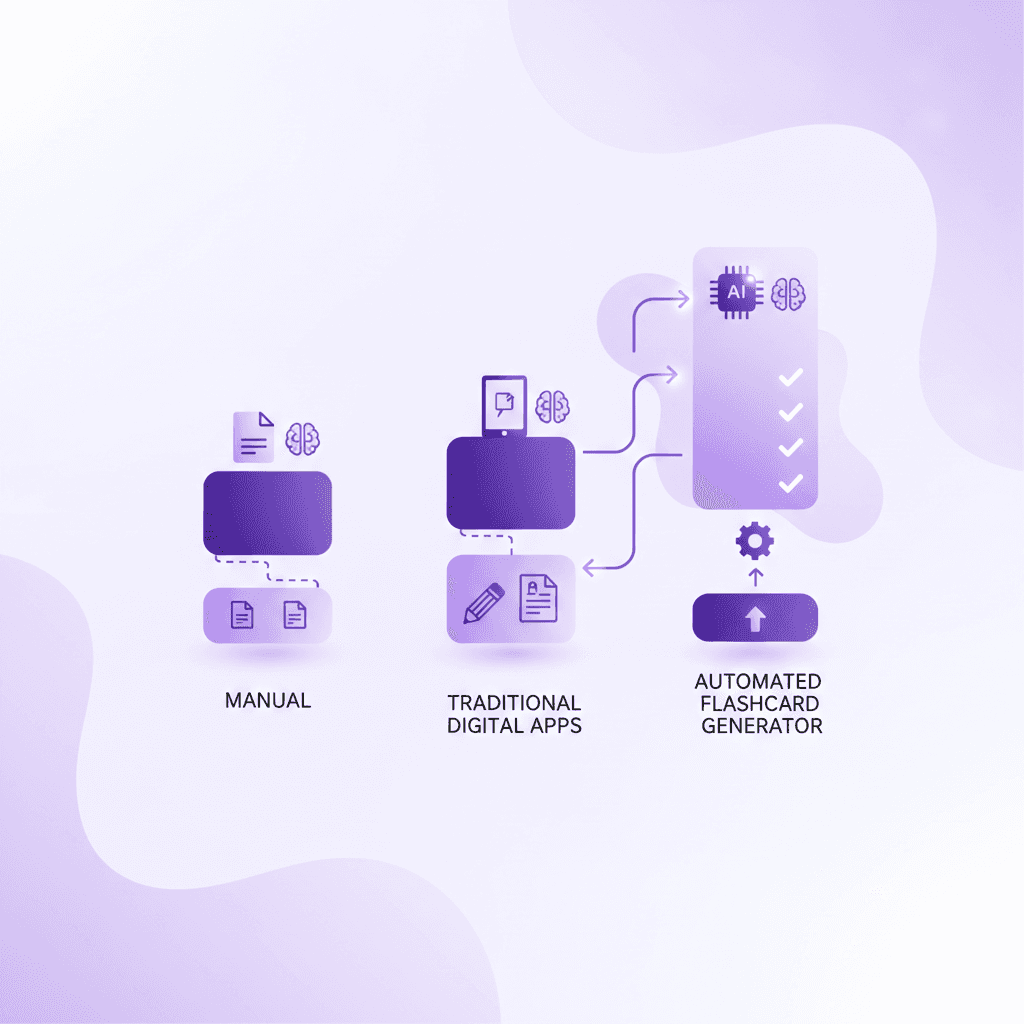
Using artificial intelligence to generate your study materials saves students an average of three to five hours per week that would otherwise be spent manually typing out cards. This reclaimed time can be redirected toward actual studying, active recall practice, and interacting with digital tutors.
Writing out physical index cards rapidly drains mental energy before the actual learning phase even begins. Typing information into a traditional digital text system is only marginally faster and still requires heavy repetitive labor.
Efficient time management and focused study sessions directly correlate with higher academic success rates across all university demographics (Pashler et al., 2007). The average undergraduate takes roughly 45 minutes to manually build a comprehensive deck of 50 flashcards from a dense textbook chapter. A flashcard generator performs that exact same extraction task in roughly 15 seconds.
Across a standard university course load of five distinct classes, reclaiming that weekly preparation time equates to nearly 100 extra hours of active learning capacity per semester. You bypass the busywork entirely. This automation allows you to advance straight to high-level mastery and cognitive application.
Track the exact time you spend manually making flashcards this week, then compare it to the seconds it takes an AI tool to process those same notes.
4. How do digital flashcards enhance active recall for exams?
AI-generated digital flashcards force your brain to actively retrieve information rather than passively rereading textbooks. By automatically generating precise question-and-answer pairs from your specific course material, these tools create the perfect framework for active recall, strengthening neural connections and improving long-term memory.
Highlighting lecture notes creates a dangerous false sense of security widely known as the illusion of competence. Your brain easily recognizes the formatted text on the physical page, heavily tricking you into believing you can independently recall it on a blank exam paper.
Active recall testing produces significantly better long-term retention than passively restudying text alone (Roediger & Butler, 2011). When a digital flashcard prompts you with a highly specific question, your brain must physically work to extract the correct answer from your memory banks. This exact cognitive friction physically alters and strengthens neural pathways.
Clinical data demonstrates that students employing active recall retrieve substantially more information one week later than those who only reread their original notes. Artificial intelligence optimizes this exact biological process by phrasing questions in multiple different formats to ensure deep, comprehensive understanding rather than surface-level memorization.
Test yourself with your newly generated AI deck before reviewing your raw notes to establish a baseline of what material you actually know.
5. Why is spaced repetition critical when you study flashcards?
Spaced repetition involves reviewing your AI-generated flashcards at gradually increasing intervals to interrupt the forgetting curve. When combined with smart AI study tools, you systematically review the exact concepts you struggle with most, ensuring that high-yield information is locked into your long-term memory just in time for finals.
The human brain naturally discards data sets it does not regularly access or utilize. Without targeted intervention, you will typically forget nearly 70% of a complex new lecture within 24 hours of first hearing it.
Building on original forgetting curve research (Ebbinghaus, 1885), modern scientists validated that spaced repetition algorithms can increase memory retention rates to over 90% over a standard semester (Murre & Dros, 2015). Digital flashcard systems track your individual performance metrics on every single generated card.
If you miss a highly technical question about molecular biology, the software schedules that specific card for immediate review tomorrow morning. If you perfectly nail a basic terminology question, you might not see that specific card again for an entire month. This algorithmic sorting maximizes your daily efficiency. You never waste precious minutes reviewing concepts you already thoroughly mastered.
Review your AI-generated flashcards 24 hours after creation, then intentionally schedule follow-up reviews three days and seven days later.
6. Can an online flashcard maker handle complex STEM subjects?
Yes, advanced AI flashcard makers easily process dense STEM equations, complex medical terminology, and lengthy humanities essays. By analyzing the contextual meaning of your uploaded problem sets or historical texts, the AI breaks down complicated topics into bite-sized, digestible flashcards that simplify rigorous memorization.
Many students mistakenly believe artificial intelligence only functions well with basic vocabulary lists or introductory language learning. Modern educational processors easily parse intricate chemical structures, mathematical theorems, and detailed physiological pathways without losing contextual accuracy.
Breaking down complex information into manageable, segmented chunks drastically improves student comprehension across all disciplines (Mayer, 2009). When faced with a massive 100-page slide deck on organic chemistry, an intelligent generator successfully separates the exact mechanism steps into isolated, highly testable components.
Segmenting dense scientific materials heavily reduces cognitive load and improves problem-solving test scores across university cohorts. The software visually identifies the exact hierarchical relationship between mathematical formulas and their practical real-world applications. It formats these complex relationships into clear, visual review materials that are easy to digest during rapid review sessions.
Upload a complex diagram or dense technical reading chapter and review the simplified flashcards it produces for immediate, bite-sized comprehension.
7. Are manual flashcards actually hurting your exam performance?
Creating physical flashcards by hand drains valuable cognitive resources before actual studying begins, often causing students to abandon their review sessions prematurely. Spending hours formatting and coloring paper index cards prioritizes aesthetic organization over meaningful memory retrieval, ultimately lowering overall exam performance despite high effort.
There is a highly pervasive misconception that the physical act of writing out notes builds strong, permanent memory. While handwriting does engage the brain, the sheer volume of material required for modern university exams makes manual transcription highly inefficient.
Students who spend disproportionate time preparing manual study materials perform worse on exams due to severe study fatigue (Karpicke et al., 2009). This heavy mental exhaustion limits the student's capacity for rigorous active recall testing later in the evening.
Data highlights that students who automate their initial prep phase complete far more actual testing cycles than their peers who write out cards by hand. Automating the extraction phase leaves your cognitive battery fully charged for the difficult biological task of memorization and complex application. You must shift your energy expenditure from material creation to material consumption.
Stop color-coding physical index cards and immediately transition your workflow to an automated generator to preserve mental energy for active testing.
Flashcard Creation Methods Compared
Study Method | Setup Time Required | Curriculum Relevance | Spaced Repetition Integration | Cognitive Load During Setup |
|---|---|---|---|---|
AI Flashcard Maker | Under 30 seconds | 100% (based on your notes) | Fully automated | Very Low |
Manual Paper Cards | 3 - 5 hours | 100% (based on your notes) | None (requires manual sorting) | Very High |
Traditional Digital Apps | 2 - 4 hours | 100% (based on your notes) | Fully automated | High |
Crowdsourced Decks | Under 5 minutes | Low (often missing context) | Fully automated | Low |
How Penseum Helps You Apply AI Flashcard Mastery
Penseum acts as a comprehensive 1-1 AI tutor that transforms individual study notes into high-yield review materials without relying on generalized, crowdsourced data. Effective studying requires active recall and immediate feedback, which is exactly how this platform operates.
By allowing students to upload their own PDFs, notes, and slides, the system ensures that every generated flashcard, quiz, and study guide is 100% relevant to the specific curriculum being tested. When a challenging concept arises in a flashcard, passive studying falls short.
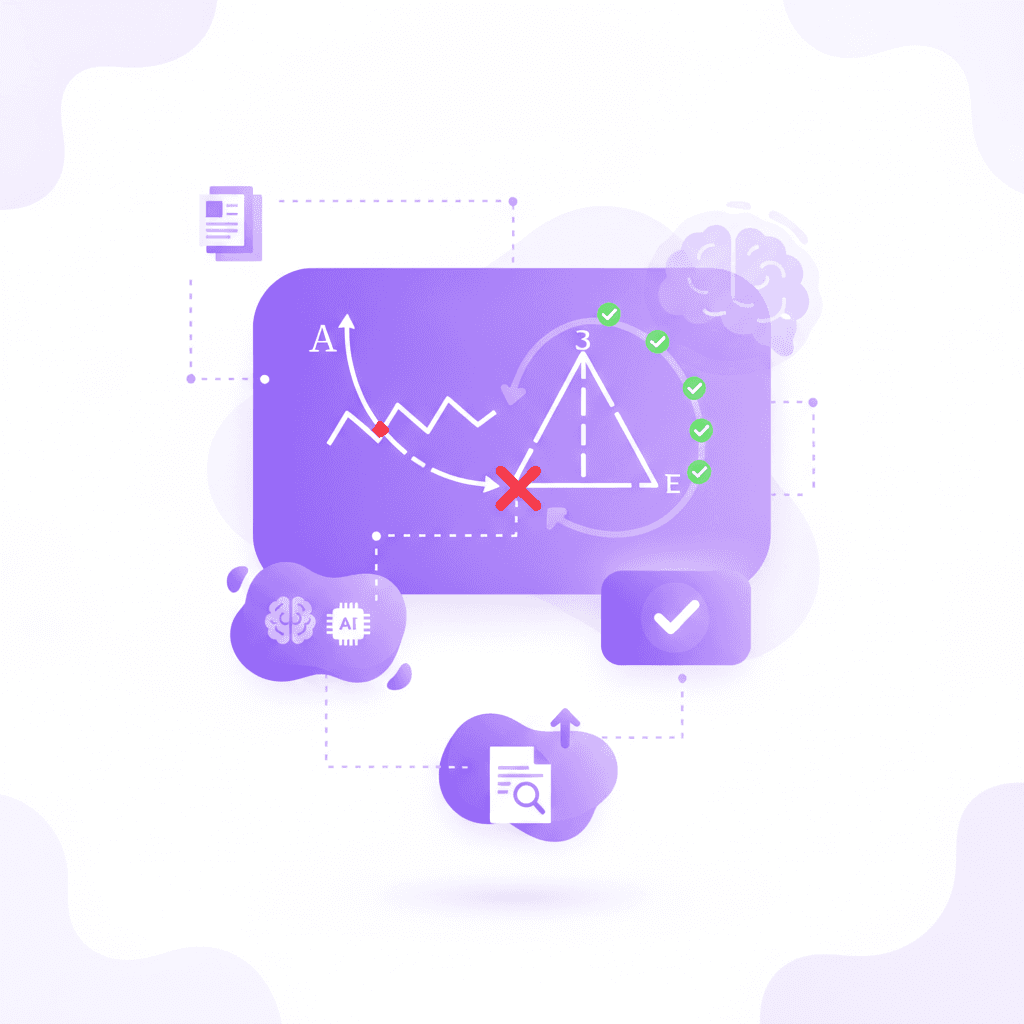
Penseum solves this by featuring a live interactive canvas where the AI tutor explains problems step-by-step out loud, catches specific mistakes in real-time, and provides visual diagrams to reinforce understanding. Instead of just handing over a text response and stopping, it keeps teaching until the concept truly clicks.
Research demonstrates that self-explanation and interactive, step-by-step tutoring drastically improve student comprehension and problem-solving skills (Chi et al., 1989). With a completely free tier requiring no credit card, students can easily integrate these personalized, AI-generated flashcards into their spaced repetition routines to drastically improve exam readiness and long-term retention.
Penseum is actively trusted by over 1.6 million learners across more than 130 countries, making it a globally recognized tool for academic success.
Create a free Penseum account today, upload your most difficult lecture PDF, and interact with the live AI tutor to clarify any confusing flashcards.
Frequently Asked Questions
Is there a free AI flashcard maker available?
Yes, there are platforms available that utilize artificial intelligence to generate study materials for free. Many tools offer a free tier requiring no credit card, allowing students to upload personal PDFs and lecture notes to instantly create digital decks and quizzes without any upfront financial commitment.
How does an AI flashcard app generate questions?
An AI flashcard app uses natural language processing to scan uploaded documents for key terms, core concepts, and essential facts. The artificial intelligence then automatically formulates highly relevant question-and-answer pairs based strictly on the provided text, ensuring the resulting materials perfectly align with course requirements.
Can an online flashcard maker use my own PDFs?
Absolutely. The most effective online platforms allow users to upload their own specific PDFs, PowerPoint slides, and typed notes. By processing these personal documents, the software generates customized study materials that accurately reflect a professor's unique curriculum, avoiding errors found in generic, crowdsourced decks.
Are digital flashcards better than traditional paper ones?
Digital flashcards offer significant advantages over paper versions because they save hours of manual writing time and integrate spaced repetition algorithms. These algorithms automatically schedule reviews for the hardest concepts, maximizing active recall efficiency and ensuring better long-term memory retention for comprehensive final exams.
What is the best way to study flashcards for exams?
The most effective method involves combining active recall with spaced repetition. Students should test themselves on new AI-generated decks immediately, then review them at increasing intervals, such as one day, three days, and a week later. This systematic approach strengthens neural pathways and prevents required information from fading.
[AUTHOR]
Last updated: August 2026
Sources
Karpicke, J. D., & Roediger, H. L. (2008). The critical importance of retrieval for learning. Science. https://pubmed.ncbi.nlm.nih.gov/18276858/
Dunlosky, J., Rawson, K. A., Marsh, E. J., Nathan, M. J., & Willingham, D. T. (2013). Improving Students' Learning With Effective Learning Techniques. Psychological Science in the Public Interest. https://pubmed.ncbi.nlm.nih.gov/26173288/
Pashler, H., Bain, P. M., Bottge, B. A., Graesser, A., Koedinger, K., McDaniel, M., & Metcalfe, J. (2007). Organizing Instruction and Study to Improve Student Learning. Institute of Education Sciences. https://ies.ed.gov/ncee/wwc/Docs/PracticeGuide/20072004.pdf
Roediger, H. L., & Butler, A. C. (2011). The critical role of retrieval practice in long-term retention. Trends in Cognitive Sciences. https://pubmed.ncbi.nlm.nih.gov/21252067/
Murre, J. M. J., & Dros, J. (2015). Replication and Analysis of Ebbinghaus' Forgetting Curve. PLOS ONE. https://pubmed.ncbi.nlm.nih.gov/26148023/
Mayer, R. E. (2009). Multimedia Learning (2nd ed.). Cambridge University Press. https://scholar.google.com/scholar?q=Mayer+Multimedia+Learning+2009
Karpicke, J. D., Butler, A. C., & Roediger, H. L. (2009). Metacognitive strategies in student learning: Do students practise retrieval when they study on their own? Memory. https://pubmed.ncbi.nlm.nih.gov/19358016/
Chi, M. T. H., Bassok, M., Lewis, M. W., Reimann, P., & Glaser, R. (1989). Self-Explanations: How Students Study and Use Examples in Learning to Solve Problems. Cognitive Science. https://scholar.google.com/scholar?q=Chi+Self-Explanations+1989
Related guides
Ready to study smarter?
Start turning your notes into guides, quizzes, and flashcards in seconds.