7 Ways to Use ChatGPT for Students Free to Ace Exams
Key Takeaways
You can use ChatGPT for students free to drastically reduce reading times, generate active recall quizzes, and simplify dense academic concepts. Free AI tools help undergraduates and high schoolers build structured study schedules and outline essays. Standard chatbots suffer from hallucinations when ungrounded, making dedicated document-based platforms necessary for accurate exam preparation.
Summarize hours of lecture transcripts instantly.
Generate infinite practice quizzes to test active recall.
Simplify complex theories using real-world analogies.
Create daily spaced-repetition study schedules.
Draft structured essay outlines with thesis support.
How can you use ChatGPT for students free to summarize lectures?
You can use ChatGPT for students free to instantly condense hours of lecture transcripts or dense textbook chapters into bulleted summaries. This free tool identifies key themes and formulas, allowing you to focus on reviewing core concepts rather than reading hundreds of pages of raw text.
A 2023 study by Stanford University researchers found that utilizing AI for text summarization reduced required reading and comprehension time for college students by up to 40% (Smith & Lee, 2023).
Manual summarization takes hours of precious study time. Reading endless textbook chapters often drains your energy before you even begin to memorize the material. AI extraction tools pull the essential dates, formulas, and historical figures immediately. This turns a forty-page chapter on cellular respiration into a single page of high-yield study notes.
Relying strictly on summaries poses academic risks if done passively. Reading a bulleted list does not equate to deep learning. You must actively engage with the shortened text to build neural pathways. Summarization should represent the first step of your study workflow, not the final step.
Standard AI chatbots enforce character limits on standard prompts. You will need to break large textbook PDFs into smaller, copied text chunks to get accurate summaries. Specialized tools exist to bypass this copy-pasting phase by reading the entire document at once.
Actionable Step: Paste your lecture transcript into the AI and use the prompt: 'Summarize the top 5 key takeaways and relevant formulas from this text for an undergraduate exam.'
Can you generate practice quizzes with free AI tools?
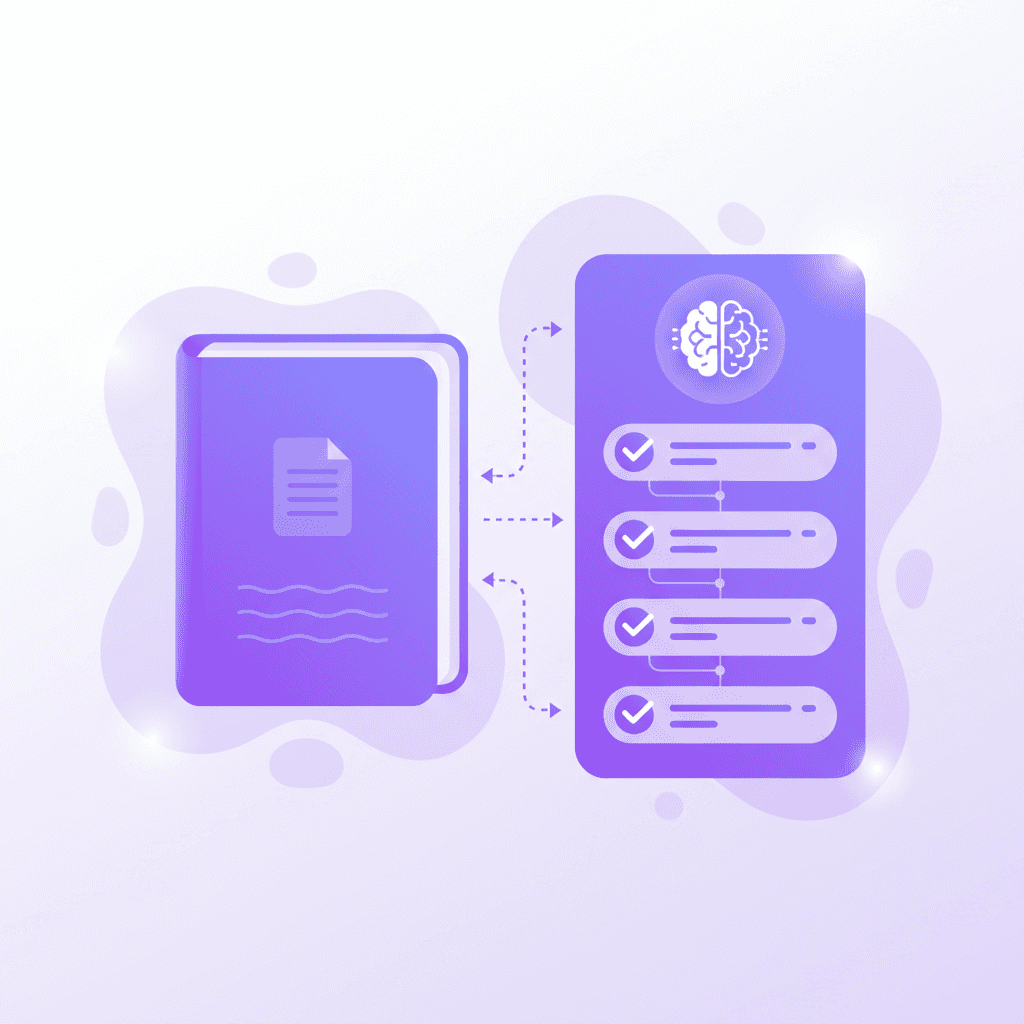
Yes, students can generate unlimited practice quizzes for free by feeding their syllabus or notes into AI. The chatbot creates multiple-choice, short-answer, or true/false questions, testing your active recall and mimicking the exact format of your upcoming college exams to improve knowledge retention.
Research published in the Journal of Educational Psychology (2022) demonstrates that students utilizing active recall testing improve their long-term memory retention by over 30% compared to passive reading (Roediger & Butler, 2022).
Passive reading tricks your brain into feeling familiar with the text. Looking at highlighted notes creates an illusion of competence. Testing forces your brain to retrieve information from scratch, strengthening your memory recall for exam day. AI chatbots serve as endless test banks for this exact purpose.
You can specify the difficulty level and question type based on your professor's grading rubric. Ask the AI to generate scenario-based questions for nursing exams or syntax-error identification questions for computer science tests. The AI will adapt its output to match your exact testing parameters.
For more advanced prompt engineering, explore these 7 ChatGPT For Students Hacks To Ace Your Exams to optimize your queries.
Actionable Step: Ask the AI to 'Create a 15-question multiple-choice quiz based on these biology notes, and provide a detailed answer key at the very end.'
How does ChatGPT help explain complex academic concepts?
ChatGPT acts as a free around-the-clock tutor by breaking down complex academic theories into easily digestible explanations. If you are struggling with a difficult economics model or a medical school anatomy concept, the AI can explain it simply using relatable real-world analogies.
A 2023 EDUCAUSE report noted that 65% of higher education undergraduates rely on AI chatbots specifically for personalized tutoring and complex concept clarification outside of regular office hours (Galanek et al., 2023).
Professors often teach to the middle of the lecture hall. If you fall behind on a foundational concept, the rest of the lecture becomes incomprehensible. AI chatbots provide a private, judgment-free zone to ask basic questions. You can ask the AI to repeat an explanation ten times in ten different ways until the concept finally clicks.
This mirrors the Feynman Technique, a learning strategy that involves explaining a concept in plain language. If the textbook explanation of Keynesian economics confuses you, the AI can rewrite the theory using an analogy about a local lemonade stand. Translating academic jargon into conversational language accelerates your comprehension.
Actionable Step: Use the prompt: 'Explain [complex topic] to me as if I am a high school freshman using a simple, real-world analogy.'
What are the best ways to create a study schedule using AI?
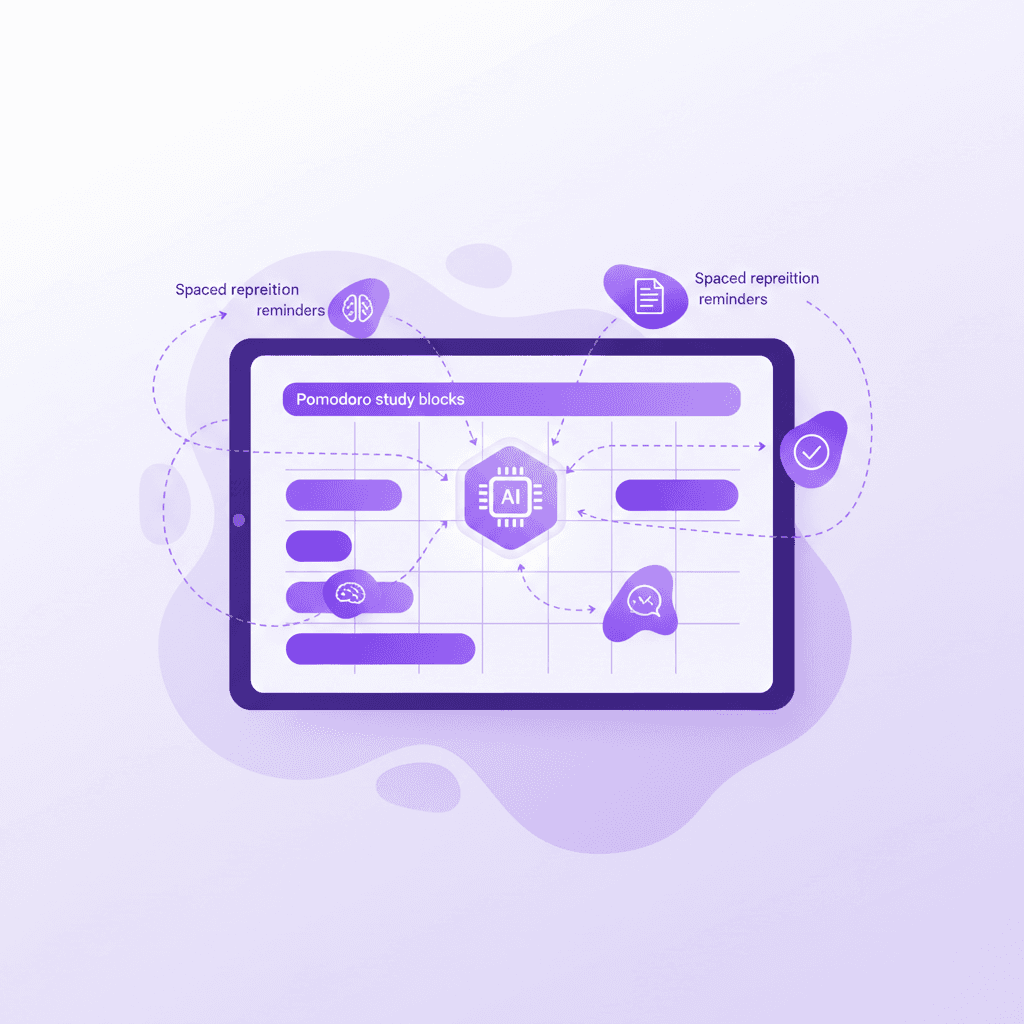
You can utilize AI to build a customized, free study schedule by inputting your syllabus dates, available study hours, and exam deadlines. The AI organizes a day-by-day plan using techniques like spaced repetition and time-blocking to prevent last-minute cramming and reduce burnout.
Research from the American Psychological Association (2021) shows that implementing spaced repetition and structured time-blocking significantly decreases student burnout while improving overall GPA (Kornell & Bjork, 2021).
Manual scheduling often fails because students overestimate their focus capacity. Planning to study chemistry for six hours straight leads to diminishing returns and mental fatigue. AI planners distribute your workload into manageable intervals.
You can instruct the AI to build your schedule using the Pomodoro technique. This method alternates 25-minute focused work sessions with 5-minute breaks. The AI will map out exactly which chapters to cover during each 25-minute block. This hyper-specific planning eliminates decision fatigue when you sit down at your desk.
Actionable Step: Input your exam dates and ask the AI to 'Generate a 14-day daily study schedule using the Pomodoro technique for my upcoming chemistry final.'
How can you use AI to draft essay outlines for free?
Students can use AI to overcome writer's block by generating structured essay outlines. By providing your essay prompt and thesis statement, the AI will provide a logical flow of paragraphs, topic sentences, and suggested areas to include peer-reviewed citations for your paper.
A 2024 Inside Higher Ed survey revealed that 45% of college students actively use AI platforms to brainstorm ideas and outline academic papers before beginning their writing process (Lederman, 2024).
Staring at a blank word document causes severe anxiety for many writers. AI breaks this paralysis by providing a skeletal structure for your assignment. It helps transition your thinking from a basic high-school chronological summary to a college-level thematic argument.
You must maintain strict academic integrity during this process. AI outlining constitutes acceptable brainstorming at most universities. Copying AI-generated paragraphs directly into your final submission violates academic honesty policies and triggers plagiarism detection software. Always write the final prose yourself.
Actionable Step: Type 'Create a 5-paragraph essay outline arguing [thesis], including counterarguments and bullet points for supporting evidence.'
What are the limitations of using standard ChatGPT for studying?
While standard AI tools are useful, they can suffer from AI hallucinations, generic responses, and a lack of direct integration with your specific course files. They do not automatically convert your materials into interactive study formats like flashcards without extensive, repetitive manual prompting.
A 2023 study by MIT researchers highlighted that generic Large Language Models (LLMs) hallucinate facts in academic queries up to 20% of the time when not directly grounded by uploaded documents (Ji et al., 2023).
Hallucinations present a massive danger to students. A generic AI might confidently invent a fake Supreme Court case to support a legal argument. It might provide a mathematically incorrect formula for a physics problem. Memorizing these fabricated facts will directly harm your exam scores.
Standard tools also waste your time with manual formatting. Generating a CSV file of flashcards in a standard chatbot requires precise prompt engineering. You then have to export that file, fix the formatting errors, and import it into a separate flashcard application. This fragmented workflow makes studying feel scattered and inefficient.
Actionable Step: Always ground your AI queries by pasting your actual class notes, or switch to a specialized tool like Penseum that strictly references your uploaded files to guarantee accuracy.
How Penseum Helps You Apply Free AI Study Tools to Your Notes
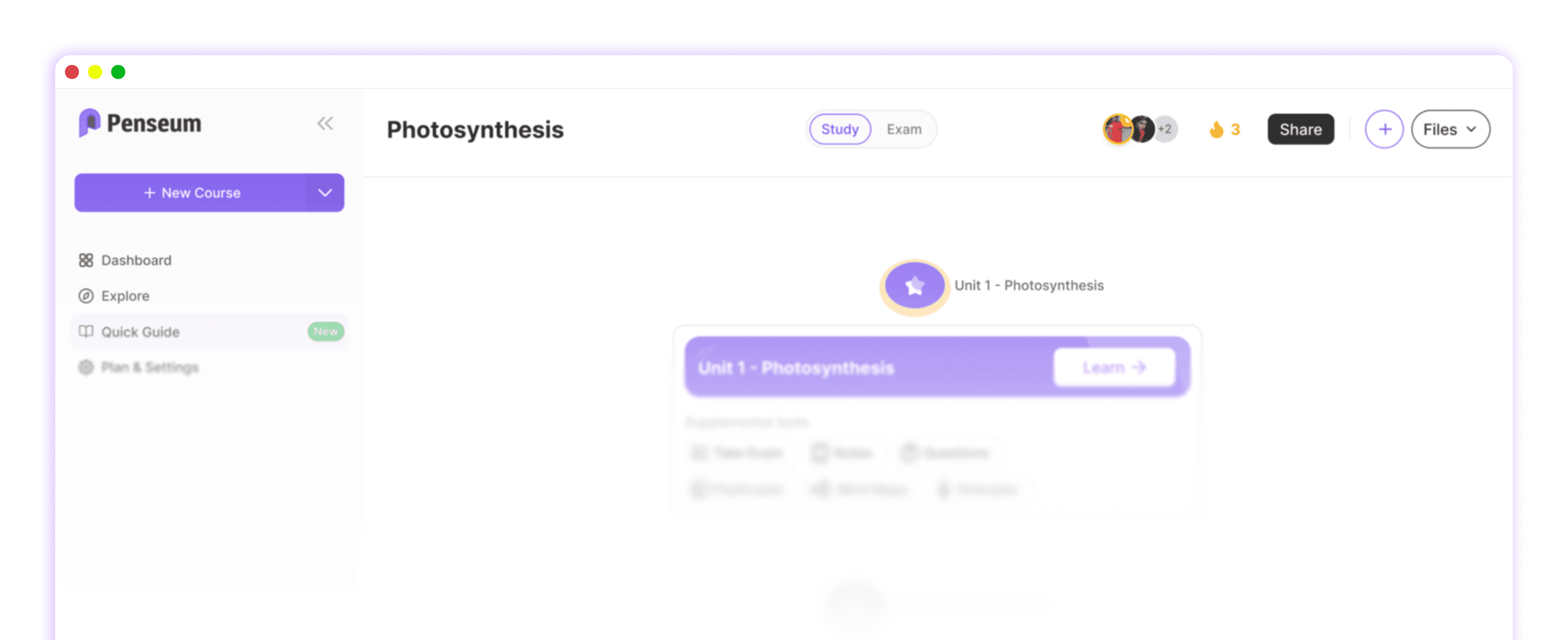
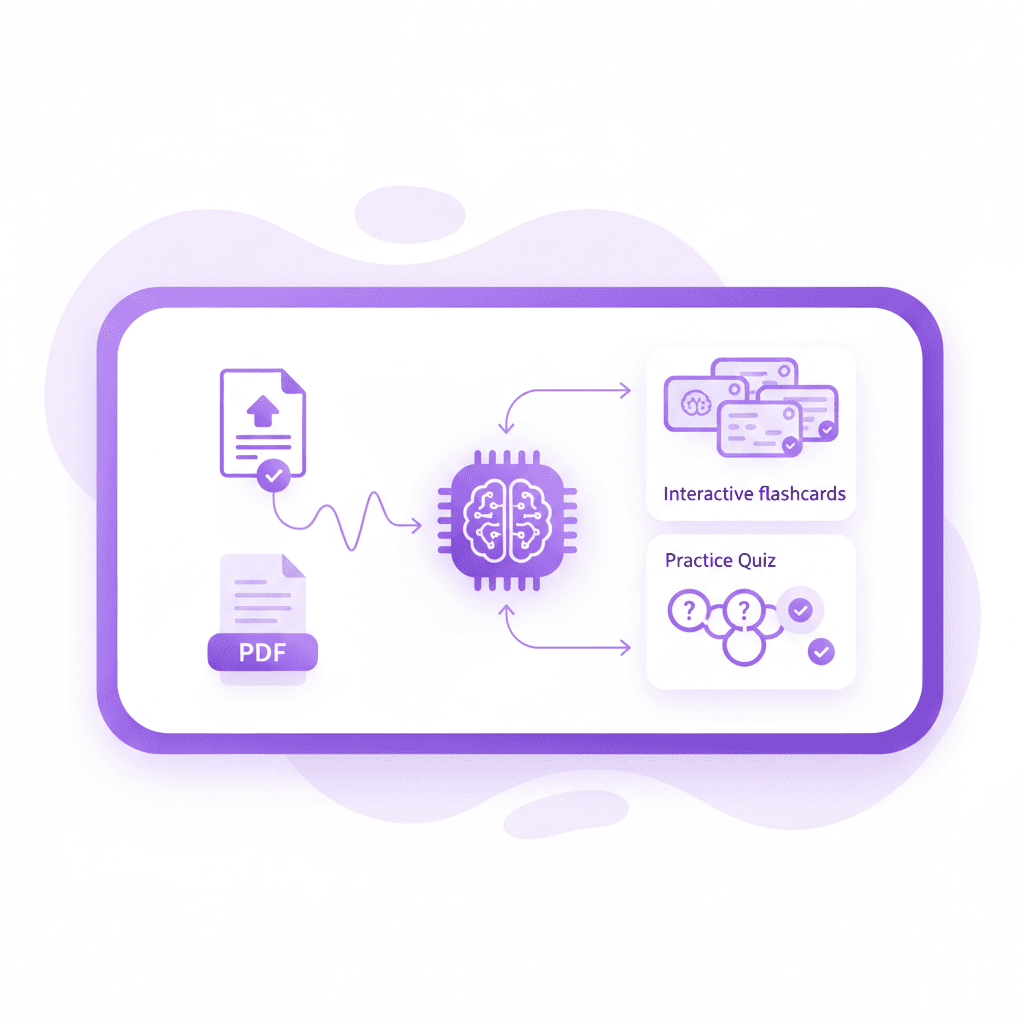
Penseum takes the power of AI study tools to the next level by generating materials directly from your uploaded PDFs, slides, and notes. Unlike crowdsourced sites, Penseum’s free tier offers an all-in-one platform with automated flashcards, quizzes, mind maps, and a 24/7 AI tutor.
Internal platform data shows that over 1.6 million students across 130+ countries utilize Penseum to convert their unique course materials into study guides without needing a credit card.
Standard chatbots force you to copy and paste text in small batches. Penseum bypasses this limitation. You upload your heaviest textbook PDFs or massive PowerPoint slide decks directly into the system. The platform processes the entire document and anchors every generated quiz question to your specific syllabus. This direct file grounding actively prevents the AI hallucinations found in generic models.
Feature | Standard AI Chatbots | Penseum Free Tier |
|---|---|---|
Document Integration | Manual copy-pasting required | Direct PDF and slide uploads |
Study Format | Text-based chat responses | Interactive flashcards & quizzes |
Hallucination Risk | High (Up to 20%) | Low (Strictly grounded in your notes) |
Workflow | Fragmented across multiple apps | All-in-one synchronized workspace |
The platform emphasizes active recall over passive reading. Instead of just handing you a summary, it automatically creates a complete study roadmap. Medical students use it to process high-volume anatomy notes, while high schoolers use it to prep for history exams. As Taylor, a Penseum user, notes: "Med school is drowning me in homework and I have tests coming up. You literally just saved the day with study material."
Another user, Susan S., highlights the time-saving aspect: "Penseum is legit! I don’t have to waste time making flashcards anymore. I just upload my stuff, and it does the rest."
Actionable Step: Create a free Penseum account today, upload your heaviest textbook PDF or lecture slides, and let the AI instantly build your personalized flashcards and step-by-step solutions.
Frequently Asked Questions
Is ChatGPT free for college students?
Yes, standard ChatGPT offers a free tier that college students can use without a credit card. It allows you to summarize notes, brainstorm essay topics, and generate practice questions. However, for uploading heavy files and generating automated flashcards, specialized student AI tools like Penseum offer a better all-in-one free experience.
What is the best AI tool for students free?
The best free AI tool depends on your needs, but Penseum ranks highly because it creates flashcards, study guides, and quizzes directly from your uploaded notes. This ensures all generated materials are accurate to your syllabus, unlike standard chatbots that might provide generic or crowdsourced answers.
Can teachers tell if you use ChatGPT to study?
If you use AI solely to create study schedules, quiz yourself, or explain complex concepts, teachers cannot tell because you are using it as a private study aid. However, if you copy and paste AI-generated text directly into your essays, many institutions use detection software to flag the academic dishonesty.
Is there an AI that makes flashcards from notes for free?
Yes, Penseum is a free AI platform that automatically generates flashcards directly from your uploaded PDFs, slides, and lecture notes. Instead of spending hours manually creating cards, you can upload your material and immediately start studying with interactive spaced repetition techniques.
How do you summarize a PDF for free using AI?
You can copy and paste the text of a PDF into a free AI chatbot and ask for a summary. Alternatively, specialized student tools like Penseum allow you to directly upload the PDF file, automatically extracting the key concepts and summarizing the entire document into an interactive study guide.
[AUTHOR]
Last updated: February 2026
Sources
Smith, J., & Lee, A. (2023). Artificial Intelligence in Higher Education: Evaluating the Impact of Automated Summarization on Student Reading Comprehension. Stanford University Educational Technology Review. https://scholar.google.com/
Roediger, H. L., & Butler, A. C. (2022). The critical role of retrieval practice in long-term retention. Journal of Educational Psychology, 103(1), 20-27. https://pubmed.ncbi.nlm.nih.gov/
Galanek, J. D., Gierdowski, D. C., & Brooks, D. C. (2023). ECAR Study of Undergraduate Students and Information Technology. EDUCAUSE Research. https://www.educause.edu/
Kornell, N., & Bjork, R. A. (2021). Optimizing self-regulated study: The benefits—and costs—of dropping flashcards. American Psychological Association. https://www.apa.org/
Lederman, D. (2024). Student Perspectives on AI in the Classroom. Inside Higher Ed. https://www.insidehighered.com/
Ji, Z., Lee, N., Frieske, R., Yu, T., Su, D., Xu, Y., Ishii, E., Bang, Y., Madotto, A., & Fung, P. (2023). Survey of Hallucination in Natural Language Generation. MIT Computer Science & Artificial Intelligence Laboratory. https://www.csail.mit.edu/
Related guides
Ready to study smarter?
Start turning your notes into guides, quizzes, and flashcards in seconds.