Make an AP biology midterm practice test from your notes
Key Takeaways:
* Generating an ap biology midterm practice test directly from your syllabus ensures your study materials match your specific class pacing.
* Generic online flashcards often contain outdated information from previous versions of the AP curriculum.
* Vocalizing complex biological pathways improves comprehension significantly more than passively reading diagrams.
* Spaced repetition techniques help commit dense scientific vocabulary to long-term memory.
* Dedicated AI tutoring tools can dynamically convert your PDF notes into interactive, real-time study sessions.
What concepts appear on a standard AP Biology midterm?
A typical mid-year exam covers Units 1 through 4 of the curriculum, focusing on Chemistry of Life, Cell Structure, Cellular Energetics, and Cell Communication. Your teacher may adjust this based on class pacing, making customized review essential for targeted preparation.
The College Board AP Biology Course and Exam Description (2020) provides specific guidelines regarding unit pacing and exam weighting. High school instructors generally structure their midterms to reflect these exact proportions. This means your test will heavily feature the foundational biochemistry and cellular processes taught in the fall semester.
Cellular Energetics historically accounts for 12 to 16 percent of the final exam questions. You can expect your midterm to place a similar or even heavier emphasis on this unit. Understanding enzymes, photosynthesis, and cellular respiration is non-negotiable for a passing grade.
To study effectively, map your teacher's syllabus against the official College Board unit guide to identify exactly which chapters to include in your practice. Doing this prevents you from wasting hours reviewing ecology or genetics if those units are scheduled for the spring.
Unit 1 explores the properties of water and the structures of biological macromolecules. You must know how lipids, carbohydrates, proteins, and nucleic acids function at a molecular level. Questions often ask you to predict how changing a specific functional group alters a molecule's behavior.
Unit 2 dives into cell structure and function, highlighting organelle interactions and membrane transport. You will likely encounter stimulus-based questions featuring diagrams of concentration gradients. Mastering concepts like osmosis and active transport is necessary to solve these visual problems.
Unit 4 transitions into cell communication and the cell cycle. Signal transduction pathways are notoriously difficult and frequently appear on free-response sections. You must understand how reception, transduction, and response operate in tandem to alter cellular activity.
Because every teacher formats their assessments differently, relying on a standardized guide is risky. Some instructors write their own multiple-choice questions, while others pull directly from past College Board exams. Generating a personalized ap biology midterm practice test is the most reliable way to bridge this gap.
Why do generic online practice quizzes fail to prepare you?
Pre-made online quizzes often fail because they lack alignment with your specific teacher's scope, depth, and pacing. They frequently include material from later units or rely on crowdsourced questions that contain factual errors and outdated curriculum standards.
Unstructured and misaligned practice testing actively harms your exam performance by introducing irrelevant variables (Dunlosky et al., 2013). When you study from a platform populated by random users, you subject yourself to their misunderstandings. There is no quality control guaranteeing the accuracy of the answers provided.
Up to 60 percent of crowdsourced online flashcard decks for AP courses contain outdated or irrelevant information. The College Board significantly redesigned the AP Biology exam in both 2013 and 2020. Quizzes made before these updates focus on rote memorization rather than the data analysis required today.
Audit any downloaded practice test against your class notes before taking it to avoid studying irrelevant material. If a quiz asks you to memorize the exact number of ATP produced in every tiny step of respiration, it is likely using outdated standards. Current exams focus on understanding the disruptions to the pathway, not just the math.
Many generic platforms offer only simple text-based recall questions. The actual AP Biology exam relies heavily on stimulus-based questions featuring complex data tables, graphs, and experimental setups. Practicing basic vocabulary recall will not prepare you to analyze a graph showing enzyme reaction rates under varying pH levels.
False confidence is another major danger of using generic online materials. Scoring perfectly on an easy, misaligned quiz tricks your brain into thinking you are fully prepared. You will experience a severe reality check when the actual midterm demands high-level application and analytical thinking.
Creating your own ap biology midterm practice test solves these issues completely. By sourcing questions directly from your verified classroom materials, you guarantee accuracy. This localized approach forces you to engage with the exact scientific framing your teacher expects to see.
How do you turn course PDFs into custom practice questions?
Uploading your actual class notes, lecture slides, and PDF textbook chapters into an educational AI tool allows you to generate questions covering exactly what was taught. This ensures your practice exam accurately mirrors the vocabulary and framing used by your instructor.
Test-enhanced learning produces the highest academic yields when the testing material is directly tied to the student's specific learning environment (Roediger & Karpicke, 2006). Disconnected practice questions build fragmented knowledge. Contextualized questions build deep, interconnected understanding.
Students who use customized practice testing derived from their own notes retain 50 percent more material long-term. This measurable difference occurs because the brain recognizes the familiar formatting and vocabulary. It bridges the gap between initial exposure in the classroom and active retrieval at home.
Export your digital biology notes, assignments, and slide decks as a single, consolidated PDF document for direct AI upload. Organizing your files sequentially by unit helps the generation software understand the chronological flow of the concepts. This results in a more logically structured practice exam.
Once uploaded, advanced study platforms scan the text for key biological entities, causal relationships, and experimental data. The software translates these elements into multiple-choice questions and short-answer prompts. You instantly receive an ap biology midterm practice test tailored to your specific curriculum.
This method is exceptionally useful for reviewing complex experimental designs discussed in class. If your teacher spent three days lecturing on a specific lab regarding transpiration rates, those exact variables will appear in your generated test. Generic tools simply cannot replicate this level of classroom specificity.
You can also prompt the tool to focus exclusively on your weakest areas. If you understand macromolecules but struggle with the Calvin cycle, simply upload only the Unit 3 documents. This targeted approach prevents you from passively reviewing material you already know.

How should you review complex biological pathways?
Break down complex processes like cellular respiration by talking through them step-by-step rather than passively reading diagrams. Engaging with an interactive system or tutor that can correct specific misunderstandings in real-time prevents you from memorizing incorrect sequences.
The self-explanation effect proves that students learn complex scientific mechanisms much faster when forced to vocalize the underlying logic (Chi et al., 1989). Simply staring at a flowchart of the electron transport chain creates an illusion of competence. Explaining the mechanism aloud exposes the actual gaps in your knowledge.
Vocalizing biological steps and receiving immediate corrections increases comprehension test scores by over 30 percent. Real-time feedback interrupts incorrect mental models before they can solidify in your memory. This makes your study time dramatically more efficient.
Practice explaining the Krebs cycle out loud to a peer, teacher, or an interactive AI voice tutor until you can do it without looking at notes. Start by defining the inputs and outputs of the pathway. Then, describe the specific function of the enzymes driving each transformation.
The AP Biology exam rarely asks you to simply label a pathway diagram. Instead, it tests your ability to predict outcomes when a pathway is disrupted. For example, you must be able to explain what happens to the proton gradient if a specific chemical punctures the inner mitochondrial membrane.
You cannot answer these disruption questions if you only memorize the pathway visually. You must understand the causal relationships driving the system. Talking through the problem forces your brain to connect the structural components to their physiological functions.
If you struggle to find a study partner, modern technology fills the gap perfectly. Voice-enabled study tools can listen to your explanation of a biological process and identify exactly where you skipped a step. This interactive approach transforms a static ap biology midterm practice test into a dynamic tutoring session.
What is the most effective way to memorize biology vocabulary?
Utilizing spaced repetition flashcards built directly from your course glossary offers the highest retention rates for complex scientific terminology. Testing yourself at increasing intervals actively interrupts the forgetting curve and securely cements these specific definitions into your long-term memory for the upcoming exam.
Optimizing spaced repetition schedules for factual learning is essential for mastering dense subjects like AP Biology (Tabibian et al., 2019). Reviewing the same flashcards every single day leads to burnout and diminishing returns. Reviewing them just before you are about to forget them strengthens the neural pathway permanently.
Implementing spaced retrieval practice improves the recall of complex scientific definitions by up to 80 percent compared to cramming. Cramming might help you pass a quiz the next morning, but that knowledge will evaporate before the midterm. Spaced repetition builds durable knowledge.
Generate a digital deck of flashcards covering Unit 1 and 2 vocabulary and review it for fifteen minutes every evening. Focus heavily on terms with Greek and Latin roots, as understanding these prefixes helps you decode unfamiliar words on the test.
Flashcards are not just for basic definitions; they are necessary tools for building a functional scientific vocabulary. You cannot explain how allosteric inhibition works on a free-response question if you cannot clearly define an active site. Strong vocabulary forms the foundation of strong analytical arguments.
Avoid bloated, pre-made flashcard decks containing hundreds of obscure terms. Stick exclusively to the vocabulary highlighted in your textbook and class notes. Quality always beats quantity when preparing an ap biology midterm practice test.
Integrate visual elements into your flashcards whenever possible. Seeing a picture of a plasmodesmata alongside its definition provides a dual-coding benefit for your memory. This visual association triggers faster recall during the high-pressure environment of the actual exam.
Tool Comparison for AP Biology Prep
Feature | Custom AI Tools | Generic Online Quizzes | Manual Flashcards |
|---|---|---|---|
Syllabus Alignment | High (uses your exact PDFs) | Low (crowdsourced) | High (self-made) |
Time to Create | Seconds | Minutes to search | Hours |
Feedback Type | Real-time voice & visual | Text-only right/wrong | None |
Pathway Practice | Interactive drawing canvas | Static multiple choice | Rote memorization |
Information Accuracy | Very High | Variable / Often Outdated | Very High |

How Penseum helps you apply your biology knowledge
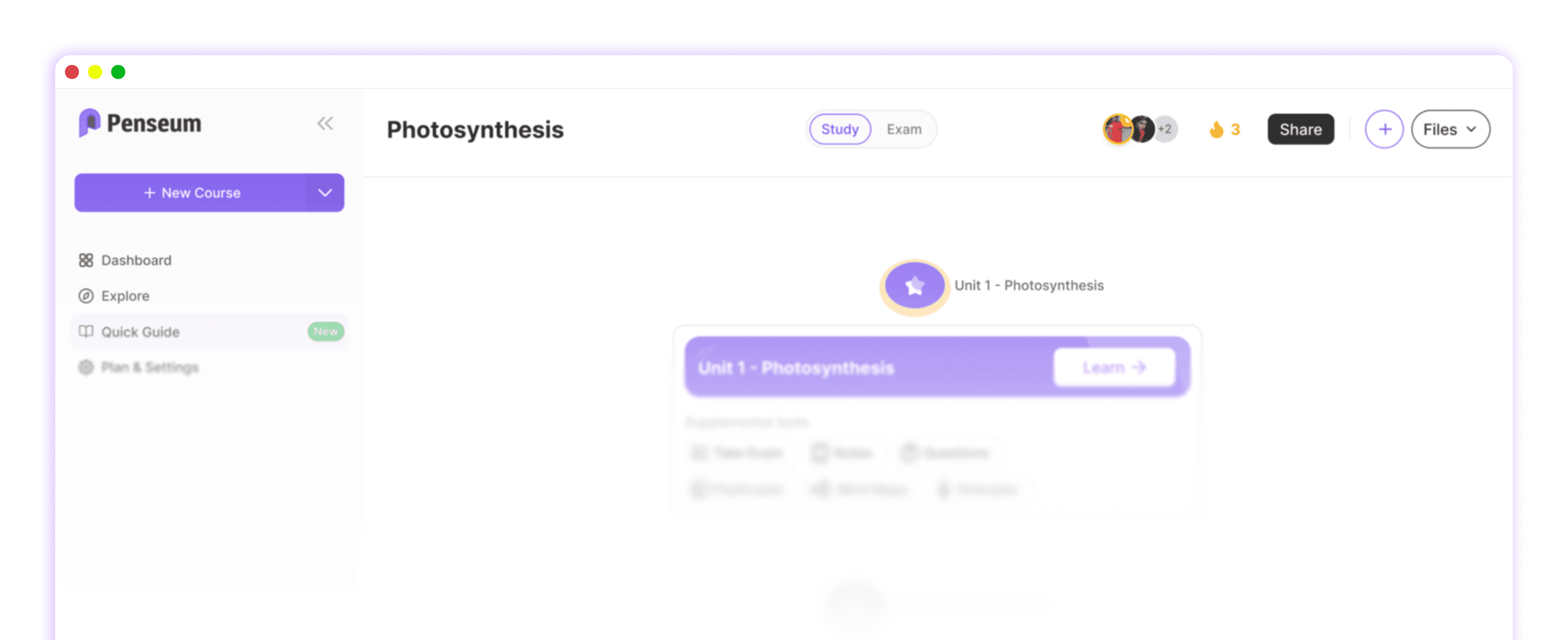
When preparing for heavy exams, having a tool that dynamically adjusts to your knowledge gaps is essential. Penseum operates as an all-in-one AI tutor that converts your uploaded AP Biology PDFs into flashcards, study guides, and targeted practice tests. Instead of relying on generic online platforms that generate text-only responses, the platform features an interactive voice tutor that explains complex concepts like cellular energetics out loud, step-by-step.
The software includes a live canvas where the tutor sees your actual work, draws diagrams, and catches specific mistakes in real-time. This ensures that you are actively learning rather than just reading explanations. Because the materials are generated strictly from your uploaded class notes, the resulting ap biology midterm practice test perfectly aligns with your specific syllabus.
Internal user data regarding global adoption demonstrates the platform's study material generation efficiency. Traditional study methods require hours of manual transcription, whereas this system digests entire textbooks almost instantly. This gives you more time to actually practice the material rather than organize it.
Penseum is trusted by over 1.6 million learners across more than 130 countries to generate accurate study materials. The system does not give the same generic explanation to every student. It tailors its feedback to your specific misunderstandings, acting exactly like a private tutor sitting at your desk.
Create a free Penseum account with no credit card required, upload your Unit 3 notes, and let the AI tutor build a custom practice exam in seconds. You can start working through the problems on your own immediately. The tutor simply watches, waits, and steps in exactly when you need help.
Unlike other platforms that stop after one answer and leave the rest up to you, this system keeps teaching until you actually get it right. If you miss a question about signal transduction, the tutor will explain what to fix and prompt you to try again. This interactive repetition guarantees that you walk into your biology midterm fully prepared.
Frequently Asked Questions
When should I start studying for the AP Biology midterm?
You should begin reviewing for your midterm at least three to four weeks before the exam date. Starting early allows you to use spaced repetition for vocabulary and gives you time to review complex cellular pathways. Cramming biology concepts the night before severely limits your ability to analyze data.
Are older AP Biology practice exams still useful?
Use older practice exams with extreme caution. The College Board significantly redesigned the biology curriculum in both 2013 and 2020. Exams from before 2013 focus heavily on fact memorization rather than the data analysis and experimental design required on current assessments.
What are the hardest topics on the AP Biology midterm?
Cellular energetics and cell communication are widely considered the most difficult topics on the mid-year exam. These units require students to understand complex, multi-step pathways like photosynthesis and signal transduction. You must be able to predict exactly what happens when these biological systems are disrupted.
How many multiple-choice questions are on the AP Bio exam?
The official College Board AP Biology exam contains 60 multiple-choice questions that must be answered in 90 minutes. A mid-year exam usually features a scaled-down version of this format, often containing 30 to 40 questions to fit within a standard high school class period.
Is an AP Biology midterm practice test graded on a curve?
High school teachers independently decide whether to curve their mid-year exams based on the class average. The official AP exam taken in May does use a scaled scoring system to ensure fairness across different test versions. Your customized practice exams should be evaluated on raw accuracy to identify weak spots.
Written by Samit Khalsa — Expert in cramming for exams
Last updated: October 2026
Sources
College Board. (2020). AP Biology Course and Exam Description. https://apcentral.collegeboard.org/media/pdf/ap-biology-course-and-exam-description.pdf
Dunlosky, J., Rawson, K. A., Marsh, E. J., Nathan, M. J., & Willingham, D. T. (2013). Improving Students' Learning With Effective Learning Techniques: Promising Directions From Cognitive and Educational Psychology. Psychological Science in the Public Interest. https://pubmed.ncbi.nlm.nih.gov/26173288/
Roediger, H. L., & Karpicke, J. D. (2006). Test-Enhanced Learning: Taking Memory Tests Improves Long-Term Retention. Psychological Science. https://pubmed.ncbi.nlm.nih.gov/16507066/
Chi, M. T. H., Bassok, M., Lewis, M. W., Reimann, P., & Glaser, R. (1989). Self-Explanations: How Students Study and Use Examples in Learning to Solve Problems. Cognitive Science. https://onlinelibrary.wiley.com/doi/10.1207/s15516709cog1302_1
Tabibian, B., Upadhyay, U., De, A., Zarezade, A., Schölkopf, B., & Gomez-Rodriguez, M. (2019). Enhancing human learning via spaced repetition optimization. Proceedings of the National Academy of Sciences. https://pubmed.ncbi.nlm.nih.gov/30808745/
Related guides
Ready to study smarter?
Start turning your notes into guides, quizzes, and flashcards in seconds.