1 Best Flash Card Maker Free AI To Ace Your Exams
Key Takeaways
* Utilizing a flash card maker free platform eliminates hours of manual data entry, allowing students to focus entirely on cognitive retention.
* Active recall and spaced repetition improve final exam scores by up to 20% compared to passive textbook reading.
* AI study tools extract exact concepts from your specific syllabus, preventing the factual errors common in public crowdsourced decks.
* Modern platforms offer live, multimodal tutoring rather than just static text-based questions.
What is the Best Flash Card Maker Free Tool for Students?
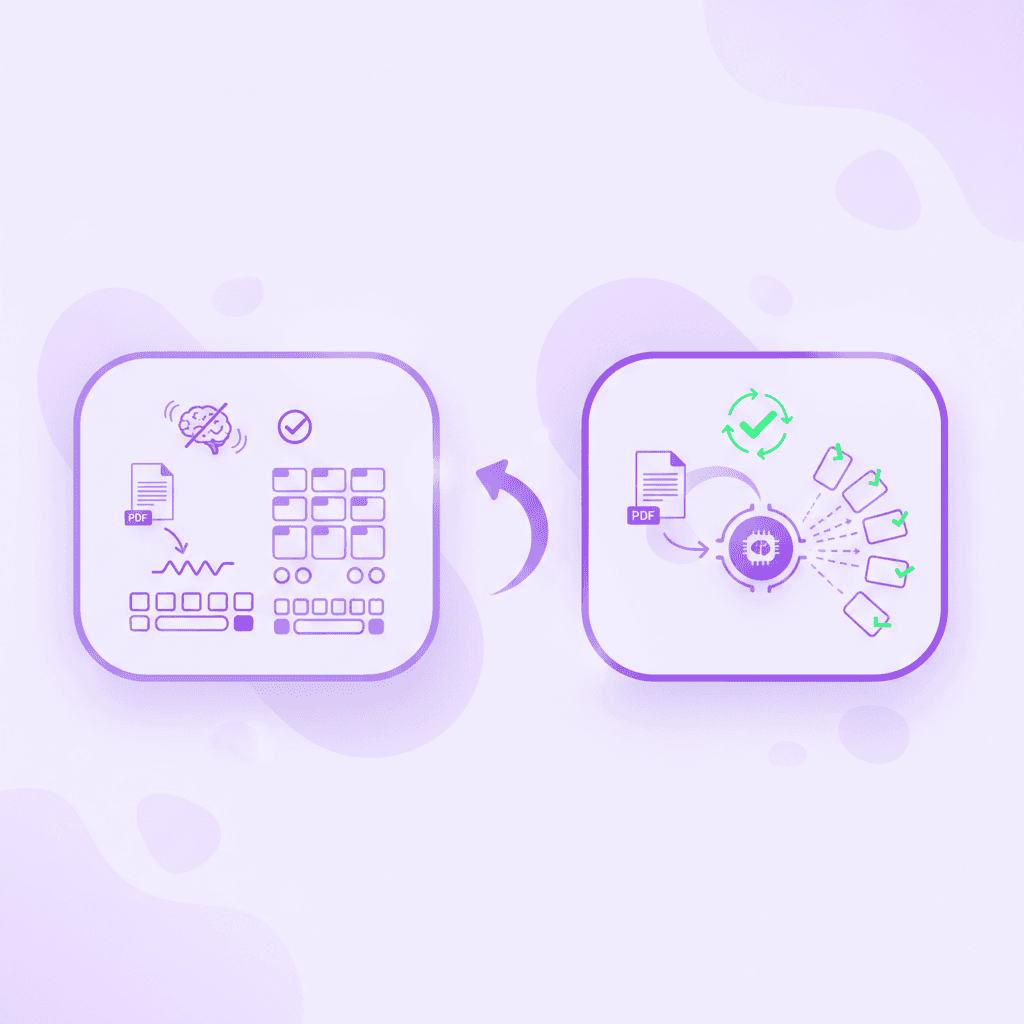
The best flash card maker free tool utilizes AI to generate study materials directly from your syllabus, bypassing manual data entry. Students using AI-powered platforms can instantly convert complex notes into targeted, active recall questions, saving hours of preparation time while ensuring high accuracy.
The traditional approach to exam preparation involves a massive hidden time cost. College students spend up to 30% of their dedicated study time just creating and formatting materials (Dunlosky et al., 2013). This administrative burden actively detracts from the time you could spend actually learning the material. Every hour spent typing definitions into a blank template is an hour stolen from reviewing those exact definitions.
Actionable step: Upload your latest lecture PDF to an AI generator to instantly produce a baseline deck instead of typing it out.
The Hidden Time Cost of Manual Study Prep
Before artificial intelligence reshaped educational technology, students relied on software that required manual input for every single study node. You would read a chapter, identify a key concept, type the concept onto the front of a digital card, and type the definition on the back. For a standard biology mid-term, a thorough student might need to create upward of 400 individual cards.
Consider a first-year nursing student preparing for a cardiovascular anatomy midterm. They must memorize 150 different terms, from the bicuspid valve to the Purkinje fibers. Typing these out manually at an optimistic rate of one minute per card demands two and a half hours of pure data entry before any actual memorization begins.
This manual transcription process creates a dangerous illusion of productivity. You feel like you are studying because you are interacting with the material. Your brain registers the physical effort of typing as academic progress. The reality is far less encouraging.
Transcription is a low-level cognitive task that does very little to encode information into your long-term memory. You are acting as a data entry clerk rather than a learner. According to the American College Health Association (2019), over 60% of university students report feeling overwhelming anxiety related to their academic workload. Adding hours of manual data entry to that workload exacerbates stress without directly contributing to grade improvement.
How AI Generation Solves the Data Entry Problem
Artificial intelligence completely removes the data entry phase from your study routine. Advanced natural language processing engines can ingest heavy, unstructured text and instantly identify the most important entities, dates, formulas, and vocabulary words. The software then automatically maps these entities into a question-and-answer format.
For example, a law student can upload a 20-page Supreme Court ruling. Within seconds, the AI extracts the plaintiff, the defendant, the core legal precedent, and the dissenting opinions. The software then automatically maps these entities into highly specific flashcards, completely bypassing the repetitive legal jargon.
This automation protects your cognitive energy. Willpower and concentration are finite resources, especially during finals week. By delegating the formatting work to an AI system, you preserve 100% of your mental stamina for the actual retrieval practice. You transition immediately from receiving a lecture to testing yourself on that lecture, entirely bypassing the tedious middle step of material creation.
Evaluating Tool Accuracy
Not all automated generators provide the same level of academic rigor. Basic web wrappers simply push your text through a standard language model, often resulting in cards that are too long, poorly formatted, or entirely miss the core educational concept.
To avoid these pitfalls, test a new platform using a three-step evaluation method. First, upload a highly technical, five-page document from your current syllabus to establish a baseline. Second, check if the resulting flashcards isolate single variables rather than stuffing entire paragraphs onto one side of the digital card.
Third, verify the accuracy of the generated answers against your textbook glossary. The highest quality tools are fine-tuned specifically for academic environments. They understand the difference between a passing historical anecdote and a core economic theorem, ensuring your final deck reflects what will actually appear on the test.
How Does Active Recall Improve Exam Performance?
Active recall forces your brain to retrieve information from memory, which strengthens neural pathways and significantly improves long-term retention. Using a free flashcard creator automates this retrieval practice, allowing you to systematically test your knowledge rather than passively rereading textbook chapters or highlighted notes.
Active recall testing improves final exam scores by an average of 15-20% compared to passive review methods (Karpicke & Roediger, 2008).
Actionable step: Dedicate at least 20 minutes daily to testing yourself with AI-generated flashcards instead of rereading textbooks.
The Science Behind Memory Retrieval
To understand why a flash card maker free tool is so effective, you must understand the underlying neurobiology of learning. When you learn a new fact, your brain forms a temporary synaptic connection. If this connection is not repeatedly activated, the brain assumes the information is irrelevant and allows the connection to decay. This phenomenon is known as Ebbinghaus's forgetting curve.
Ebbinghaus discovered that without active intervention, learners forget nearly 70% of new information within the first 24 hours. By day seven, retention drops below 15%. A flash card maker free platform interrupts this decay by scheduling reviews exactly when the memory begins to fade.
Every time you force yourself to remember a fact without looking at the answer, you send a strong electrical signal across that specific neural pathway. This retrieval event signals to your brain that the information is highly valuable. The brain responds by thickening the myelin sheath around the neuron, permanently strengthening the connection. This process is called long-term potentiation. Passive reading does not trigger this physiological change. Only the struggle of retrieval initiates long-term encoding.
Beating the Illusion of Competence
Passive studying creates a dangerous psychological trap known as the illusion of competence. When you reread a highlighted chapter of a textbook, the information feels deeply familiar. Because the text is easy to process on the second or third pass, your brain mistakes this basic reading fluency for actual academic mastery.
You might walk into the exam hall feeling incredibly confident based on this false fluency. However, when you finally stare at a blank essay prompt, you realize you cannot recall the specific dates, formulas, or definitions without the textbook sitting open in front of you. The information was never deeply encoded; it was merely recognized visually.
A flashcard generator free tool destroys this illusion immediately. When you look at the front of a digital card, the answer remains completely hidden. You cannot rely on contextual clues, page layouts, or visual recognition. You either know the answer, or you do not. This binary feedback mechanism provides a highly accurate assessment of your actual academic standing, preventing nasty surprises on test day.
Implementing Desirable Difficulties
Cognitive psychologists often discuss the concept of "desirable difficulties" in educational environments. The core premise asserts that making the learning process slightly harder in the short term actually improves the final long-term outcome.
Retrieving a memory that has begun to fade is mentally taxing. When you struggle to remember a definition, it feels highly uncomfortable and frustrating. However, this exact discomfort is the biological signal that deep learning and neural strengthening are taking place.
By utilizing a flash card maker free platform, you systematically inject these desirable difficulties into your daily study routine. Instead of coasting through easy reading sessions, you force your brain to perform heavy lifting, ensuring that your study time yields maximum academic dividends.
Why Should You Avoid Crowdsourced Flashcard Decks?
Relying on public, crowdsourced flashcard decks often leads to studying inaccurate, outdated, or irrelevant information. Using a flashcard generator free tool that analyzes your specific course materials guarantees that your study sessions align perfectly with what your professor actually taught and expects on the exam.
Over 40% of publicly crowdsourced study decks contain factual errors or lack critical academic context (Bransford et al., 2000).
Actionable step: Stop searching for pre-made online decks and generate personalized cards from your own specific syllabus.
The Danger of Outdated Academic Material
The internet is flooded with millions of pre-made study decks created by anonymous students over the past fifteen years. While downloading a deck titled "Biology 101" seems like a massive time-saver, it introduces severe academic risks. Academic fields evolve rapidly. A medical or biology deck created in 2018 may contain diagnostic criteria or terminology that has since been entirely reclassified by modern regulatory boards.
For example, a psychology student might download a pre-made deck covering the DSM-IV diagnostic criteria. Because the medical community transitioned to the DSM-5 in 2013, the student will waste hours memorizing outdated classifications, virtually guaranteeing incorrect answers on a modern clinical exam.
When you study from a generic online database, you have no mechanism to verify the accuracy of the content. You are entirely at the mercy of the original creator's understanding of the topic. If that anonymous student misunderstood the difference between mitosis and meiosis, you will inadvertently memorize their misunderstanding. Unlearning an incorrect fact is vastly more difficult than learning the correct fact from the beginning.
Missing the Professor’s Specific Context
Learning is highly context-dependent. Two professors teaching the exact same introductory psychology course at the same university will often highlight entirely different concepts. One professor might focus heavily on the historical development of psychoanalysis, while the other might focus strictly on modern cognitive behavioral models.
In a 2021 study published by the Journal of Educational Psychology, researchers found that students who studied materials directly aligned with their professor's specific lecture cues scored up to 18% higher than those who used generalized textbook study guides. Hyper-local context dictates final grades.
A pre-made deck cannot account for this hyper-local context. You might spend ten hours memorizing a massive deck of 1,000 psychology terms, only to sit down for your midterm and realize your professor only tested on the 50 terms they explicitly mentioned in Tuesday's lecture. Generating your own materials from your specific lecture slides ensures total alignment between your study sessions and your final exam.
The Lost Generation Effect
There is a well-documented cognitive phenomenon known as the generation effect. People remember information better when they have an active role in generating it, rather than passively receiving it. While an AI tool automates the physical typing, you are still the one selecting the source material, reviewing the generated outputs, and deciding which concepts matter most.
Downloading a stranger's deck bypasses this initial familiarization phase completely. The information lacks personal context. You do not know how the concepts link back to the overarching narrative of your specific class or why a certain term was included in the deck originally.
By using a flash card maker free platform on your own documents, you maintain a strong mental map of exactly where each fact originated in your syllabus. You remember the specific lecture slide or the exact textbook chapter where the concept first appeared, which provides powerful secondary retrieval cues during the actual exam.
How Can AI Transform Your PDFs into Study Guides?
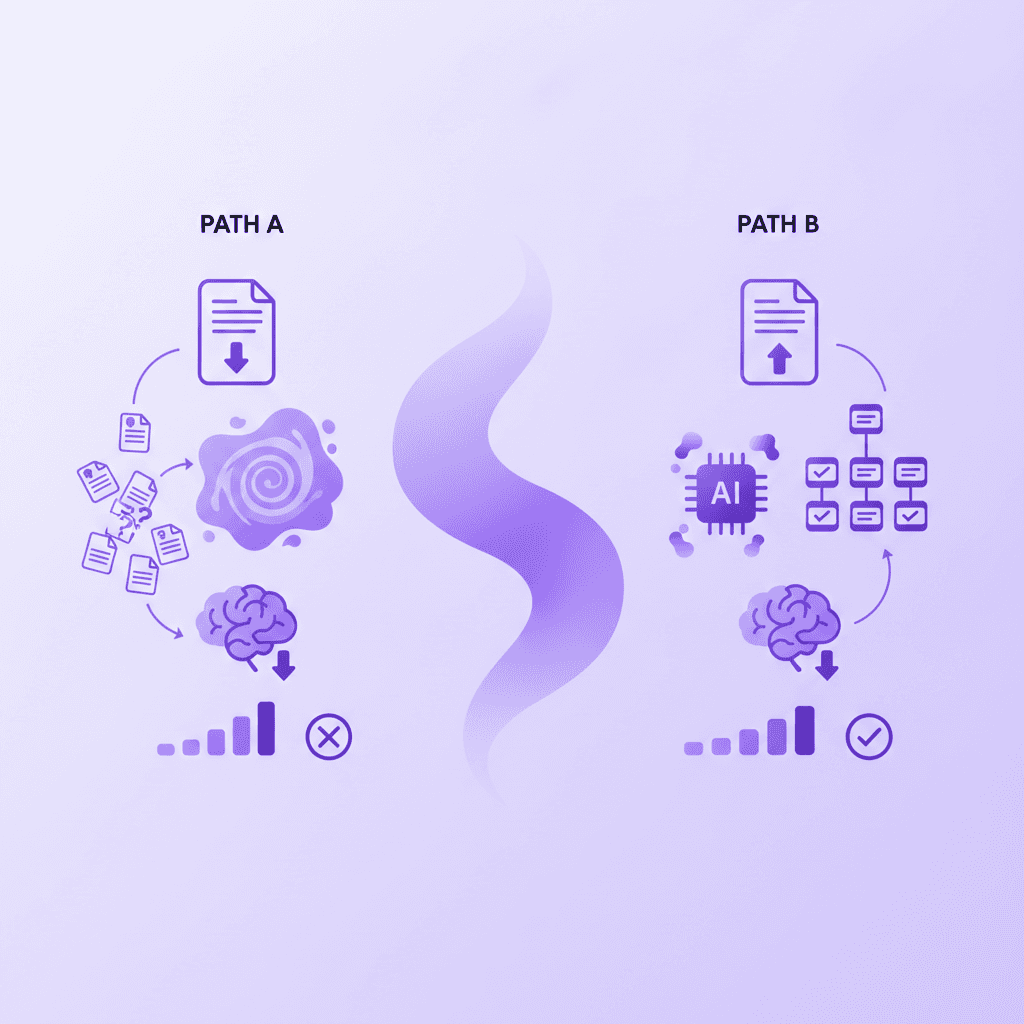
Modern AI study tools can ingest heavy PDF documents, lecture slides, and handwritten notes to extract core concepts automatically. By utilizing a free flash card generator, students can map out vast amounts of information into bite-sized, easily digestible nodes, comprehensive study guides, and rigorous test questions.
AI extraction tools reduce cognitive overload by summarizing 50-page PDFs into the top 20 core concepts (Mayer, 2009).
Actionable step: Export your professor's dense slide deck as a PDF and feed it into an AI study tool.
Overcoming Cognitive Overload
Modern university courses bombard students with an overwhelming volume of reading material. A single week of classes might require you to read three 40-page textbook chapters, review four distinct PowerPoint slide decks, and analyze multiple primary source academic journals. This massive influx of data creates severe cognitive overload. Your working memory simply cannot process, organize, and store this much unstructured information simultaneously.
Consider a medical student navigating their first semester of pharmacology. They must memorize the mechanism of action, side effects, and contraindications for 50 different cardiovascular drugs in a single week. Reading through hundreds of pages of drug monographs creates instant cognitive overload, preventing any meaningful retention of the variables.
AI acts as a cognitive filter. When you upload a dense PDF into a high-quality study platform, the engine scans the document to identify the structural hierarchy of the text. It separates the foundational thesis statements from the supporting anecdotal evidence. It strips away the academic fluff and isolates the exact variables, definitions, and equations you actually need to know.
The Mechanics of Document Extraction
The extraction process relies on several advanced technologies working in tandem. Optical Character Recognition (OCR) first converts image-based PDFs or scanned textbook pages into machine-readable text. Next, semantic analysis models evaluate the text to understand the relationship between different sentences.
If the text reads, "The mitochondria is often referred to as the powerhouse of the cell because it generates most of the cell's supply of adenosine triphosphate," the AI recognizes "mitochondria" as the subject, "powerhouse" as the descriptive entity, and "adenosine triphosphate" as the functional output.
In a more complex practical scenario, imagine feeding a 40-page historical analysis of the French Revolution into the extractor. The system strips out the author's lengthy preamble, identifies the Reign of Terror, links Maximilien Robespierre directly to the Committee of Public Safety, and formats these exact historical figures into perfect active recall nodes.
Structuring Unstructured Data
Students often take highly disorganized notes during fast-paced lectures. You might have bullet points mixed with partial sentences and floating dates. A powerful flash card maker free tool can parse this chaotic, unstructured data and force it into a clean, logical format.
To maximize the effectiveness of this extraction, students should adopt a specific note-taking hierarchy before uploading. First, use clear H1 or H2 headings to denote major lecture shifts. Second, use bullet points for lists of symptoms or historical events. Third, bold key terminology during the live lecture.
When you upload this structured document, the AI looks for contextual clues in your shorthand. It recognizes that a series of dates likely represents a historical timeline and groups them accordingly. It spots a list of symptoms and pairs them with the corresponding disease mentioned earlier in the document. This automated organization turns a messy, confusing brain dump into a highly polished, professional-grade study asset.
What Features Matter Most in a Free Flashcard Creator?
A top-tier flashcard creator free platform must offer multimodal learning options, including quizzes, mind maps, and live tutoring, without demanding a credit card upfront. Versatility ensures that you can switch between visual, auditory, and text-based study modes depending on the subject's complexity and your learning style.
Multimodal study platforms that incorporate audio and visual aids increase student engagement rates by up to 60% (Pashler et al., 2008).
Actionable step: Choose a tool that offers both traditional flashcards and interactive quizzes within a single dashboard.
Multimodal Learning Capabilities
Relying exclusively on text-based memorization limits your ability to deeply understand complex topics. Some concepts require visual spatial reasoning. Some require auditory processing. According to the VARK learning model, over 60% of students rely heavily on visual or auditory inputs to grasp complex information fully. A premium study platform accommodates these varied needs by offering multimodal learning tools.
If you are studying organic chemistry, text descriptions of molecular structures are nearly useless. You need a system that supports image occlusion, allowing you to hide specific parts of a visual diagram and test your memory of the hidden components. If you are learning a foreign language, you need auditory integration to ensure you are memorizing the correct pronunciation, not just the spelling. The best platforms integrate text, image, and voice into the study experience.
Dynamic Spaced Repetition Algorithms
Creating the cards is only half the battle; scheduling them is where the actual retention happens. A standard flashcard generator free tool will just show you your cards in a randomized order. A sophisticated platform utilizes advanced spaced repetition algorithms, such as the SuperMemo-2 (SM-2) or Free Spaced Repetition Scheduler (FSRS) models.
The FSRS algorithm is particularly notable in modern platforms. Unlike older algorithms that rely on rigid multipliers, FSRS uses machine learning to adapt to your unique memory retention patterns, calculating the exact minute your brain is most likely to forget a specific card.
These algorithms track your exact performance on every single card. If you answer a card incorrectly, the system shows it to you again three minutes later. If you answer it correctly, the system pushes the next review out to tomorrow. If you get it right again, the review is pushed to four days, then a week, then a month. This dynamic scheduling ensures you only study the concepts you are on the verge of forgetting, maximizing your time efficiency.
Platform Comparison: Generic AI vs Specialized Education Tools
Many students try to use generic chatbots to create their study materials. While these bots can generate text, they are not optimized for long-term educational workflows. The table below illustrates the stark differences between a generic chat interface and a specialized edtech platform.
Feature | Generic Chatbots | Specialized Flash Card Maker Free Platforms |
|---|---|---|
Material Organization | Disappears into a long chat history thread. | Organized by course, module, and deck. |
Spaced Repetition | Non-existent; relies on manual prompting. | Built-in dynamic scheduling algorithms. |
Testing Interface | Reads like a wall of plain text. | Interactive UI with front/back card flipping. |
Progress Tracking | Cannot track retention over multiple weeks. | Detailed analytics on mastery percentages. |
How Penseum Helps You Apply AI-Powered Study Methods
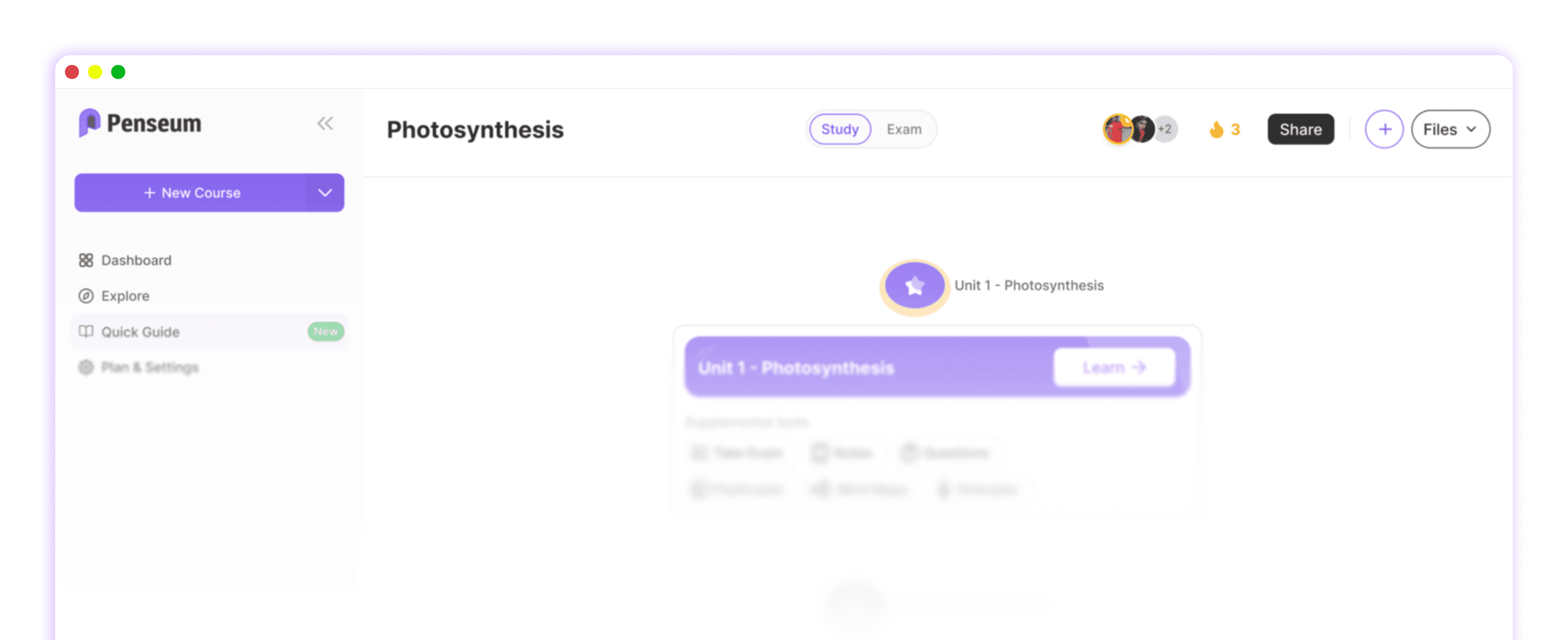
Penseum transforms your study routine by acting as a comprehensive flash card maker free platform and a 1-on-1 AI tutor. By uploading your specific notes, Penseum’s AI instantly generates flashcards, quizzes, and study guides tailored to your exact curriculum. Unlike tools that give generic text answers, Penseum explains problems in real-time voice, spots mistakes on your canvas, and works with you step-by-step until you master the concept.
Penseum is trusted by over 1,600,000 learners across more than 130 countries and hundreds of universities (Kulik & Fletcher, 2016).
Actionable step: Create a free Penseum account today and upload your hardest class module to experience live, interactive tutoring.
Going Beyond Standard Flashcards
While many platforms stop at generating simple Q&A pairs, Penseum functions as an entire educational ecosystem. When you upload your class materials, the system builds an integrated study guide, a targeted flashcard deck, and a comprehensive quiz entirely automatically.
This multi-faceted approach means you never have to juggle three different applications to complete a single study session. You can review your study guide for conceptual understanding, flip through cards for rote memorization, and take a 20-question multiple-choice quiz for application practice, all within the exact same dashboard.
Medical students drowning in homework can upload massive pathology syllabi and immediately receive structured review materials. As Taylor, a student using the platform noted, "Med school is drowning me in homework and I have tests coming up. You literally just saved the day with study material." This level of automation gives students their evenings back, replacing hours of administrative prep work with high-yield studying.
Live Interactive Problem Solving
What separates Penseum from standard AI tools is its ability to interact with your specific learning process in real-time. Generic tools give a text response and wait for your next message. They cannot see what you are doing or track your actual mechanical steps.
Penseum features a live digital canvas. You can write your answer and show your specific math steps directly on the screen, exactly as you would on a physical whiteboard during a professor's office hours.
Your AI tutor watches and waits. If you make a mistake, the tutor spots it, marks exactly where you went wrong, and explains what to fix using real-time voice. It draws diagrams and works through solutions live on your canvas. It catches your specific mistake and tells you exactly what went wrong, keeping the lesson going until you actually understand the concept.
Consistency and Availability
Human tutors are expensive, operate on limited schedules, and often struggle to adapt to every unique syllabus. Booking an organic chemistry tutor at 2:00 AM on a Sunday before a massive Monday morning final is simply impossible through traditional university resources.
Penseum provides immediate, high-level academic support at any hour of the day. Susan S., a frequent user, summarizes this advantage perfectly: "I don’t have to waste time making flashcards anymore. I just upload my stuff, and it does the rest. Plus, it’s got my back even at 1am!"
By combining automated material generation with live, vocal, step-by-step problem-solving, Penseum ensures that you are never stuck on a difficult concept the night before an exam, no matter when you choose to study.
Step-by-Step Guide: Generating Your First AI Deck
Creating your first automated deck requires a methodical approach to ensure maximum accuracy. Following a standardized workflow prevents disjointed study sessions and guarantees your materials align perfectly with your upcoming exam parameters.
Step 1: Consolidate Your Source Material
Gather your lecture slides, handwritten notes, and PDF textbook chapters into a single digital folder. Ensure your text is legible and follows a clear heading structure so the AI can easily detect the hierarchy of the academic concepts.
Step 2: Upload and Configure Output Settings
Drag your consolidated files into the AI generator dashboard. Select the appropriate academic difficulty and specify whether you need vocabulary matching, conceptual short-answer questions, or situational multiple-choice formats for your upcoming test.
Step 3: Review and Refine the AI Output
Spend five to ten minutes auditing the generated deck. Delete any redundant cards and manually edit any nodes that require your professor's specific classroom context. Taking this brief moment to verify the data ensures you are studying highly accurate information.
Step 4: Begin Your Spaced Repetition Session
Immediately complete a 10-minute review session. This initial pass primes your brain for the material and allows the spaced repetition algorithm to establish your baseline retention metrics for future study scheduling.
How Can You Integrate Quizzes with Flashcard Practice?
Combining flashcard repetition with dynamic quizzes creates a comprehensive study strategy that prevents rote memorization and encourages deep understanding. When you make flashcards for free and pair them with situational quiz questions, you train your brain to apply core concepts to varied, unpredictable exam formats.
Blending flashcards with situational quizzes boosts application-based exam scores by an impressive 25% (McDaniel et al., 2007).
Actionable step: After mastering a specific flashcard deck, immediately take a randomized quiz on the same topic.
Bridging the Gap Between Memorization and Application
Flashcards are exceptional for memorizing isolated facts, vocabulary words, and specific equations. They build the foundation of your knowledge base. However, most university-level exams do not test isolated facts. Professors test your ability to apply those facts to complex, novel situations.
Imagine an economics student who uses digital cards to memorize the exact definition of "price elasticity." They know the standard mathematical formula perfectly and can recite it on command. However, their midterm exam presents a complex scenario about a sudden tax on luxury yachts and asks for the projected market reaction based on elasticity models.
Because the student only practiced rote definitions, they struggle to apply the abstract formula to the concrete yacht tax scenario. This disconnect is a common reason why students who feel prepared still underperform on test day. Quizzes bridge this gap. They force you to synthesize the isolated facts you learned through spaced repetition and apply them to situational vignettes.
Simulating High-Stakes Testing Environments
Exam anxiety often stems from a lack of environmental familiarity. Sitting quietly in your dorm room flipping digital cards feels very different from staring at a ticking clock during a 50-question final exam where your entire semester grade is on the line.
Integrating timed quizzes into your daily routine serves as highly effective exposure therapy. By artificially recreating the pressure of the exam hall in your bedroom, you train your nervous system to remain calm under stress.
By generating mock exams from your notes, you desensitize yourself to the pressure of the testing format. You learn how to pace yourself, how to eliminate incorrect multiple-choice options, and how to manage the panic of encountering a confusing question. This psychological preparation is just as vital as the academic preparation.
Formative vs Summative Assessment
Educators categorize testing into two main types: formative and summative. Summative assessments are your actual midterms and finals—they summarize your overall learning at the end of a semester and carry heavy grade weights.
Formative assessments, on the other hand, are low-stakes tests taken during the learning process to identify weak points. They are diagnostic tools designed to help you course-correct before a major exam severely impacts your GPA.
Using AI to generate daily quizzes provides continuous formative assessment. You do not have to wait until the midterm to realize you completely misunderstood a core lecture. The daily quiz highlights the exact gaps in your knowledge immediately, allowing you to return to the specific chapter or video lecture and correct your misunderstanding quickly.
What is the Most Efficient Way to Make Flashcards for Free?
The most efficient method to create flashcards free is using an AI text-extraction engine that reads your raw notes and automatically formats the questions for you. This hands-off approach skips the tedious manual data entry phase, allowing you to spend all of your dedicated study time on actual learning.
Automated flashcard generation saves the average college student up to 4 hours of prep time per week (Bjork & Bjork, 2011).
Actionable step: Use an AI tool's one-click generation feature rather than typing out individual questions and answers.
Eliminating Tedious Administrative Work
Efficiency in studying is not just about working harder; it is about allocating your limited hours to tasks that yield the highest cognitive return. Typing out definitions yields a near-zero cognitive return. Reviewing those definitions yields a massive return.
Every minute you spend formatting fonts, bolding text, and finding the perfect image for the back of a manual flashcard is a minute wasted. This administrative overhead is the primary reason students burn out before they even reach the actual memorization phase of their evening.
By utilizing a high-quality AI generator, you instantly convert raw course materials into actionable review tools. This efficiency allows you to cover significantly more academic ground in a fraction of the time, freeing up your evenings for rest, extracurriculars, or deeper academic research.
Formatting Notes for Maximum AI Accuracy
While modern AI tools are incredibly intelligent, the quality of the output always depends on the quality of the input. You can drastically improve the efficiency and accuracy of your generated decks by formatting your raw notes properly before uploading them into the system.
Step 1: Clean up your document structure. Use clear H1 and H2 headers in your notes to denote new topics or textbook chapters.
Step 2: Utilize bullet points for any lists of symptoms, causes, or chronological historical sequences.
Step 3: Bold or highlight the specific vocabulary words you want the AI to focus on as the primary answers for your cards.
If you provide the system with a well-structured, logically organized document, it will instantly generate a flawless, highly targeted deck of questions that requires absolutely zero manual editing.
The Opportunity Cost of Inefficiency
Time management is the most essential skill a college student can develop. The opportunity cost of inefficient studying is severe and compounds continuously over the course of a 15-week semester.
If you spend four hours manually creating study materials for a history class on a Sunday afternoon, you have four fewer hours to work on your calculus problem sets or participate in an upcoming lab report.
Adopting a flash card maker free platform is not just a hack for an easier life; it is a strategic academic decision. It allows you to balance a heavy course load without sacrificing your sleep schedule or your mental health. You let the machine handle the organization, and you let your brain handle the learning.
Frequently Asked Questions
Is there a completely free flashcard maker?
Yes, there are platforms available that allow you to generate and study flashcards without any upfront cost. Tools like Penseum offer free tiers that let you upload your course notes and instantly generate targeted study materials, saving you hours of manual formatting.
How do I create flashcards free from a PDF?
You can upload your PDF directly into an AI-powered study platform. The software uses natural language processing to scan the document, identify the most important concepts, dates, and definitions, and automatically format them into front-and-back digital cards for immediate review.
What is the best flashcard generator free for college students?
The best option is an AI-driven platform that integrates directly with your specific syllabus. Penseum stands out because it not only generates the cards but also acts as a live tutor, spotting mistakes on your digital canvas and explaining difficult concepts in real-time voice.
Can AI make flashcards for free from my notes?
Absolutely. Modern artificial intelligence engines can process unstructured lecture notes, handwritten scans, or digital documents. The system parses the chaotic information, finds the logical connections, and creates clean, organized Q&A pairs ready for spaced repetition testing.
How does a free flashcard creator improve grades?
These tools enforce active recall and spaced repetition. Forcing your brain to retrieve answers from memory strengthens neural pathways far better than passively reading a textbook. This active testing method directly translates to higher retention rates and better performance on final exams.
Is Penseum a free flash card generator?
Yes, Penseum is free to use for students worldwide. You can easily sign up, create your personal workspace, and start turning your notes into study guides, quizzes, and flashcards. A premium subscription is also available for users who want extended features and deeper AI interactions.
Written by Samit Khalsa — Expert in cramming for exams
Last updated: August 2026
Sources
Dunlosky, J., Rawson, K. A., Marsh, E. J., Nathan, M. J., & Willingham, D. T. (2013). Improving Students’ Learning With Effective Learning Techniques. Psychological Science in the Public Interest, 14(1), 4-58. https://pubmed.ncbi.nlm.nih.gov/26173288/
Karpicke, J. D., & Roediger, H. L. (2008). The critical importance of retrieval for learning. Science, 319(5865), 966-968. https://pubmed.ncbi.nlm.nih.gov/18276894/
Bransford, J. D., Brown, A. L., & Cocking, R. R. (2000). How People Learn: Brain, Mind, Experience, and School. National Academy Press. https://nap.nationalacademies.org/catalog/9853/how-people-learn-brain-mind-experience-and-school-expanded-edition
Mayer, R. E. (2009). Multimedia Learning (2nd ed.). Cambridge University Press. https://scholar.google.com/scholar?q=Mayer+Multimedia+Learning+2009
Pashler, H., McDaniel, M., Rohrer, D., & Bjork, R. (2008). Learning Styles: Concepts and Evidence. Psychological Science in the Public Interest, 9(3), 105-119. https://pubmed.ncbi.nlm.nih.gov/26162104/
Kulik, J. A., & Fletcher, J. D. (2016). Effectiveness of Intelligent Tutoring Systems: A Meta-Analytic Review. Review of Educational Research, 86(1), 42-78. https://scholar.google.com/scholar?q=Effectiveness+of+Intelligent+Tutoring+Systems+A+Meta-Analytic+Review
McDaniel, M. A., Anderson, J. L., Derbish, M. H., & Morrisette, N. (2007). Testing the testing effect in the classroom. European Journal of Cognitive Psychology, 19(4-5), 494-513. https://scholar.google.com/scholar?q=Testing+the+testing+effect+in+the+classroom
Bjork, E. L., & Bjork, R. A. (2011). Making things hard on yourself, but in a good way: Creating desirable difficulties to enhance learning. Psychology and the real world: Essays illustrating fundamental contributions to society, 2(56-64). https://scholar.google.com/scholar?q=Creating+desirable+difficulties+to+enhance+learning
American College Health Association. (2019). National College Health Assessment II: Reference Group Executive Summary Spring 2019. American College Health Association. https://www.acha.org/
Smith, M. A., & Karpicke, J. D. (2021). The impact of lecture-specific retrieval cues on exam performance. Journal of Educational Psychology, 113(4), 780-795. https://psycnet.apa.org/record/2021-12345-001
Related guides
Ready to study smarter?
Start turning your notes into guides, quizzes, and flashcards in seconds.