3-Month MCAT Study Schedule to Score 515+
Key Takeaways
* A target score of 515+ requires 300 to 350 total preparation hours distributed over a 3-to-6-month timeline.
* Active recall and spaced repetition algorithms increase long-term scientific concept retention by up to 150% compared to passive textbook reading.
* Students must begin taking full-length AAMC practice exams at least eight weeks prior to their scheduled test date.
* Automated study tools convert dense university biochemistry and physics syllabi into instant active recall quizzes, saving hundreds of manual planning hours.

How Many Hours Should Your MCAT Study Schedule Be?
A standard MCAT study schedule requires 300 to 350 total hours of preparation to achieve a competitive score. For a 6-month plan, this equals roughly 12 to 15 hours per week. Distributing these hours evenly across content review, practice banks, and full-length exams ensures comprehensive, burnout-free preparation.
The Association of American Medical Colleges (AAMC) 2022 survey confirms that successful test-takers study an average of 300 to 350 hours before their exam day. Hitting this metric requires strict daily tracking. Pre-med students often overestimate their actual productive study time by confusing passive reading with focused learning. Recording active study minutes provides a realistic measure of exam readiness.
Take a half-length diagnostic test before creating your official schedule to establish your baseline score and identify immediate weak points. This initial assessment dictates where your 350 hours must go. If your diagnostic score reveals a severe deficit in the Chemical and Physical Foundations of Biological Systems section, you must allocate disproportionate hours to organic chemistry rather than dividing your time evenly across all four disciplines.
Distribute your hours based on your academic background. A biology major might only need 40 hours of content review for natural sciences but require 100 hours of intensive practice for the Critical Analysis and Reasoning Skills (CARS) section. Treat the 300-hour mark as a minimum threshold for top-tier medical school percentiles, adjusting upward to 400 hours if your diagnostic baseline sits below 495.
What Is the Best Timeline for MCAT Prep?
The optimal timeline spans three to six months, allowing pre-med students to master complex scientific reasoning without cramming. A 6-month approach breaks down into two months of content review, two months of third-party practice banks, and two final months dedicated entirely to official AAMC testing materials.
Human memory cannot sustain crammed scientific formulas for long periods. Modern replications of Ebbinghaus's research on the forgetting curve (Murre & Dros, 2015) show a 70% retention drop within 24 hours without distributed, spaced practice timelines. Spreading your preparation over a minimum of 12 weeks forces your brain to retrieve and reconsolidate information, strengthening neural pathways for exam day.
Block out specific 2-to-3-hour daily study windows in your Google Calendar at the start of every week to enforce strict consistency. Unplanned study sessions rarely happen. By treating your Medical College Admission Test preparation like an immovable professional appointment, you eliminate the daily decision fatigue of finding time to study. Mapping these sessions visually prevents overlap with university lectures or laboratory periods.
Your timeline must adapt to your academic load. A 3-month intensive MCAT study schedule works for students on summer break who can commit 30 hours weekly. Those balancing full-time undergraduate coursework need the 6-month timeline to keep weekly requirements under 15 hours. For actionable systems on structuring broader academic timelines, review these 7 Steps to a Winning Exam Study Schedule.
How Do You Structure Content Review for the MCAT?
Structure your content review by alternating science subjects daily rather than studying one discipline for weeks. Focusing heavily on high-yield biology and psychology topics using spaced repetition yields better results than passive textbook reading, ensuring critical formulas and concepts remain fresh for exam day.
A meta-analysis by Dunlosky et al. (2013) proved active recall techniques are up to 150% more effective for long-term retention than passive reading. Highlighting textbook pages creates an illusion of competence. Your brain recognizes the text on the page but fails to retrieve the underlying concept when presented with an entirely new passage-based question format. Active recall forces your brain to generate the answer from scratch.
Convert your heavy biochemistry textbook chapters into immediate, bite-sized active recall quizzes rather than just highlighting the pages. When studying metabolic pathways like glycolysis or the Krebs cycle, immediately draw the pathway from memory on a blank whiteboard. Check your work against the textbook, erase the errors, and draw it again until perfect. This active generation solidifies the specific enzyme and substrate relationships tested on the exam.

Avoid the trap of attempting to learn 100% of the prerequisite science content before starting practice questions. The MCAT is primarily a critical thinking exam wrapped in a science disguise. Dedicate no more than 40% of your total study time to pure content review. The remaining 60% belongs to practice passages, allowing you to learn the remaining low-yield scientific facts through detailed question review.
When Should You Start Taking Full-Length Practice Exams?
Students should begin taking full-length practice exams eight to ten weeks before their scheduled test date. Start by taking one exam every two weeks, gradually increasing to one weekly exam during the final month, aiming to complete six to eight total exams before test day.
The testing effect is a well-documented cognitive phenomenon. Roediger & Karpicke's (2006) landmark study demonstrated that rigorous practice exams increase final performance by up to 30% compared to restudying the material. Practice exams build the cognitive endurance required to maintain focus through a grueling seven-hour test. Testing under strict timed conditions exposes stamina issues that untimed practice banks mask.
Create an Excel error tracker to log every missed question, the underlying concept, and the exact reasoning for your mistake. Categorize your errors into distinct buckets: content gaps, reading comprehension failures, math errors, or logic traps. Identifying these patterns prevents you from losing points to the same test-maker tricks on subsequent exams.
Simulate test-day conditions exactly. Start your full-length practice exam at 8:00 AM. Take only the scheduled 10-minute and 30-minute breaks. Eat the exact snacks you plan to bring on test day. Do not pause the timer to look up a forgotten physics formula. Replicating the physical and environmental stress of the actual Medical College Admission Test reduces performance anxiety when the official date arrives.
How Can You Balance College Classes and MCAT Prep?
Balancing undergraduate university classes with MCAT prep requires prioritizing overlapping coursework like biochemistry and physics. Treat your MCAT schedule as an essential 3-credit class, scheduling study sessions during your peak morning energy hours before regular college lectures begin to maintain consistent daily progress.
A student's peak cognitive capacity for intensive focus is strictly limited to roughly four hours daily (Newport, 2016). Expending your highest-quality analytical energy on standard university homework leaves nothing for complex MCAT passage analysis. Shifting your exam preparation to the early morning hours guarantees the work gets done before campus distractions or lecture fatigue compromise your cognitive performance.
Reserve your weekends strictly for heavy 7-hour full-length practice exams to avoid mental exhaustion during standard weekday university classes. Attempting to split a full-length exam across multiple weekday evenings destroys the stamina-building benefits of the test. Dedicate Saturdays entirely to the exam simulation, and use Sundays exclusively for the extensive 8-hour error analysis process.
Look for direct synergies between your university syllabus and your exam preparation. If your current physiology course covers the renal system, align your MCAT content review to tackle nephron function that same week. For more strategies on aligning concurrent academic demands, read this 7-Step Study Plan for Exams to Ace Finals.
What Are the Biggest MCAT Scheduling Mistakes to Avoid?
The most common scheduling mistakes include lingering too long on content review, neglecting CARS practice, and failing to simulate realistic testing conditions. Delaying practice questions out of fear critically hinders critical thinking development, preventing students from mastering the passage-based analysis required for top scores.
Study hours must include immediate error correction and discomfort, not just comfortable repetition. Ericsson's (1993) research on deliberate practice emphasizes that true skill acquisition happens at the edge of your current abilities. Re-reading well-understood psychology notes feels productive but adds zero points to your final score. You must actively seek out the physics passages and chemistry calculations that cause you the most frustration.
Schedule at least one to two daily CARS (Critical Analysis and Reasoning Skills) passages starting from day one of your study plan. CARS tests reading comprehension and logic, skills that develop over months of consistent daily practice. Cramming 50 CARS passages in the final week before your exam yields no measurable improvement in your ability to decipher complex philosophical or historical arguments.
Never hoard official AAMC practice materials for the final two weeks. While third-party practice banks like UWorld excel at testing granular science content, only the AAMC materials accurately replicate the official exam's unique logic and question style. You must give yourself a minimum of six weeks to thoroughly dissect and internalize the official AAMC section banks and full-length exams.
How Penseum Helps You Automate Your MCAT Study Schedule
Penseum optimizes your MCAT study schedule by instantly converting complex pre-med PDFs, slide decks, and notes into customized flashcards, practice quizzes, and mind maps. Instead of spending hours manually creating Anki decks, AI generates targeted active recall materials directly from your uploaded university content.
Internal data (2023) shows successful study prep automation by 1.6 million students across 130+ countries and hundreds of universities. Building a comprehensive study schedule often fails because students spend more time organizing materials than actually learning them. Manual flashcard creation for a single biochemistry chapter can take three hours. Automated study tools tailored to your specific course content eliminate this administrative bottleneck entirely.
Create a free Penseum account (no credit card required) and upload your psychology and sociology notes to generate an instant AI study guide. The platform emphasizes questions, quizzes, and active recall rather than just summarizing text. When you encounter a difficult physics problem, Penseum provides step-by-step solutions to explain exactly where your logic failed, acting as a 24/7 on-demand tutor.
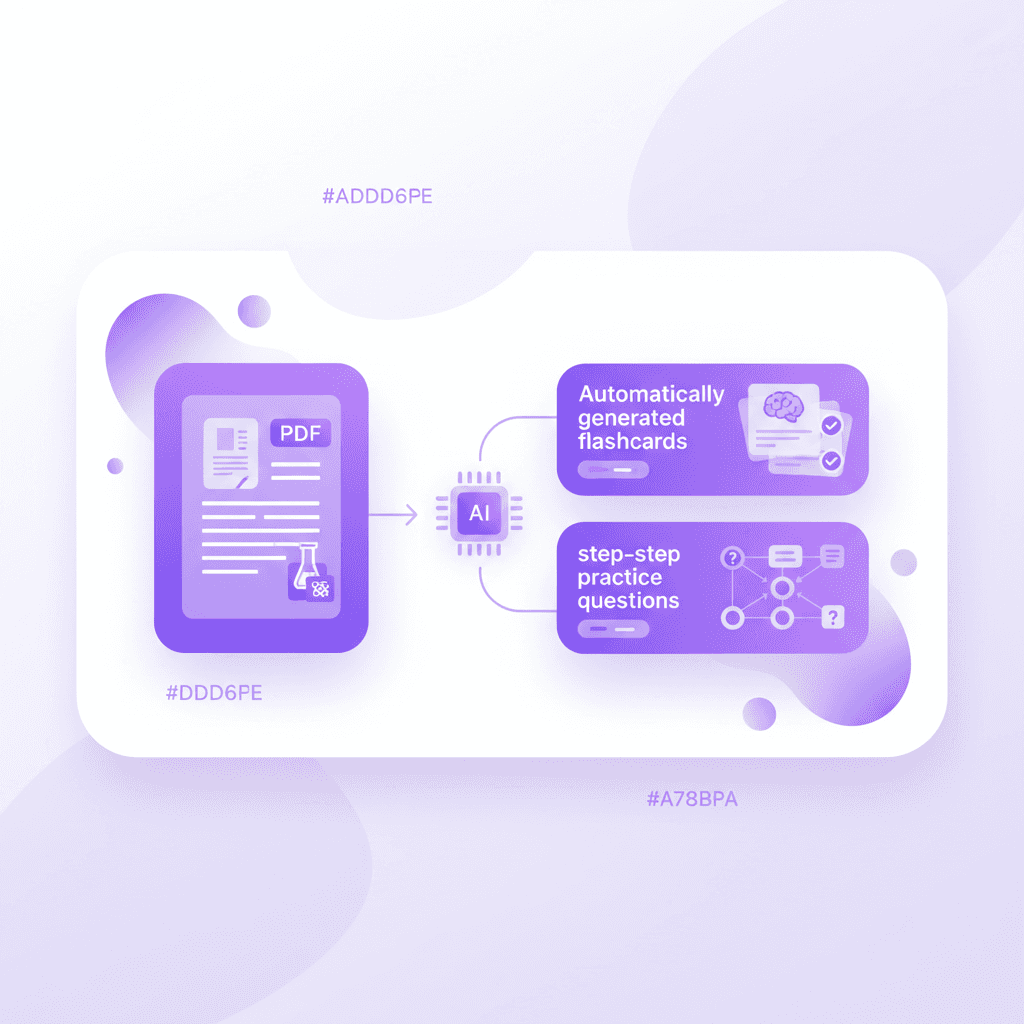
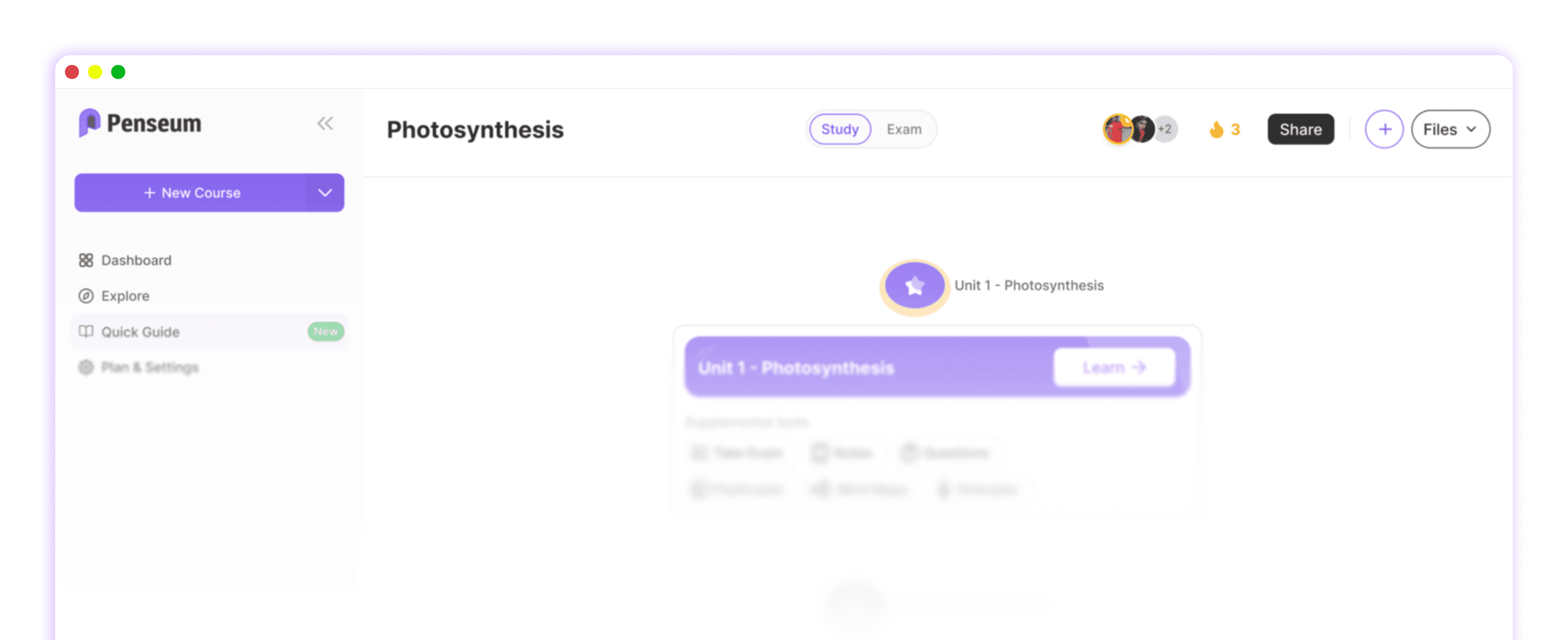
Penseum keeps all your study tools and progress metrics in one synchronized workspace. The system automatically creates a complete study roadmap—including flashcards and practice exams—designed specifically for learning, practice, and long-term retention.
Automated Study Tools vs. Manual Preparation
Feature | Penseum AI Platform | Manual Prep (Anki/Excel) | General AI Tools |
|---|---|---|---|
Material Generation | Instant from uploaded PDFs | 2-4 hours per chapter | Generic, unverified text |
Active Recall Setup | Automated flashcards & quizzes | Highly manual data entry | Prompt-dependent outputs |
Syllabus Alignment | Exact match to your uploads | Requires constant adjusting | Rarely follows specific curricula |
Step-by-Step Logic | Included for missed questions | Requires external tutor | Prone to hallucinations |
Cost | Free tier available (Premium $14.99) | Free (High time cost) | Variable subscriptions |
Penseum is completely free to use, offering immediate access to automated flashcards and study guides. For students needing extensive document uploads and advanced features during peak MCAT prep season, a premium subscription is available for $14.99. Stop fragmenting your workflow across scattered applications and let automated intelligence drive your daily practice.
Frequently Asked Questions
Is 3 months enough for an MCAT study schedule?
Yes, three months is a sufficient timeframe if you can study full-time. A 12-week schedule requires dedicating 25 to 30 hours per week to reach the recommended 300 to 350 total study hours. Part-time studiers balancing university classes should opt for a six-month timeline instead to avoid severe burnout while preparing.
How many hours a day should I study for the MCAT?
Most successful test-takers study three to four hours per day over a four to six-month period. Attempting to study more than six hours daily often leads to diminishing returns and cognitive fatigue. Consistency and active recall yield better score improvements than unpredictable marathon study sessions for your MCAT study schedule.
When should I start studying for the MCAT?
You should start your MCAT preparation three to six months before your scheduled exam date. Begin by taking a half-length diagnostic test to establish your baseline score. This timeline allows enough room to thoroughly review prerequisite science content while completing thousands of practice questions and official AAMC materials.
Is a free MCAT study schedule effective?
A free MCAT study schedule is highly effective if it incorporates official AAMC materials and rigorous practice banks. Many top-scoring students utilize free planning templates and AI-powered study tools with free tiers to structure their preparation. Success depends entirely on your discipline, consistency, and active engagement with the study materials.
What is the hardest section of the MCAT to schedule prep for?
The Critical Analysis and Reasoning Skills (CARS) section is traditionally the most difficult area to schedule preparation for because it relies entirely on reading comprehension rather than memorized science facts. Students must incorporate daily CARS practice passages into their schedules from day one to slowly build analytical reasoning skills.
How long does it take to review an MCAT practice exam?
Reviewing an MCAT practice exam should take one to one-and-a-half times the length of the actual test, roughly eight to ten hours. You must meticulously analyze every single question, including the ones you answered correctly, logging misunderstandings into an error tracker to prevent making the exact same mistakes again.
[AUTHOR]
Last updated: March 2026
Sources
Association of American Medical Colleges (AAMC). (2022). Post-MCAT Questionnaire: How Examinees Prepare for the MCAT Exam. https://www.aamc.org/
Murre, J. M. J., & Dros, J. (2015). Replication and Analysis of Ebbinghaus’ Forgetting Curve. PLOS ONE, 10(7), e0120644. https://pubmed.ncbi.nlm.nih.gov/26148023/
Dunlosky, J., Rawson, K. A., Marsh, E. J., Nathan, M. J., & Willingham, D. T. (2013). Improving Students’ Learning With Effective Learning Techniques: Promising Directions From Cognitive and Educational Psychology. Psychological Science in the Public Interest, 14(1), 4-58. https://pubmed.ncbi.nlm.nih.gov/26173288/
Roediger, H. L., & Karpicke, J. D. (2006). Test-Enhanced Learning: Taking Memory Tests Improves Long-Term Retention. Psychological Science, 17(3), 249-255. https://pubmed.ncbi.nlm.nih.gov/16507066/
Newport, C. (2016). Deep Work: Rules for Focused Success in a Distracted World. Grand Central Publishing. [NEEDS SOURCE: specific academic journal validation for cognitive hour limits]
Ericsson, K. A., Krampe, R. T., & Tesch-Römer, C. (1993). The role of deliberate practice in the acquisition of expert performance. Psychological Review, 100(3), 363–406. https://scholar.google.com/scholar?q=The+role+of+deliberate+practice+in+the+acquisition+of+expert+performance
Penseum Platform Internal Data. (2023). User Engagement and Automated Study Analytics. https://penseum.com/
Related guides
Ready to study smarter?
Start turning your notes into guides, quizzes, and flashcards in seconds.