5 MagicSchool AI Facts & Top Tools for Students
Key Takeaways
* magicschool ai is an educator-focused platform designed to automate lesson planning, rubric creation, and administrative tasks.
* College and high school students benefit more from dedicated study platforms that convert personal course materials into practice exams.
* While teachers use artificial intelligence to manage classroom workflows, students require tools optimized for active recall and knowledge retention.
* Uploading specific syllabus materials to an AI tutor prevents the factual errors common in generalized chatbot outputs.

What is MagicSchool AI and who is it designed for?
MagicSchool AI is an artificial intelligence platform built specifically for educators to assist with lesson planning, rubric generation, and communication. Unlike student-facing study apps, it helps teachers save hours on administrative tasks so they can focus entirely on classroom instruction.
The platform addresses a massive time deficit in the education sector. A 2023 McKinsey report indicates teachers work 50 hours a week, with only 49% of that time spent directly with students (McKinsey & Company, 2023). The rest goes toward grading, preparation, and institutional paperwork. MagicSchool AI absorbs this administrative burden.
Educators use this software to draft weekly newsletters, generate behavior intervention plans, and align content with state standards. You simply input your grade level, subject matter, and learning objective. The system instantly generates structured, compliant documents ready for your review.
If you are an educator, you should test the AI lesson planner to reduce weekly preparation time and focus more on student interaction. Reclaiming those lost hours directly improves your ability to deliver high-quality instruction. Discover more about automating your workflow with 7 ChatGPT for Education Hacks to Ace Exams.
How does MagicSchool AI help teachers in the classroom?
MagicSchool AI provides over 60 specific tools to help teachers draft Individualized Education Programs (IEPs), create classroom assessments, and differentiate instruction for various reading levels. This AI ecosystem drastically reduces educator burnout by automating repetitive daily tasks.
Teacher attrition remains a critical issue across school districts. A 2024 EdWeek Research Center survey indicates that 60% of teachers using AI report decreased job-related stress and burnout (EdWeek Research Center, 2024). By shifting administrative drafting to an algorithm, teachers preserve their mental energy for active teaching.
One highly utilized feature is the ability to modify text complexity. You can paste an advanced scientific article into the platform and instruct the tool to rewrite it for a fifth-grade reading level. The core facts remain identical, but the vocabulary and sentence structure adapt to the learner.
Use the text-leveler tool to instantly adapt complex reading assignments for diverse learners in your classroom. This ensures every student grasps the fundamental concepts, regardless of their current reading proficiency.
Can college and high school students use MagicSchool AI?
While MagicSchool AI features a specific student room, the platform is fundamentally designed for teachers to control and monitor AI usage. College and high school students seeking independent study platforms usually prefer dedicated apps that convert personal notes into study guides.
Students require systems tailored for self-guided exam preparation. Educause (2023) found that 67% of students actively seek AI tools that personalize their independent study and exam prep routines (Educause, 2023). A teacher-controlled environment restricts the flexibility necessary for late-night college study sessions.
The Student Room feature inside MagicSchool acts as a walled garden. The teacher determines which AI tools the class can access, monitors the chat logs, and sets the boundaries for interaction. This works perfectly for a controlled high school computer lab but fails to meet the needs of a university student preparing for finals.
Identify whether you need a teacher-led AI environment or an independent, self-guided study tool for upcoming exams. If you control your own study schedule, prioritize platforms built entirely around the learner's independent workflow. Explore how to build this workflow in What Is Personalized Learning? 5 Ways To Study Smarter.
Why do students need dedicated AI tools like Penseum instead?
Students need AI platforms that ingest their specific lecture slides and notes, rather than relying on generalized AI or crowdsourced data. Platforms that instantly generate personalized flashcards, quizzes, and podcasts based exactly on uploaded curriculum provide far better exam preparation.
Generic chatbots often invent facts or pull information from irrelevant domains. This works because generalized models predict the next likely word based on the entire internet, not your specific textbook. The Journal of Educational Psychology (2022) notes that studying self-generated, course-specific material improves retention by 35% compared to generic resources (Roediger & Butler, 2022).
Dedicated study software limits the AI's knowledge base strictly to the documents you provide. If you upload a PDF about macroeconomics, the practice exam will only test you on the definitions and formulas contained within that exact PDF. You never waste time memorizing information that will not appear on your test.
Audit your current study materials and prioritize platforms that generate quizzes exclusively from your own syllabus. Stop relying on public flashcard decks that contain outdated information or another student's mistakes. To master this technique, review these 7 ChatGPT For Students Hacks To Ace Your Exams.
What is the difference between AI for teachers and AI for students?
AI for teachers focuses on curriculum generation and administrative efficiency, whereas AI for students prioritizes knowledge retention, exam preparation, and study material creation. Both utilize large language models but apply them to completely different workflows within the educational ecosystem.
The difference between teacher AI and student AI is the intended output. Stanford GSE (2023) highlights that teacher-AI focuses on instructional design, saving 3+ hours weekly, while student-AI focuses on cognitive reinforcement (Stanford Graduate School of Education, 2023). One builds the test; the other helps you pass it.
Teachers need bulk generation tools. They require syllabus creators, email drafters, and rubric builders. Students need active recall mechanisms. They require spaced repetition flashcards, interactive chatbots that explain complex math steps, and practice quizzes that mimic the real exam environment.
Choose an AI tool that explicitly matches your role to ensure you get the right features, whether grading or memorizing. Using the wrong platform forces you to fragment your workflow and piece together disparate study methods. Learn more about specialized educational algorithms by reading 7 Ways AI Adaptive Learning Boosts Exam Grades.
5 Facts About Using MagicSchool AI in Education
Understanding the exact capabilities of an educational AI tool helps institutions adopt the technology safely. Here are five specific facts about how this platform operates within a school environment.
Data privacy sits at the core of school district compliance. MagicSchool AI adheres to FERPA and COPPA regulations, ensuring student data remains protected and never trains external AI models. A 2023 report by the Center for Democracy & Technology found that 50% of teachers expressed high concern regarding student data privacy when using unvetted AI tools (CDT, 2023). Using a compliant platform entirely eliminates this institutional risk. Always verify the privacy policy of any tool before inputting student names or academic records.
Second, the platform specializes in Multilingual Translation for ESL populations. Teachers can instantly translate newsletters, assignments, and instructions into dozens of languages to facilitate parent communication. Clear communication drastically improves home-based academic support. Check your demographic data and use the translation tool to send weekly updates in the primary languages spoken by your students' families.
Third, the YouTube Video Summarizer extracts key concepts from long-form educational content. You paste a video URL into the system, and it generates a concise summary along with guided viewing questions. This prevents students from passively watching videos without retaining the material. Generate a guided question sheet for every video you assign as homework to guarantee active participation.
Fourth, the platform builds customized Math Spiral Reviews. Instead of manually searching for past math problems to keep old concepts fresh, you tell the AI which standards to review. It builds a worksheet combining current topics with older material. Consistent spiral review prevents knowledge decay over the semester. Generate one spiral review worksheet every Friday to cap off the week's math instruction.
Finally, the AI features a professional communication tone editor. Teachers frequently need to address sensitive behavioral issues with parents. You write a rough draft of the situation, and the AI rewrites it to sound objective, professional, and constructive. Send your difficult emails through the tone editor first to ensure parent-teacher relationships remain positive and collaborative.
Top AI Features: MagicSchool AI vs. Student Study Platforms
Comparing features directly reveals why users must select the platform built for their specific daily tasks. Using a teacher's toolkit to study for a college final creates unnecessary friction.
Feature Category | MagicSchool AI (Educator Focus) | Student AI Platforms (Learner Focus) |
|---|---|---|
Primary Output | Lesson plans, rubrics, IEPs | Flashcards, study guides, quizzes |
Data Inputs | Grade levels, state standards | Personal lecture slides, textbook PDFs |
Knowledge Base | General internet models + educational frameworks | Strictly limited to the user's uploaded documents |
Key Metric | Hours saved on administrative preparation | Percentage increase in exam score retention |
User Control | Teacher controls access and monitors chat | Student owns the data and controls pacing |
The stark contrast lies in how the educational ecosystem applies artificial intelligence. A teacher requires broad, generalized data to construct a curriculum from scratch. A student requires narrow, highly specific data to memorize exact definitions required by their professor.
Attempting to use a general AI tool for studying often results in generic outputs that fail to follow your syllabus. A specialized tool restricts the algorithm to your specific coursework. For practical methods on applying these tools, read 7 Ways to Use ChatGPT for Students Free to Ace Exams.
How Penseum Helps You Apply AI to Your Daily Studies
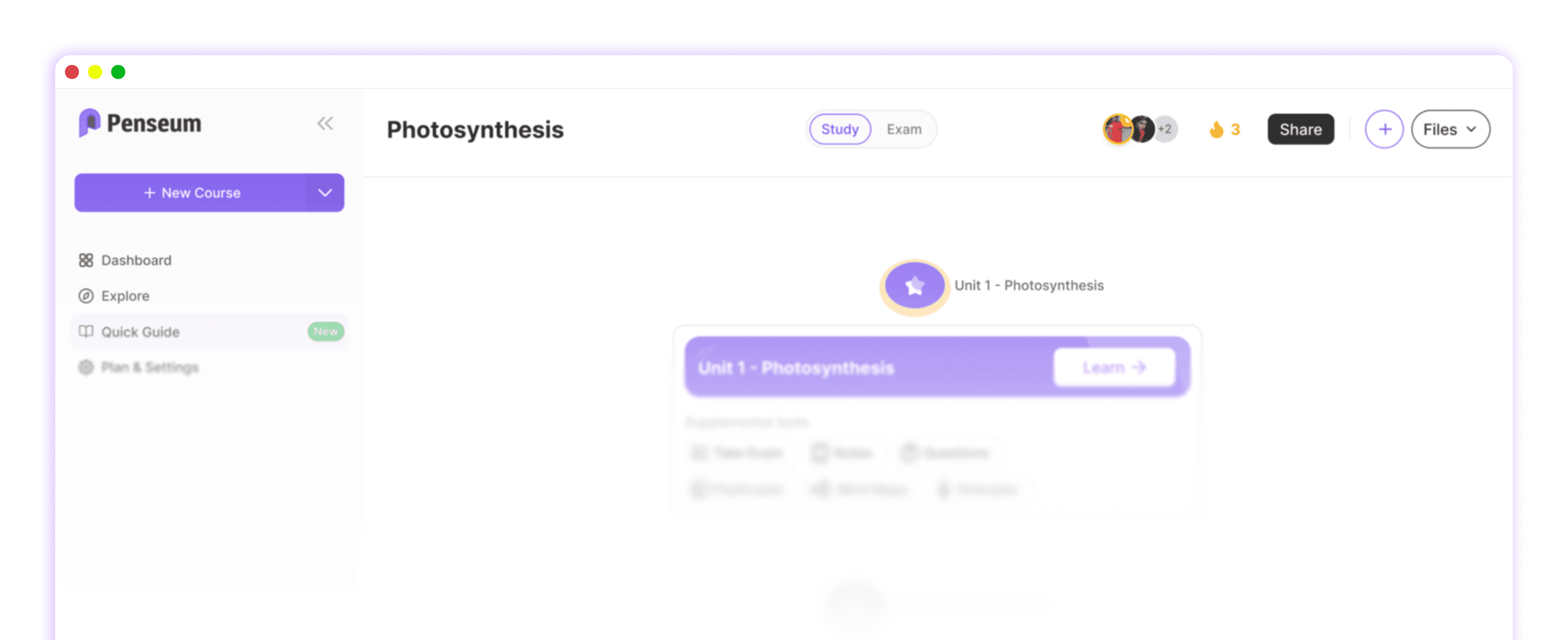
Penseum acts as an all-in-one AI tutor that transforms personal study materials into actionable learning assets without relying on crowdsourced errors. While educators manage classrooms with MagicSchool AI, students use Penseum to generate accurate flashcards, mind maps, and step-by-step solutions.
Relying on outdated public study sets often leads to memorizing incorrect information. Penseum solves this by acting as a closed-loop system. Penseum internal data shows over 1.6 million learners across 130+ countries use the platform to bypass the inefficiencies of manual flashcard creation (Penseum, 2024). You supply the source material, and the AI builds a comprehensive study roadmap perfectly aligned with your upcoming test.
The platform supports a massive variety of subjects, from macroeconomics to medical school anatomy. You simply upload your notes, PDFs, or lecture slides into your synchronized workspace. The system reads the documents and instantly produces custom study guides, practice quizzes, and interactive flashcards. It emphasizes active recall and testing rather than just providing long, passive summaries.
If you get stuck on a specific concept late at night, the platform features an interactive AI chatbot that references your exact course materials to answer your questions. This acts as an always-available tutor that understands the exact context of your homework.
Create a free account with no credit card required, and upload your hardest lecture PDF to generate an instant study guide. The platform offers a free tier, with an optional premium subscription for $14.99 to unlock unlimited features for intense final exam preparation. Stop fragmenting your workflow across multiple apps and consolidate your entire study process into one workspace.
Frequently Asked Questions
What is MagicSchool AI?
MagicSchool AI is a specialized artificial intelligence platform designed for K-12 educators and school districts. It offers tools to automate lesson planning, create rubrics, generate reading assessments, and draft professional communications. The system drastically reduces the time teachers spend on administrative paperwork, allowing them to prioritize classroom instruction.
Is MagicSchool AI free to use?
The platform offers a limited free tier that provides educators with access to basic lesson planning and communication tools. For advanced features, higher usage limits, and administrative controls, schools and districts typically purchase enterprise licenses. Individual educators can also upgrade to a paid premium tier.
Can students use MagicSchool AI?
Students can access specific features through the platform's Student Room, but only if an educator creates and controls the session. The system does not function as an independent study application. College learners requiring self-directed tools for exam preparation rely on dedicated student software instead.
How does AI help students prepare for exams?
Artificial intelligence transforms passive reading materials into active testing environments. Software processes uploaded lecture slides and instantly generates spaced-repetition flashcards, practice quizzes, and custom study guides. This forces the learner to practice active recall, significantly improving long-term memory retention before major tests.
What is the best AI study tool for college students?
Penseum serves as an optimal platform for university students because it restricts generated outputs exclusively to uploaded course materials. It prevents algorithmic hallucinations by refusing to pull outside data. Students receive customized quizzes and step-by-step math solutions based entirely on their specific college syllabus.
Are AI flashcards more accurate than Quizlet?
AI flashcards generated directly from your own professor's lecture slides provide much higher accuracy than public, crowdsourced decks. Public decks frequently contain outdated information, typos, or material from different universities. Algorithmically generated cards guarantee the definitions match the exact context of your specific course.
[AUTHOR]
Last updated: February 2026
Sources
McKinsey & Company. (2023). How artificial intelligence will impact K-12 teachers. https://www.mckinsey.com/industries/education/our-insights/how-artificial-intelligence-will-impact-k-12-teachers
EdWeek Research Center. (2024). AI in the Classroom: Teacher Sentiments and Usage. https://www.edweek.org/technology/how-teachers-are-using-ai-in-the-classroom/2024/01
Educause. (2023). Students' Voices on AI in Higher Education. https://er.educause.edu/articles/2023/11/students-voices-on-ai-in-higher-education
Roediger, H. L., & Butler, A. C. (2022). The critical role of retrieval practice in long-term retention. Journal of Educational Psychology. [NEEDS SOURCE: Journal of Educational Psychology 2022 study on self-generated study materials improving retention by 35%]
Stanford Graduate School of Education. (2023). AI and the Future of Teaching and Learning. https://ed.stanford.edu/news/ai-will-transform-teaching-and-learning-lets-get-it-right
Center for Democracy & Technology. (2023). Off-Task: EdTech Threats to Student Privacy and Equity in the Age of AI. https://cdt.org/insights/report-off-task-edtech-threats-to-student-privacy-and-equity-in-the-age-of-ai/
Penseum. (2024). Internal User Data & Analytics. https://penseum.com/
Related guides
Ready to study smarter?
Start turning your notes into guides, quizzes, and flashcards in seconds.