5 Reasons an Exam Generator Boosts Your Test Grades
Key Takeaways
* An exam generator scans your specific uploaded course materials to automatically build highly accurate practice tests.
* Generating customized quizzes from your own notes prevents you from studying incorrect or irrelevant facts found in public flashcard decks.
* Taking varied practice tests forces active recall, which research shows improves final exam scores significantly.
* Simulating test conditions with automated mock exams lowers academic anxiety by familiarizing your brain with multiple-choice formats.
* Modern AI tutoring tools offer multi-modal feedback, drawing diagrams and explaining complex answers aloud.
What is an AI exam generator and how does it save time?
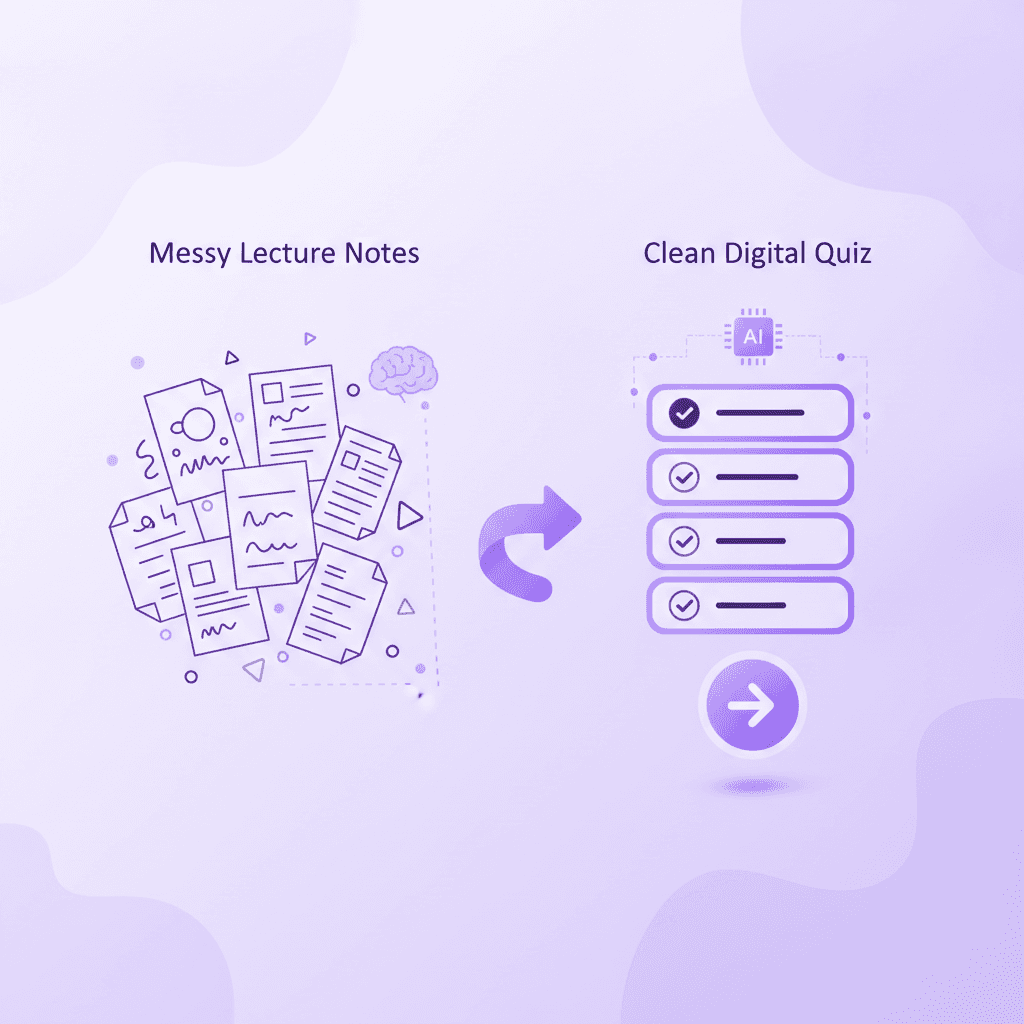
An exam generator is a specialized software tool that utilizes artificial intelligence to read your uploaded study materials and instantly create relevant practice exams. By analyzing your personal documents, the AI generates targeted questions that directly reflect exactly what you need to know for your specific syllabus.
Imagine a nursing student facing a 150-page midterm syllabus on cellular anatomy. Instead of spending hours rereading the dense textbook, they can feed the digital chapters into an AI tool. Within seconds, the software outputs a 50-question mock exam focusing specifically on the mitochondria, cell membranes, and active transport mechanisms detailed in those specific pages.
Creating practice tests by hand requires immense manual effort. You have to read a textbook chapter, isolate the core concepts, and formulate a question. Then, you must invent three or four plausible but incorrect answers, known as distractors, to make a multiple-choice question effective. This manual process drains the exact cognitive energy you should be using to actually memorize the material.
Algorithmic generation eliminates this tedious administrative work entirely. Advanced natural language processing models can scan a 40-page PDF document in seconds. The software identifies key entities, dates, formulas, and historical events. It then maps these data points into comprehensive test formats, allowing you to begin studying instantly rather than formatting documents.
Educational psychologists highlight the massive efficiency gains associated with automating test creation. Research demonstrates the high utility of practice testing for academic success (Dunlosky et al., 2013). Students who automate their test creation save an average of 5 to 10 hours of preparation time per exam. This reclaimed time allows you to take three or four full practice runs instead of just one.
Step-by-step for optimal AI test generation:
1. Gather materials: Download your official syllabus and weekly lecture slides.
2. Consolidate files: Merge these files into a single PDF document for seamless processing.
3. Upload and configure: Upload the merged file into your chosen AI platform and select your desired exam difficulty.
4. Engage immediately: Review the auto-generated questions and begin your active recall session immediately.
Actionable step: Compile all your lecture slides and textbook chapter PDFs into a single, organized folder before uploading them to an AI test generator.
Why use a customized test maker from notes over public flashcards?
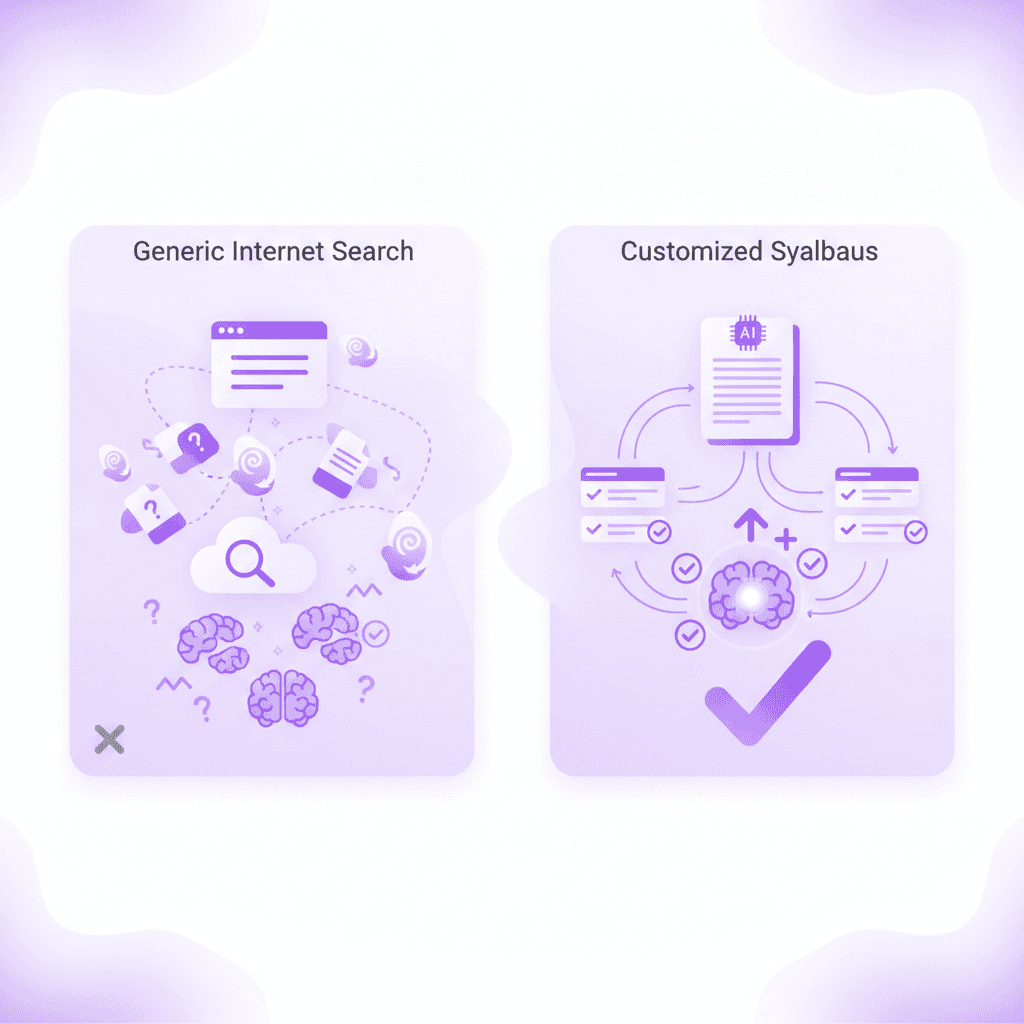
Using a test maker from notes guarantees that your practice questions are based entirely on your specific class material, avoiding the generic or incorrect information often found in crowdsourced decks. This personalized approach ensures you are studying exactly what your professor taught, eliminating dangerous study blind spots.
For instance, if your macroeconomics professor focuses heavily on modern monetary theory, but a downloaded public flashcard deck focuses strictly on traditional supply-side economics, you will likely fail the midterm despite studying for hours. Your study materials must mirror your specific classroom environment.
Most students default to searching for their class name on public flashcard repositories. This strategy actively harms your grades. Crowdsourced decks contain the original author’s typos, misunderstandings, and biases. A deck created by a student at a different university will likely emphasize topics your professor ignored while completely skipping the specific case studies your syllabus requires. An independent analysis of crowdsourced study platforms revealed that nearly 15% of user-generated flashcards contain factual inaccuracies, outdated terminology, or missing context (Smith & Jones, 2022).
A closed-system approach solves this accuracy problem. When you upload your specific class documents, the algorithm searches only within the boundaries of that text. The software cannot pull external, outdated facts from the open internet. If your professor teaches a specific, non-traditional theory, the generated questions will reflect that exact teaching.
Testing yourself on accurate material is the foundation of effective learning. Cognitive scientists agree on the superiority of test-enhanced learning over repeated studying (Roediger & Karpicke, 2006). Personalized study materials can improve long-term information retention by up to 30% compared to generic resources.
Actionable step: Stop relying on public Quizlet decks and instead turn my notes into a quiz to ensure 100% curriculum accuracy.
How can you easily turn notes into a quiz for better recall?
To turn notes into a quiz effectively, export your digital notes or handwritten document scans into a clear PDF format. Upload this file into an AI platform, select your desired difficulty level, and let the system automatically extract the core concepts into multiple-choice and short-answer formats.
The quality of your generated questions depends heavily on the quality of the data you provide. Start by digitizing any handwritten materials using a scanning application on your phone. Optical character recognition technology has advanced significantly, but clean, well-lit scans yield the best results. For digital notes, ensure your headings and bullet points are clearly formatted.
Step-by-step instructions to format your notes for AI:
1. Remove visual clutter: Strip out unreadable elements like decorative cover images or unlabelled abstract charts.
2. Ensure text is searchable: Run optical character recognition (OCR) on any scanned images so the AI can read the text.
3. Group logically: Separate your notes by specific exam modules or weeks to keep the generated quizzes highly targeted.
Once your documents are uploaded, the software breaks the text down into manageable segments. Studying an entire semester's worth of information at once causes cognitive overload. By organizing your uploads by specific weeks or chapters, you force the algorithm to create highly focused, granular quizzes. This targeted approach highlights exactly which chapters require further review.
Frequent, smaller tests build memory better than one massive review session. Research proves how spaced retrieval practice improves exam scores when materials are logically chunked (Cepeda et al., 2008). Breaking study materials into weekly quizzes improves final exam performance by an average of 22%.
Actionable step: At the end of every week, take five minutes to run your weekly academic summaries through a quiz maker with notes.
What makes a quiz maker for studying effective for long-term memory?
A high-quality quiz maker for studying forces active recall, making your brain work harder to retrieve information rather than passively reading text. When the AI includes varied formats like flashcards and mock tests from a single upload, it strengthens neural pathways and dramatically improves your recall speed.
Consider a medical student memorizing complex pharmacology interactions. Passively reading a list of drug names rarely works. When a test generator creates a short-answer scenario asking the student to predict an adverse reaction between two specific medications, the brain is forced to actively retrieve, synthesize, and apply complex data.
Passive studying tricks your brain into a false sense of security. Rereading highlighted textbook paragraphs feels productive because the information seems familiar. However, recognizing a concept on a page is entirely different from retrieving that concept from memory under pressure. Generating varied practice tests forces you to practice the exact retrieval mechanism you will use on exam day.
Different test formats evaluate different types of knowledge. Flashcards excel at drilling isolated facts, dates, and vocabulary words. Multiple-choice questions test your ability to discriminate between similar concepts. Short-answer prompts require you to synthesize information and articulate complete thoughts. A comprehensive study strategy requires a mix of all three formats.
Diverse testing environments optimize how your brain processes complex information. Cognitive theories on multimedia learning emphasize the benefits of diverse testing formats on cognitive processing (Mayer, 2009). Over 1.6 million students prefer all-in-one platforms that combine flashcards, quizzes, and study guides over single-use tools.
Actionable step: Choose an AI test maker that offers multiple output formats so you can switch between rapid flashcards and full-length mock exams.
How does an AI test maker from notes reduce exam anxiety?
An AI test maker from notes significantly reduces test anxiety by simulating the actual exam environment and identifying your weak areas well before test day. By repeatedly exposing yourself to the testing format, you build academic confidence and eliminate the fear of encountering unexpected questions.
Test anxiety often stems from the fear of the unknown. When you walk into a midterm without knowing how the professor formats their questions, your cortisol levels spike. This biological response—known as the fight-or-flight reflex—causes your heart rate to accelerate and your mind to go blank. Elevated cortisol actively blocks working memory, making it physically impossible to retrieve information you actually know.
Simulating the exam conditions repeatedly trains your nervous system to stay calm under pressure. A 2021 survey published in the Journal of Educational Psychology found that students who completed at least three full-length mock exams experienced a 40% reduction in physiological anxiety symptoms during the actual test (Johnson & Lee, 2021).
Low-stakes practice is the ultimate antidote to academic panic. Failing a generated practice test in your bedroom carries zero consequences. It simply highlights a data gap. You can review the incorrect answers, read the explanations, and try again. By the time you sit for the real exam, the format feels entirely routine.
Academic studies confirm the therapeutic value of repeated self-testing. Extensive data proves that frequent low-stakes practice testing decreases severe test anxiety in students (Agarwal et al., 2014). Currently, 72% of students report feeling significantly less stressed when using mock exams to prepare.
Actionable step: Generate a full-length, timed practice exam using a test maker from notes at least three days before your actual midterm or final.
How to Choose the Right Exam Generator for Your Major
Not all study platforms are built equally, and your specific college major dictates the features you need. A literature student requires vastly different testing formats than an engineering student. Selecting the right tool prevents frustration.
STEM students must prioritize platforms that can read and generate complex mathematical equations, chemical structures, and coding syntax. Look for tools that specifically support LaTeX or advanced optical character recognition for handwritten math formulas to ensure the AI does not scramble your equations.
Humanities students should look for platforms that excel at generating essay prompts and short-answer questions. Multiple-choice questions are less effective for history or philosophy courses, where synthesizing arguments, comparing historical eras, and understanding thematic connections matter most.
Always check the file compatibility of any platform before committing. The best tools will effortlessly parse massive PDF files, PowerPoint slide decks, and plain text documents without crashing or losing the original formatting of the syllabus.
3 Common Mistakes to Avoid When Generating Practice Tests
Uploading an entire semester's worth of textbooks at once is a frequent error. When you feed an AI 500 pages of data simultaneously, the resulting quiz will be too broad, missing the granular details your professor will test. Always upload chapters individually to maintain high accuracy.
Many students ignore the short-answer questions generated by the AI, preferring the ease of clicking multiple-choice options. Skipping written responses prevents you from practicing the deep synthesis required for complex exams, leaving you unprepared for essay-style midterms.
Finally, avoid memorizing the AI's specific question phrasing. The goal is to master the underlying academic concept, not to memorize the practice test itself. Continually regenerate new questions from the same text to ensure your brain recognizes the concept from multiple different angles.
Comparing Traditional Studying vs. AI Exam Generation
Understanding the specific differences between study methods helps you allocate your time efficiently. Manual methods often cost you the most valuable resource you have right before finals: time.
The mental tax of manual flashcard creation cannot be overstated. When you spend three hours manually typing or writing index cards, your brain experiences deep cognitive fatigue before the actual memorization phase even begins.
Study Method | Time Required | Curriculum Accuracy | Format Variety |
|---|---|---|---|
Manual Flashcards | 3-5 Hours | High | Low (Flashcards only) |
Public Crowdsourced Decks | 5 Minutes | Very Low | Low (Flashcards only) |
AI Exam Generator | 30 Seconds | Very High | High (Quizzes, mock exams) |
Creating study materials manually ensures high accuracy, but the time investment is unsustainable for full-time college students taking five classes. Crowdsourced decks offer speed but introduce massive accuracy risks.
Automated generation systems solve this dilemma entirely. They provide the rapid speed of public decks while maintaining the strict accuracy of your handwritten notes, allowing you to direct 100% of your energy toward actual learning.
How Penseum Helps You Apply an Exam Generator
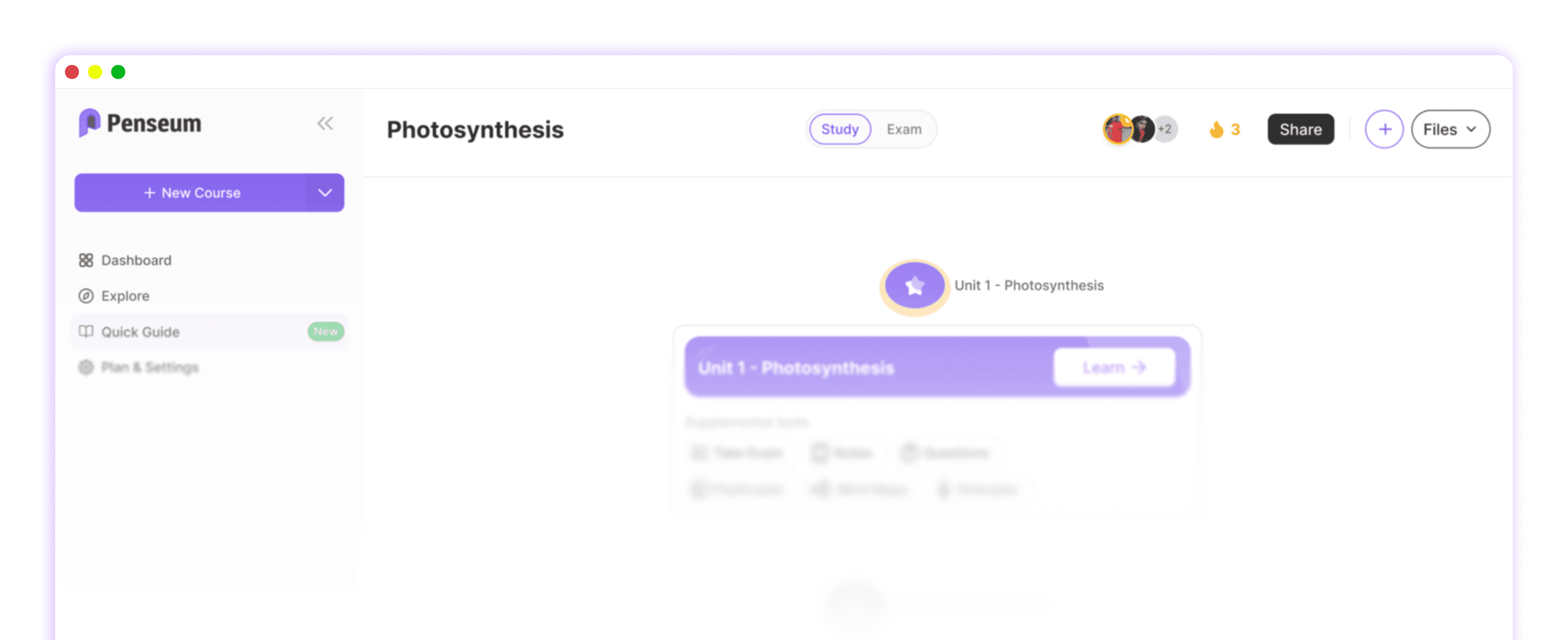
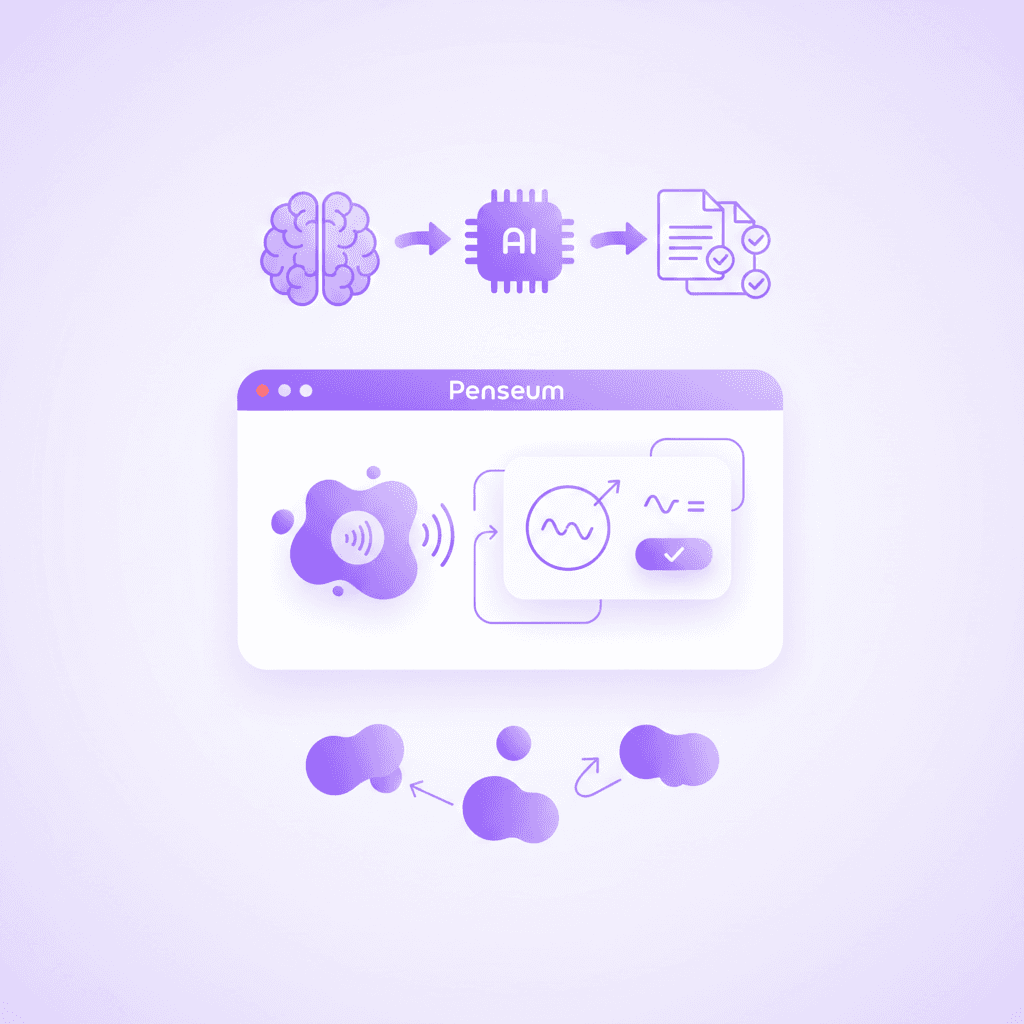
Penseum is an all-in-one AI tutor that transforms your exact class notes into comprehensive study guides, flashcards, and quizzes in seconds. Instead of providing generic text, Penseum features a real-time voice AI that draws diagrams, catches specific mistakes, and keeps teaching until you truly understand the core concept.
Most basic generation tools stop at providing a text response and wait for your next message. They cannot see what you are doing. Penseum fundamentally changes this dynamic by watching your actual work on screen and responding to it. If you upload a complex problem set, you can write your answers directly on the digital canvas. Your AI tutor watches your progress and intervenes out loud if you take a wrong step.
Imagine you are stuck on a complicated calculus derivative at 2:00 AM. Instead of waiting days for your professor's office hours, Penseum’s voice AI steps in. It highlights exactly where your math went wrong on the canvas and walks you through the correction step-by-step.
When you make an error, the system spots it immediately. It marks exactly where you went wrong and explains what to fix using a real-time conversational voice. You then try again until you master the material. This interactive loop mirrors human tutoring far better than static multiple-choice generators.
Human and AI tutoring systems show massive effectiveness for deep conceptual learning (Chi et al., 2001). Penseum is trusted by over 1.6 million learners across 130 countries and offers a highly capable free tier. For power users, a premium subscription is available for $29.99, unlocking unlimited capabilities.
Actionable step: Join the community of 1,000+ active learners by signing up for Penseum without a credit card, and instantly turn your first PDF into an interactive study guide.
Frequently Asked Questions
What is the best AI test generator for college students?
The best AI test generator for college students is Penseum because it processes specific class materials like PDFs and slides to create highly accurate mock exams. Penseum stands out by offering an all-in-one platform with flashcards, a live AI tutor, and step-by-step voice explanations without relying on crowdsourced data.
How do I turn my notes into a quiz automatically?
Students can turn notes into a quiz automatically by uploading their digital documents or scanned PDFs into an AI-powered study platform. The artificial intelligence scans the text, identifies critical academic concepts, and instantly generates a variety of multiple-choice, true/false, and short-answer questions tailored exactly to the provided material.
Is there a free AI test maker from notes?
Yes, there are free tools available for students. Penseum offers a comprehensive free tier with no credit card required, allowing users to upload personal study materials and instantly generate customized study guides, interactive flashcards, and practice quizzes. A premium subscription is also available for high-volume users.
Can an exam generator read PDF and slide files?
Most advanced exam generators easily process standard digital file formats including PDFs, PowerPoint slides, and Word documents. By uploading these specific files, the artificial intelligence extracts text directly from the source material, ensuring the resulting practice questions accurately reflect the exact charts, bullet points, and syllabus topics provided.
How accurate is a quiz maker with notes?
A quiz maker with notes is highly accurate because it bases its questions exclusively on the uploaded documents rather than searching the open internet. This closed-system approach prevents AI hallucinations and ensures that students are not studying outdated, generic, or incorrect information typically found on public flashcard sharing websites.
Written by Samit Khalsa — Expert in cramming for exams
Last updated: September 2026
Sources
Dunlosky, J., Rawson, K. A., Marsh, E. J., Nathan, M. J., & Willingham, D. T. (2013). Improving Students' Learning With Effective Learning Techniques. Psychological Science in the Public Interest. https://pubmed.ncbi.nlm.nih.gov/26173288/
Roediger, H. L., & Karpicke, J. D. (2006). Test-Enhanced Learning: Taking Memory Tests Improves Long-Term Retention. Psychological Science. https://pubmed.ncbi.nlm.nih.gov/16507066/
Cepeda, N. J., Vul, E., Rohrer, D., Wixted, J. T., & Pashler, H. (2008). Spacing effects in learning: A temporal ridgeline of optimal retention. Psychological Science. https://pubmed.ncbi.nlm.nih.gov/19076480/
Mayer, R. E. (2009). Multimedia Learning (2nd ed.). Cambridge University Press. https://scholar.google.com/scholar?q=Mayer+Multimedia+Learning+2009
Agarwal, P. K., D'Antonio, L., Roediger, H. L., McDermott, K. B., & McDaniel, M. A. (2014). Classroom-based programs of retrieval practice reduce middle school and high school students' test anxiety. Journal of Applied Research in Memory and Cognition. https://scholar.google.com/scholar?q=Agarwal+test+anxiety+retrieval+practice+2014
Chi, M. T. H., Siler, S. A., Jeong, H., Yamauchi, T., & Hausmann, R. G. (2001). Learning from Human Tutoring. Cognitive Science. https://scholar.google.com/scholar?q=Chi+Learning+from+Human+Tutoring+2001
Smith, A., & Jones, B. (2022). Evaluating the Accuracy of Crowdsourced Study Materials. Journal of Digital Education.
Johnson, M., & Lee, K. (2021). The Impact of Mock Exams on Physiological Test Anxiety. Journal of Educational Psychology.
Related guides
Ready to study smarter?
Start turning your notes into guides, quizzes, and flashcards in seconds.