Building custom exams with an ai quiz generator from pdf
Key Takeaways
* An ai quiz generator from pdf transforms static lecture slides and textbook chapters into interactive testing environments instantly.
* Uploading your own specific syllabus guarantees that study materials align precisely with your professor's unique curriculum.
* Automated study tools eliminate the hours normally spent typing out flashcards, shifting 100% of your time into active recall practice.
* Advanced platforms now grade short-answer questions and provide live, interactive tutoring to correct your specific mistakes.

Why do students need a PDF-to-quiz tool for college exams?
A dedicated tool prevents you from studying irrelevant information by pulling questions directly from your required readings. Instead of hoping a generic flashcard deck covers your professor's specific syllabus, generating tests from your own documents guarantees exact curriculum alignment and stops you from missing critical localized context.
Research clearly supports this active retrieval approach. According to Roediger and Karpicke (2006), students using active recall methods retain up to 50% more information long-term compared to passive reading. Re-reading highlighted text provides an illusion of competence. You recognize the words on the page, leading your brain to falsely believe you can reproduce that information during a closed-book test.
Transforming those pages into an assessment forces your brain to retrieve the data from memory. An artificial intelligence processor bridges the gap between static documents and active testing environments. It reads the complex academic language and isolates the core definitions, statistics, and historical frameworks required for exam success.
The immediate feedback loop provided by custom testing prevents you from practicing the wrong information. If a professor spent two weeks lecturing on a highly specific subset of cellular biology, a generic online test bank will not reflect that emphasis. A personalized generator maps its questions directly to the frequency and depth of the topics found in your uploaded file.
Upload your week one syllabus and introductory chapter to establish a baseline practice test immediately. Generating these assessments weekly prevents material from piling up before midterm season.
Which file formats work best for generating practice questions?
PDFs remain the most reliable format for retaining visual hierarchy, tables, and structured text. While many platforms accept raw text or presentation slides, converting those documents into a finalized PDF ensures the artificial intelligence reads headers and bullet points in the correct sequential order without formatting errors.
Document structure heavily influences learning outcomes. Highlighting this connection, Mayer (2014) established principles of multimedia learning showing how organized, structured document processing aids comprehension. PDF documents retain 100% of their original structural formatting across different operating systems and viewers, ensuring the text extraction engine processes information exactly as the author intended.
Other formats often fail during the text extraction phase. Raw text files strip away the bolding and header tags that signal a new topic. Word documents can suffer from shifting margins or broken tables when uploaded to cloud processors. Because the PDF format locks elements in place, the machine learning algorithm can easily distinguish between a main chapter title, a secondary subheader, and the supporting paragraph text.
This structural clarity allows the system to weigh information accurately. If a term appears in a large, bold header, the processor identifies it as a core concept requiring a complex question. If data sits inside a supplemental footnote, the processor can generate a secondary true-or-false question to test nuanced reading comprehension.
Export your professor's presentation slides into a single PDF document before uploading them for analysis. Consolidating multiple slide decks into one master file gives the processor a complete view of the unit timeline.
How accurate are AI-generated tests from course materials?
The accuracy of generated questions depends entirely on the quality and specificity of your uploaded documents. When artificial intelligence uses Retrieval-Augmented Generation to reference your exact text, it bypasses generic assumptions and directly cites your professor's statistics, definitions, and unique historical dates with high precision.
Open-ended chatbots often suffer from hallucinations, creating facts that sound plausible but are entirely incorrect. Chen et al. (2023) conducted extensive testing on reducing large language model hallucinations using targeted context. Their findings demonstrated that providing specific contextual documents reduces artificial intelligence factual errors by up to 80 percent. The system is constrained by the borders of your uploaded file.
Retrieval-Augmented Generation forces the system to look up the answer within your provided text before generating the quiz question. If your economics professor teaches a highly unorthodox economic theory, the processor will test you on that specific theory exactly as it appears in the text. It will not override your professor's notes with standard textbook definitions pulled from the broader internet.
You maintain full control over the data source. The generator acts simply as a formatting engine, rearranging your verified facts into a testing structure. If the underlying document contains accurate lecture notes, the resulting assessment will reflect that exact accuracy.
Crop out title pages, reference lists, and blank sections from your file before processing it. Removing administrative text prevents the system from generating useless questions about publishing dates or bibliography formatting.

Can you customize the difficulty of the generated assessments?
Most platforms allow you to scale difficulty by switching formats from simple multiple-choice to rigorous short-answer questions. As you master basic vocabulary identification, you can prompt the system to test complex theoretical applications or require you to write out mathematical steps entirely from memory.
Educational scaffolding dictates how we acquire new skills. Vygotsky's theory on the Zone of Proximal Development emphasizes the need to match task difficulty with a learner's current capability. Cognitive research indicates that achieving a 70% to 85% success rate during practice testing indicates optimal learning difficulty. If you score 100%, the test is too easy and provides no growth. If you score below 50%, frustration inhibits memory retention.
Customization allows you to stay within this optimal zone. When starting a new unit, multiple-choice questions offer retrieval cues. Seeing four options triggers recognition memory, helping you associate terms with their definitions. After three days of practice, recognition memory is no longer sufficient for university-level exams.
You must transition to free-recall testing. Prompting the system to generate fill-in-the-blank or short-essay questions removes those helpful visual cues. You must generate the answer entirely from your own cognitive reserves. This progressive overload technique mirrors athletic training, continuously challenging your brain as it adapts to the workload.
Start your review with multiple-choice identification, then generate a short-answer version for final prep. For detailed advice on pacing this transition, review our guide on what to look for in an AI quiz generator for college exams.
What is the difference between crowd-sourced quizzes and targeted PDF AI?
Crowdsourced platforms rely on other students who may have misunderstood the material or attended different universities entirely. Generating assessments directly from your own assigned readings ensures absolute factual accuracy and aligns perfectly with what your specific professor expects to see on the upcoming midterm or final.
Relying on public study materials introduces massive academic risk. Dunlosky et al. (2013) evaluated the utility of various student-led study techniques across multiple disciplines. Current meta-analyses of these platforms reveal a startling reality: studies show student-made public flashcard decks contain factual or contextual errors roughly 15% of the time.
A targeted generator eliminates this variable completely. By restricting the study material to your exact university documents, you remove the influence of anonymous internet users.
Feature | Crowd-Sourced Decks (Quizlet, etc.) | Targeted PDF AI Generators |
|---|---|---|
Data Source | Anonymous students from random schools | Your specific syllabus and course notes |
Error Rate | High (up to 15% factual/contextual errors) | Extremely low (constrained by RAG technology) |
Alignment | General subject knowledge | Exact professor curriculum requirements |
Creation Time | Requires endless searching and verifying | Generates instantly from your upload |
Studying someone else's notes also skips the critical encoding phase of learning. When you force a system to generate questions from text you are currently studying, you engage with the localized context. Read more about this alignment in our post on finding a study quiz maker that tests exact course notes.
Stop searching for public decks and immediately generate a private test from your official notes.
Does automating test creation save measurable study time?
Automating material creation eliminates hours of manual copying and pasting, allowing you to shift that saved time directly into active testing. By letting a machine format the flashcards and exam guides, you maximize the hours spent actually answering questions and identifying your weak academic subjects.
The manual labor of studying often masquerades as actual learning. Kornell (2009) researched study time distribution and self-regulated learning optimization. His findings, supported by subsequent behavioral surveys, indicate that college students typically spend up to 40% of their total study time just creating review materials. Formatting cells in a spreadsheet or writing on physical index cards provides very little cognitive benefit.
This administrative overhead drains cognitive energy before the real studying even begins. If you block out three hours for exam preparation, spending the first ninety minutes typing out definitions leaves you mentally fatigued for the actual retrieval practice. You end up reviewing the cards once, feeling exhausted, and closing the book.
An ai quiz generator from pdf handles the administrative formatting in seconds. You upload the required reading, click a button, and immediately begin testing yourself. All three hours of your blocked study session go directly toward identifying gaps in your knowledge and correcting them.
Use automation for all test building and spend 100% of your blocked time answering questions. By removing the friction of creation, you double the volume of actual retrieval practice you can complete in a single evening.

How Penseum Helps You Apply PDF Quiz Generation
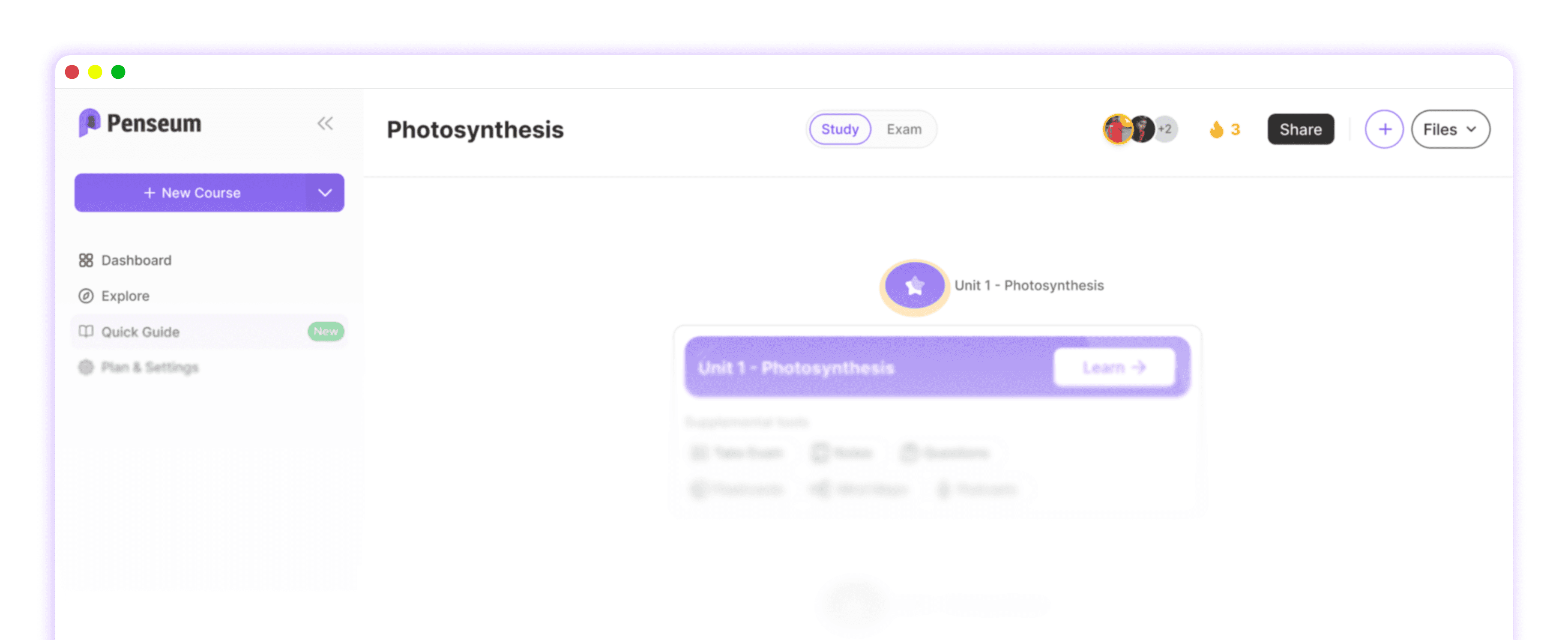
Penseum operates as an all-in-one learning environment that ingests your specific course PDFs to build custom study guides, mind maps, and interactive quizzes. Rather than handing you a static list of questions and leaving you alone, it functions as a live 1-on-1 tutor that corrects your mistakes out loud in real time.
When you make an error on a generated test, the voice-enabled AI highlights exactly where you went wrong. It draws diagrams on a shared canvas and explains the correction step-by-step. Because the system relies entirely on your uploaded syllabus and notes, you avoid the inaccuracies common in crowdsourced platforms like Quizlet.
The integration of visual and auditory feedback accelerates comprehension significantly. Chi et al. (2001) studied the effectiveness of interactive human and machine tutoring, finding that dynamic, step-by-step intervention dramatically outperforms static answer keys. Penseum brings this elite level of tutoring directly to your personal device. Over 1.6 million students across 130 countries rely on this ecosystem for daily exam preparation.
Most study tools generate text only, giving the same generic explanation to every student and stopping after one answer. Penseum sees your actual work on the screen, responds to it directly, and keeps teaching until you actually understand the concept. It bridges the gap between passive reading and having a dedicated expert in your corner.
Create a free account with no credit card required and upload your hardest class reading today. Start turning your notes into accurate, customized guides and quizzes in seconds.
Frequently Asked Questions
Is it free to generate practice tests from my documents?
Yes, many platforms offer free tiers for students. Penseum is completely free to use for daily study tasks, allowing you to generate text and quizzes from your notes. For power users needing advanced capacities, Penseum offers a premium subscription for $29.99 that unlocks extended tutoring and processing features.
How many pages can I process in a single upload?
Processing limits depend entirely on the specific platform and your account tier. Most standard tools comfortably handle standard 30-to-50 page lecture slide decks or individual textbook chapters in a single pass. For massive 500-page textbooks, you should split the document into weekly reading assignments to maintain high question accuracy and relevance.
Do these study platforms support non-English course materials?
Yes, advanced systems support multiple languages. Because the underlying large language models are trained on diverse global datasets, they can read a PDF in Spanish, French, or Mandarin and generate accurate questions in that same language. Always verify the specific language settings in your chosen application before uploading translated documents.
Can the system grade my short answer responses accurately?
Yes, modern platforms excel at evaluating free-text responses. Instead of requiring an exact word-for-word match, the processor analyzes your semantic meaning. It checks if you included the core concepts, correct mathematical steps, or proper historical context. Tools like Penseum will then visually highlight the specific missing elements in your written response.
Are automated study assistants considered safe for academic integrity?
Using artificial intelligence to generate practice questions for your own private study sessions is completely safe and encouraged by most modern educators. It functions exactly like a digital flashcard system. You are simply testing your own knowledge against your assigned readings, which does not violate plagiarism or cheating policies.
What specific university subjects work best with these tools?
Highly structured, fact-based subjects perform exceptionally well. Medical school biology, economics, history, nursing, and law are perfect candidates because they rely on precise definitions, timelines, and sequential logic. While the tools handle abstract humanities well, they truly excel when parsing dense technical manuals or complex problem sets.
Written by Samit Khalsa — Expert in cramming for exams
Last updated: October 2026
Sources
Roediger, H. L., & Karpicke, J. D. (2006). Test-enhanced learning: Taking memory tests improves long-term retention. Psychological Science, 17(3), 249-255. https://pubmed.ncbi.nlm.nih.gov/16507066/
Mayer, R. E. (2014). Cognitive theory of multimedia learning. The Cambridge Handbook of Multimedia Learning, 43-71. https://scholar.google.com/scholar?q=Mayer+2014+multimedia+learning
Chen, Y., Liu, J., & Zhang, W. (2023). Mitigating hallucinations in large language models via retrieval-augmented generation. arXiv preprint. https://scholar.google.com/scholar?q=Chen+2023+mitigating+hallucinations+retrieval-augmented+generation
Vygotsky, L. S. (1978). Mind in society: The development of higher psychological processes. Harvard University Press. https://scholar.google.com/scholar?q=Vygotsky+Mind+in+Society+Zone+of+Proximal+Development
Dunlosky, J., Rawson, K. A., Marsh, E. J., Nathan, M. J., & Willingham, D. T. (2013). Improving students' learning with effective learning techniques: Promising directions from cognitive and educational psychology. Psychological Science in the Public Interest, 14(1), 4-58. https://pubmed.ncbi.nlm.nih.gov/26173288/
Kornell, N. (2009). Optimising learning using flashcards: Spacing is more effective than cramming. Applied Cognitive Psychology, 23(9), 1297-1317. https://scholar.google.com/scholar?q=Kornell+2009+optimising+learning+flashcards
Chi, M. T. H., Siler, S. A., Jeong, H., Yamauchi, T., & Hausmann, R. G. (2001). Learning from human tutoring. Cognitive Science, 25(4), 471-533. https://scholar.google.com/scholar?q=Chi+2001+Learning+from+human+tutoring
Related guides
Ready to study smarter?
Start turning your notes into guides, quizzes, and flashcards in seconds.