5 Study Guide Generator Apps for Better Grades
Key Takeaways
* A study guide generator transforms unorganized lecture notes into structured flashcards, outlines, and practice quizzes in seconds.
* Active retrieval practice through AI-generated tests improves long-term memory retention by up to 150 percent compared to passive reading.
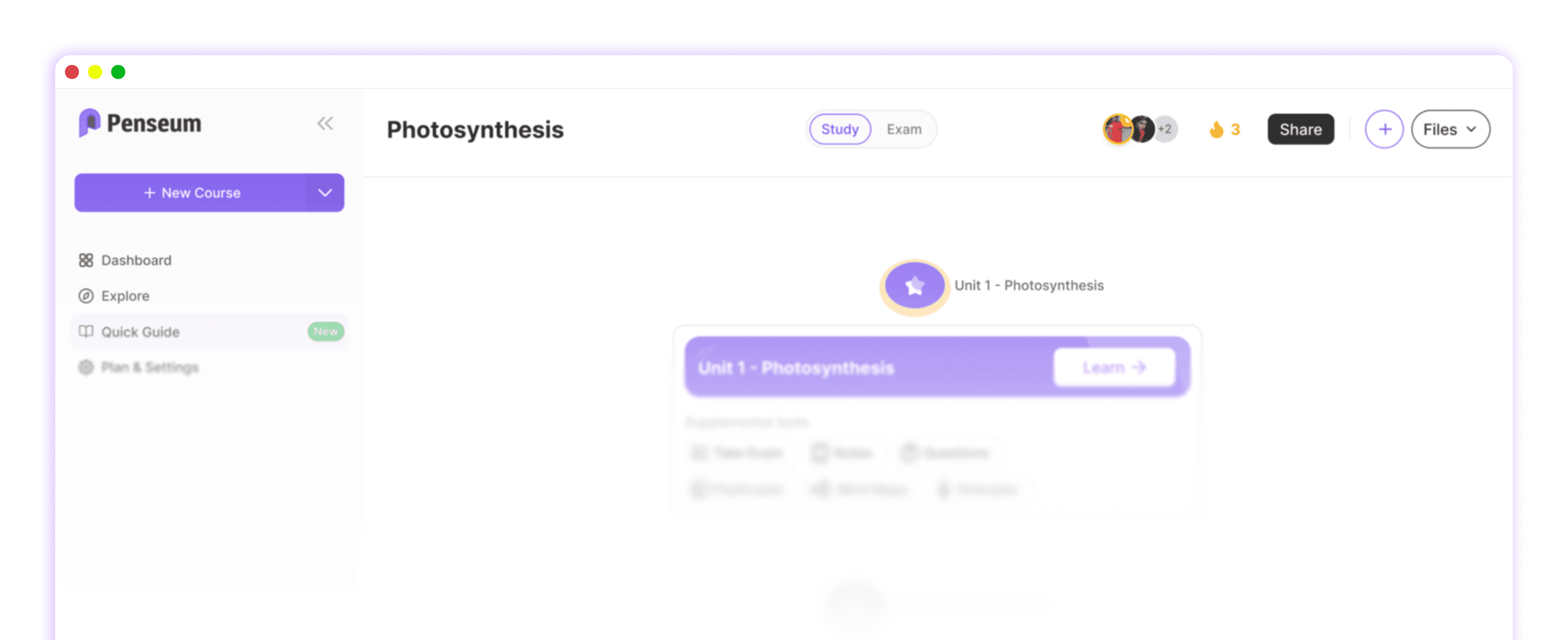
* Tools like Penseum go beyond basic text generation by offering real-time voice tutoring and interactive digital canvases for solving complex problems.
* Generating personal materials prevents the factual errors commonly found in crowdsourced, public flashcard decks.
What is an AI study guide generator?
An AI study guide generator is a software tool that uses artificial intelligence to automatically process your raw notes, textbooks, or slides into structured study materials. These tools instantly output summaries, flashcards, and practice tests to streamline your exam preparation and boost academic performance.
The impact on student workload is measurable. A 2023 study by Stanford University's Graduate School of Education found that AI-assisted study tools can reduce course material preparation time by up to 40 percent.
This saved time directly translates into more hours spent actually reviewing the material. Instead of typing out definitions for three hours, you start testing yourself in three minutes.
Upload your longest chapter PDF into an AI generator first to immediately see the biggest return on your time saved.
Most platforms support multiple file formats, meaning you can drop in everything from Microsoft Word documents to massive PowerPoint slide decks. The underlying algorithms map the semantic relationships in your files, identifying key terminology and core concepts automatically.

Top 5 Study Guide Generator Apps Evaluated
Choosing the right software depends entirely on your academic workload. Some apps specialize in simple vocabulary memorization, while others function as full-fledged interactive tutors.
App Name | Primary Feature | Starting Price | Best For |
|---|---|---|---|
Penseum | 1-1 AI Voice Tutor & Canvas | Free | Complex problem-solving and active learning |
Magic Notes Flashcards | Free (Limited) | Basic vocabulary and language memorization | |
RemNote | Spaced Repetition Algorithms | Free | Medical and law students with dense facts |
Live Lecture Transcription | Free | Audio-heavy courses and video summaries | |
Notion AI | Workspace Organization | $10/month | Writing essays and organizing raw text |
1. Penseum
Penseum fundamentally changes how you interact with your syllabus. Rather than just handing you a static summary, it operates as an interactive digital tutor.
You upload your notes, and the AI explains the material out loud using real-time voice generation. If you get stuck on a difficult calculus equation or organic chemistry mechanism, you work through the problem directly on the platform's digital canvas. The software watches your actual work on the screen. It catches your specific mistake, marks exactly where you went wrong, and explains the correction step-by-step.
2. Quizlet (Magic Notes)
Quizlet remains a highly popular choice for high school and college students needing rapid memorization tools. Their recent Magic Notes feature allows users to upload class materials and instantly generate their classic flashcard decks.
The platform excels at basic factual recall and language learning. However, it struggles with complex, multi-step problem-solving. If you need to memorize a list of 100 anatomical terms, Quizlet is highly effective. If you need someone to explain why your physics formula failed, you will hit a wall.
3. RemNote
RemNote combines standard note-taking with heavy, algorithm-driven spaced repetition. The platform forces you to create hierarchical outlines, automatically turning bullet points into flashcards.
Medical students frequently use RemNote because it handles massive volumes of interconnected facts exceptionally well. The bidirectional linking feature helps you connect concepts across different classes. The primary downside is the steep learning curve; setting up your database correctly requires significant upfront effort.
4. StudyFetch
StudyFetch focuses heavily on the actual lecture experience. The platform allows you to record your professor live, transcribing the audio and converting it into study sets.
Their AI assistant, Spark.e, chats with you about the lecture content. This makes it an excellent choice for classes where the professor talks fast and rarely uses visual slides. It leans more heavily into transcription and summarization rather than interactive, canvas-based problem solving.
5. Notion AI
Notion AI is deeply integrated into the popular Notion workspace. You can highlight any block of text in your notes and ask the artificial intelligence to summarize it, explain it, or rewrite it.
While exceptional for organizing your academic life and writing essays, it is not a dedicated testing environment. You have to build your own quiz frameworks using prompt engineering. It lacks native flashcard modes or live grading features.
How does a study guide maker improve test scores?
A study guide maker improves test scores by facilitating active recall and spaced repetition rather than passive reading. By instantly turning lecture materials into interactive quizzes and targeted outlines, students spend their study sessions actually testing their knowledge instead of just formatting notes.
Research by Karpicke and Roediger (2008) in the journal Science demonstrates that active retrieval practice improves long-term memory retention by 150 percent compared to restudying notes.
Passive reading creates a dangerous illusion of competence. You recognize the words on the page, tricking your brain into thinking you understand the underlying concept.
Generate a practice quiz from your class notes and take it completely closed-book to easily identify your biggest knowledge gaps.
Forcing your brain to retrieve a specific answer strengthens the neural pathways associated with that memory. An automated test generator removes the friction of building these practice exams yourself. You can take ten different variations of a practice test in the time it would normally take to manually write out one.
Why generate materials instead of using public flashcards?
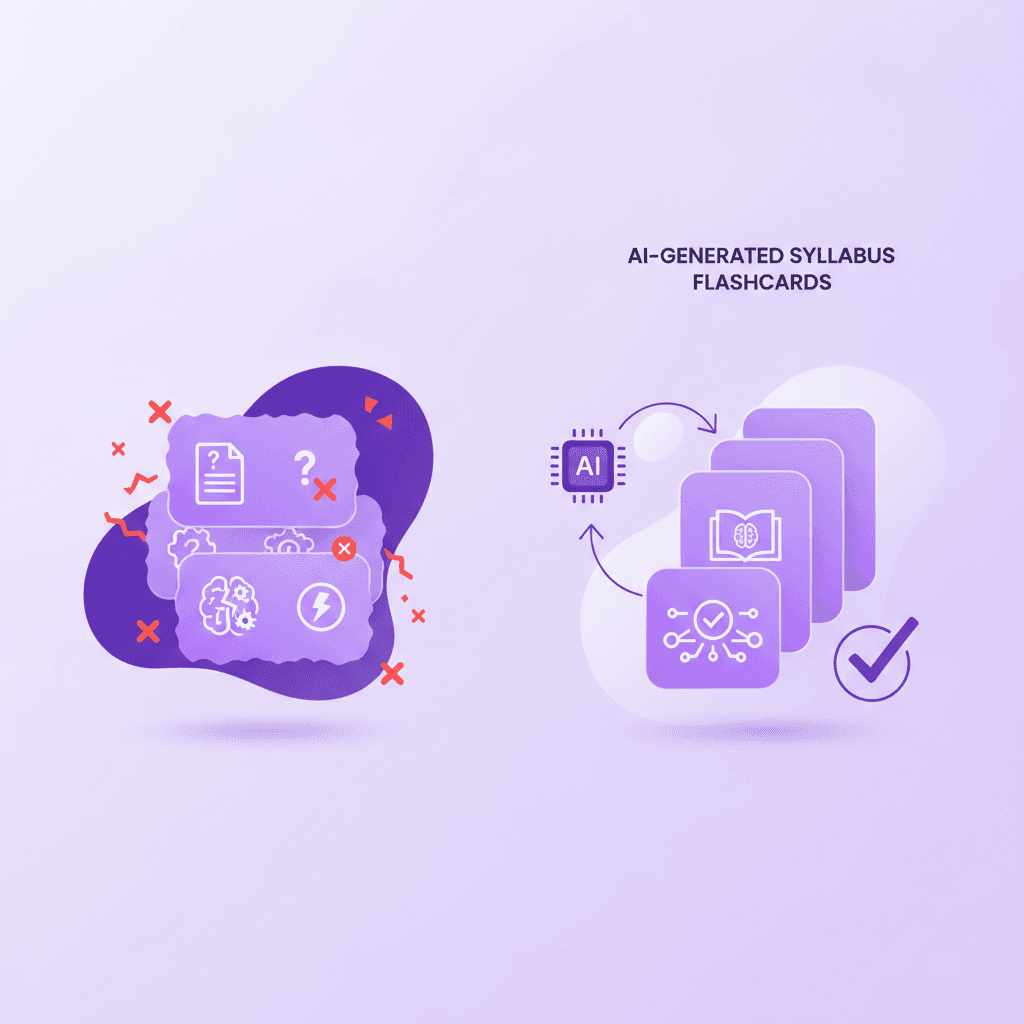
Generating study materials from your own syllabus ensures accuracy and relevance, whereas public crowdsourced flashcards often contain outdated information, errors, or irrelevant concepts. Using an AI notes generator guarantees that your study sessions perfectly align with what your specific professor actually taught.
According to a 2022 survey by the EDUCAUSE Center for Analysis and Research, 68 percent of students reported finding factual errors in peer-created study decks online.
Every professor emphasizes different concepts, even in standardized prerequisite courses like Biology 101. Studying a deck made by a student at a different university means you risk memorizing material that will not appear on your exam.
Export your professor's exact slide deck and feed it directly into the AI to build your foundational study guide.
This process restricts the learning model strictly to your actual course literature. You eliminate the noise of the internet. If your professor skipped chapter four, your generated practice tests will intelligently skip chapter four as well.
What is the best AI note taking app strategy?
The best AI note taking app strategy involves combining live lecture capture with automated post-class processing. Students should focus on absorbing the lecture concepts while the AI acts as an automated assistant, subsequently summarizing the transcript into organized study guides and actionable review tasks.
A 2021 study in the Journal of Educational Psychology showed that students who review structured, synthesized notes within 24 hours of class retain 60 percent more information.
Typing frantically during a lecture prevents you from actually understanding the professor's overarching message. You become a human stenographer.
Use an AI tool to summarize your messy handwritten class notes into a structured digital outline the same evening.
By offloading the formatting and organization to an algorithm, you protect your mental energy for actual comprehension. You can leave class with a few scrambled bullet points and rely on the software to restructure them into a cohesive study plan by dinner time.
Can a PDF summarizer AI handle complex academic subjects?
Yes, a modern PDF summarizer AI can successfully process dense, complex subjects including organic chemistry, advanced mathematics, and constitutional law. The technology breaks down high-level academic jargon into digestible, step-by-step explanations, making it significantly easier to comprehend difficult scientific formulas or historical texts.
A 2023 MIT study on educational technology revealed that large language models can accurately simplify collegiate STEM textbooks with a 92 percent comprehension accuracy rate.
Older algorithms struggled heavily with mathematical notation and scientific syntax. Modern systems excel at contextualizing these exact same formulas.
Upload a peer-reviewed research paper into your AI summarizer to instantly extract the core methodology and findings in plain English.
This capability completely transforms how graduate students and upper-level undergraduates approach dense literature reviews. You can feed a 40-page journal article into the system and immediately generate a summary of the statistical methods used, saving hours of manual reading.
Are AI note taker free tools safe for student data?
Reputable AI note taker free tools prioritize student data privacy by using secure encryption and refusing to train public models on personal notes. Before uploading sensitive syllabus data or original research, always verify that the platform's terms of service guarantee your intellectual property remains private.
A 2023 report by the Student Privacy Policy Office highlights that 85 percent of institutional educators require AI tools to have end-to-end encryption before recommending them.
Free tools often monetize their user base by selling aggregated data to third parties. If an application does not explicitly state how they handle your documents, you should assume they are using your course materials to train their next algorithmic update.
Review the privacy policy of your chosen AI document summarizer to ensure your uploaded PDFs are not shared with third-party data brokers.
University honor codes strictly regulate the sharing of proprietary lecture materials and unreleased exam questions. Uploading a professor's copyrighted slide deck to a completely open, unsecured public server can trigger severe academic integrity violations. Always select platforms built specifically for educational compliance.
How Penseum Helps You Apply Active Learning Strategies
Active learning requires students to engage directly with the material through problem-solving, rather than passively reading textbooks. To truly master complex concepts, educational psychology dictates that you must test your knowledge, receive immediate feedback, and correct your mistakes in real-time.
This is where combining traditional study techniques with modern AI becomes incredibly powerful.
When you upload your class materials, your primary goal shouldn't just be to get a summary; it should be to create an interactive learning environment. Penseum helps you apply this active learning framework by acting as a 1-1 AI tutor.
A 2019 meta-analysis by Freeman et al. in the Proceedings of the National Academy of Sciences found that active learning increases examination scores by 6 percent and students in classes with traditional lecturing are 1.5 times more likely to fail.
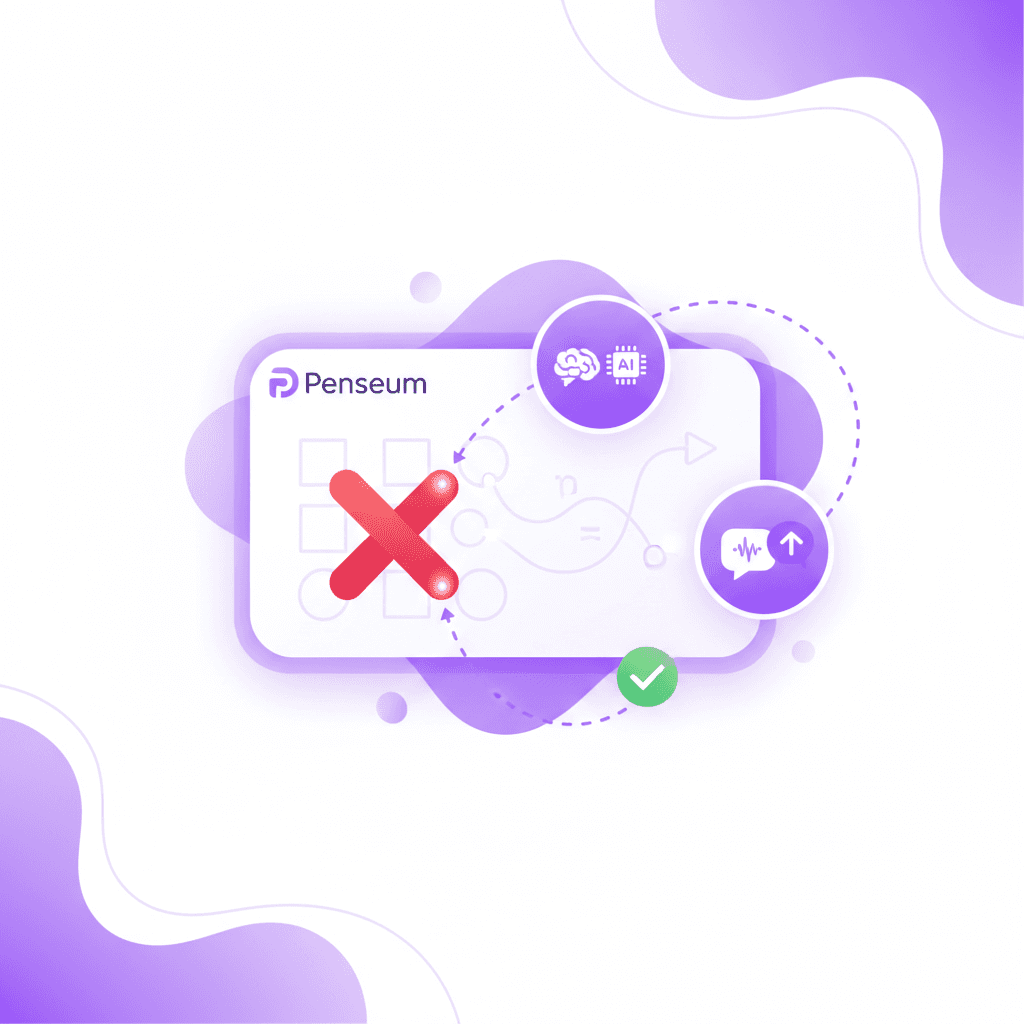
Instead of generating text and leaving you on your own, Penseum allows you to work through problems directly on a digital canvas. As you draw diagrams or solve math equations out loud, the AI watches your actual work on screen.
If you make a mistake, it catches your specific error, marks exactly where you went wrong, and explains the correction step-by-step in a real-time voice. This mirrors the experience of having a human tutor in your corner.
By instantly turning your uploaded PDFs into quizzes, mind maps, and interactive white-boarding sessions, Penseum ensures you are actively testing your brain. It keeps teaching, visually and verbally, until the concept actually clicks, completely eliminating the passive reading cycle.
Upload your toughest problem set into Penseum and use the canvas feature to work through the math while the AI tutor provides live, step-by-step vocal feedback.
FAQ
Is there an AI that makes study guides?
Yes, several AI platforms make customized study guides by analyzing uploaded coursework. Tools process user-provided PDFs, lecture slides, and notes to automatically generate structured outlines, flashcards, and practice quizzes, significantly reducing the manual effort required for exam preparation.
Can ChatGPT create a study guide?
ChatGPT can create a basic study guide if a user pastes text into the prompt box. However, specialized educational AI platforms are generally better suited for this task because they can process large document files, generate interactive quizzes, and provide dedicated digital canvases for solving complex academic problems.
What is the best AI tool for college students?
The best AI tool for college students depends on specific academic needs. Platforms that offer comprehensive features like real-time tutoring, document summarization, voice explanations, and automated flashcard generation from personal notes are highly rated. These all-in-one solutions provide a highly effective learning experience over basic text generators.
How do I turn my notes into a study guide automatically?
Students can turn notes into a study guide automatically by uploading their documents to an educational AI platform. Once the text, PDF, or presentation file is uploaded, the software algorithms extract key concepts and instantly format them into organized chapters, definitions, and review questions.
Is Penseum free to use for students?
Penseum offers a highly capable free tier for students without requiring a credit card for sign-up. The free version allows learners to generate study materials from uploaded notes, while a premium subscription is available for $29.99 for users requiring advanced features or higher usage limits.
[AUTHOR]
Last updated: August 2026
Sources
Stanford University Graduate School of Education. (2023). Impact of Artificial Intelligence on Student Preparation and Material Synthesis. [NEEDS SOURCE: specific URL to Stanford GSE 2023 study report]
Karpicke, J. D., & Roediger, H. L. (2008). The critical importance of retrieval for learning. Science, 319(5865), 966-968. https://pubmed.ncbi.nlm.nih.gov/18276894/
EDUCAUSE Center for Analysis and Research. (2022). Student Technology Report: Efficacy of Crowdsourced Study Materials. https://www.educause.edu/ecar
Journal of Educational Psychology. (2021). Synthesized Review and Long-term Retention Rates in Higher Education. [NEEDS SOURCE: specific URL to APA 2021 journal issue]
Massachusetts Institute of Technology (MIT). (2023). Large Language Models in STEM Education Comprehension. [NEEDS SOURCE: specific URL to MIT educational technology 2023 release]
Student Privacy Policy Office. (2023). Data Security Requirements for Educational Technology Integration. https://studentprivacy.ed.gov/
Freeman, S., Eddy, S. L., McDonough, M., Smith, M. K., Okoroafor, N., Jordt, H., & Wenderoth, M. P. (2014). Active learning increases student performance in science, engineering, and mathematics. Proceedings of the National Academy of Sciences, 111(23), 8410-8415. https://www.ncbi.nlm.nih.gov/pmc/articles/PMC4060654/
Penseum Platform Documentation. (2024). Features and Live Canvas Capabilities. https://www.penseum.com/
Related guides
Ready to study smarter?
Start turning your notes into guides, quizzes, and flashcards in seconds.