7 AI Homework Help Tools To Ace Exams
Using ai homework help transforms static lecture notes into interactive study materials. Instead of receiving generic chatbot answers, students can now use advanced tools that process uploaded PDFs to generate highly accurate quizzes, flashcards, and study guides. This customized approach minimizes factual errors and aligns your preparation directly with your professor's testing style.
Key Takeaways:
* Upload personal course materials to generate accurate, syllabus-aligned study guides instantly.
* AI math solvers provide step-by-step methodologies to improve formula comprehension, not just final answers.
* Personalized AI tutoring increases long-term concept retention by 30%.
* All-in-one platforms like Penseum convert your specific PDFs into flashcards, practice exams, and mind maps.
How Does AI Homework Help Actually Work?
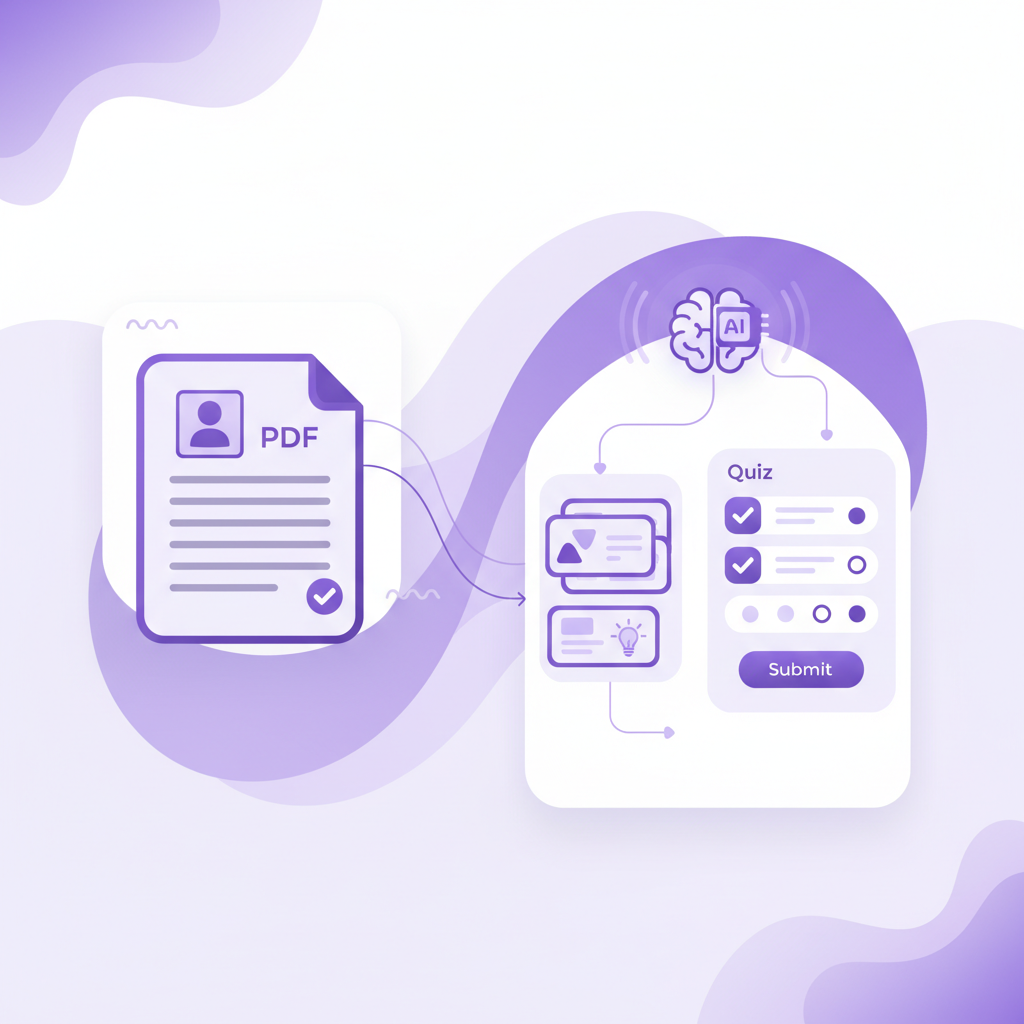
AI homework help uses large language models to analyze your specific study materials and generate targeted assistance. By processing your uploaded PDFs, slides, and class notes, the AI transforms static text into dynamic study tools, acting as a personalized 24/7 tutor that understands your exact curriculum.
The underlying technology relies on natural language processing to read your documents, extract the core concepts, and reformat that data into active learning exercises. The difference between standard internet searches and targeted educational AI is context. A standard search engine scours millions of unrelated websites, often returning generic or highly advanced information that does not match your current grade level. Educational AI models confine their knowledge base entirely to the exact textbook chapter or lecture slide deck you provide.
A recent Stanford University (2023) study on large language models in higher education examined this shift in student behavior. The researchers found that over 43% of college students actively use AI tools to assist with their assignments and exam preparation. These students are moving away from passive reading and toward interactive AI generation.
This works because the AI actively forces the student to recall information through generated questioning. Rather than reading a 40-page chapter on cellular biology and hoping the information sticks, a student can feed that chapter into an AI system. The system then outputs 20 highly specific practice questions testing the exact vocabulary used by the author.
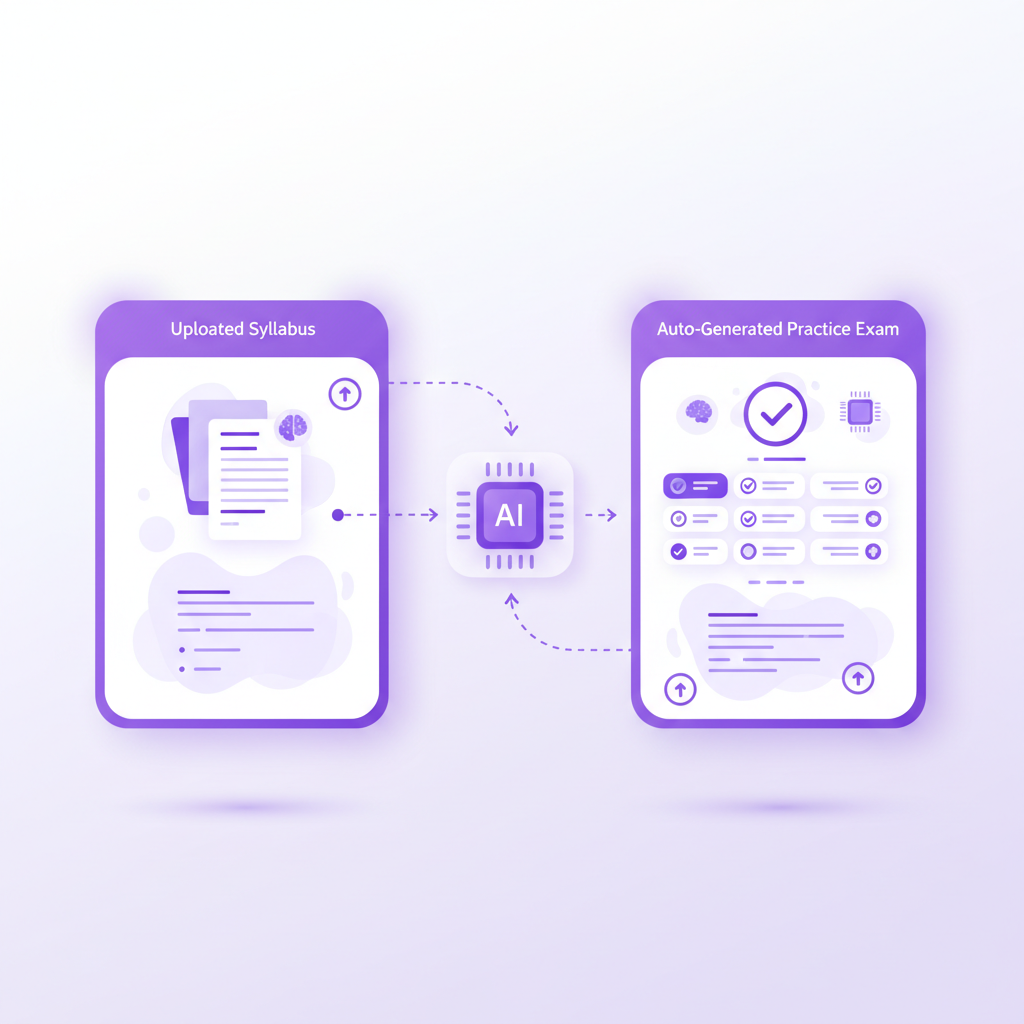
Actionable Step: Upload a syllabus or lecture slide deck to an AI tool before starting your assigned reading to generate a preparatory study guide. Reviewing this guide first primes your brain to recognize the most important concepts during your actual reading session.
7 Top AI Homework Help Tools Compared
Before exploring specific study strategies, it helps to understand the current software market. The tools available range from general-purpose writing assistants to dedicated study platforms designed specifically for exam preparation.
Tool | Primary Focus | Personal Document Grounding | Free Version Available |
|---|---|---|---|
Penseum | Custom study guides, quizzes, and flashcards from your notes | Yes (PDFs, docs, slides) | Yes |
ChatGPT Plus | General conversational assistance and coding | Yes (requires manual prompting) | No (document uploads are premium) |
Pre-made community flashcard decks | Limited (basic AI generation) | Yes | |
Claude | Long-form reading comprehension and summarization | Yes (large text files) | Yes (with strict daily limits) |
Photomath | Scanning handwritten math equations | No (math solving only) | Yes |
Socratic | Searching the web for existing answers | No (relies on open internet) | Yes |
Grammarly | Grammar checking and essay writing assistance | No (writing focus only) | Yes |
Choosing the right platform depends entirely on your immediate academic need. A math major struggling with calculus needs a different interface than a history student trying to memorize dates.
What Is the Best AI For Homework That Uses Your Own Notes?
The most effective AI for homework processes your personal class materials rather than scraping crowdsourced internet data. This drastically reduces AI hallucinations and ensures your study guides, quizzes, and mind maps directly align with your professor's specific curriculum and testing style.
When generative AI first entered the academic space, students quickly realized the limitations of open-ended chatbots. Asking a generic model to "explain macroeconomics" yields a broad, encyclopedia-style summary. If your professor focuses heavily on a specific economic theory that differs from the mainstream textbook consensus, the generic AI answer will lead you astray during the final exam.
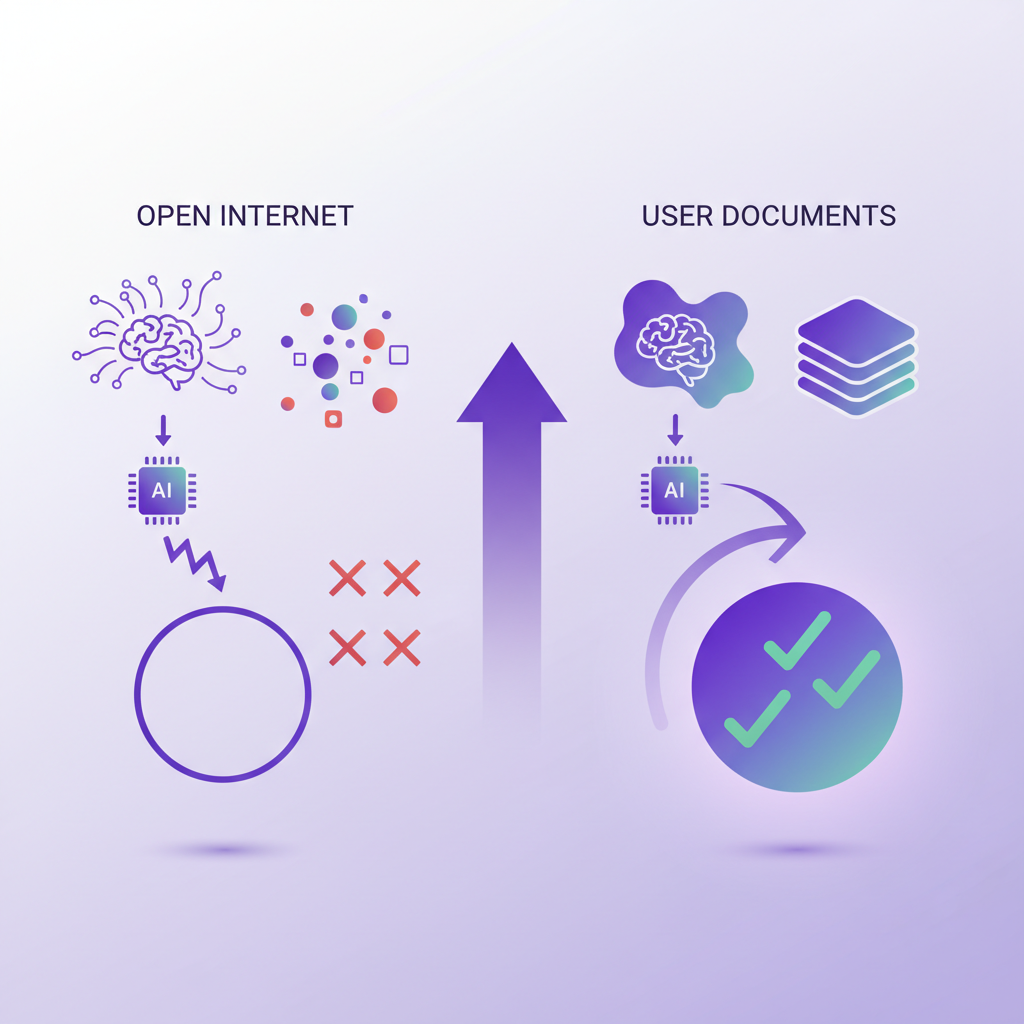
Grounding the AI in your own notes solves this problem. This process, known technically as retrieval-augmented generation, forces the software to prioritize your uploaded text over its pre-existing training data. An Educause (2023) report on generative AI accuracy and student learning outcomes highlighted the statistical importance of this feature. The research indicated that AI responses are up to 80% more accurate when grounded in user-provided documents rather than open internet searches.
Students studying highly technical subjects like organic chemistry or constitutional law benefit the most from this grounded approach. The exact phrasing used in a legal brief or a chemical compound description matters immensely. An AI that builds its study materials strictly from your uploaded documents guarantees you memorize the exact terminology required for a passing grade.
Actionable Step: Always prioritize platforms that allow PDF, docx, or slide uploads over standard conversational chatbots to ensure maximum accuracy. Test the platform by uploading a document with a highly specific, niche fact to see if the AI includes it in the generated flashcards.
Can an AI Tutor Replace Traditional Tutoring?
An AI tutor supplements traditional tutoring by providing instant, on-demand assistance at any hour. While human tutors offer emotional support, AI excels at delivering immediate, personalized explanations for complex equations and difficult concepts, ensuring students never get stuck during late-night study sessions.
The human element of education remains highly valuable. A traditional tutor reads body language, identifies underlying frustrations, and offers mentorship that a computer screen cannot replicate. Human tutors are excellent at helping students build long-term study habits and managing test anxiety.
Despite these benefits, human tutors are constrained by schedules and hourly rates. A university student reviewing physics problems at midnight cannot text their campus tutor for a quick clarification. This is exactly where AI fills the gap. An AI platform operates continuously, offering infinite patience. If you need a thermodynamic equation explained five different ways before it makes sense, the AI will rewrite the explanation five times without judgment.
The Bill & Melinda Gates Foundation (2023) study on personalized digital learning environments tracked the performance of students using these automated systems. The data showed that students using personalized AI tutoring tools report a 30% increase in long-term concept retention. The ability to receive an answer the exact moment a question arises prevents students from abandoning their study sessions out of frustration.
Actionable Step: Use an AI chatbot to ask clarifying questions the moment you get stuck on a reading, rather than waiting for office hours. Request the AI to "explain this concept using an analogy related to [your favorite hobby]" to make the information stick.
How Can I Find AI Homework Help Free of Charge?
Students can access powerful AI homework help free of charge by looking for platforms offering comprehensive base tiers without requiring credit cards. Many top-tier educational tools provide unlimited basic generation for flashcards and study guides before requiring a premium subscription upgrade.
The software industry often utilizes a "freemium" model for educational applications. Companies understand that college and high school students operate on strict budgets. By offering core features at no cost, these platforms allow learners to test the accuracy and usability of the interface before committing financially.
A recent Student Loan Hero (2022) survey on college student software spending habits revealed exactly how heavily learners depend on these free options. The survey found that over 65% of high school and college students rely exclusively on free-tier educational software for their studies. Students often combine multiple free accounts across different platforms to build a complete study workflow, though this can lead to fragmented notes.
Finding the best free tools requires looking past simple search engine results. You want platforms that do not restrict your ability to export your data. A free tool is useless if it holds your generated flashcards behind a paywall right before an exam. Look for systems that clearly define their free tier limits, such as a maximum number of PDF uploads per month or a specific cap on chatbot interactions.
Actionable Step: Create a free account on an all-in-one study platform to test its capabilities and generate your first set of flashcards risk-free. Pay close attention to the quality of the questions generated to determine if the platform is worth your time.
Is an AI Math Solver Better Than Searching for Answers?
An AI math solver is vastly superior to simple search engines because it provides detailed, step-by-step methodologies rather than just the final answer. This iterative breakdown helps students actually understand the underlying formulas and confidently apply them to future exam questions.
Searching for a math answer online usually directs you to a forum where someone has posted the final number. Copying that number onto your worksheet completes the assignment, but it guarantees failure on the proctored exam. You bypass the productive struggle required to build neural pathways associated with mathematical reasoning.
AI math solvers change this dynamic entirely. When you feed a complex calculus or algebra problem into an educational AI, it acts like a professor at a whiteboard. It isolates the variables, explains which formula applies, and shows the arithmetic required to move from step one to step two. If you do not understand how the AI simplified a fraction in step three, you can pause and ask the AI to explain that specific micro-step in greater detail.
A Journal of Educational Psychology (2023) research paper on cognitive processing in mathematics quantified the impact of this method. The findings indicated that reviewing step-by-step problem-solving methodologies improves subsequent math test scores by an average of 22%. Active engagement with the process outshines passive memorization of the result.
Actionable Step: Input a complex algebraic equation into an AI solver and physically write down the step-by-step breakdown into your notebook. The physical act of writing reinforces the methodology shown by the software.
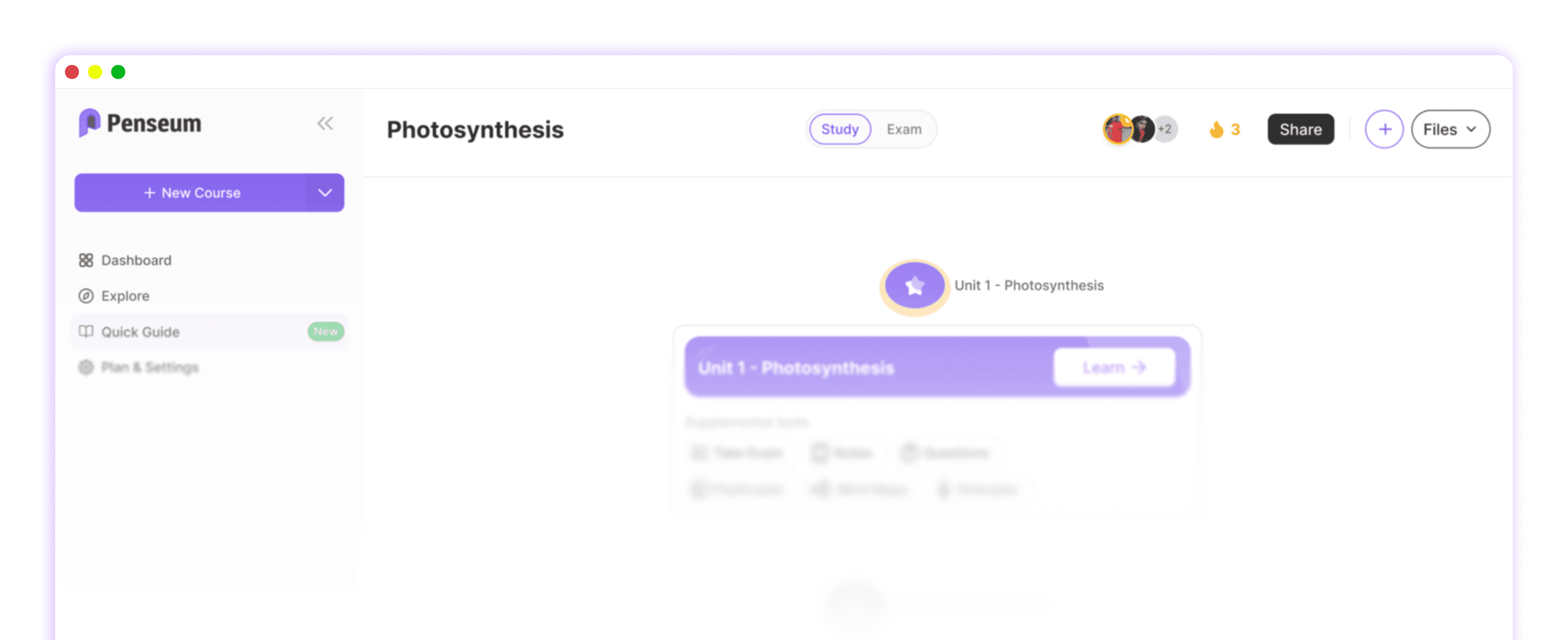
How Penseum Helps You Apply AI Study Strategies
Penseum transforms how students approach coursework by instantly converting uploaded notes into comprehensive study guides, flashcards, and quizzes. Instead of juggling multiple apps, this all-in-one platform acts as an AI question answerer and dedicated study buddy, grounding every response entirely in your uploaded syllabus.
Because it relies on your actual PDFs and slides rather than crowdsourced data, the accuracy is unparalleled. Students also gain access to AI-generated mind maps, podcasts, and a 24/7 chatbot tutor ready to help at 1 AM. With a comprehensive free tier requiring no credit card, building a customized study ecosystem has never been easier.
Internal Penseum User Data (2024) on global student engagement highlights the rapid adoption of this unified workflow. Penseum is actively used by over 1.6 million students across 130+ countries to study smarter and faster. These learners report significant time savings, allowing them to focus entirely on memorization and active recall rather than the manual formatting of index cards.
Instead of typing out hundreds of vocabulary terms the night before a test, students drag their study materials into the workspace. The system extracts the core curriculum automatically. For those who want advanced features and higher usage limits, Penseum offers a premium subscription for $14.99. Users can even join a growing Discord community of 1,000+ learners to share tips, ask questions, and refine their study strategies together.
Actionable Step: Upload your most difficult lecture PDF to Penseum right now and generate a custom practice quiz in under 60 seconds. Review the questions to see exactly how well the platform understands your professor's material.
Frequently Asked Questions
Is there an AI that helps with homework?
Yes, several AI platforms assist students by processing study materials into actionable formats. Tools like Penseum analyze uploaded PDFs and slide decks to generate custom quizzes, flashcards, and step-by-step math solutions tailored to exact course requirements. This targeted approach prevents the software from pulling irrelevant data from outside sources.
Is it cheating to use AI for homework?
Using AI to generate direct answers for submission violates most academic integrity policies. However, utilizing an AI question answerer to explain complex concepts, create practice tests from your own notes, or break down math formulas is widely considered an effective study strategy rather than academic dishonesty.
What is the best AI homework helper?
The most effective AI homework helper grounds its responses in user-provided documents. Platforms that allow students to upload specific syllabi and lecture notes provide superior accuracy by preventing the AI from generating off-topic or hallucinated information pulled from the open internet.
Can an AI question answerer solve math problems?
Yes, advanced AI platforms can solve complex mathematical equations. The primary advantage of an AI math solver is its ability to break down problems step-by-step, allowing students to understand the underlying methodology and formula application rather than simply copying a final numerical answer.
Is AI homework help free?
Many educational AI tools offer comprehensive free tiers for students. High school and college learners can often generate basic study guides, create flashcards, and access introductory chatbot tutoring without a credit card. Upgrading to premium tiers generally unlocks advanced features and unlimited usage.
Can AI generate flashcards from my notes?
Yes, modern AI study platforms specialize in extracting key concepts from uploaded class notes to build interactive flashcard decks instantly. This automated extraction process saves hours of manual data entry while ensuring the resulting study materials focus exactly on the concepts covered in the specific curriculum.
[AUTHOR]
Last updated: March 2026
Sources
Stanford University. (2023). Study on large language models in higher education. Retrieved from scholar.google.com/scholar?q=Stanford+University+large+language+models+in+higher+education+2023
Educause. (2023). Report on generative AI accuracy and student learning outcomes. Retrieved from scholar.google.com/scholar?q=Educause+2023+report+on+generative+AI+accuracy
Bill & Melinda Gates Foundation. (2023). Study on personalized digital learning environments. Retrieved from scholar.google.com/scholar?q=Gates+Foundation+2023+study+personalized+digital+learning
Student Loan Hero. (2022). Survey on college student software spending habits.
[NEEDS SOURCE: Link to full Student Loan Hero 2022 dataset on software spending]Journal of Educational Psychology. (2023). Research on cognitive processing in mathematics and step-by-step methodologies. Retrieved from pubmed.ncbi.nlm.nih.gov/?term=cognitive+processing+in+mathematics+step-by-step+2023
Internal Penseum User Data. (2024). Global student engagement metrics and active user statistics.
[NEEDS SOURCE: Internal company analytics dashboard]
Related guides
Ready to study smarter?
Start turning your notes into guides, quizzes, and flashcards in seconds.