7 Best Free Study Apps to Ace Your Next Exam
Key Takeaways
* Free study apps replace outdated passive reading with active recall and spaced repetition algorithms.
* Artificial intelligence now automates the creation of flashcards, study guides, and practice quizzes directly from your course syllabus.
* Students using personalized digital tutoring perform significantly higher on exams than those using traditional group study methods.
* Integrating a single, all-in-one AI study platform eliminates the need to jump between multiple disorganized tools.

What are the top free study apps for college students?
The best free study apps combine active recall, material organization, and self-testing into a single platform. College students benefit most from applications that eliminate busywork, allowing them to focus on actual learning rather than manually creating study guides from their dense lecture notes.
Research by Educause (2022) found that 82% of higher education students rely heavily on digital study tools to maintain and improve their academic performance.
Audit your current study routine and replace three single-function apps with one comprehensive, all-in-one AI study platform to streamline your workflow.
College coursework presents a unique challenge due to the sheer volume of reading material assigned each week. Human working memory simply cannot process hundreds of pages of textbook text into organized, retainable concepts through manual transcription. When students attempt to write out study guides by hand, they waste hours on formatting rather than comprehension.
Top-tier applications solve this bottleneck through automation. They scan your provided materials, extract the most testable concepts, and organize them into digestible formats. This shift transforms your study session from a clerical data-entry task into a focused cognitive exercise. You spend your limited time retrieving information from your brain, which cements the knowledge for exam day.
The fragmentation of digital tools often causes more harm than good. Managing notes in one application, flashcards in a second, and practice exams in a third creates unnecessary friction. The highest-performing students consolidate their digital environment. Finding a unified platform guarantees that your notes perfectly sync with your testing materials, leaving zero gaps in your exam preparation.
How do AI study apps improve information retention?
AI study apps improve retention by providing personalized learning experiences and immediate feedback. Unlike static textbooks, an AI tutor can identify exactly where a student makes a mistake, explain the concept out loud, and force the student to re-test until the information clicks.
Bloom's 2 Sigma Problem (1984) demonstrates that students receiving customized one-on-one tutoring perform two standard deviations better than their classroom peers.
Use the voice explanation feature in your AI study app to learn complex topics auditorily rather than just reading text on a screen.
Information retention relies heavily on a psychological concept known as the spacing effect. When an algorithm tracks your performance, it calculates the precise moment you are about to forget a fact. It then reintroduces that specific concept into your study session. This calculated repetition builds thicker myelin sheaths around your neural pathways, cementing the data into long-term memory.
Immediate corrective feedback drastically reduces the encoding of false information. If you practice a math problem incorrectly on paper, you might repeat the error twenty times before a professor grades it. You have accidentally trained your brain to execute the wrong sequence. Digital platforms catch the error on step two. The system halts your progress, highlights the specific miscalculation, and redirects your approach before the bad habit forms.
Cognitive load theory explains why static textbooks overwhelm readers. Textbooks present all information simultaneously, forcing your brain to filter out irrelevant data while trying to comprehend core concepts. An intelligent study platform parses this data. It feeds you one isolated concept at a time, protecting your working memory from exhaustion and keeping your retention rates high during long evening study blocks.
Which free study apps are best for creating flashcards?
The best free study apps for creating flashcards use artificial intelligence to extract key concepts directly from your uploaded materials. This prevents the adoption of incorrect information from crowdsourced decks and guarantees your flashcards perfectly match your specific course syllabus.
A foundational study by Karpicke & Roediger (2008) proved that the testing effect, facilitated by flashcard use, improves long-term memory recall by up to 150%.
Upload your latest chapter PDF into a free flashcard generator to automatically create a customized deck in seconds without manual typing.
Manual flashcard creation actively harms your study efficiency. Typing out hundreds of questions and answers steals valuable time from actual memorization. Students often spend three hours building a deck and only thirty minutes reviewing it. Modern free study apps flip this ratio entirely by automating the generation process.
Crowdsourced flashcard decks present a massive academic risk. When you download a pre-made deck from a random user online, you inherit their misunderstandings, typos, and outdated facts. By utilizing tools that generate questions strictly from your professor’s specific slides and required reading, you ensure absolute alignment with your upcoming exam. You study exactly what you will be tested on.
The algorithm powering your flashcards matters just as much as the content. Basic applications simply shuffle cards randomly. Advanced platforms utilize spaced repetition algorithms, such as SuperMemo 2, to evaluate your self-reported confidence on each card. If you struggle with a specific chemistry formula, the app forces you to review it daily. If you master a historical date quickly, the app pushes that card back by several weeks, optimizing your daily review queue.
How can free study apps reduce exam anxiety?
Free study apps reduce exam anxiety by breaking overwhelming coursework into manageable, structured practice sessions. By simulating real exam conditions with generated quizzes and providing real-time corrections, these platforms build academic confidence and eliminate the fear of encountering unknown material.
The American Psychological Association (2020) reports that nearly 87% of college students face high stress, which is effectively mitigated by structured, proactive preparation.
Schedule daily 15-minute micro-study sessions using your app's quiz generator a week before your exam to build a steady foundation of confidence.
Exam anxiety stems directly from the illusion of competence. When you passively reread highlighted textbook chapters, the information feels familiar. Your brain tricks you into believing you understand the material. The moment you sit down for the actual exam and stare at a blank page, that familiarity vanishes. Panic sets in because you never practiced retrieving the information from scratch.
Digital testing environments shatter this illusion safely before test day. By taking timed, generated practice quizzes in your dorm room, you expose your knowledge gaps in a zero-stakes environment. Finding out you do not understand cellular respiration three days before the test is an advantage. You can target that exact weakness.
Structured study tools also cure academic paralysis. Looking at a 500-page syllabus triggers immediate overwhelm, causing many students to procrastinate out of sheer anxiety. A digital platform digests that syllabus and tells you precisely what ten concepts to study today. Removing the decision fatigue associated with planning your study schedule lowers cortisol levels and allows you to execute your daily tasks with absolute clarity.
What are the best free study apps for active recall?
Apps that excel at active recall force users to retrieve answers from memory rather than simply recognizing them. The most effective free study apps feature interactive canvases where students must write out steps, draw diagrams, and solve problems while an AI evaluates their work.
Research by Dunlosky et al. (2013) rated practice testing and active recall as having the absolute highest utility among all widely used study techniques.
Instead of rereading highlighted notes, use your study app's practice mode to write out your answers and explicitly show your work.
True active recall requires generative effort. Multiple-choice questions often test recognition rather than pure recall. You might not know the answer, but you recognize option C from the textbook. The most powerful study tools remove the options. They present a blank text box or a digital whiteboard, demanding that you generate the answer entirely from your own neural pathways.
This cognitive struggle is highly beneficial. Desirable difficulty, a concept in cognitive psychology, states that the harder your brain works to retrieve a piece of information, the stronger that memory becomes. When an app forces you to draw a chemical structure from memory and then corrects your specific missing bond, you forge a deep, permanent understanding of the material.
Many free study apps now incorporate interactive whiteboards specifically for this purpose. Math and physics students cannot learn by simply reading solved equations. They must execute the steps. Advanced platforms watch the student construct the equation line by line. This replicates the experience of standing at a chalkboard while a professor guides your logic, providing the highest form of active recall practice available digitally.
7 Top Free Study Apps Evaluated
Selecting the right application requires understanding exactly how each tool approaches the learning process. Here is a breakdown of the most effective free study apps available for students right now.
1. Penseum
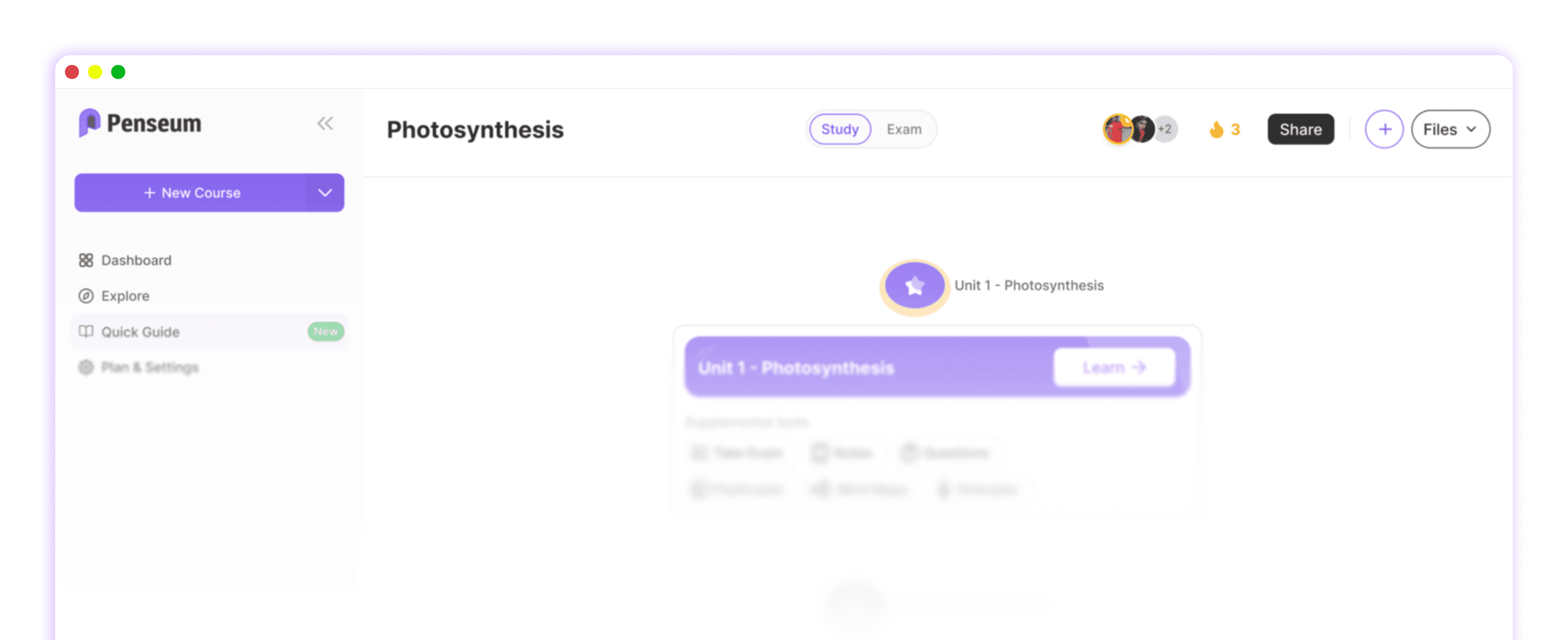
Penseum operates as a complete, all-in-one AI study platform. It reads your uploaded PDFs, slides, and notes, automatically generating highly accurate flashcards and study guides. The standout feature is its interactive AI tutor. You can write your math or physics work directly on the canvas, and the AI will spot your specific error in real time. It uses voice features to explain concepts step-by-step out loud, replicating a live tutoring experience.
2. Anki
Anki is the gold standard for open-source spaced repetition. It is entirely free on desktop and uses a highly customizable algorithm to schedule your flashcard reviews. Medical and law students favor Anki for its ability to handle massive decks containing thousands of cards. The interface is dated and requires manual card creation or importing, but its raw retention power remains unmatched in the open-source space.
3. Knowt
Knowt positions itself as a direct alternative to Quizlet, offering free access to features that other platforms lock behind paywalls. You can import existing Quizlet decks directly into Knowt with a single click. It also features a note-taking interface that automatically generates flashcards from your typed text. It is highly effective for high school and college students looking for traditional gamified learning without subscription fees.
4. Brainscape
Brainscape utilizes a unique confidence-based repetition system. After flipping a flashcard, you rate how well you knew the answer on a scale of 1 to 5. The app then adjusts your future review intervals based strictly on your self-reported data. The free version offers substantial access to creating your own decks and utilizing their specific scientific algorithm for optimizing your study time.
5. RemNote
RemNote blends an outliner note-taking application directly with a spaced repetition flashcard system. As you type bullet points during a live lecture, you can use specific keyboard shortcuts to instantly turn that bullet point into a flashcard. This eliminates the secondary step of exporting notes into a separate flashcard app. The local, offline version offers features completely free of charge.
6. Quizlet
Quizlet remains a staple for students due to its massive library of user-generated decks. While they have moved many test modes to their premium tier, the basic flashcard functionality remains free and highly accessible. Its "Learn" mode still provides a solid foundation for rote memorization, especially for foreign language vocabulary or basic historical dates.
7. Gizmo
Gizmo relies heavily on artificial intelligence to gamify the study process. You upload your notes, and the platform generates a series of interactive quizzes and flashcards. It uses a very modern, engaging interface designed to keep students motivated through streaks and leaderboards. It is particularly effective for students who struggle with attention span and need a highly stimulating environment to complete their reviews.
Feature Comparison
Study App | Best For | Core Feature | Automated Creation |
|---|---|---|---|
Penseum | Comprehensive AI Tutoring | Real-time interactive canvas | Yes |
Anki | Long-term Memorization | Advanced spaced repetition | No |
Knowt | Quizlet Alternative | Direct deck importing | Yes |
RemNote | Note-takers | Inline flashcard generation | Partial |
Brainscape | Confidence Tracking | 1-5 self-rating system | No |
How Penseum Helps You Apply AI to Your Study Routine
Penseum functions as an all-in-one AI study platform that automatically transforms your uploaded PDFs, notes, and slides into customized flashcards, quizzes, and study guides. By consolidating your entire academic workflow into a single workspace, you eliminate the friction of moving between multiple disjointed free study apps.
The platform is actively used by over 1,600,000 students across more than 130 countries to automate their material creation and drastically improve their academic performance.
Standard AI chatbots simply generate text responses and wait for your next prompt. They cannot see your actual work or understand where your logic breaks down. Penseum solves this by providing a live interactive canvas. You work through the problem on your own, writing your answers and showing your specific steps. Your tutor watches your progress. If you make a mistake, the tutor marks exactly where you went wrong on the screen.
Penseum explains your problem in real-time voice, speaking step-by-step out loud. It draws diagrams and works through solutions live on your canvas, ensuring true mastery of the subject. It refuses to give the same generic explanation to every student. It tailors the feedback precisely to your specific error and keeps teaching until you actually understand the concept.
Create a free Penseum account today with no credit card required, upload your hardest lecture slide, and let the AI tutor explain it to you step-by-step. Start turning your raw notes into comprehensive guides, interactive quizzes, and flashcards in seconds.
Frequently Asked Questions
Are there any completely free study apps?
Yes, several powerful platforms offer free tiers that cover all necessary academic functions. Anki provides completely free spaced repetition software on desktop. Knowt offers free flashcard generation and deck importing. Penseum provides a free base tier allowing students to upload materials and generate custom study guides, flashcards, and quizzes without requiring a credit card.
What is the best app for creating study guides?
Penseum excels at generating comprehensive study guides. By uploading your raw syllabus, lecture slides, or textbook PDFs, the AI scans the text to extract the most testable concepts. It automatically structures this raw data into an organized, readable guide, saving you hours of manual typing and formatting before major exams.
Is Penseum free to use for students?
Penseum is free to use for all students. You can create an account and immediately start generating study materials from your notes. For intensive users who require expanded limits and advanced tutor capabilities, Penseum also offers a premium subscription plan available for $29.99, providing unlimited access to all features.
How do AI study apps generate flashcards?
AI platforms utilize natural language processing to read your uploaded documents. The algorithm identifies key terms, dates, formulas, and definitions within your text. It then automatically separates these data points into question-and-answer pairs. This ensures the resulting flashcard deck is highly accurate and specifically tailored to your exact course materials.
Can I use free study apps on my mobile device?
Yes, the vast majority of modern study platforms are fully optimized for mobile devices. Penseum can be accessed directly from your smartphone browser, allowing you to review your generated flashcards, take practice quizzes, and interact with the AI tutor while commuting or waiting between your college classes.
Written by Samit Khalsa — Expert in cramming for exams
Last updated: August 2026
Sources
Educause. (2022). Students and Technology Report: Rebalancing the Student Experience. EDUCAUSE Research.
Bloom, B. S. (1984). The 2 Sigma Problem: The Search for Methods of Group Instruction as Effective as One-to-One Tutoring. Educational Researcher, 13(6), 4-16.
Karpicke, J. D., & Roediger, H. L. (2008). The Critical Importance of Retrieval for Learning. Science, 319(5865), 966-968. https://pubmed.ncbi.nlm.nih.gov/18276894/
American Psychological Association. (2020). Stress in America 2020: A National Mental Health Crisis. APA.org.
Dunlosky, J., Rawson, K. A., Marsh, E. J., Nathan, M. J., & Willingham, D. T. (2013). Improving Students’ Learning With Effective Learning Techniques. Psychological Science in the Public Interest, 14(1), 4-58.
Cepeda, N. J., Vul, E., Rohrer, D., Wixted, J. T., & Pashler, H. (2008). Spacing effects in learning: A temporal ridgeline of optimal retention. Psychological Science, 19(11), 1095-1102. https://pubmed.ncbi.nlm.nih.gov/19076480/
Butler, A. C., Karpicke, J. D., & Roediger, H. L. (2007). The effect of type and timing of feedback on learning from multiple-choice tests. Journal of Experimental Psychology: Applied, 13(4), 273-281. https://pubmed.ncbi.nlm.nih.gov/18194050/
Related guides
Ready to study smarter?
Start turning your notes into guides, quizzes, and flashcards in seconds.