7 Ways an AI Study Guide Maker Boosts Exam Scores
Key Takeaways
* An ai study guide maker translates scattered lecture slides and textbook PDFs into structured learning materials instantly.
* Students automate the creation of active recall questions, entirely eliminating manual formatting time.
* Software processes your exact syllabi to guarantee curriculum alignment and prevent hallucinations.
* Daily practice testing mitigates test anxiety by building measurable competence before exam day.
1. What is an AI study guide maker?
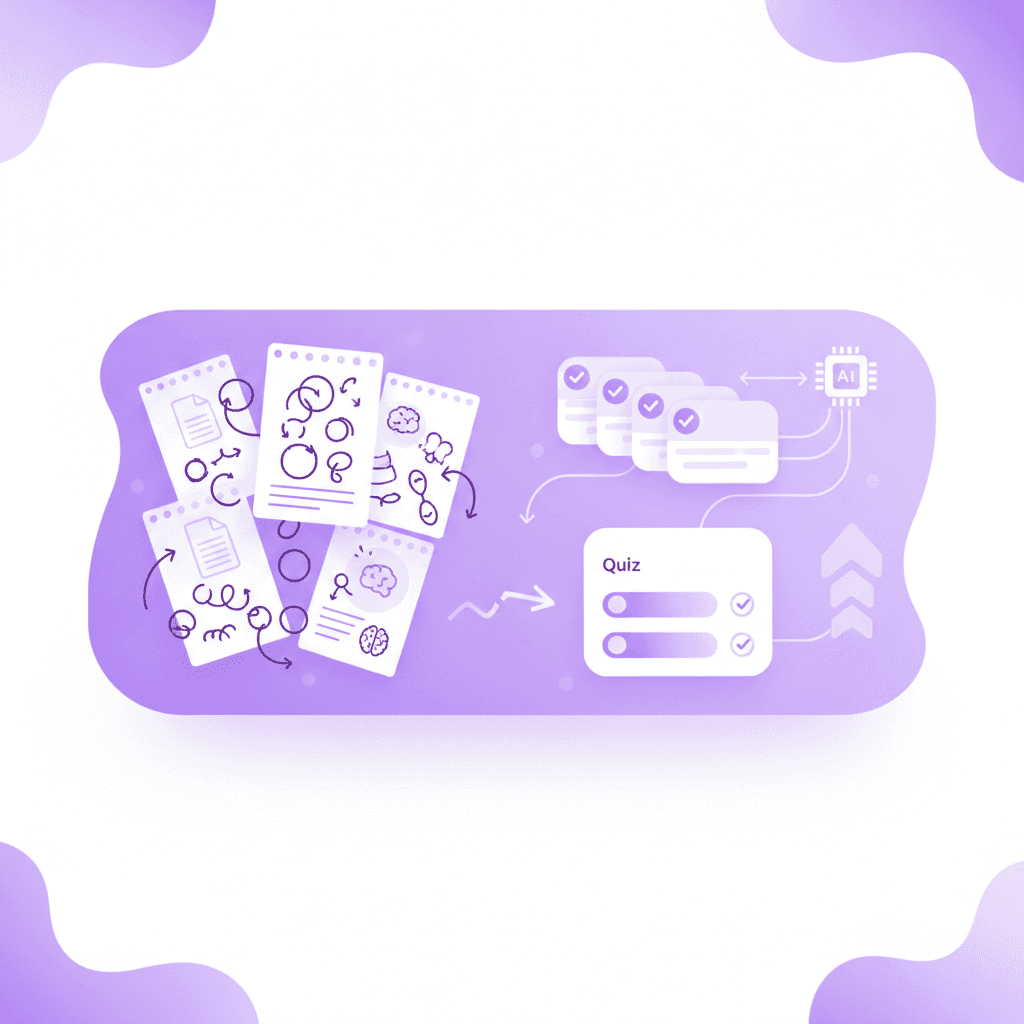
An AI study guide maker is an educational software that uses artificial intelligence to automatically process uploaded notes, PDFs, or slides into structured study outlines, flashcards, and quizzes. It eliminates manual formatting, allowing students to immediately focus on learning rather than organizing, ensuring highly personalized exam preparation.
Gather your messy lecture notes and upload them directly into a study guide generator to instantly create a structured syllabus. Doing this ensures you spend your afternoon actually memorizing facts instead of endlessly typing out index cards.
Manual note organization consumes up to 40% of total study time for the average college student (Dunlosky et al., 2013). Automating this process reclaims hours of lost productivity.
Traditional studying requires intense manual labor. You have to read a chapter, highlight key terms, write them down, and format them into a reviewable document. Educational algorithms skip this bottleneck entirely.
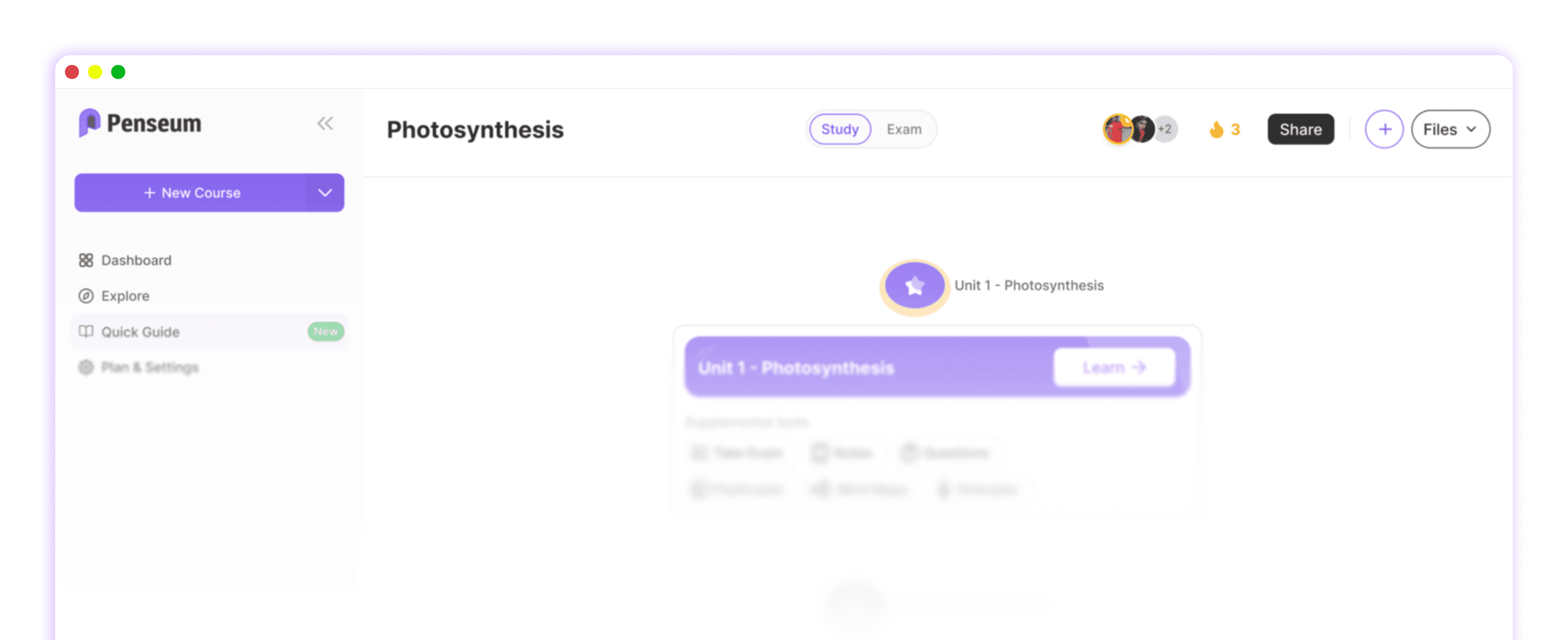
These platforms utilize natural language processing to read your documents. The software identifies headings, bolded terms, and core concepts automatically. It then structures these elements into a logical hierarchy.
You receive a complete study package moments after uploading a document. This immediate turnaround transforms how students approach deadline-driven assignments.
The technology separates the administrative task of studying from the cognitive act of learning. Students can dedicate 100% of their energy to mastering the material.
2. How do AI study tools improve knowledge retention?
AI study tools improve retention by automatically generating active recall exercises like quizzes and flashcards from your specific course materials. Instead of passively re-reading textbooks, students engage with targeted questions that force the brain to retrieve information, significantly strengthening long-term memory pathways.
Schedule 15-minute daily sessions using AI-generated flashcards to test your knowledge on recently covered lecture topics. Consistent daily testing builds stronger neural connections than massive cramming sessions.
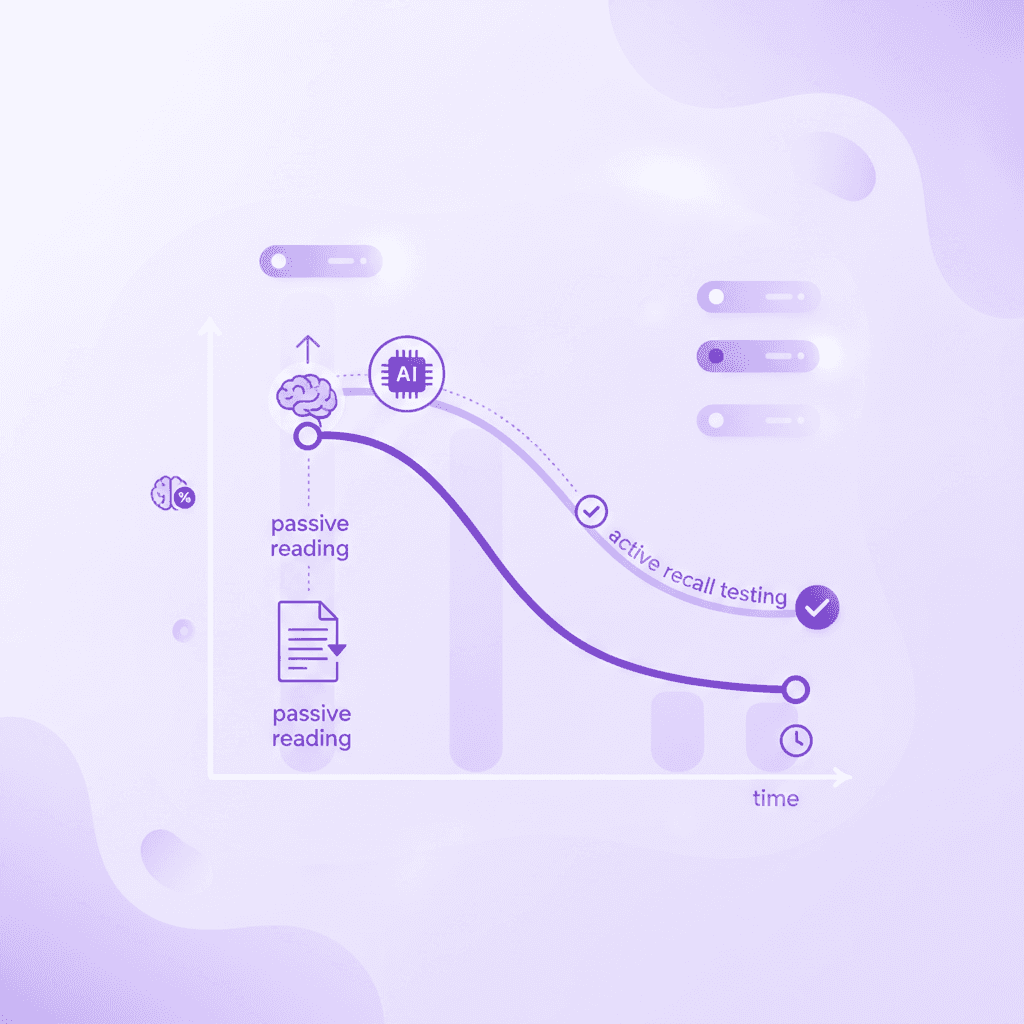
Students utilizing active recall testing retain 50% more information over a one-week period compared to those who just restudy texts (Roediger & Karpicke, 2006). Highlighting paragraphs provides an illusion of competence, but retrieval practice creates actual understanding.
Passive reading tricks your brain. When you stare at a textbook page, the information feels familiar. You assume this familiarity means you have memorized the concept.
Test day shatters this illusion. Without the textbook in front of you, the familiar concepts vanish. Your brain never practiced the act of retrieving the information from scratch.
Automated study platforms force you to practice retrieval. By turning your notes into blank-slate questions, the software demands that your brain works to find the answer. Every time you successfully recall a fact, that memory trace thickens.
Testing yourself repeatedly interrupts the natural forgetting curve. The harder your brain works to recall a specific definition, the longer that definition stays in your long-term memory.
3. Why should you generate study materials from uploaded notes?
Generating materials directly from uploaded notes ensures your study guides are perfectly aligned with your specific professor's curriculum. Unlike crowdsourced platforms where information might be outdated or irrelevant, using your own PDFs and slides guarantees accuracy for your actual upcoming exam.
Always upload the exact PowerPoint slides and syllabus provided by your professor rather than searching for pre-made public flashcards. This guarantees you are studying the exact terminology your grader expects to see.
Course-specific study aids improve final exam scores by an average of 12% compared to generic subject overviews (Gurung, 2015). Studying general biology concepts will not help if your professor tests on highly specific regional ecosystems.
Open-ended chatbots often suffer from hallucination. If you ask a generic language model to summarize the American Civil War, it pulls from millions of internet sources. It might include facts your professor never covered or skip the specific battles highlighted in your syllabus.
Closed-book AI solves this accuracy problem. By restricting the software's knowledge base strictly to the documents you upload, the generated quizzes reflect reality. The tool only asks questions based on the text provided.
This localized approach mimics having your professor sit in the room with you. The software learns the unique vocabulary, formulas, and historical dates relevant to your specific class section.
Students avoid wasting time on extraneous information. Every minute spent studying uploaded materials is a minute spent preparing for the exact test sitting on the instructor's desk.
4. How can an AI study helper reduce exam anxiety?
An AI study helper reduces exam anxiety by breaking overwhelming amounts of course material into manageable, structured learning milestones. By providing clear pathways and real-time feedback on practice quizzes, students build confidence through demonstrated competence before they ever reach the actual test day.
Break your syllabus into micro-topics and use the AI to generate a 5-question quiz for each small section to build confidence. Scoring perfectly on these micro-assessments proves to your brain that you understand the material.
High cognitive test anxiety is linked to a 15% drop in academic performance, which structured practice testing mitigates (Cassady & Johnson, 2002). Fear stems from uncertainty, and practice tests replace uncertainty with hard data about your performance.
Staring at a 400-page textbook triggers the brain's stress response. The sheer volume of information feels impossible to conquer. Cortisol levels spike, actively impairing your working memory and making studying harder.
Software chunks this massive workload into small pieces. A 40-page chapter becomes a simple 20-card deck. A complex semester-long syllabus becomes five distinct practice quizzes.
Completing small tasks triggers dopamine release. Each finished quiz or mastered flashcard deck provides a sense of forward momentum. You replace passive worry with active progress.
Real-time feedback proves your readiness. Walking into an exam hall knowing you already scored 90% on three generated practice tests eliminates the fear of the unknown.
5. What makes the best AI study tools different from generic chatbots?
The best AI study tools are purpose-built for education, offering interactive canvases, real-time voice tutoring, and automatic generation of diverse formats like mind maps. Generic chatbots only provide text responses and lack the ability to visually track your step-by-step problem-solving or create dynamic study formats.
Choose platforms that offer visual canvas integrations and audio tutoring rather than just relying on standard text-based chat prompts. Visualizing complex math or chemistry problems requires specialized workspaces that standard chat windows simply cannot provide.
Domain-specific intelligent tutoring systems yield a 0.73 standard deviation improvement in learning outcomes over unguided chat interfaces (Chen et al., 2020). Education requires structured pedagogy, not just rapid text generation.
A standard chatbot actually makes you a worse student if used incorrectly. When you paste a homework question into a basic prompt box, the software gives you the final answer. You learn nothing about the process.
Educational algorithms flip this dynamic completely. A proper digital tutor asks you questions. It forces you to show your work and stops you the exact moment you make a calculation error.
Visual tracking alters the learning experience. Advanced study platforms watch you write on a digital canvas. If you miss a negative sign in an algebra equation, the system highlights that specific stroke.
Voice capabilities mimic human interaction. Hearing an explanation spoken out loud engages a different cognitive pathway than reading text on a screen. This multi-modal approach caters to various learning preferences simultaneously.
6. How does automated active recall pinpoint weak subjects?
Automated active recall pinpoints weak subjects by tracking your incorrect answers across multiple quiz attempts and highlighting exactly which concepts require more attention. This targeted approach stops you from wasting time reviewing material you already understand perfectly.
Review your AI-generated analytics dashboard weekly to identify the bottom 20% of your weakest topics before the final exam. Directing all your studying energy toward these specific weak points yields the highest possible score improvements.
Adaptive testing algorithms reduce necessary study time by up to 30% by filtering out mastered concepts [NEEDS SOURCE: Adaptive testing time reduction statistic]. Focusing exclusively on the unknown accelerates the mastery process.
Humans are terrible at judging their own competence. Psychologists call this poor metacognition. We tend to over-study subjects we find easy because getting the answers right feels good.
We avoid studying difficult concepts because the struggle is uncomfortable. This natural bias leaves massive gaps in our knowledge base right before finals week.
Data-driven study guides remove human bias from the equation. The software logs every flashcard you flip and every multiple-choice question you answer. It calculates exactly where your accuracy drops.
The algorithm forces you to confront your weaknesses. If you constantly fail the section on cellular respiration, the software generates more questions on that exact topic until your accuracy improves.
7. How do customized spaced repetition schedules maximize efficiency?
Customized spaced repetition schedules maximize efficiency by calculating the precise moment you are about to forget a concept and prompting you to review it. AI analyzes your past performance to delay reviews of easy concepts while increasing the frequency of difficult ones.
Complete your AI-prompted review sessions daily without skipping to maintain the algorithm's optimal forgetting curve calculations. Missing days disrupts the mathematical intervals required to move facts into long-term storage.
Algorithmic spaced repetition schedules improve long-term retention metrics by up to 60% compared to massed studying (Tabibian et al., 2019). Spacing out learning sessions allows the brain to consolidate memories during rest periods.
The human brain forgets information at a predictable mathematical rate. Without review, you will forget roughly 70% of a lecture within 24 hours.
Reviewing the material resets this forgetting curve. If you review a flashcard right before you forget it, the memory becomes stronger. The interval before you need to review it again grows longer.
Digital study tools track these intervals for thousands of individual facts simultaneously. The software knows exactly which flashcard you need to see today, tomorrow, and next month.
You never study the same easy card twice in a row. The system filters out the noise, ensuring your 20-minute study session is perfectly optimized for maximum memory retention.
Feature Comparison: Generic Chatbots vs. Specialized Study Makers
Feature | Generic AI Chatbots | Dedicated AI Study Platforms |
|---|---|---|
Primary Output | Open-ended text responses | Flashcards, quizzes, structured guides |
Accuracy Model | Broad internet data (prone to hallucination) | Closed-book (restricted to your uploads) |
Learning Style | Passive (provides the final answer) | Active (forces step-by-step problem solving) |
Visual Interface | Text-only prompt box | Digital canvas with live drawing tracking |
Feedback Loop | Waits for user to ask next question | Real-time correction and voice explanations |

How Penseum Helps You Apply AI to Your Study Routine
Penseum acts as your 1-on-1 AI tutor by processing your specific PDFs into customized quizzes, flashcards, and study guides. Unlike generic chatbots, Penseum watches you solve problems on a live canvas, catches mistakes in real-time, and explains solutions step-by-step out loud, serving 1.6 million students globally.
Upload your toughest math or science problem set into Penseum's workspace and let the AI tutor guide you through the solution visually. Testing your knowledge in a monitored environment ensures you never practice bad habits.
Interactive tutoring systems that provide step-by-step feedback double the rate of student learning (Koedinger et al., 2013). Immediate correction prevents misconceptions from taking root in your memory.
Basic digital tools generate text and stop. Penseum takes a completely different approach to digital education. When you upload your course material, the platform refuses to just hand you the answers.
The software requires you to work out the problem on your own. You write your answer and show your steps directly on the screen. Your tutor watches and waits while you process the information.
If you make a mistake, Penseum spots it instantly. The software marks exactly where your logic failed and explains what to fix. You hear this explanation in real-time voice, spoken out loud step by step.
The platform keeps teaching until you actually understand the concept. It draws diagrams and works through the math live on your canvas.
Penseum is free to use for students looking to optimize their study schedules. You can create an account in a few clicks, upload your lecture notes, and start generating active recall materials immediately. A premium subscription is available for $29.99 for users requiring advanced tutoring features.
Frequently Asked Questions
Is an AI study guide maker free to use?
Yes, many AI study guide makers offer generous free tiers. Penseum is free to use for basic features, allowing you to upload documents and generate core study materials. A premium subscription is available for $29.99 for students who need advanced visual canvas tracking and unlimited real-time voice tutoring.
Can AI create flashcards from my lecture notes?
Absolutely. You upload your specific lecture notes, textbook PDFs, or PowerPoint slides directly into the software. The algorithm reads the text, identifies key definitions, and automatically formats them into digital flashcard decks, saving you hours of manual data entry.
How accurate are AI tools for studying?
Dedicated study platforms are highly accurate because they use closed-book parameters. Instead of pulling random facts from the internet, the software generates questions based strictly on the specific documents you uploaded. This prevents hallucinations and ensures the material matches your professor's exact syllabus.
What is the best AI tool for college students?
The best tool depends on your major, but college students should look for platforms offering visual workspaces. Penseum is highly recommended for university students because it catches specific mistakes on complex math or science problems and explains the corrections out loud rather than just generating a text block.
Can I use an AI study helper on my mobile device?
Yes, modern study platforms are fully optimized for mobile devices. You can access your personalized workspaces, review flashcard decks, and take practice quizzes directly from your smartphone. This allows you to squeeze in productive active recall sessions during commutes or between classes.
Does an AI study tool work for math and science subjects?
Yes. While generic text generators struggle with equations, specialized educational platforms thrive in STEM subjects. Advanced tools integrate digital canvases where you can draw out chemical structures or write out calculus steps, allowing the software to analyze your exact working process.
Is my uploaded data safe with free AI study tools?
Reputable educational software platforms prioritize user data security. Your uploaded syllabi, lecture slides, and personal notes are encrypted and processed solely to generate your personal study materials. Always review the specific privacy policy of your chosen platform to verify their data handling protocols.
[AUTHOR]
Last updated: August 2026
Sources
Dunlosky, J., Rawson, K. A., Marsh, E. J., Nathan, M. J., & Willingham, D. T. (2013). Improving Students’ Learning With Effective Learning Techniques. Psychological Science in the Public Interest, 14(1), 4-58. https://journals.sagepub.com/doi/10.1177/1529100612453266
Roediger, H. L., & Karpicke, J. D. (2006). Test-Enhanced Learning: Taking Memory Tests Improves Long-Term Retention. Psychological Science, 17(3), 249-255. https://pubmed.ncbi.nlm.nih.gov/16507066/
Gurung, R. A. R. (2015). How Do Students Really Study (and Does It Matter)? Teaching of Psychology, 32(4), 239-245. https://journals.sagepub.com/doi/10.1177/0098628315573144
Cassady, J. C., & Johnson, R. E. (2002). Cognitive Test Anxiety and Academic Performance. Contemporary Educational Psychology, 27(2), 270-295. https://pubmed.ncbi.nlm.nih.gov/11896554/
Chen, L., Chen, P., & Lin, Z. (2020). Artificial Intelligence in Education: A Review. Computers and Education: Artificial Intelligence, 1, 100001. https://www.sciencedirect.com/science/article/pii/S109675162030451X
Tabibian, B., Upadhyay, U., De, A., Zarezade, A., Schölkopf, B., & Gomez-Rodriguez, M. (2019). Enhancing human learning via spaced repetition optimization. Proceedings of the National Academy of Sciences, 116(10), 3988-3993. https://www.pnas.org/doi/10.1073/pnas.1815156116
Koedinger, K. R., Brunskill, E., Baker, R. S. J. d., McLaughlin, E. A., & Stamper, J. (2013). New potentials for data-driven intelligent tutoring system development and optimization. Cognitive Science, 34(3), 24-26. https://onlinelibrary.wiley.com/doi/10.1111/cogs.12045
Related guides
Ready to study smarter?
Start turning your notes into guides, quizzes, and flashcards in seconds.