7 Ways: How to Focus While Studying to Ace Exams
Key Takeaways
Learning how to focus while studying requires actively managing your environment, applying structured time intervals, and utilizing active retrieval methods. Passive reading inevitably leads to distraction, whereas interactive testing forces continuous cognitive engagement.
Visual clutter and digital interruptions cost students up to 40% of their productive time.
The Pomodoro Technique prevents mental fatigue by enforcing strict 25-minute work intervals.
Active recall testing improves long-term memory retention by up to 80% compared to re-reading.
AI tools transform passive syllabus documents into interactive quizzes, instantly doubling focus intervals.

Why Do I Lose Focus While Studying?
Students lose focus because of digital distractions, mental fatigue, and passive reading habits. Without active engagement, your brain naturally seeks more stimulating activities like scrolling social media. Understanding these psychological triggers is the essential first step in learning how to focus while studying and building sustainable concentration habits.
Gloria Mark (2004) at UC Irvine found it takes an average of 23 minutes and 15 seconds to fully return to an original task after a distraction. Every quick glance at a text message completely resets your cognitive momentum. Your working memory must constantly reload the academic information, accelerating mental exhaustion.
Identify your single biggest distraction trigger—such as your smartphone or noisy roommates—and actively remove it from your immediate physical environment before opening your textbook. This single action protects your baseline attention span. Leaving a phone face-down on the desk still drains cognitive capacity because your brain actively works to ignore it.
Passive review methods compound this issue. Staring at highlighted text does not demand high-level processing from your prefrontal cortex. You must replace passive absorption with interactive learning methods that force your brain to work harder. The moment the reading becomes passive, your internal monologue drifts toward unrelated thoughts.
How Can the Pomodoro Technique Improve Concentration?
The Pomodoro Technique boosts concentration by breaking work into short, intense bursts. Working for 25 minutes followed by a 5-minute break prevents mental fatigue and burnout. This highly structured approach makes intimidating study sessions feel manageable and trains your brain to sustain intense focus over longer periods.
Francesco Cirillo's time-boxing research (1980s) demonstrated improved cognitive agility, while recent productivity studies indicate structured work-break intervals can increase overall productivity by up to 30%. Short sprints of intense focus align perfectly with natural human ultradian rhythms. These biological cycles govern our natural energy peaks and troughs throughout the day.
Set a physical timer or study app for exactly 25 minutes of uninterrupted work, and physically step away from your desk during the subsequent 5-minute break. Do not spend this break scrolling through digital feeds. Stretch, drink water, or look out a window to give your visual cortex a chance to recover from screen glare.
The primary difference between random studying and the Pomodoro method is absolute predictability. Knowing a dedicated break is guaranteed removes the internal anxiety that causes students to prematurely abandon difficult textbook chapters. This predictability naturally extends your total daily studying endurance.
Does Active Recall Help You Focus Better?
Active recall forces your brain to retrieve information rather than passively reading it, which drastically increases your focus. When you constantly test yourself with questions or flashcards, your mind cannot wander. This highly active engagement method naturally prevents daydreaming and accelerates the overall memorization process.
Karpicke & Roediger (2008) proved that students utilizing active recall testing retain up to 80% more information long-term compared to those using passive review methods. The simple act of searching your memory for an answer builds stronger neural pathways. This works because retrieval practice physically alters how your brain stores data.
Stop re-reading your notes repetitively; instead, write down three complex questions about the material you just read and attempt to answer them entirely from memory. If you cannot answer them, briefly review the source material and try the retrieval process again. Continual self-testing acts as an immediate diagnostic tool, instantly revealing your knowledge gaps before an exam.
Integrating these testing strategies requires consistency and a shift in habit. Read our detailed guide on 5 Active Recall and Spaced Repetition Tips for Exams to master this specific retrieval process. This approach directly challenges traditional schooling methods, which heavily favor passive textbook highlighting over active cognitive retrieval.
How Does Your Physical Environment Impact Study Focus?
Your physical environment directly dictates your cognitive focus. Visual clutter actively competes for your brain's processing capacity, leading to decreased performance and increased stress. Creating a dedicated, deeply organized study space signals to your brain that it is time to concentrate, minimizing internal wandering.
Researchers at the Princeton Neuroscience Institute (2011) discovered that multiple visual stimuli present in physical clutter severely restrict a student's ability to focus and process information. Every extra object in your peripheral vision requires unconscious processing power. Removing these objects instantly frees up mental bandwidth for complex problem-solving.
Spend five uninterrupted minutes completely clearing your desk of everything except the specific textbook, notebook, or device you need for your current study session. Store loose papers in folders and remove secondary electronics from the entire room. A barren desk forces your eyes straight back to your core academic material.
Environmental optimization extends beyond basic cleanliness and organization. Lighting, chair ergonomics, and room temperature all play massive roles in sustaining high-level attention over multiple hours. For a comprehensive breakdown of environmental setup, review our 7 Steps on How to Study for Better Exam Grades.
Why Should You Stop Multitasking While Studying?
Multitasking while studying is a myth; you are actually rapidly switching tasks, which continuously drains cognitive energy. Checking text messages while reading textbook chapters fractures your attention span, significantly reducing your reading comprehension and making routine study sessions take exponentially longer.
The American Psychological Association (2001) found that continuous task-switching and multitasking behaviors can cost an individual up to 40% of their total productive study time. The human brain cannot process two complex streams of information simultaneously. Transitioning from a complex math equation to a short social media comment forces a complete mental reboot.
Put your mobile phone completely out of sight on 'Do Not Disturb' mode, and strictly limit background audio to instrumental music or white noise. Audio tracks with prominent lyrics actively compete with the reading comprehension centers of your brain. White noise serves specifically to mask unpredictable background sounds, keeping your auditory processing systems completely neutral.
Singular focus always outperforms divided attention across all academic metrics. Attempting to watch a dense lecture video while writing an unrelated history essay guarantees poor performance on both tasks. Force yourself to complete one assignment entirely before opening a different application.
How Does Spaced Repetition Sustain Long-Term Attention?
Spaced repetition sustains attention by distributing study sessions over increasing intervals of time, rather than cramming information all at once. This logical method prevents the intense cognitive fatigue naturally associated with marathon study sessions. Studying for shorter periods across multiple days keeps your brain fresh and highly responsive to new academic concepts.
Research published in the journal Memory & Cognition demonstrates that spaced distribution of study material yields a 45% higher retention rate than massed practice. Your brain physically consolidates memories during sleep and rest periods. This means the empty spaces between your active study sessions are just as valuable as the active reading time itself.
Schedule your study sessions using a digital calendar, breaking a large exam syllabus into five distinct review periods spread evenly over two weeks. Review the oldest material first before moving on to new chapters. This specific sequencing guarantees that foundational concepts are completely solidified as the final exam date approaches.
Consistent spacing naturally limits daily study time to strict, manageable blocks. Knowing you only have to study a subject for thirty minutes highly limits the dread that typically causes procrastination. Discover exact scheduling templates in our post on 5 Spaced Repetition Tips for Better Grades.
Does Listening to Specific Audio Increase Study Focus?
Listening to specific audio formats, such as binaural beats or steady white noise, increases study focus by completely masking unpredictable background distractions. Constant, low-level sound creates an isolated auditory environment, preventing sudden noises from breaking your deep concentration. This highly controlled soundscape helps your brain enter a flow state faster and maintain it longer.
A 2017 study in the Frontiers in Human Neuroscience journal found that listening to specific auditory beats can enhance working memory capacity and improve sustained attention metrics by up to 15%. The steady rhythm acts as an unconscious anchor for the wandering mind. This tactic is highly effective in notoriously noisy dormitories or crowded university libraries.
Put on noise-canceling headphones and play a continuous track of brown noise or instrumental lo-fi music at a low volume. Never listen to songs with unpredictable tempo changes while studying complex subjects. Your brain will automatically attempt to decode the rhythmic patterns, stealing processing resources directly away from your test preparation.
Different frequencies work for different subjects and individuals. Experiment with white noise for heavy reading comprehension, and rhythmic instrumental beats for repetitive tasks like math problem sets.
How Penseum Helps You Apply Active Focus Techniques
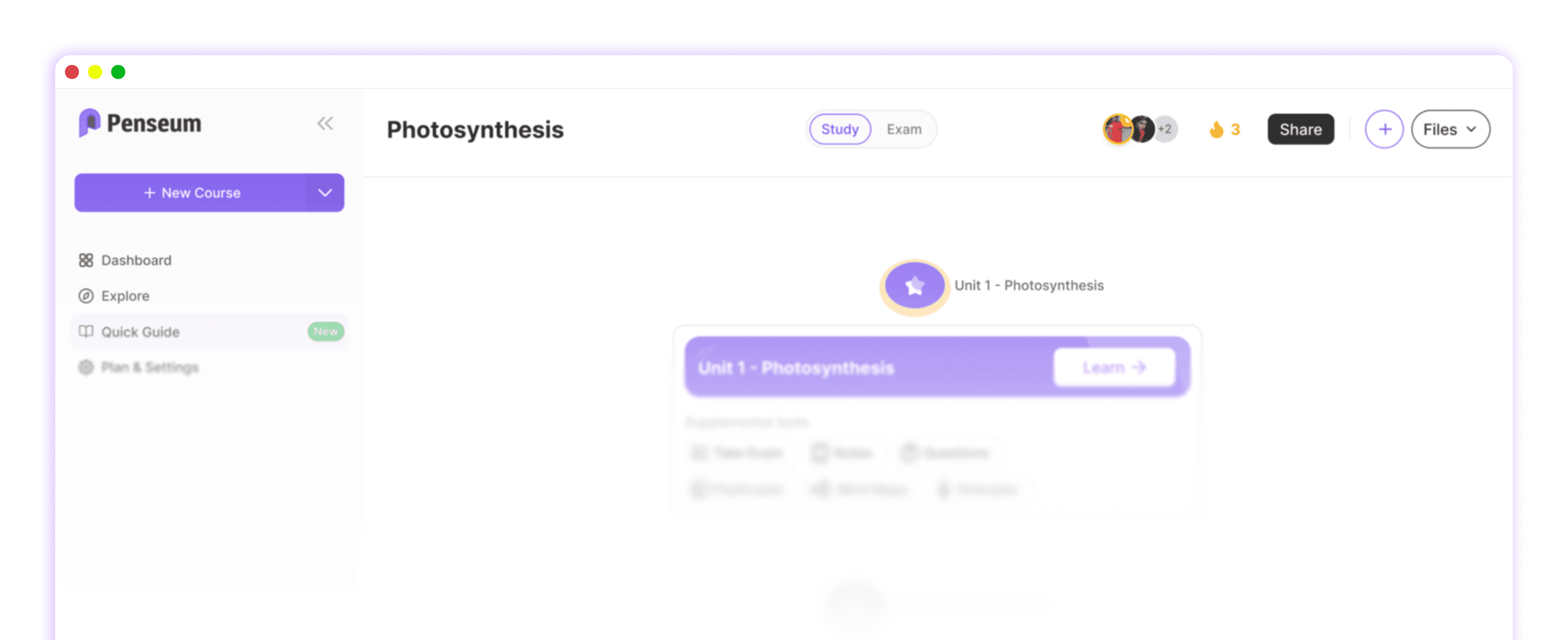
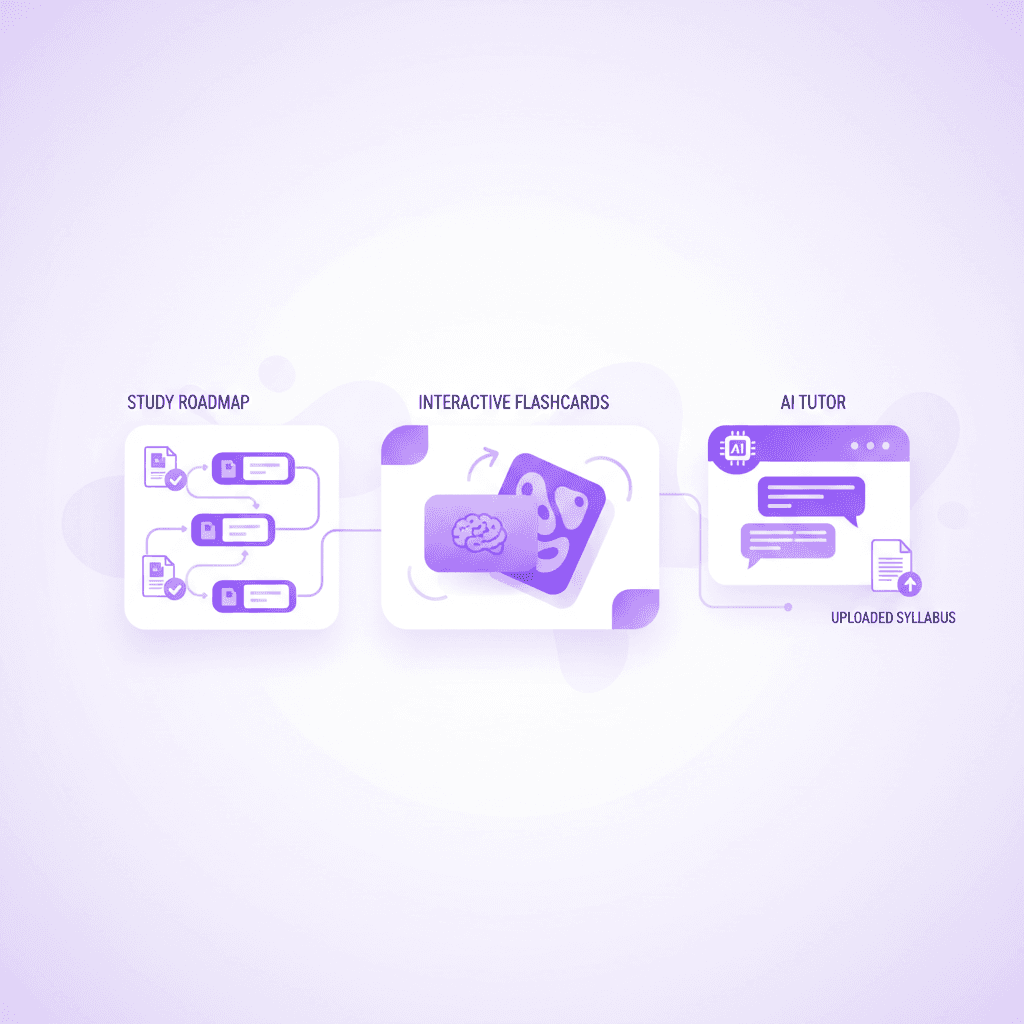
Passive reading drains your energy and destroys concentration. By actively turning notes into interactive quizzes and flashcards, your brain stays engaged. Penseum helps you apply active recall by generating study guides and podcasts directly from your uploaded materials, eliminating prep work so you can immediately focus on high-yield learning.
Educational psychology indicates that interactive study tools double focus times. Penseum supports this methodology by offering free AI-driven interactive study generation, trusted by over 1,000,000 learners across 130+ countries. When you eliminate the tedious administrative task of manually writing out flashcards, you preserve your peak mental energy for actual long-term memorization.
Upload your class syllabus, PDF textbook chapters, or lecture slides to Penseum to instantly generate a personalized active study guide and flashcard deck. All your customized study tools and exact progress metrics live safely in one synchronized workspace. This entirely removes the technical friction that typically leads to study procrastination.
When you encounter a difficult equation or dense theory, Penseum provides exact step-by-step solutions to guide your understanding. You no longer have to waste hours searching the internet for vague explanations. The platform acts as a precise private tutor directly aligned with your specific uploaded course material.
Late-night study sessions often leave students stranded without immediate academic help. Penseum solves this massive pain point with a highly accurate AI chatbot available 24 hours a day. You can ask targeted questions about your syllabus at 1 AM and receive immediate, customized answers.
Basic generation features are entirely free to use, making it accessible for all students. A premium subscription is also available for $14.99 to unlock advanced generation limits. Start turning your notes into guides, quizzes, and flashcards in seconds.
Penseum vs. General AI Tools
Feature Focus | Penseum Workspace | General AI Chatbots |
|---|---|---|
Primary Function | Designed specifically for learning, practice, and exam retention. | Designed for general use, not optimized for studying. |
Workflow | All study tools and progress metrics live in one synchronized workspace. | Fragment your workflow, making studying feel scattered. |
Output Quality | Study tools tailored exactly to your uploaded course content. | Produce generic outputs that ignore your specific syllabus. |
Active Learning | Emphasizes specific questions, quizzes, and cognitive recall. | Focus mainly on basic summaries, with highly limited testing. |
Tool Integration | Automatically creates a complete study roadmap including flashcards. | Require multiple separate tools to cover notes and quizzes. |
Frequently Asked Questions
What is the best way to focus on studying for hours?
The best way to focus on studying for hours is to strictly implement the Pomodoro Technique. Work intensely for 25 minutes, then take a mandatory 5-minute break. After completing four cycles, take a longer 30-minute break. This specific interval training prevents mental exhaustion and sustains your cognitive energy. You must also remove all digital distractions from your physical environment to maintain deep concentration over long periods.
How do you focus on studying when you are tired?
To focus on studying when you are tired, you must completely abandon passive reading. Passively staring at a textbook will instantly induce sleepiness. Instead, switch entirely to active recall methods like practicing with flashcards or answering complex quiz questions. Standing up while reviewing material or walking around your room while explaining concepts aloud increases blood flow and temporarily combats intense physical fatigue.
Does listening to music help you focus while studying?
Listening to music only helps you focus while studying if the audio is strictly instrumental. Classical music, lo-fi beats, or steady brown noise mask disruptive background sounds and keep your auditory processing centers neutral. Songs containing lyrics actively compete with your brain's reading comprehension abilities, severely reducing your information retention and destroying your overall academic concentration.
Why do I get distracted so easily when studying?
You get distracted easily when studying because your brain naturally seeks high-dopamine activities over demanding cognitive labor. Smartphones, social media notifications, and noisy environments provide immediate mental stimulation. If your study methods rely entirely on passive reading rather than active engagement, your mind will aggressively wander to find a more rewarding stimulus.
How can a study schedule improve concentration?
A structured study schedule improves concentration by entirely removing decision fatigue. When you know exactly what academic subject to study and at what specific time, you eliminate the mental friction of starting. Scheduling smaller, spaced repetition sessions prevents overwhelming exam anxiety, making it significantly easier to sit down and focus immediately on the complex material in front of you.
How do I retain information faster for exams?
You retain information faster for exams by testing yourself immediately after reading a chapter. Do not wait until the end of the week to review your notes. Generate practice quizzes using your syllabus and attempt to answer them without looking at the source material. This immediate retrieval practice physically strengthens the neural pathways required for long-term memory storage.
[AUTHOR]
Last updated: February 2026
Sources
Mark, G., Gonzalez, V. M., & Harris, J. (2005). No task left behind? Examining the nature of fragmented work. Proceedings of the SIGCHI Conference on Human Factors in Computing Systems. https://dl.acm.org/doi/10.1145/1054972.1055017
Cirillo, F. (2006). The Pomodoro Technique. Francesco Cirillo. https://francescocirillo.com/products/the-pomodoro-technique
Karpicke, J. D., & Roediger, H. L. (2008). The critical importance of retrieval for learning. Science. https://pubmed.ncbi.nlm.nih.gov/18276858/
McMains, S., & Kastner, S. (2011). Interactions of top-down and bottom-up mechanisms in human visual cortex. Journal of Neuroscience. https://pubmed.ncbi.nlm.nih.gov/21228167/
Rubinstein, J. S., Meyer, D. E., & Evans, J. E. (2001). Executive control of cognitive processes in task switching. Journal of Experimental Psychology. https://pubmed.ncbi.nlm.nih.gov/11488431/
Cepeda, N. J., et al. (2006). Distributed practice in verbal recall tasks: A review and quantitative synthesis. Psychological Bulletin. https://pubmed.ncbi.nlm.nih.gov/16719566/
Garcia-Argibay, S., Santed, M. A., & Reales, J. M. (2017). Binaural auditory beats affect long-term memory. Psychological Research. https://pubmed.ncbi.nlm.nih.gov/29080138/
Related guides
Ready to study smarter?
Start turning your notes into guides, quizzes, and flashcards in seconds.