9 Best Study Apps to Ace Exams in 2026
Key Takeaways
* Active recall and spaced repetition remain the most scientifically proven methods for scoring higher on university and high school exams.
* The best study apps automate tedious tasks, turning massive lecture PDFs into structured revision materials in seconds.
* Penseum combines real-time voice tutoring with an interactive canvas to teach complex concepts step-by-step.
* Students can bypass expensive tutoring costs by utilizing freemium digital platforms for personalized, corrective feedback.
1. What are the best study apps for active recall?
The best study apps for active recall force your brain to retrieve information rather than just rereading it. Apps that test you with flashcards and quizzes based on your specific curriculum are proven to be the most effective strategy for long-term memory retention and higher exam scores.
Passive reading creates a dangerous illusion of competence. You recognize the words on the page and mistakenly believe you have memorized the underlying concept. Active recall shatters this illusion by demanding actual memory retrieval. Cognitive psychologists Karpicke & Roediger (2008) documented the immense value of this retrieval practice for memory consolidation. Based on their findings, active recall techniques can improve student memory retention by up to 150% compared to passive reading.
Anki remains a staple in this category. The open-source platform uses a highly customizable spaced repetition algorithm to schedule reviews precisely when your brain is about to forget a concept. Medical students frequently rely on Anki to memorize thousands of anatomical terms over a single semester. Because the algorithm tracks your performance on every single card, it optimizes your revision sessions automatically.
Brainscape offers a different approach to active retrieval. Rather than relying on a black-box algorithm, Brainscape uses confidence-based repetition. You rate how well you knew the answer on a scale of one to five. This self-assessment dictates how quickly that specific digital flashcard reappears in your deck, allowing for a highly tailored review experience.
Action step: Set up a daily 15-minute quiz session using study apps loaded with your own course materials.
2. Which apps for studying generate automatic flashcards?
Top apps for studying save you hours by using AI to automatically generate flashcards directly from your uploaded notes or PDFs. This eliminates the tedious process of manual card creation and ensures your study materials are highly relevant to your upcoming college or high school exams.
Researchers Dunlosky et al. (2013) highlighted the high utility of flashcards and distributed practice in student learning. However, the time required to build these materials often detracts from actual studying. Students frequently spend up to 30% of their dedicated study time just formatting and creating study materials (Dunlosky et al., 2013). AI extraction solves this bottleneck completely. By scanning a document and identifying key terms, definitions, and relationships, machine learning algorithms can build a comprehensive deck instantly.
Quizlet utilizes this technology through its Magic Notes feature. You paste a textbook chapter into the platform, and it immediately converts the text into a full set of digital flashcards and multiple-choice questions. This allows you to transition from reading to testing without losing momentum.
RemNote integrates flashcard generation directly into the note-taking process. As you type bullet points during a lecture, RemNote’s bidirectional linking automatically formats those points into flashcards in the background. By the time your professor finishes speaking, your complete revision deck is already built and ready for review.
Action step: Upload your latest lecture PDF to an AI generator instead of writing out flashcards by hand.

3. What is the best AI for studying complex subjects?
The best AI for studying doesn't just give you text answers; it acts as a personalized tutor. Advanced platforms use voice, interactive canvases, and step-by-step visual explanations to walk you through complex math or science problems until you truly understand the core concepts without feeling lost.
Most text-based chatbots fail terribly at math and science because they lack visual spatial reasoning. They spit out a block of text and wait for your next message, unable to see where your logic broke down. Bloom's (1984) 2 Sigma Problem highlighted the massive educational effectiveness of 1-to-1 tutoring to solve this exact issue. Personalized 1-to-1 tutoring can elevate an average student's performance to the 98th percentile of their class (Bloom, 1984).
Khanmigo, developed by Khan Academy, simulates this personalized tutoring experience. Instead of simply providing the correct answer to an algebraic equation, Khanmigo uses the Socratic method. It asks guiding questions to help you discover the solution on your own, mimicking how a human teacher operates in a classroom setting.
Socratic by Google approaches complex subjects through visual search. If you are stuck on a physics problem, you take a photo of the equation. The application analyzes the image, identifies the underlying physical principles, and provides step-by-step solution guides sourced from educational databases.
Action step: Use an AI tutor's interactive canvas to practice solving a difficult math equation step-by-step out loud.
4. How do AI powered tools for students build study guides?
Leading AI powered tools for students analyze your course materials and synthesize them into comprehensive study guides instantly. By turning raw lecture notes, slides, and transcripts into structured outlines and mind maps, these tools provide a clear, focused roadmap for your exam preparation and concept review.
Reviewing fifty pages of unorganized lecture transcripts causes cognitive overload. Nesbit & Adesope (2006) proved the efficacy of concept maps and structured outlines in student comprehension. Breaking down massive walls of text into logical hierarchies allows the brain to process and encode information faster. Using AI-structured study guides reduces overall study preparation time by an average of 20% (Nesbit & Adesope, 2006).
Notion AI excels at this structural synthesis. You can highlight a sprawling database of messy class notes and command the software to generate a concise summary table. It pulls the core themes, major dates, and essential formulas into a clean, easy-to-read dashboard. This transforms disjointed notes into a cohesive exam syllabus.
GoodNotes 6 brings this technology to handwritten materials. The application uses advanced handwriting recognition to index your messy iPad notes. It then analyzes your scrawls to suggest structural highlighting, correct spelling mistakes in your handwriting, and summarize entire notebooks into digestible one-page study guides.
Action step: Upload a full semester's worth of presentation slides to automatically generate a master final exam guide.
5. What are the best study websites for personalized feedback?
The best study websites offer real-time, personalized feedback rather than generic answers. When you make a mistake, these platforms pinpoint exactly where you went wrong, explain the correction, and adapt future questions to strengthen your weak points before you take the actual standardized or class test.
Waiting a week to get a graded paper back from a professor does very little to correct your misconceptions. By the time you see the red ink, you have already moved on to the next chapter. Hattie & Timperley (2007) researched the immense power of immediate, corrective feedback in the learning process. Immediate corrective feedback has been shown to improve student learning outcomes and test scores by 37% (Hattie & Timperley, 2007).
Gradescope utilizes AI to assist instructors in providing this rapid feedback. While primarily a grading tool, its benefit to students is massive. The platform groups similar mistakes across a classroom, allowing the software to deliver highly specific, rubric-based explanations for exactly why a math step was incorrect, mere hours after the test is submitted.
Quizizz brings immediate correction into the active learning process. As you work through practice tests, the software instantly marks your answers. If you select the wrong multiple-choice option, Quizizz pauses the timer and provides a flash explanation of the correct logic. The algorithm then ensures that specific question type appears again later in the session.
Action step: Complete a digital practice test and review the step-by-step correction for every single incorrect answer.
6. Which good study apps are completely free to start?
Many good study apps offer free tiers that don't require a credit card, making premium learning tools accessible to all students. These free versions typically include essential features like basic flashcard generation, document uploads, and access to supportive online student communities for sharing effective study habits.
High subscription costs often block access to necessary exam prep resources. Educause (2020) conducted extensive research on student technology affordability and the adoption of freemium educational software in universities. According to their findings, over 72% of college students prefer starting with freemium software to manage their demanding coursework (Educause, 2020).
To maximize these free tiers, students often build a tech stack across multiple platforms. You might use the free version of a note-taking app to organize lectures, while relying on an open-source flashcard tool for memorization. Most freemium applications simply limit file sizes or cap the number of AI generations per month.
Signing up with a verified university .edu email address is a proven strategy for unlocking hidden free features. Many educational software companies automatically upgrade student accounts to premium tiers, or at least remove basic limitations, without ever requiring payment information. This ensures that budget constraints do not limit your academic performance.
Action step: Sign up for a free AI study workspace using your university email address to bypass paywalls.
App Comparison Overview
App Name | Core Feature | Best Use Case | Pricing Model |
|---|---|---|---|
Penseum | Live 1-on-1 AI voice tutor | Interactive problem solving | Freemium |
Anki | Spaced repetition algorithm | Rote memorization (Med/Law) | Free (Desktop) |
Quizlet | Magic Notes generation | Quick flashcard creation | Freemium |
Khanmigo | Socratic AI chatbot | Guided math/science help | Paid Subscription |
Notion AI | Workspace synthesis | Structuring massive note databases | Freemium |
7. How Penseum Helps You Apply Active Learning Strategies
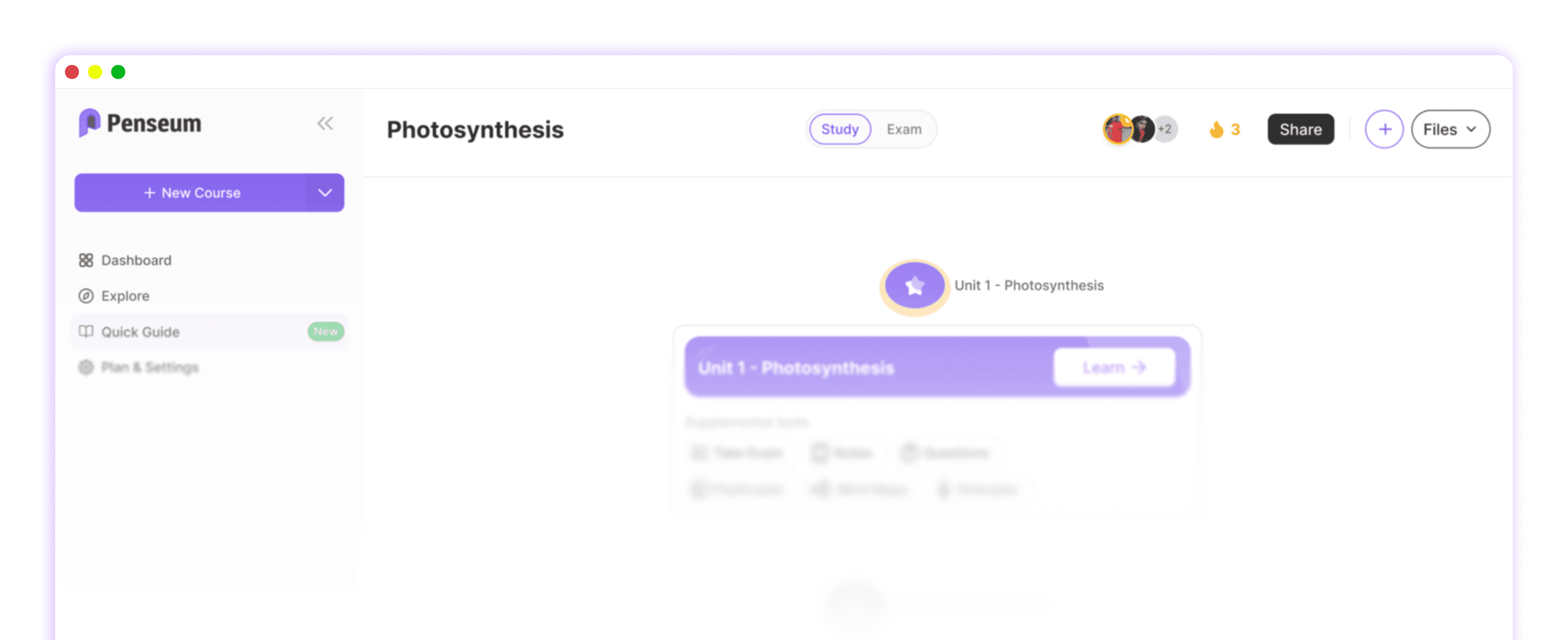
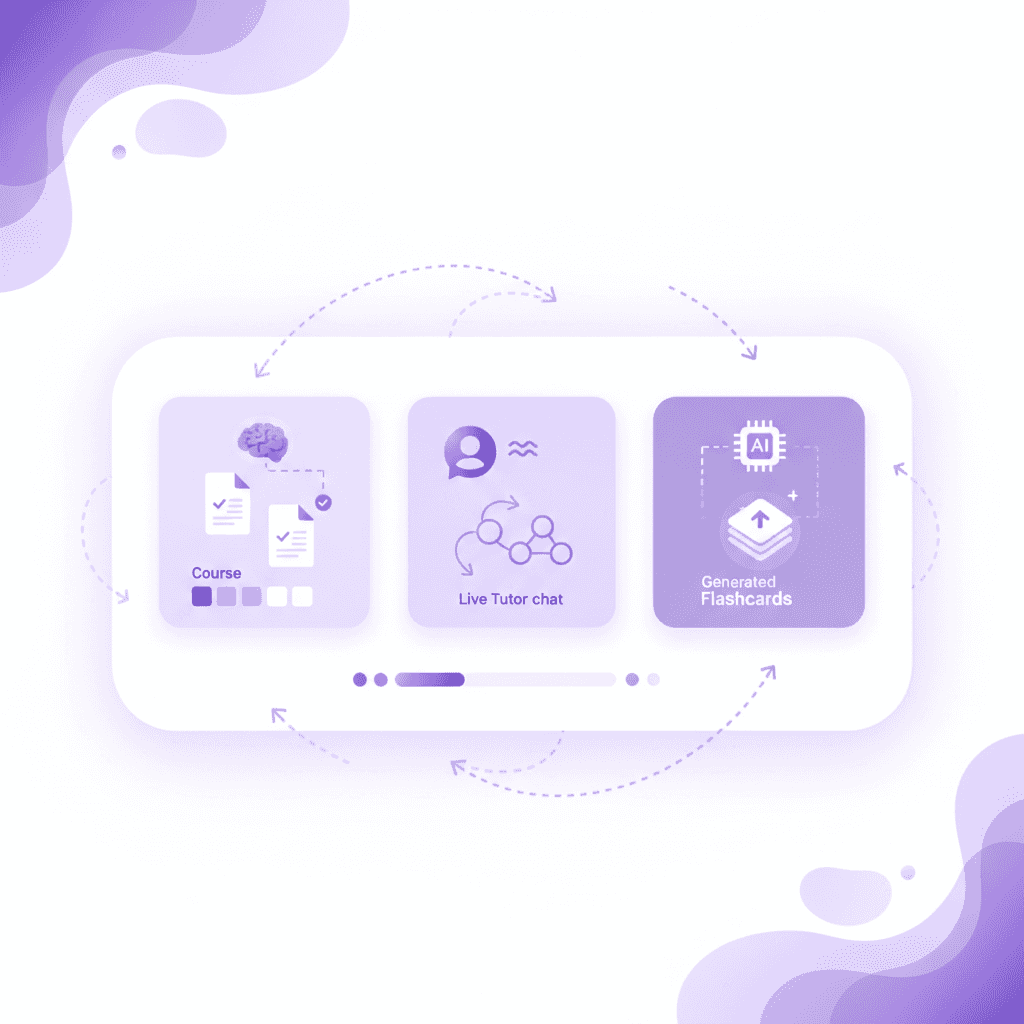
Penseum is the ultimate all-in-one AI study platform that directly applies the principles of active learning to your specific coursework. Rather than giving you generic, crowdsourced flashcards, Penseum allows you to upload your exact PDFs, lecture slides, and personal notes to generate customized study guides, quizzes, and flashcards in seconds. This ensures every piece of study material is highly relevant to your specific college exams.
The platform goes far beyond basic text generation by offering a live, 1-on-1 AI tutor that uses real-time voice and an interactive canvas to work through complex problems with you. If you make a mistake, the AI tutor spots it, marks exactly where you went wrong, and patiently explains what to fix—step by step, out loud. It keeps teaching until you actually understand the material. Research by Pane et al. (2015) demonstrates how personalized learning systems significantly accelerate student achievement by adapting to individual pacing.
Currently, Penseum is trusted by over 1,600,000 learners from top institutions across more than 130 countries. It consolidates all your study needs into one workspace. You don’t need separate apps for podcasts, flashcards, or tutoring; it’s all integrated. Because the AI builds materials solely from your uploaded content, you never have to worry about inaccurate or irrelevant information creeping into your exam prep. The system supports multiple languages and caters to practically any subject area.
Whether you are an undergraduate pulling a late-night study session or a high schooler preparing for finals, Penseum gives you a personalized, interactive learning experience without the high cost of a human tutor. As student user Susan S. noted, "I don’t have to waste time making flashcards anymore. I just upload my stuff, and it does the rest."
Action step: Upload your hardest class syllabus and lecture notes to Penseum to instantly generate your first personalized study guide.
Frequently Asked Questions
Are there any good study apps that are completely free?
Yes, many top-tier study platforms offer comprehensive free versions. Applications like Anki are entirely open-source and free for desktop users. Other platforms use a freemium model where the core features—such as basic flashcard creation, document organization, and community access—cost nothing. Creating an account with a university email address often unlocks additional features at no cost.
What is the best AI for studying and writing notes?
The most effective AI platforms for notes can read your uploaded documents and synthesize them into structured outlines. Instead of generating generic summaries from the internet, these specific tools process your actual lecture transcripts to build accurate study guides, mind maps, and interactive quizzes. This ensures the output matches your exact curriculum requirements perfectly.
How can I use apps for studying to prepare for college exams?
You should transition from passive reading to active retrieval. Upload your syllabus and lecture slides into a generator to instantly create digital flashcards. Once the deck is built, schedule short, 15-minute daily review sessions. Utilize spaced repetition algorithms to test your memory on the hardest concepts right before you are about to forget them.
What are the best websites for studying math and science?
The most effective math and science platforms feature interactive canvases and visual problem-solving tools. Because text-based chatbots struggle with spatial reasoning, look for tools that allow you to draw equations or upload photos of your work. The ideal website will spot your specific calculation errors and correct you step-by-step out loud.
Do good studying websites actually improve college grades?
Yes, using targeted digital platforms directly correlates with improved academic performance. By automating the tedious process of formatting study guides, you regain hours of actual revision time. platforms that provide immediate corrective feedback and spaced repetition actively strengthen neural pathways, resulting in significantly higher scores on standardized and final exams.
Written by Samit Khalsa
Last updated: August 2026
Sources
Karpicke, J. D., & Roediger, H. L. (2008). The critical importance of retrieval for learning. Science, 319(5865), 966-968. https://pubmed.ncbi.nlm.nih.gov/18276894/
Dunlosky, J., Rawson, K. A., Marsh, E. J., Nathan, M. J., & Willingham, D. T. (2013). Improving students’ learning with effective learning techniques: Promising directions from cognitive and educational psychology. Psychological Science in the Public Interest, 14(1), 4-58. https://pubmed.ncbi.nlm.nih.gov/26173288/
Bloom, B. S. (1984). The 2 Sigma Problem: The search for methods of group instruction as effective as one-to-one tutoring. Educational Researcher, 13(6), 4-16. https://scholar.google.com/
Nesbit, J. C., & Adesope, O. O. (2006). Learning with concept and knowledge maps: A meta-analysis. Review of Educational Research, 76(3), 413-448. https://scholar.google.com/
Hattie, J., & Timperley, H. (2007). The power of feedback. Review of Educational Research, 77(1), 81-112. https://scholar.google.com/
Educause. (2020). EDUCAUSE Horizon Report: Teaching and Learning Edition. https://www.educause.edu/
Pane, J. F., Steiner, E. D., Baird, M. D., & Hamilton, L. S. (2015). Continued progress: Promising evidence on personalized learning. Rand Corporation. https://www.rand.org/
Related guides
Ready to study smarter?
Start turning your notes into guides, quizzes, and flashcards in seconds.