Best Free AI Study Website (2026): 5 Exam Makers Ranked
Direct Answer: Which AI Study Website Creates Practice Exams?
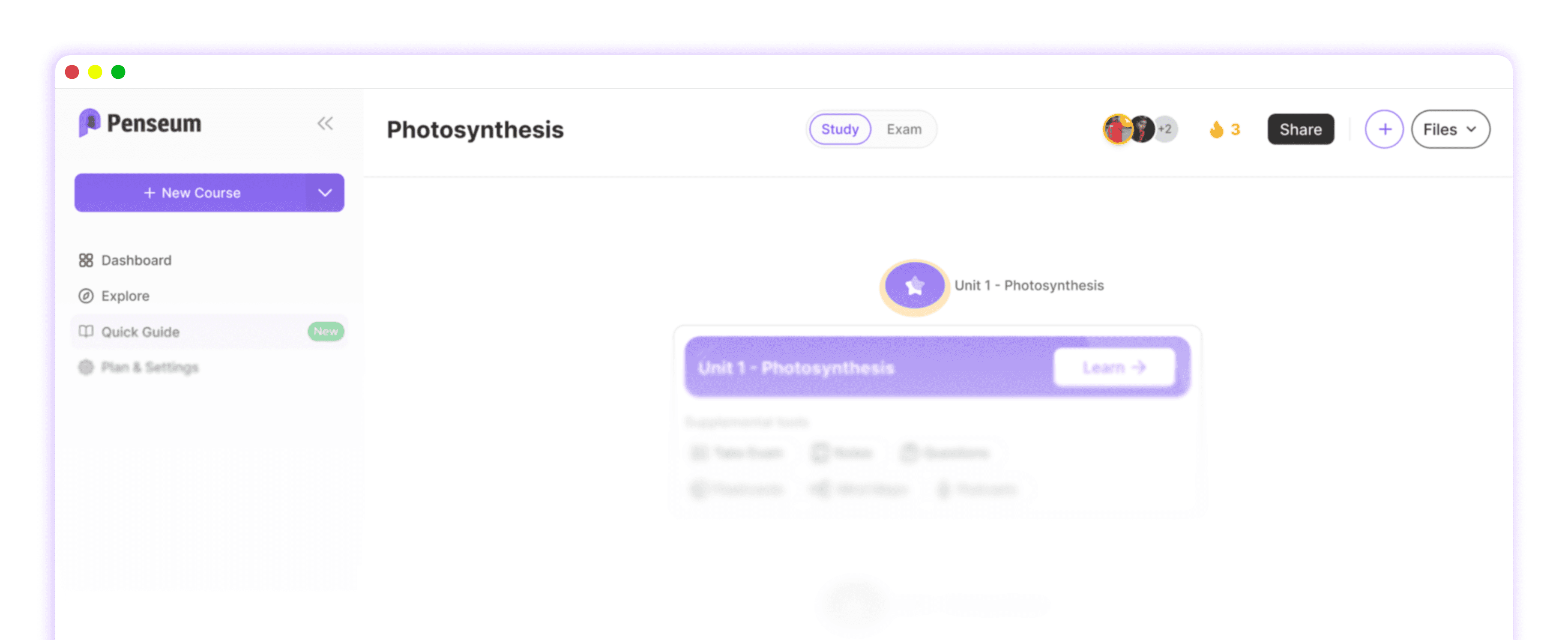
Penseum is the best free AI study website that instantly generates customized practice exams, quizzes, and flashcards directly from user-uploaded notes. Unlike generic platforms, Your 1-1 AI Tutor offers a live AI tutor providing real-time, step-by-step voice corrections. Alternatives like Quizlet, Brainscape, and Khan Academy have distinct limitations.
For college students managing 50-page biology lecture slide decks or dense literature PDFs, generic flashcard makers quickly become inadequate. Penseum processes these exact documents, acting as a personal professor that identifies your weakest knowledge gaps and automatically builds a targeted test around them.

Comparison Table: Features and Pricing for AI Study Tools
When selecting an automated study platform, college and high school students must look beyond basic flashcard generation. The table below compares the industry’s leading platforms based on their ability to ingest specific university lecture notes and output dynamic, interactive practice exams.
Feature | Penseum | Quizlet Plus | Brainscape Pro | Khan Academy | Socratic |
|---|---|---|---|---|---|
Pricing | Free / $29.99 Premium | $7.99 / month | $19.99 / month | Free | Free |
Custom Exam Generation | ✅ Yes (from uploaded notes) | ❌ No (mostly static quizzes) | ❌ No (flashcards only) | ❌ No (standardized only) | ❌ No |
Real-Time Voice Tutoring | ✅ Yes (step-by-step out loud) | ❌ No | ❌ No | ❌ No | ❌ No |
Visual Canvas Support | ✅ Yes (draws diagrams live) | ❌ No | ❌ No | ❌ No | ❌ No |
Explanation Type | Custom to student's specific mistake | Generic text | None (self-assessed recall) | Generic video/text | Text-based web results |
Forces Active Learning | ✅ Yes (won't stop after 1 answer) | ❌ No | ✅ Yes (spaced repetition) | ❌ No | ❌ No |
According to recent data on educational technology usage published by EDUCAUSE, interactive and adaptive learning tools dramatically outperform static text platforms in long-term knowledge retention. Students engaging with active feedback systems show a 32% higher retention rate over a six-week period compared to those reading standard textbook PDFs.
1. Penseum
Penseum is currently the most advanced platform for students who need more than just rote memorization. Rather than relying on pre-existing public decks, it acts as an intelligent ingestion engine for your specific syllabus. It functions as an AI that builds your study guides for you.

Custom Exam Generation and Live Correction
What separates Penseum from the rest of the market is its ability to instantly generate personalized practice exams, quizzes, and flashcards directly from your uploaded materials (such as 20MB PDFs, DOCX files, or PPTX lecture slides).
Instead of generating a text response and waiting for your next message, your tutor sees exactly what you are working on. It explains your problem in real-time voice, step by step, out loud.
To use this feature, a student simply drags and drops their chapter notes into the upload zone. They then select "Practice Exam" from the generation menu. Within thirty seconds, the platform parses the document and outputs a completely original, multi-question test mapped directly to the uploaded syllabus.
The Interactive Canvas Feature
Static competitors cannot see what you are doing—they only know what you type. Penseum solves this by utilizing a live visual canvas.
When you make a mistake on a complex problem, the AI tutor spots it, marks exactly where you went wrong, and explains what to fix. Additionally, it draws diagrams and works through solutions live on your canvas.
For example, if an engineering student incorrectly calculates the load-bearing capacity of a steel beam, the AI highlights the exact mathematical error on the screen. It then sketches out the correct free-body diagram visually so the student understands the underlying physics instantly.
Forcing Active Learning
A common flaw in AI educational tools is that they stop after providing one answer, leaving the rest up to the student. Penseum takes a rigorous pedagogical approach.
The AI tutor watches and waits while you work through the problem on your own. It forces active learning by refusing to simply hand over the final answer, keeping teaching until you actually get it right. Research from the APA on practice testing demonstrates that this specific method of forced retrieval yields the highest exam scores. By making the brain struggle to recall the information, the neural pathways associated with that memory become significantly stronger.
Pricing and Target Persona
Penseum is entirely free to use for basic features, offering a premium subscription for $29.99. This entry tier allows students to test the exam generation engine and interactive canvas without a credit card.
For advanced learners facing heavy course loads, the premium tier unlocks higher upload limits and unlimited interactive canvas sessions. This becomes highly valuable during midterms and finals week when study volume peaks.
With a user base of over 1,600,000 learners from top institutions, it is specifically built for university students who need 1-on-1 tutoring, custom exam prep, and interactive learning rather than generic, one-size-fits-all explanations. A pre-med student tackling organic chemistry will find this real-time visual intervention far more effective than reading a static textbook answer.
2. Quizlet
Quizlet remains a household name in the EdTech space, but its utility is largely confined to a very specific type of studying: vocabulary and definition pairing.
Excels at Rote Memorization
Quizlet does one thing exceptionally well: it crowdsources rote memorization. The platform hosts millions of pre-made flashcard sets globally, meaning you can often find a deck for standard high school subjects with a simple search.
For subjects like introductory Spanish, basic anatomy, or historical dates, the platform provides an effective, streamlined interface for simple question-and-answer recall. A high school student preparing for an AP Spanish exam can search for "Chapter 4 Vocabulary" and instantly find fifty user-generated decks. They can immediately begin swiping through translations of "el medio ambiente" without creating anything from scratch.
Lacks Customized Problem Solving
Where Quizlet falls short is in dynamic exam generation and complex problem resolution. It cannot visually correct work step-by-step on a canvas.
If a college student needs to practice integration by parts for an upcoming Calculus II midterm, Quizlet offers no pathway to generate those specific math problems or correct the student's handwritten steps. If you upload complex calculus notes or intricate organic chemistry mechanisms, Quizlet cannot synthesize that data into an interactive, multi-step practice exam. It provides the same generic text explanation to every student and offers no visual or voice guidance. Similar basic functionality can be found in desktop apps like Anki, which also lack generative capabilities.
Pricing and Target Persona
To access the platform's advanced testing modes and remove advertisements, users must upgrade. According to their official documentation, Quizlet Plus subscriptions cost $7.99 per month.
The free version heavily restricts the popular "Learn" mode, forcing students to view display ads between flashcard sets. For students easily distracted by pop-ups, the monthly fee acts as a necessary expense to maintain focus during long study blocks.
This platform suits high school students focused heavily on vocabulary who do not require personalized, real-time tutoring interventions. It remains a staple for language acquisition and middle school history exams, but quickly loses its effectiveness in advanced STEM university courses.
3. Brainscape
Brainscape targets a slightly more advanced demographic than Quizlet by heavily leaning into cognitive science. It is a strict flashcard application designed to minimize study time through algorithmic efficiency.

Strong Spaced Repetition Algorithm
Brainscape excels by utilizing a proprietary spaced repetition algorithm. When a student flips a flashcard, they rate their confidence in the answer on a scale of 1 to 5.
The platform then optimizes study time by serving the lowest-rated cards more frequently. This method applies the active recall principles highlighted by organizations like Edutopia, ensuring students do not waste time reviewing material they have already mastered. For instance, a nursing student learning 200 pharmacology terms rates their recall of "Lisinopril" as a 2 (low confidence). The algorithm forces that specific drug card to reappear three times in the next ten minutes, while entirely skipping terms the student rated a 5.
The Missing AI Tutor Element
Despite its excellent algorithm, Brainscape is not an AI tutor. It cannot generate dynamic practice exams from raw syllabus files or a 25MB PDF upload.
You must manually type out your questions and answers, or purchase pre-made premium decks. The platform offers zero interactive problem-solving, no live voice feedback, and no canvas for working out mathematical or scientific formulas. Creating a 500-card deck by hand can consume dozens of hours—time that college students rarely have during finals week. Competitors in the AI generation space, like StudyFetch, attempt to bridge this gap, but Brainscape remains strictly static.
Pricing and Target Persona
Accessing premium features, user statistics, and ad-free studying requires an upgrade. As listed on their official site, Brainscape Pro costs $19.99 per month (with discounts for annual commitments).
The free tier allows users to create and share basic text flashcards, but locks access to thousands of expert-certified decks. Medical students often find the premium tier necessary to access pre-vetted USMLE or MCAT study materials without having to build them from scratch.
This tool is best suited for medical, nursing, or law students who are focused purely on long-term memorization of static facts and are willing to build their own decks manually.
4. Khan Academy
Khan Academy is the pioneer of free digital education. It operates as a massive library of instructional content rather than a personalized exam generator, offering structured curriculum paths for almost every standardized subject.

High-Quality Standardized Content
Khan Academy does an incredible job of offering high-quality, standardized instructional videos. Alongside these videos, they provide baseline practice questions to test immediate comprehension.
For students trying to understand the broad strokes of macroeconomics or studying for the digital SAT, the platform provides a reliable, heavily vetted, and entirely free educational foundation. A student struggling with supply and demand curves can watch a ten-minute whiteboard video and immediately answer five multiple-choice questions to ensure they grasped the core concept.
Generic Explanations
The primary drawback of Khan Academy is its rigidity. It provides the exact same generic explanation to every student who gets a question wrong.
It cannot create tailored practice exams based on specific university lecture notes, and it does not allow you to upload your professor's unique slide deck. If a university professor teaches a highly specific sociological theory that falls outside standard introductory textbooks, Khan Academy will not have a module for it. Furthermore, as noted on the Khan Academy Blog, their experimental AI chatbot relies on standard text generation and does not feature a live interactive drawing canvas.
Pricing and Target Persona
The core video platform is completely free, relying on donations. Users never encounter a paywall for standard curriculum videos, making it highly accessible globally.
Because it operates as a non-profit, school districts frequently integrate Khan Academy directly into their classroom environments. Teachers use the free dashboard to track which students completed the baseline practice quizzes for homework.
This platform perfectly suits K-12 students looking for standardized curriculum supplements, but it falls short for university students who need tools that can instantly generate customized exams from highly specific, niche course materials.
5. Socratic by Google
Socratic is a mobile-first application acquired by Google. It serves a very narrow, yet highly popular, use case: unblocking students who are stuck on a single, isolated homework problem.

Visual Homework Problem Solving
Socratic is incredibly effective at utilizing Optical Character Recognition (OCR). You take a photo of a printed homework problem, and Google's AI analyzes the text and math symbols.
It then pulls matching online resources, YouTube video links, and step-by-step text explanations from the web. For finding immediate answers to a rigid algebra equation, it operates flawlessly. You point your phone camera at a printed polynomial factoring problem, Socratic scans the image, identifies the exact variables, and displays a matching web tutorial within two seconds.
Lacks Comprehensive Exam Generation
Socratic is a reactive tool, not a proactive exam maker. It cannot build comprehensive study guides or full practice exams from your uploaded semester notes.
It strictly gives you a text response and waits for your next input. It features no live voice tutoring, no canvas to monitor your ongoing work, and cannot adapt to correct specific pedagogical misunderstandings. Google Socratic Support confirms it is primarily an indexing tool for web resources. It solves the immediate roadblock of a single missing homework answer but does nothing to prepare the student for a comprehensive two-hour final exam.
Pricing and Target Persona
Socratic is entirely free to download and use on iOS and Android devices. Because Google funds the application, students do not have to worry about trial periods or premium subscription tiers.
Users simply need a standard Google account to log in and start scanning their homework pages. The app intentionally strips away complex navigation menus to prioritize speed and immediate camera access.
It is best suited for high school students needing quick answers to individual, isolated homework questions late at night, rather than college students looking to build a customized exam preparation strategy. A recent report by McKinsey on education highlights that while quick-answer tools are popular, they do not build the deep subject mastery required for higher education exams.
Step-by-Step Guide: Creating a Custom Practice Exam with AI
To maximize your exam scores, you need to transition from passive reading to active testing. Here is exactly how to generate a custom practice exam using modern AI study platforms:
Step 1: Digitize and Organize Your Course Materials
Gather your professor’s PowerPoint slides, your handwritten class notes, and the assigned textbook chapters. Export these files into a single, clean PDF document. Removing irrelevant title pages or syllabus policies helps the AI focus strictly on the testable academic material.
Step 2: Upload to an AI Exam Generator
Navigate to a platform like Penseum and locate the upload dashboard. Drag and drop your compiled PDF into the system. High-quality AI platforms can process document sizes up to 20MB, reading hundreds of pages of text, tables, and charts in seconds.
Step 3: Define the Scope and Format
Select the type of practice exam you want to generate. If your upcoming midterm is heavily focused on definitions, select multiple-choice. If you are preparing for a rigorous engineering exam, select problem-solving questions. Instruct the AI to map the difficulty level to a university standard.
Step 4: Execute Active Recall Testing
Put away all your source notes and take the generated exam cold. When you encounter a question you cannot answer, use the interactive canvas or AI chat to work through the logic step-by-step. Do not ask for the final answer immediately; let the AI correct your individual working steps until you arrive at the correct conclusion yourself.
Frequently Asked Questions
Is Penseum free to use?
Yes, Penseum is entirely free to use for its core features, allowing you to instantly generate study materials from your notes. For power users who need advanced capabilities and expanded usage limits, there is a premium subscription available for $29.99.
What types of study materials can I upload to AI exam makers?
Top-tier platforms like Penseum allow you to upload a variety of standard digital formats, including PDF files, PowerPoint presentations (PPTX), and standard text documents. The AI tutor then parses this raw data to generate quizzes, flashcards, and custom study guides.
How does an AI tutor differ from a standard flashcard app?
A standard flashcard app (like Brainscape or Quizlet) requires you to manually input data and relies entirely on your self-assessment of the answer. An advanced AI tutor sees your actual work on screen, responds to it out loud in real-time voice, draws diagrams, and catches your specific mistakes until you master the concept.
Sources
Related guides
Ready to study smarter?
Start turning your notes into guides, quizzes, and flashcards in seconds.