Best quizlet alternatives free (2026): AI PDF uploads
Key Takeaways
* Discovering viable quizlet alternatives free of restrictive paywalls requires shifting from manual deck creation to automated generation tools.
* Generative artificial intelligence processes dense lecture notes and syllabi instantly into highly targeted practice questions.
* The most effective study applications combine direct file uploads with interactive tutoring to verify comprehension before exam day.
* Look for platforms that support direct PDF and slide uploads to bypass character limits.
* Always export your existing flashcard decks via CSV to maintain your study streaks during platform migrations.
What makes a reliable free Quizlet alternative for college students?
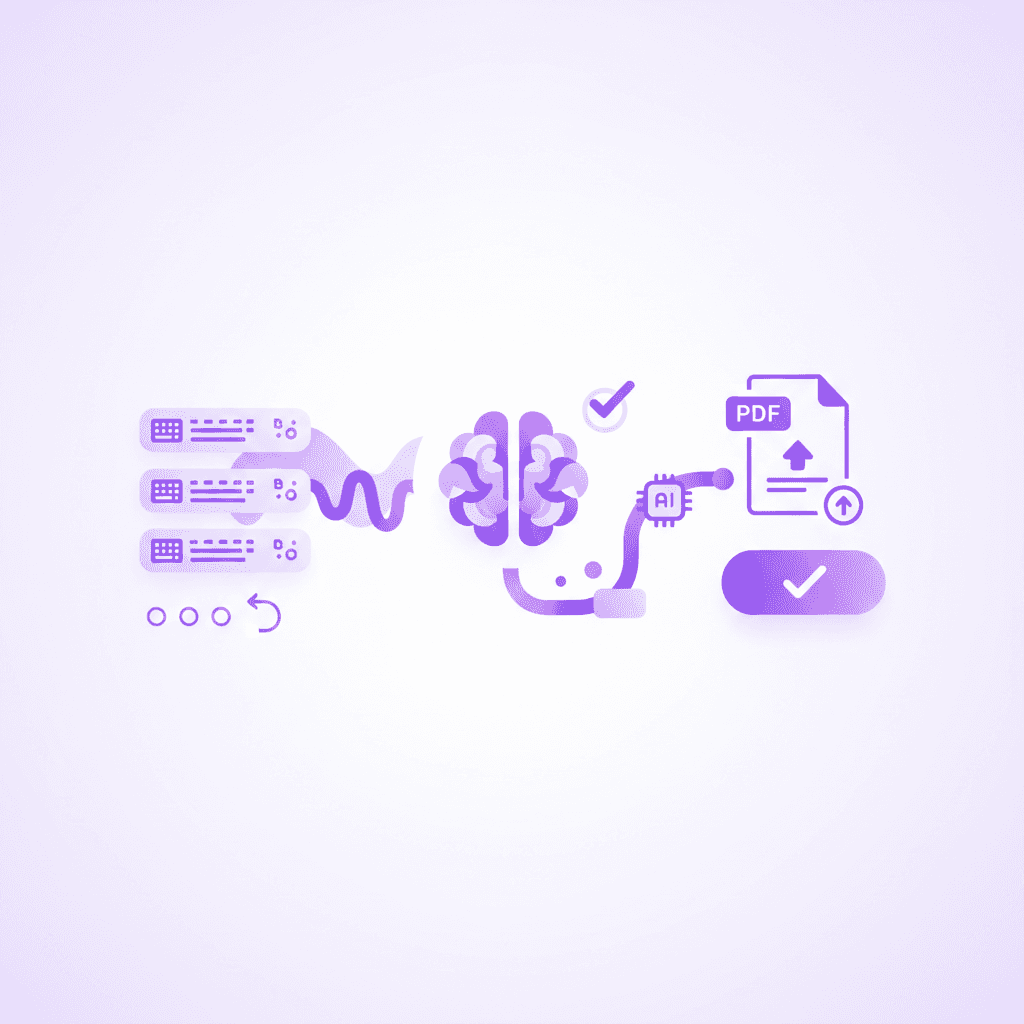
Finding reliable quizlet alternatives free of subscriptions requires evaluating platforms that generate accurate, course-specific materials. The best options eliminate the need for crowdsourced decks by utilizing artificial intelligence to process your specific lecture notes, PDFs, and syllabi instantly into highly targeted practice questions.
Research indicates that active retrieval practice produces better retention than passive studying (Karpicke & Roediger, 2008). Passively reading highlighted textbook chapters yields lower test scores than forcing your brain to recall specific facts. You need applications that facilitate immediate testing without hiding essential self-assessment tools behind a paywall. Approximately 43% of undergraduate students report needing better digital tools specifically designed for exam preparation. Relying on decks created by past students introduces significant risks. Those shared files often contain outdated information, missing context, or outright factual errors.
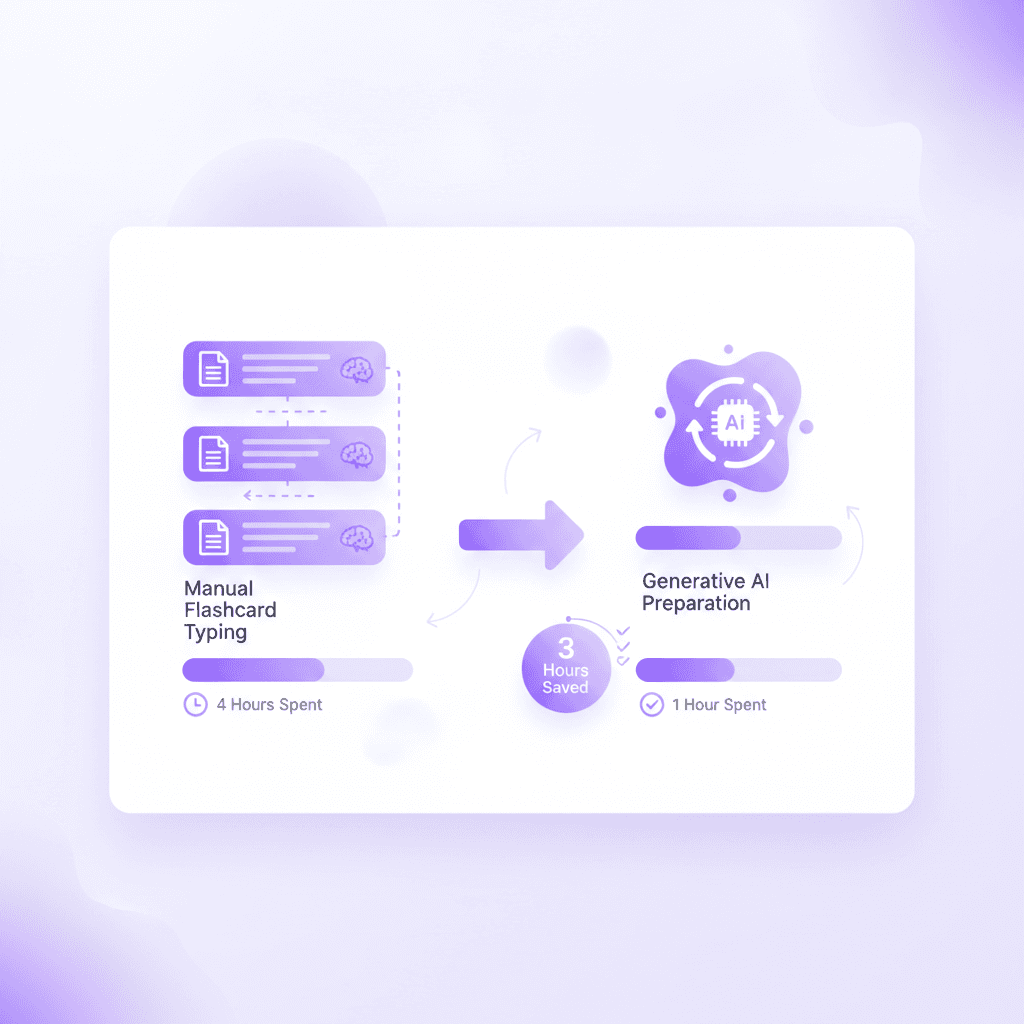
The digital study landscape has shifted toward automation. You no longer need to spend three hours manually typing questions into a digital database. Modern tools parse your provided documents to ensure the resulting quizzes reflect exactly what your professor taught. This precision ensures your study hours directly translate to higher exam performance.
Audit your current digital study tools and delete any applications that charge for basic self-testing features. Your study budget should not dictate your ability to perform basic active recall. Finding a platform that offers unrestricted access to core testing mechanisms is the first step toward building an effective study routine.
How do generative AI study tools compare to traditional flashcard apps?
Traditional flashcard applications rely heavily on manual data entry or crowdsourced libraries containing outdated information. Generative AI study tools instantly analyze uploaded source materials to produce custom flashcards, quizzes, and mind maps, guaranteeing that every practice question aligns perfectly with your current curriculum.
Educational technology studies show AI systems significantly reduce administrative preparation time for learners (Hwang et al., 2020). Writing out hundreds of digital cards drains cognitive energy before the actual learning phase even begins. AI-powered platforms can generate comprehensive study guides in seconds rather than the hours required for manual creation. This time reallocation allows students to focus entirely on memorization and conceptual understanding. You spend your evening absorbing the material rather than organizing it.
Traditional tools operate on basic text matching and static databases. Generative systems utilize advanced natural language processing to understand the context of your notes. If you upload a complex medical case study, the AI distinguishes between symptoms, diagnoses, and treatment plans. It then constructs varied question types—ranging from multiple-choice to fill-in-the-blank—based on that exact document. You gain a multidimensional testing environment that adapts to the density of your source material. Exploring 7 Alternatives to Quizlet for Better Grades reveals just how rapidly these automated systems are replacing older, static applications.
Upload a ten-page syllabus to a generative AI platform to test how quickly it structures your study roadmap. Watch how the system identifies key themes and learning objectives automatically, giving you a clear metric for its processing speed and accuracy.
Which study platforms allow you to upload PDFs and slides directly?
Modern study platforms prioritize direct file integration, allowing users to upload extensive PDFs, PowerPoint slides, and typed notes directly into their workspaces. The system then extracts key concepts automatically, ensuring students study the exact material their professors provided rather than generic subject overviews.
Self-testing via personalized materials yields higher academic performance than studying generic content (Dunlosky et al., 2013). Generic questions found in public databases rarely match the specific emphasis your instructor places on certain topics. Direct-upload functionality bridges this gap entirely. You feed the system the exact slide deck used in Tuesday's lecture, and the resulting quiz reflects Tuesday's specific learning objectives. Over 1.6 million students globally currently utilize direct-upload platforms for their university exam preparations.
The mechanics behind this process rely on optical character recognition and semantic parsing. You drop a 40-page PDF into the application. The software scans the text, identifies headers, isolates bullet points, and recognizes bolded terminology. It filters out irrelevant formatting and page numbers to focus purely on the educational substance. Law students uploading massive case files or nursing students importing dense anatomical diagrams benefit heavily from this targeted extraction. You bypass character limits and manual copy-pasting entirely.
Locate your longest lecture slide deck and upload it to verify the file size limits of your chosen study tool. Testing an application's capacity to handle image-heavy PowerPoint files immediately reveals its utility for your most demanding courses.
How can live AI tutors replace standard flashcard memorization?
Standard memorization fails when applied to complex problem-solving subjects like mathematics or chemistry. Live AI tutors address this by functioning as interactive coaches that review your on-screen work, catch specific mistakes in real-time, and explain the proper steps out loud before you continue.
Interactive, step-by-step tutoring significantly lowers error rates compared to static answer keys (Chi et al., 2001). A standard flashcard simply flips to reveal the final number. If your answer is wrong, you must independently deduce where your calculation went off track. Interactive AI tools help students correct mathematical and scientific errors 40% faster before they become ingrained habits. The system watches your process on a digital canvas. If you drop a negative sign in step two of an algebra equation, the tutor interrupts to point out that specific oversight.
This interactive feedback loop mirrors working with a human study buddy. Text-only chatbots often deliver massive blocks of generic text that fail to address your unique point of confusion. Advanced AI tutors utilize real-time voice features to explain concepts out loud while drawing diagrams directly on your screen. You engage both visual and auditory learning pathways simultaneously. This multimodal approach solidifies procedural knowledge far better than reading a static explanation.
Speak your answers out loud while working with a voice-enabled AI tutor to increase your active engagement. Forcing yourself to articulate the steps of a complex problem exposes gaps in your understanding that silent reading obscures.
What are the hidden limits in most free study applications?
Many applications advertise themselves as free but impose severe restrictions on daily usage, file uploads, and advanced testing modes. Students often encounter unexpected paywalls just days before finals, discovering that access to essential features requires immediate premium upgrades or expensive monthly subscriptions.
Paywalls in educational technology disproportionately impact students relying on last-minute exam preparation (Selwyn, 2016). Companies frequently design their freemium models to trigger restrictions right when user activity peaks. A large percentage of flashcard apps limit free users to creating just three custom decks per week. Others cap PDF uploads at five megabytes, effectively blocking any high-resolution lecture slides or full textbook chapters.
These hidden limits disrupt your study workflow. You waste valuable time splitting PDFs into smaller files or rationing your automated quiz generations to stay under a daily quota. Some platforms lock their spaced repetition algorithms behind a subscription, leaving free users with only basic, randomized testing that fails to optimize memory retention. True free alternatives should provide a complete testing cycle without demanding a credit card mid-session.
Check the pricing and FAQ pages of any application for daily usage caps before committing your semester notes. Identifying these restrictions early prevents the frustration of losing access to your customized study materials the night before a major exam.
Comparing Study Platform Architectures
Feature Capability | Legacy Flashcard Apps | Modern Generative AI Platforms |
|---|---|---|
Material Generation | Manual typing by the user | Instant extraction from PDFs/Slides |
Error Correction | None (User self-evaluates) | Live, step-by-step visual coaching |
Content Relevancy | Relies on crowdsourced, generic data | Hyper-specific to user-uploaded syllabi |
Study Modalities | Static text cards | Voice tutors, mind maps, dynamic quizzes |
How do you transition your study workflow to a new platform?
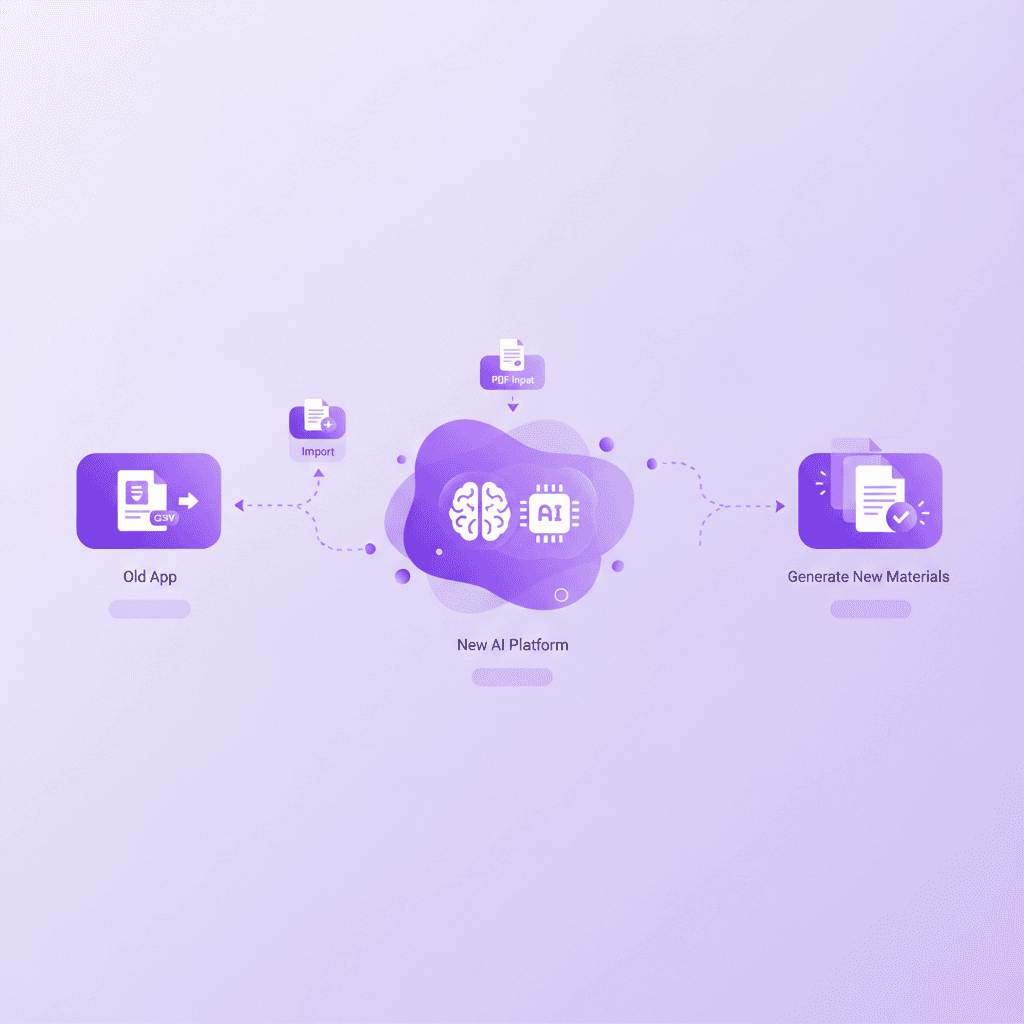
Switching study platforms requires exporting your existing data and establishing a new routine. Students should seek out tools that offer easy importing features, allowing them to transfer old materials directly while utilizing advanced AI capabilities to generate fresh content from new course documents.
Organized digital environments contribute to reduced cognitive load during intensive study sessions (Fiorella & Mayer, 2015). Fragmenting your study materials across three different applications forces your brain to constantly switch contexts. Consolidating your notes, flashcards, and practice tests into a single workspace streamlines your focus. Students transitioning to generative AI tools report saving up to three hours a week on administrative study preparation. You reclaim those hours for actual knowledge acquisition.
The technical migration process is straightforward if you plan ahead. Most legacy platforms allow you to download your custom decks as CSV files. You then upload these formatted spreadsheets into your new application. It is best to handle this migration during a lighter study week rather than attempting it mid-terms. Once your old data is secure, you can begin testing the new platform's automated generation features with fresh lecture slides, gradually phasing out the old manual entry habits.
Export your most critical study decks as CSV files before deleting your account on your previous flashcard platform. Securing a local backup of your hard work ensures you never lose access to foundational concepts from prerequisite courses.
How Penseum Helps You Apply Active Recall and Master Complex Concepts
Active recall requires retrieving information from memory, which strengthens neural pathways for exam day. Applying this concept manually means spending hours drafting questions from lecture slides. Penseum automates this critical study phase by transforming your uploaded PDFs, notes, and slides directly into practice materials.
Instead of searching for pre-made, crowdsourced decks that might contain errors or irrelevant information, learners get a personalized suite of flashcards, quizzes, and study guides based strictly on their syllabus. When studying complex subjects, simply flipping a flashcard is not enough. Knowing the final answer to an equation does not prove you understand the underlying formula.
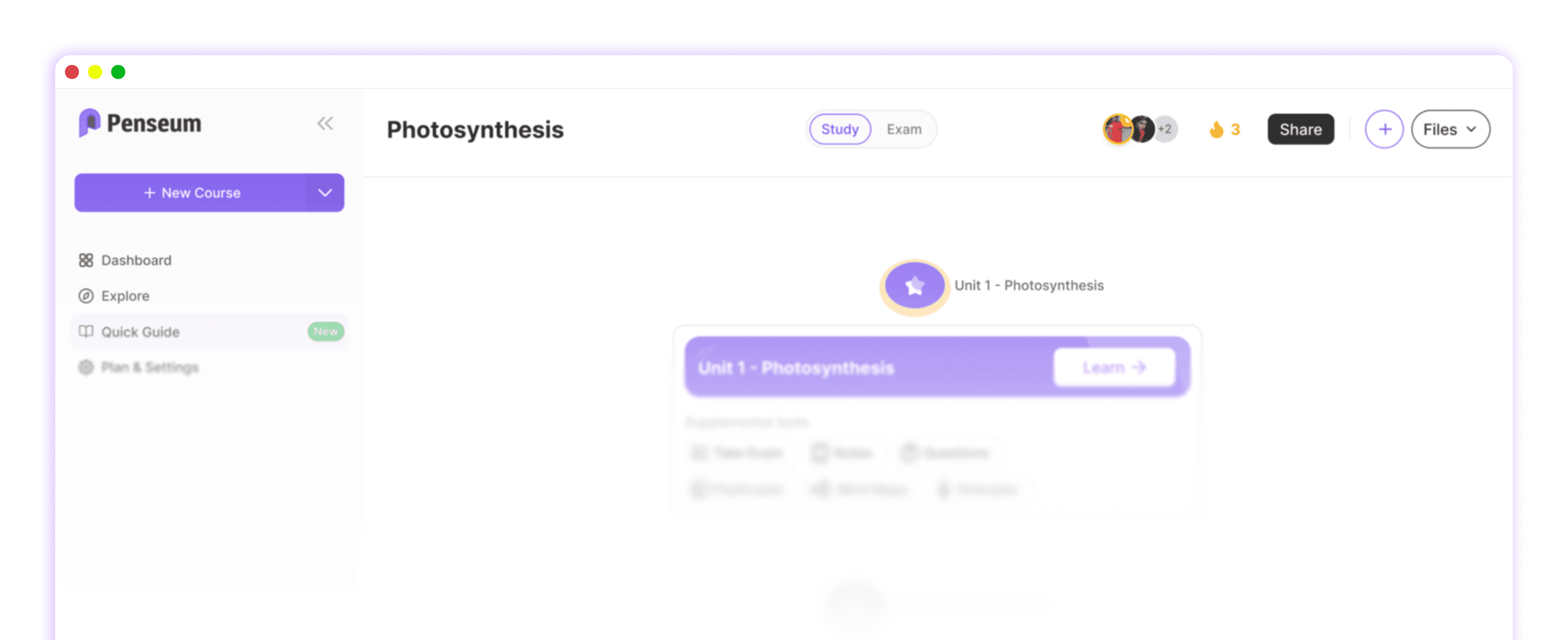
This is where Penseum's interactive canvas and live voice AI tutor step in. If a mathematical equation or a medical concept is confusing, the AI tutor explains the problem step-by-step out loud, functioning like a real-time study buddy. The system watches your work on the screen, catches specific mistakes, and tells you exactly what went wrong without giving away the final answer immediately. This forces the brain to engage in active problem-solving rather than passive reading.
The platform also operates a free tier requiring no credit card, serving over 1.6 million students across more than 130 countries. By consolidating mind maps, podcasts, flashcards, and a 1-on-1 AI tutor into a single workspace, students can shift their energy from administrative prep work to genuine knowledge retention. Start turning your notes into guides, quizzes, and flashcards in seconds.
Frequently Asked Questions
Are there any truly free alternatives to Quizlet?
Yes. Several generative AI platforms offer completely free tiers that do not require credit cards. These platforms allow you to generate custom study materials, quizzes, and flashcards directly from your uploaded notes without locking basic self-testing features behind immediate paywalls.
Can I import my existing Quizlet decks to other apps?
Most modern study platforms support CSV imports. You can export your existing flashcard decks from your current application as a comma-separated values file and upload that file directly into your new workspace. This process preserves your historical study data and prevents you from having to start over.
What is the best app for generating flashcards from PDFs?
Applications featuring optical character recognition and semantic parsing excel at this task. Platforms like Penseum allow users to upload extensive PDFs, slide decks, and syllabi directly. The software then automatically extracts key concepts to instantly build accurate, curriculum-specific flashcards and quizzes.
Do free study platforms support multiple subjects and languages?
Yes. Advanced generative study tools process multiple languages and adapt to various academic subjects. Whether you upload a Spanish literature syllabus, a complex chemistry slide deck, or a historical manuscript, the underlying AI comprehends the text and generates appropriate practice materials.
How accurate are AI-generated flashcards compared to human notes?
AI-generated materials boast exceptional accuracy because they draw directly from your specific uploaded documents. Unlike crowdsourced human notes that often contain personal biases or outdated facts, the AI extracts exact definitions and formulas verbatim from your professor's original source files.
Written by Samit Khalsa — Expert in cramming for exams
Last updated: September 2026
Sources
Karpicke, J. D., & Roediger, H. L. (2008). The critical importance of retrieval for learning. Science, 319(5865), 966-968. https://pubmed.ncbi.nlm.nih.gov/18276859/
Hwang, G. J., Xie, H., Wah, B. W., & Gašević, D. (2020). Vision, challenges, roles and research issues of Artificial Intelligence in Education. Computers & Education: Artificial Intelligence, 1, 100001. https://www.sciencedirect.com/science/article/pii/S2666920X2030001X
Dunlosky, J., Rawson, K. A., Marsh, E. J., Nathan, M. J., & Willingham, D. T. (2013). Improving students' learning with effective learning techniques: Promising directions from cognitive and educational psychology. Psychological Science in the Public Interest, 14(1), 4-58. https://pubmed.ncbi.nlm.nih.gov/26173288/
Chi, M. T., Siler, S. A., Jeong, H., Yamauchi, T., & Hausmann, R. G. (2001). Learning from human tutoring. Cognitive Science, 25(4), 471-533. https://scholar.google.com/
Selwyn, N. (2016). Digital downsides: exploring university students' negative engagements with digital technology. Teaching in Higher Education, 21(8), 1006-1021. https://scholar.google.com/
Fiorella, L., & Mayer, R. E. (2015). Learning as a generative activity: Eight learning strategies that promote understanding. Cambridge University Press. https://educause.edu/
Roediger, H. L., & Butler, A. C. (2011). The critical role of retrieval practice in long-term retention. Trends in Cognitive Sciences, 15(1), 20-27. https://pubmed.ncbi.nlm.nih.gov/20951630/
Related guides
Ready to study smarter?
Start turning your notes into guides, quizzes, and flashcards in seconds.