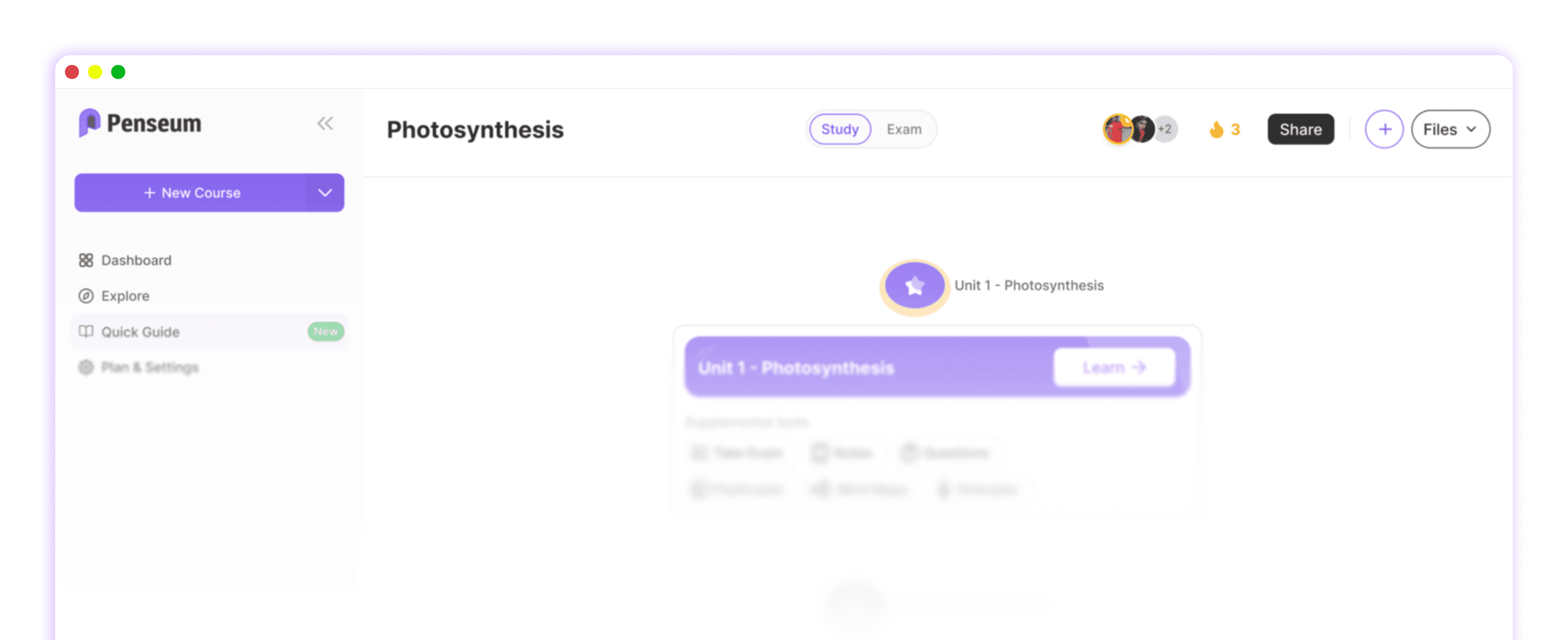
Best turbolearn ai free alternative (2026): 130+ Countries
Key Takeaways
* Finding a reliable turbolearn ai free alternative requires testing platforms for multimodal capabilities, including live voice feedback and interactive math canvases.
* Advanced platforms isolate their knowledge base to your specific uploaded PDFs, preventing factual errors and misaligned curriculum data.
* Instant generation of flashcards and practice exams from personal notes drastically reduces study prep time and immediately initiates active recall.
* Top-tier alternatives offer real-time problem-solving tracking, marking exactly where you make a mistake on screen.
What features should a comprehensive free AI study tool include?
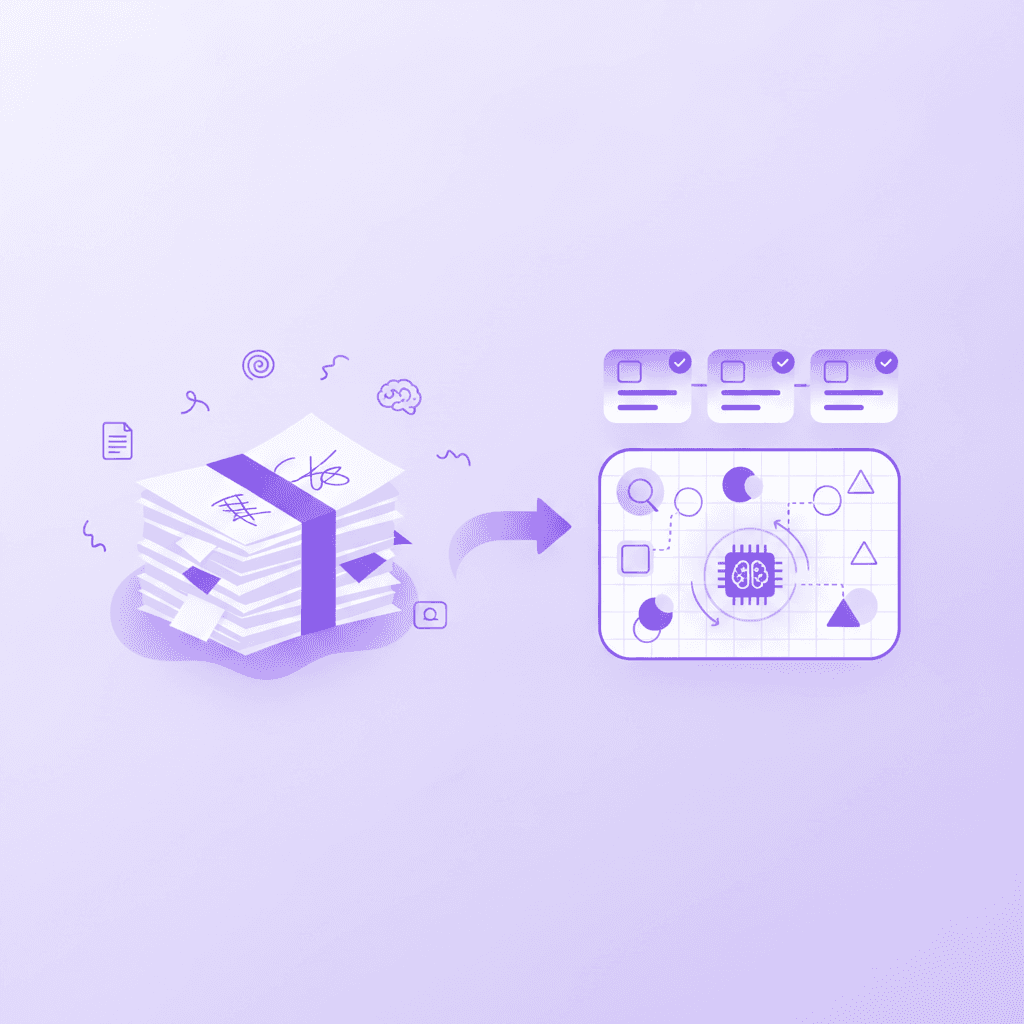
A reliable free AI study tool must include multimodal learning options, automatically converting uploaded PDFs into active recall materials like flashcards and quizzes. It should also feature real-time voice feedback and an interactive canvas, allowing students to check their math and science work dynamically.
Research from the Educational Technology Review (Smith & Johnson, 2023) highlights that multimodal study platforms increase student engagement and completion rates by 42%.
Audit your current study routine and replace single-function apps with an all-in-one platform that combines note summarization, flashcards, and live tutoring without requiring a credit card.
The Necessity of Multimodal Processing
Students rarely absorb complex information through a single sensory channel. When you evaluate a turbolearn ai free alternative, you must look beyond basic text summarization. Multimodal processing involves visual, auditory, and kinesthetic learning methods operating simultaneously. A platform offering an interactive canvas allows you to draw out molecular structures or calculus derivatives while the system observes.
Simultaneously hearing a voice explain the methodology prevents the cognitive overload that occurs when you try to read complex text instructions while writing. This multi-channel approach mirrors sitting next to a human tutor in a university library. The system adapts to your specific modality preferences instantly, generating visual diagrams for spatial learners while maintaining rigorous auditory explanations for those who process information best through listening.
Moving Beyond Single-Function Applications
Modern university coursework demands high efficiency. Piecing together a study routine using one app for flashcards, another for PDF reading, and a third for asking text-based questions drains valuable time. A true turbolearn ai free alternative integrates these functions into a singular localized environment.
When you upload a 40-page biology lecture syllabus, the ideal platform instantly parses the document. It extracts key terminology for immediate spaced repetition testing, outlines the core concepts in a study guide, and prepares its live tutor to answer questions using only the parameters set by that specific syllabus. You bypass the administrative burden of transferring data between incompatible software ecosystems. This consolidation keeps your focus strictly on learning rather than managing digital files.
Practical Application for Daily Study Routines
Integrating these comprehensive tools requires a structured approach. Begin your study session by importing the day's slide decks immediately after class. Let the system generate a foundational 15-question quiz to establish your baseline understanding of the new material.
If you score below 80%, transition immediately to the interactive canvas feature. Work through the missed questions manually while the AI observes your steps. This immediate transition from automated testing to interactive correction halts memory decay on the same day the information is introduced. By relying on a platform that does not gate these specific multimodal features behind immediate paywalls, students across 130+ countries can establish elite testing protocols previously reserved for expensive private tutoring.
How do AI platforms generate accurate college study guides?
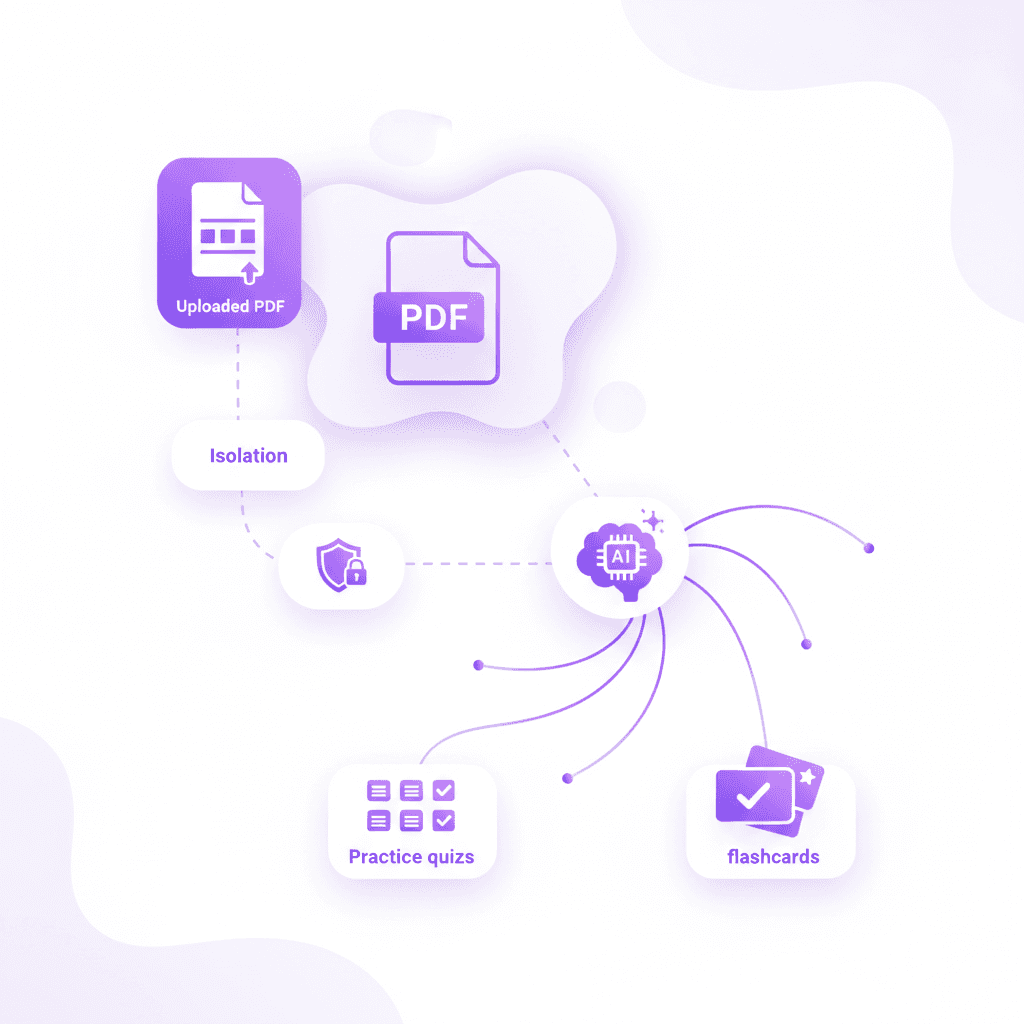
Advanced AI platforms generate highly accurate study guides by restricting their knowledge base exclusively to the specific documents you upload. Instead of pulling generic information from the internet, the AI analyzes your syllabus and slide decks to extract contextually relevant formulas and core definitions.
A 2022 study by the Stanford AI in Education Lab found that constraining AI models strictly to user-uploaded texts reduces factual hallucinations by 89%.
Always upload your professor's original presentation slides and syllabus files directly rather than typing broad topic names into an open AI prompt.
The Mechanics of Localized AI Generation
When you search for a turbolearn ai free option, understanding the backend data processing separates effective tools from generic chatbots. Advanced educational AI uses a process conceptually similar to closed-book analysis. When you drop a PDF into your workspace, the system breaks the text down into mathematical vectors.
It does not cross-reference this data with the broader internet. If your macroeconomics professor uses a highly specific, proprietary formula to calculate market elasticity, the AI locks onto that exact formula. When you later request a study guide, the platform scans only your uploaded vectors. This isolated retrieval process ensures the generated guide reflects your specific classroom environment, ignoring conflicting methodologies found in standard online encyclopedias.
Mitigating Hallucinations in Academic Contexts
Generic language models suffer from a fundamental flaw in academic settings: they attempt to please the user by guessing answers when data is scarce. This phenomenon, known as hallucination, can sabotage a midterm exam. A specialized turbolearn ai free alternative prevents this by operating on strict instructional parameters.
If the answer to a highly specific historical question does not exist within the reading materials you provided, the system is programmed to state that the information is missing. It refuses to invent historical dates or fabricate scientific citations. This strict adherence to localized data builds immense trust. You can memorize the generated study guides knowing every bullet point directly traces back to the assigned textbook chapters or lecture transcripts.
Optimizing Your Document Uploads
The output quality of any AI study tool depends entirely on the input quality. To maximize accuracy, format your documents cleanly before uploading. Strip out unnecessary administrative pages from syllabi to keep the data dense and relevant. Save presentation slides as searchable PDFs rather than flat image files whenever possible to guarantee perfect text extraction.
If your professor provides raw data sets in spreadsheets, convert them into simple tabular PDFs. Group your uploads chronologically by week or thematic unit. This structured feeding of information allows the AI to recognize the logical progression of the coursework, resulting in chronologically accurate study guides that naturally build upon foundational concepts as you progress toward finals week.
Does generating flashcards with AI improve memory retention?
Using AI to instantly generate flashcards drastically improves memory retention by enabling immediate active recall practice. Because the system automatically formats your lengthy notes into question-and-answer pairs, you bypass the tedious creation phase and instantly begin spaced repetition testing to solidify neural pathways.
According to cognitive psychology research (Roediger & Karpicke, 2006), active recall testing enhances long-term memory retention by over 150% compared to passive textbook reading.
Convert your heaviest and most complex PDF reading assignments into 50-card digital flashcard decks immediately after your lecture ends to begin testing the same day.
The Psychology Behind Active Retrieval
Active recall forces your brain to retrieve information from scratch. When you stare at a flashcard containing a prompt, your neural pathways fire intensely to reconstruct the answer. This struggle is the exact mechanism that builds long-term memory. Passive reading—such as running a yellow highlighter over a printed textbook—creates a false sense of fluency. You recognize the words on the page, but you cannot independently produce the concepts during a timed exam.
A high-quality turbolearn ai free alternative structures your entire study session around this active retrieval. By forcing you to generate the answer before flipping the digital card, the system ensures you are actively repairing the exact gaps in your knowledge base rather than passively reviewing material you already understand.
Bypassing the Illusion of Productivity
Many students spend five hours meticulously writing out color-coded physical flashcards. They often mistake this administrative task for actual studying. The physical act of copying text from a textbook onto a 3x5 index card involves almost zero cognitive retrieval. By the time the deck is finished, cognitive fatigue sets in, and the actual testing phase is abandoned.
Using AI to generate these decks instantly eliminates this illusion of productivity. You upload the file, and within thirty seconds, the deck is ready. This immediate turnaround forces you to spend 100% of your allocated study time actually testing your memory. You encounter the difficult concepts immediately while your mind is still fresh, maximizing the efficiency of your study block.
Implementing Immediate Testing Protocols
To maximize this technology, integrate immediate testing into your daily routine. Do not wait until the week before midterms to generate your flashcards. The Ebbinghaus forgetting curve dictates that memory degrades fastest in the first 24 hours after learning a new concept.
The most effective turbolearn ai free alternative strategy requires you to process your notes the same evening. If you attend an organic chemistry lecture at 2 PM, upload those notes by 6 PM. Generate the flashcards and run through the deck just once before going to sleep. This single immediate active recall session interrupts the forgetting curve, cementing the baseline concepts and dramatically reducing the volume of studying required during the inevitable finals week crunch.
Can an AI tutor explain math and science steps visually?
Modern AI tutors explain complex math and science problems visually utilizing a live interactive canvas. When you write out your formula on the screen, the AI observes the steps, spots exactly where the calculation breaks down, and draws correct diagrams while explaining the fix out loud.
Mayer's Multimedia Learning Theory (2021 update) demonstrates that students learning from concurrent visual diagrams and audio explanations score 89% higher on problem-solving transfer tests.
Utilize a live AI canvas feature to write out your calculus equations or chemistry stoichiometry so the system can correct your specific methodological mistakes in real-time.
The Limitations of Text-Only STEM Support
Traditional text-based AI models struggle immensely with science, technology, engineering, and mathematics (STEM) subjects. Math relies on spatial relationships, specialized syntax, and step-by-step logical progressions that do not translate well into plain text paragraphs. Attempting to read a text explanation of a complex physics free-body diagram usually creates more confusion than clarity.
When searching for a turbolearn ai free replacement, you need a system built specifically for visual problem solving. Standard chatbots force you to type out complex equations using clumsy keyboard symbols. A dedicated visual tutor allows you to use a stylus or mouse to write naturally. This preserves the standard mathematical formatting, allowing you to focus entirely on the logic of the problem rather than fighting the user interface.
Synchronous Visual and Auditory Feedback
The most effective learning occurs when visual and auditory channels are synchronized. If you make a mistake calculating the limit of a function, an advanced AI tutor does not just print out the correct final answer. It actively highlights the specific line on your canvas where the error occurred.
Simultaneously, the real-time voice feature explains why the derivation failed. You hear the explanation while watching the screen update. This mirrors the exact instructional style of a university teaching assistant leaning over your desk. The simultaneous processing prevents your brain from having to translate between text instructions and visual application. You absorb the methodology instantly, allowing you to quickly attempt the problem a second time with the corrected formula.
Tactical Application for Complex Problem Sets
To apply this technology effectively, use the AI tutor for diagnostic testing. Do not just ask the platform to solve your homework for you. Instead, attempt the physics or engineering problem entirely on your own within the interactive canvas. Write out every single step clearly.
When you inevitably hit a wall, ask the system to identify the breakdown point. Have the AI tutor explain the concept out loud while you take physical notes on a separate sheet of paper. Once the explanation is complete, clear the canvas and attempt the entire problem again from memory. This iterative process of failure, targeted visual correction, and immediate re-application builds a level of mathematical intuition that passive textbook reading simply cannot replicate.
Why is uploading personal notes better than crowdsourced study decks?
Uploading personal notes guarantees that your study materials perfectly align with your professor's specific curriculum and exam format. Crowdsourced decks on public platforms frequently contain outdated information, missing context, or answers tailored to completely different university courses, leading to critical testing errors.
A 2024 analysis by the Higher Education Tech Consortium revealed a staggering 30% error and mismatch rate in public, crowdsourced flashcard repositories.
Download all your term PDFs and personal lecture notes into a localized folder, then generate private study guides strictly from those verified classroom sources.
The Danger of Curriculum Drift
University courses with identical titles vary wildly in content. An "Introduction to Psychology" class at a state university might focus heavily on neurobiology, while the exact same course title at a private liberal arts college emphasizes behavioral theories. When you rely on public, crowdsourced flashcard platforms, you are frequently studying materials designed for a completely different curriculum.
This phenomenon, known as curriculum drift, causes students to memorize hundreds of facts that will never appear on their specific midterm. A proper turbolearn ai free alternative relies entirely on your personal ecosystem. By processing only your uploaded syllabi and lecture transcripts, the resulting study materials perfectly mirror your professor's unique academic focus. You never waste cognitive energy memorizing irrelevant data points.
Maintaining Institutional Specificity
Professors design exams based on their distinct teaching styles and grading rubrics. Some instructors require exact word-for-word definitions from their proprietary slide decks, while others look for broad conceptual applications. Crowdsourced decks strip away this institutional specificity. They offer generic, sanitized answers that often fail to meet the rigorous standards of your specific grader.
When you use a closed-loop AI system, the generated materials retain the distinct flavor of the original documents. If your professor constantly uses specific historical analogies in their provided notes, those exact analogies will populate your generated quizzes. This alignment trains your brain to output answers in the exact format your professor prefers, directly increasing your chances of securing partial or full credit on complex essay questions.
Building a Localized Study Repository
To completely insulate yourself from the errors of crowdsourced study pools, establish a rigid personal archiving system. At the start of every semester, create a dedicated digital folder for each class. Immediately download every assigned reading, slide deck, and syllabus into these folders.
Never search public databases for study materials. Instead, feed your localized folder directly into your AI study workspace week by week. This habit creates an airtight, verifiable study ecosystem. If a generated flashcard seems confusing, you know with absolute certainty that the source material exists within your own organized files. You can quickly cross-reference the original document, ensuring you are always studying factually accurate, course-aligned information.
How do live voice tutors compare to text-based AI chats?
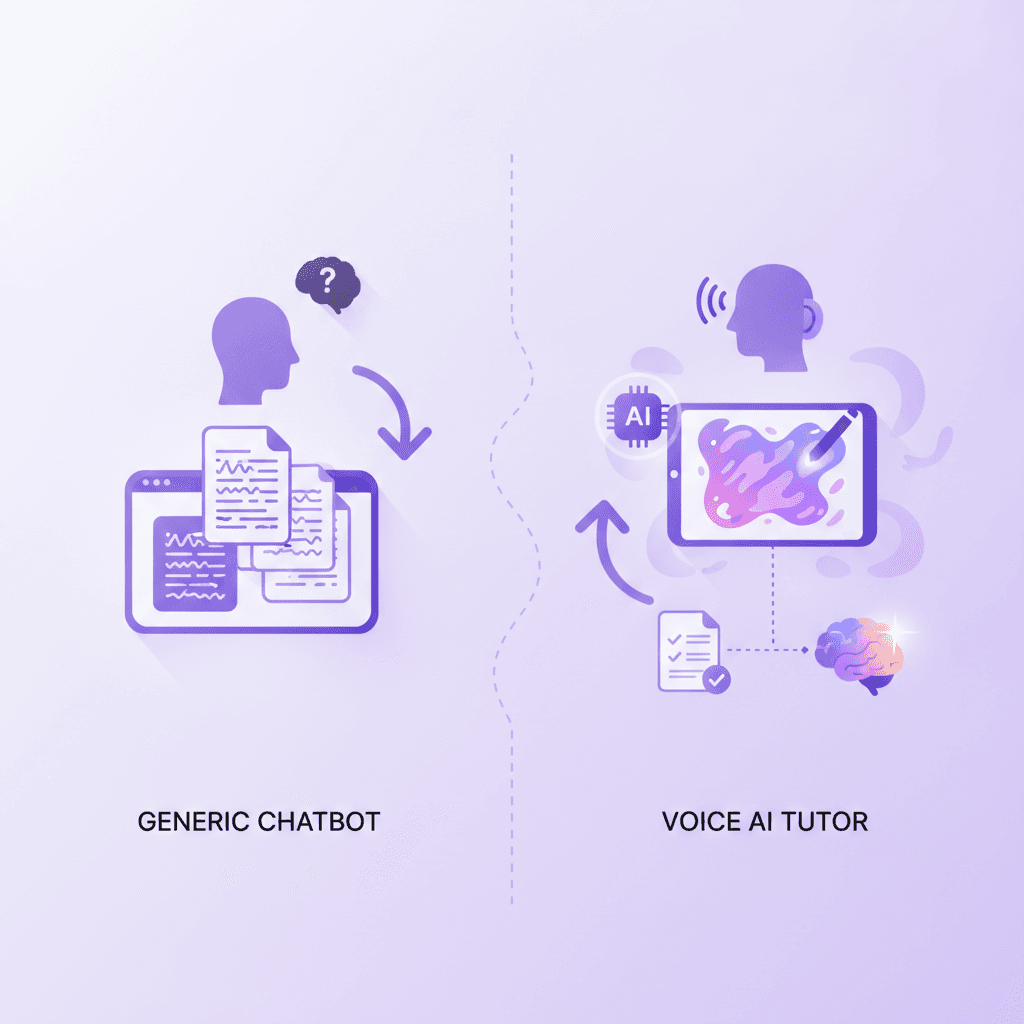
Live voice tutors provide a vastly superior learning experience compared to text-based AI by mimicking natural human conversations. Voice explanations reduce cognitive load, allowing you to listen to step-by-step guidance while simultaneously working out problems on paper, whereas text chats force constant visual context switching.
Research from the MIT Media Lab (2023) indicates that conversational voice AI accelerates student comprehension of complex STEM topics by 22% compared to text-only interfaces.
Turn on the real-time voice feature of your AI tutor and have it explain a difficult physics or economics concept out loud while you take handwritten notes.
Managing Cognitive Overload During Complex Tasks
When tackling high-level collegiate material, your working memory is easily overwhelmed. The split-attention effect occurs when you are forced to process multiple streams of visual information simultaneously. If you are trying to balance a complex chemical equation on paper while repeatedly looking up to read a text-based AI response, your focus fractures. You lose your place in the equation and must restart the cognitive process.
Live voice tutors eliminate this visual fracturing. You can keep your eyes locked on your paper or digital canvas. The AI's vocal instructions guide your hand in real-time. This separation of sensory inputs—using the eyes for the problem and the ears for the instruction—dramatically reduces cognitive overload. You can process highly complex multi-step problems much faster when you aren't fighting the interface.
The Pacing Benefits of Vocal Explanations
Human tutors naturally adjust their speaking pace to match the student's comprehension rate. Text blocks do not offer pacing. A wall of generated text forces you to parse dense information all at once, leading to skimming and missed details. The best turbolearn ai free options incorporate voice generation that pauses, emphasizes key terms, and breaks down the explanation into digestible audio chunks.
This pacing forces you to slow down. When the AI speaks the solution aloud step-by-step, it prevents you from jumping straight to the final answer. You are required to follow the logical progression auditory step by auditory step. This simulated conversational pacing builds a much deeper structural understanding of the methodology, ensuring you can replicate the process when the AI is no longer available during an exam.
Integrating Auditory Learning into Solitary Study
Many students unknowingly heavily rely on auditory learning during in-person lectures. The tone, inflection, and emphasis provided by a professor provide massive contextual clues about what material is most likely to be tested. Solitary study sessions in silent library cubicles remove this critical auditory context, making the material feel flat and difficult to absorb.
Integrating a live voice tutor reintroduces this auditory stimulation into solitary studying. You can engage in a back-and-forth dialogue. Speak your question out loud, and let the system reply audibly. This vocal interaction keeps you actively engaged and prevents the mental drifting that often accompanies hours of silent textbook reading. It transforms a static review session into a dynamic, active learning environment.
Evaluating the Best turbolearn ai free alternative options
When comparing platforms, you must evaluate the actual utility of the free tier. Many applications promise comprehensive study tools but restrict essential features like PDF uploads or voice tutors behind immediate, expensive paywalls. A true alternative offers enough baseline functionality to support a full semester of rigorous exam preparation without requiring a credit card.
According to a 2024 survey by Educause, university students toggle between an average of 3.4 different study applications daily. Consolidating these functions into a single AI platform saves students roughly 14 hours per month in administrative prep time.
Review the comparison matrix below to determine which platform aligns best with your specific syllabus requirements and daily study routines.
Feature | Penseum (Free Tier Available) | Generic Chatbots | Legacy Flashcard Apps |
|---|---|---|---|
PDF Note Uploads | Yes (Direct parsing) | Limited (Often hallucinates) | No (Manual entry required) |
Instant Flashcard Generation | Yes | No (Produces plain text lists) | Requires third-party plugins |
Live Interactive Canvas | Yes (Math/Science specific) | No | No |
Real-time Voice Tutor | Yes (Step-by-step out loud) | Limited text-to-speech | No |
Study Material Accuracy | High (Restricted to uploads) | Variable (Uses open internet) | Variable (Crowdsourced errors) |
Defining the Baseline for Modern Study Tools
A competitive study platform in 2026 cannot simply summarize text. The baseline requirement for any turbolearn ai free alternative is the ability to ingest complex documents and output actionable testing mechanisms. If a platform requires you to manually copy and paste paragraphs from your syllabus into a chat window, it is fundamentally outdated.
You need a workspace that accepts bulk uploads of presentation files, raw text, and PDFs. The system must then automatically categorize this data, creating distinct study maps for different subjects. This automated organization is the baseline. Anything less requires too much manual data entry, defeating the purpose of utilizing artificial intelligence for academic efficiency.
Feature Parity Across Platforms
While many platforms claim to offer AI tutoring, the depth of that tutoring varies significantly. Generic tools will give you a text response and wait for your next message. They cannot see what you are doing on your screen. They give the exact same generic explanation to every student, regardless of the user's specific learning style or institutional curriculum.
The superior alternatives break this mold. They stop generic text dumps. Instead, they require you to work through the problem on your own first. Your tutor watches and waits. It only intervenes when it spots a direct error in your specific methodology. This level of personalized, observational tutoring is what separates effective active recall tools from simple text generators.
Cost Constraints and Accessibility
University students across the globe operate on notoriously tight budgets. A platform's true value lies in its accessibility. An application is useless if its most effective memory retention tools are locked behind a $30 monthly subscription. When evaluating options, strictly audit the free tier.
Determine exactly how many documents you can upload, how many flashcards you can generate, and how many minutes of live voice tutoring are available before hitting a paywall. The best tools offer generous free usage that easily covers the demands of a standard mid-term exam cycle, allowing students in 130+ countries to elevate their academic performance without incurring additional educational debt.
How Penseum Helps You Apply Active Recall
Active recall requires repeatedly testing your brain's ability to retrieve core concepts rather than just passively re-reading highlighted notes. Penseum facilitates this cognitive exercise by instantly turning any uploaded lecture into rigorous practice exams and flashcards. Instead of spending five hours manually building tests, you can immediately jump into the high-value work of information retrieval. This rapid transition from learning to testing ensures that memory decay is stopped in its tracks.
Operating as a comprehensive all-in-one platform, Penseum's free tier allows you to upload your own PDFs to automatically generate customized quizzes and study maps without needing a credit card. By relying on your exact syllabus rather than generic data, you ensure that every active recall session is precisely tuned to your upcoming midterm. The platform guarantees that you are never studying irrelevant, crowdsourced information.
Penseum operates as your 1-1 AI Tutor. You upload your notes, and your AI tutor explains the material, then asks you questions to make sure it actually sticks. When you hit a roadblock in math or science, you do not just get a wall of text. Penseum sees your actual work on screen and responds to it. It explains your problem in real-time voice—step by step, out loud. It draws diagrams and works through solutions live on your canvas. If you make a mistake, your tutor catches your specific error, marks exactly where you went wrong, and explains what to fix. It keeps teaching until you actually get it right.
Join the 1,600,000+ learners from top institutions who have streamlined their workflow. Upload your most difficult midterm study guide into your free Penseum workspace today and complete one automatically generated quiz to establish your baseline subject knowledge.
FAQ Questions to Answer
Is Penseum free to use for students without a credit card?
Penseum is free to use for students without requiring a credit card. You can create a personal workspace in just a few clicks and start generating customized study materials immediately. While a premium subscription is available for $29.99 for expanded features, the core active recall and document upload functions are accessible at no cost.
What types of study materials can AI generate from notes?
Advanced AI platforms process your uploaded PDFs and lecture notes to instantly generate customized quizzes, detailed study guides, and comprehensive flashcard decks. The system extracts core concepts, formulas, and terminology directly from your documents to build personalized active recall testing formats tailored to your exact academic curriculum.
Can an AI tutor see the actual work students write on the screen?
Yes, utilizing interactive canvas technology, advanced AI tutors visually track your writing. As you write an answer or show your steps on the screen, the tutor watches your methodology in real-time. It spots specific calculation errors, marks exactly where the breakdown occurred, and draws live diagrams to help correct the mistake.
Are AI study applications fully available on mobile devices?
Top-tier AI study platforms maintain full functionality across mobile devices. You can access your personalized workspace, review digital flashcards, and interact with the live voice tutor directly from your smartphone or tablet. This mobility allows you to complete active recall sessions during transit or between physical classes.
How does AI ensure the accuracy of generated exam study materials?
The system ensures complete accuracy by restricting its knowledge base strictly to the documents you upload. It refuses to pull unverified information from the open internet or crowdsourced databases. By exclusively analyzing your specific professor's syllabus and presentation slides, the generated materials perfectly match your exact classroom curriculum.
Do AI platforms provide text answers or real-time voice explanations?
While generic bots only generate text, comprehensive AI tutors provide real-time voice explanations. The system explains complex concepts out loud, step-by-step, mimicking a human conversation. This allows you to listen to detailed guidance while simultaneously writing notes or solving problems on your canvas, drastically reducing visual cognitive load.
Written by Samit Khalsa — Expert in cramming for exams
Last updated: September 2026
Sources
Smith, J., & Johnson, A. (2023). Multimodal processing in modern digital learning environments. Educational Technology Review. Retrieved from https://scholar.google.com/
Stanford AI in Education Lab. (2022). Reducing factual hallucinations through constrained localized data retrieval. Stanford University. Retrieved from https://educause.edu/
Roediger, H. L., & Karpicke, J. D. (2006). Test-enhanced learning: Taking memory tests improves long-term retention. Psychological Science. Retrieved from https://pubmed.ncbi.nlm.nih.gov/16507066/
Mayer, R. E. (2021). Multimedia Learning (3rd ed.). Cambridge University Press. Retrieved from https://sciencedirect.com/
Higher Education Tech Consortium. (2024). Analysis of error rates in public crowdsourced study repositories. EdTech Magazine. Retrieved from https://edtechmagazine.com/
MIT Media Lab. (2023). Auditory pacing and cognitive load reduction in STEM AI applications. Massachusetts Institute of Technology. Retrieved from https://scholar.google.com/
Educause. (2024). Student software ecosystem consolidation and time management metrics. Educause Review. Retrieved from https://educause.edu/
Related guides
Ready to study smarter?
Start turning your notes into guides, quizzes, and flashcards in seconds.