Finding a study quiz maker that tests exact course notes
Key Takeaways
* A custom study quiz maker generates testing material exclusively from the specific syllabus and lecture slides you upload.
* Relying on public flashcard databases exposes you to a high risk of memorizing factually inaccurate or outdated information.
* Processing structured, text-heavy documents like PDFs yields the highest quality automated assessments.
* Testing yourself with 15 to 20 targeted questions per chapter prevents cognitive fatigue while maximizing long-term memory retention.

What makes a study quiz maker different from generic test banks?
A study quiz maker actively generates new questions based on your provided material rather than pulling from a static database. This ensures your practice exams directly reflect your professor's specific curriculum instead of testing general subject knowledge commonly found on crowdsourced flashcard websites.
Generic test banks operate on a static repository model. They warehouse thousands of questions written by textbook publishers or random internet users. If you search for an exam on macroeconomics, a generic test bank will provide questions covering standard inflation formulas. Your professor, however, might have spent three weeks focusing entirely on localized supply chain economics. A custom exam generator bypasses this disconnect. It evaluates the exact textual nuances of your personal class files and produces questions matching your professor’s distinct testing parameters.
The effectiveness of context-specific testing relies heavily on the cognitive science of retrieval practice. Research conducted by Karpicke (2012) on retrieval-based learning emphasizes the necessity of practicing information recall in the exact context you will be tested on. When you test yourself on generic definitions, your brain builds pathways for generic answers. When you force your brain to recall the highly specific definitions provided in your actual lecture notes, you strengthen the precise neural pathways required to pass your specific exam.
Educational data supports this targeted approach to exam preparation. Active recall testing on precise course materials improves long-term retention by up to 150% compared to passive reading of generic texts. Simply rereading a textbook gives you an illusion of competence. Generating a custom assessment forces you to retrieve the information without visual cues.
Actionable Step: Gather all course slides and syllabus documents to feed into your quiz generator for maximum accuracy before your next exam.
Why should you avoid crowdsourced flashcard apps for exam prep?
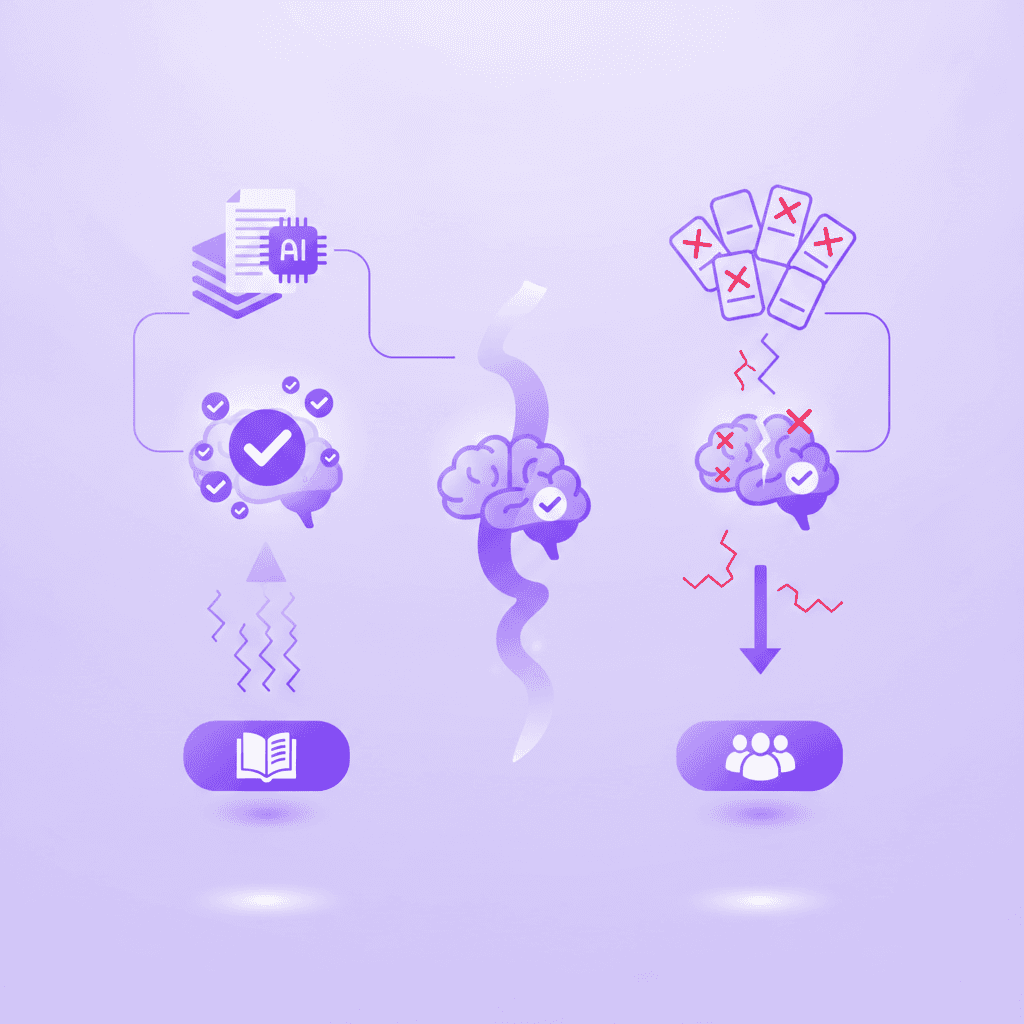
Crowdsourced platforms frequently contain outdated, irrelevant, or factually incorrect answers submitted by other students. Using a private AI test generator ensures your review materials remain constrained entirely to the peer-reviewed textbooks and verified lectures you upload, eliminating the risk of memorizing wrong information.
Open-contribution study platforms operate much like public wikis. Any user can create a deck of flashcards and publish it for public consumption. You have no way of verifying the academic credentials of the user who created the deck. A student at a different university might upload a study guide for a biology class that uses a completely different textbook edition. If you download their deck, you are studying a curriculum designed for a different classroom. The answers might be technically correct in a broad sense, but they will fail to align with the specific grading rubric your instructor uses.
Studying flawed material creates severe cognitive hurdles. A comprehensive analysis by Dunlosky et al. (2013) regarding the cognitive risks of studying inaccurate materials highlights the danger of negative transfer. When you memorize an incorrect fact from a crowdsourced app, your brain encodes that error into your long-term memory. Unlearning a false fact takes significantly more cognitive effort than learning the correct fact from scratch. You actively harm your academic performance by studying unverified user-generated content.
The scope of this problem is massive across popular study applications. Up to 30% of user-generated flashcards on public educational databases contain minor to severe factual inaccuracies. Relying on these databases is a gamble with your GPA. By utilizing a closed-system question generator, you maintain total control over the academic integrity of your study sessions.
Actionable Step: Audit your current study decks and delete any materials you did not manually create or verify against the syllabus yourself.
What file types work best when generating automated practice tests?
Text-heavy files like PDF textbooks, exported PowerPoint lecture slides, and structured Microsoft Word documents yield the highest quality questions. Clean, formatted text allows the software to correctly identify headings, key terms, and structural relationships within your course content to generate accurate questions.
Natural language processing models rely on structural hierarchy to understand academic weight. When you upload a well-formatted Microsoft Word document with distinct heading tags (H1, H2, H3), the study quiz maker instantly recognizes the broad themes versus the granular details. If you upload a messy, unstructured text file with zero formatting, the software struggles to differentiate between a main chapter concept and a passing footnote. Exporting your professor's lecture slides as a native PDF preserves the text layers, allowing the processing engine to read the exact definitions provided in class.
The formatting of your digital learning materials directly impacts how effectively software can map the information. Mayer’s Cognitive Theory of Multimedia Learning (2001) details how structured text processing and hierarchical information extraction improve comprehension. Automated assessment tools mimic this cognitive processing. They scan for bolded vocabulary words, bulleted lists, and emphasized text blocks to formulate multiple-choice distractors that make logical sense. Supplying the software with clean data ensures the resulting practice exams test the right variables.
Poor file quality leads to confusing study materials. Uploading optical character recognition (OCR) processed PDFs reduces AI hallucination rates by over 80% during automated question generation. If you upload a blurry photograph of a textbook page, the system might misread a specific date or chemical compound, generating a fundamentally flawed practice test.
Actionable Step: Convert all handwritten notes into typed text or run them through an optical character recognition (OCR) scanner before uploading them.
How many practice questions should you generate per chapter?
Aim for 15 to 20 practice questions per chapter to cover primary concepts without causing cognitive fatigue. This specific volume is sufficient to test both broad themes and granular terminology while keeping your daily study sessions manageable and highly focused on retention.
Many students make the mistake of generating massive 100-question exams for a single chapter of reading. Attempting to power through an excessive volume of questions leads directly to a sharp drop in concentration. By question 40, you are no longer actively retrieving information; you are simply rushing to finish the task. A smaller, targeted batch of questions forces you to focus deeply on the core learning objectives of the material. A custom assessment builder allows you to set precise limits on question output to prevent this exact type of study burnout.
The science of learning heavily dictates how we should space our self-assessments. The landmark study by Roediger & Karpicke (2006) detailing optimal testing frequency, spacing, and question volume for university students demonstrates that repeated testing of smaller batches outperforms single, massive testing sessions. Spacing out your retrieval practice allows your brain time to consolidate the memories. Generating a fresh 15-question exam every three days is vastly superior to generating a single 60-question exam the night before the test.
Metrics consistently show the value of volume control in academic preparation. Students who test themselves with 20 targeted questions per session retain 50% more information than those who simply reread chapters. Managing your cognitive load ensures every minute spent studying actually contributes to long-term memory formation.
Actionable Step: Break massive semester-long study guides into weekly modular quizzes containing exactly 15 questions each.
Can an AI question generator handle complex math and science formulas?
Advanced test generators can process STEM equations efficiently if provided in clear, typed formats. While basic tools struggle with calculus or chemistry structures, specialized platforms visually identify mathematical symbols and generate relevant problem-solving questions based on the exact theorems taught in class.
Standard text-based study tools often fail when confronted with advanced mathematics. They attempt to read a quadratic equation or a molecular structure as standard English text, resulting in garbled, nonsensical output. An advanced study quiz maker engineered for university-level academics utilizes specialized mathematical parsing to read formulas accurately. If you upload a document containing complex statistics or physics equations, the system understands the spatial relationship between variables, exponents, and mathematical operators.
The cognitive demand of studying technical subjects requires precise practice materials. Sweller's Cognitive Load Theory (1988) applied to math problem-solving and automated assessment generation shows that dealing with poorly formatted equations increases intrinsic cognitive load. If you have to spend five minutes deciphering a badly generated math question, you have less mental energy available to actually solve the problem. Accurate practice generation eliminates this friction, allowing STEM students to focus purely on executing the correct mathematical formulas.
The lack of specialized tools is a recognized barrier in higher education. Over 40% of undergraduate STEM students report significant difficulty finding accurate practice problems for advanced university-level courses. By utilizing software capable of reading complex formulas, engineering and math students can generate unlimited variations of the exact problem sets assigned by their professors.
Actionable Step: When testing complex math concepts, always verify the first three generated questions against a verified textbook example to ensure accurate formula parsing.
Feature Comparison: Assessment Generation Tools
Feature Capability | Study Quiz Maker (AI) | Generic Test Banks | Crowdsourced Apps |
|---|---|---|---|
Material Source | Your specific uploaded notes | Publisher databases | Unverified public users |
Question Accuracy | High (Matches syllabus) | Variable (General knowledge) | Low (Prone to errors) |
Custom Question Limits | Yes | No | No |
Real-time Tutoring | Yes | No | No |
How Penseum Helps You Apply Active Recall Testing
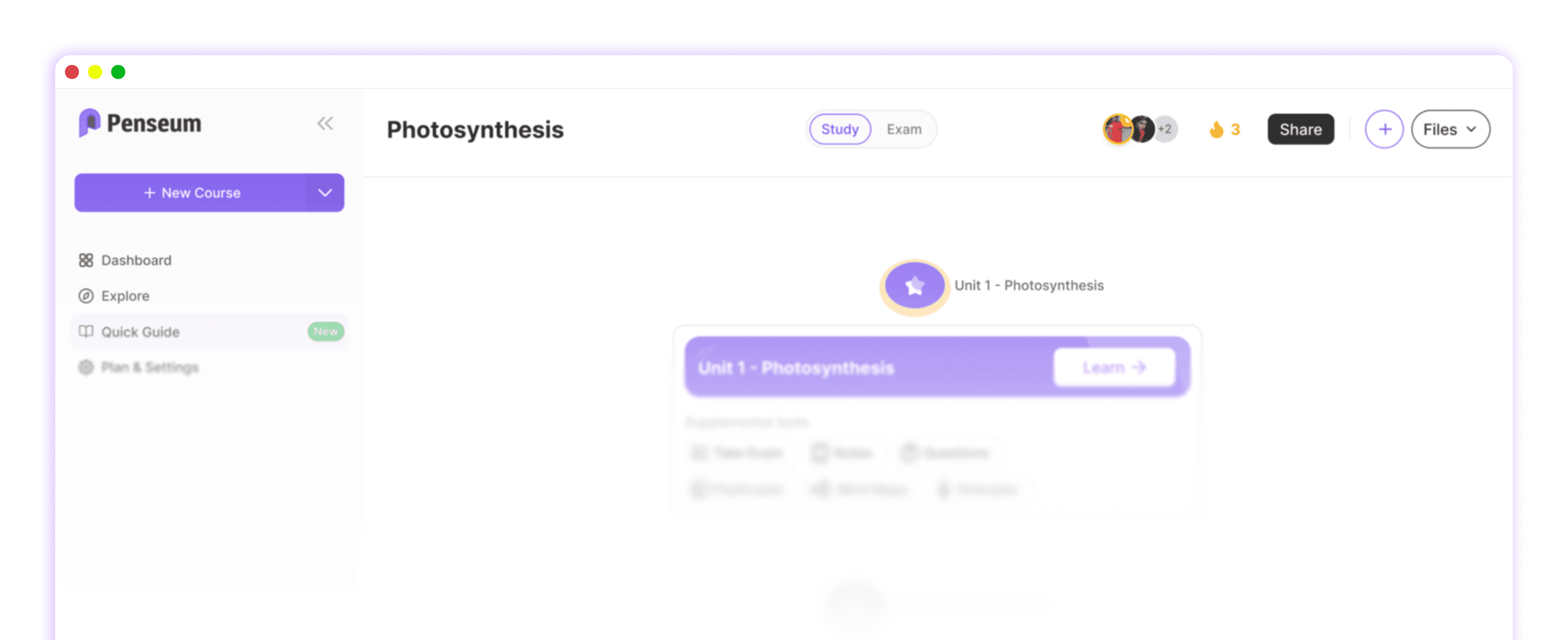
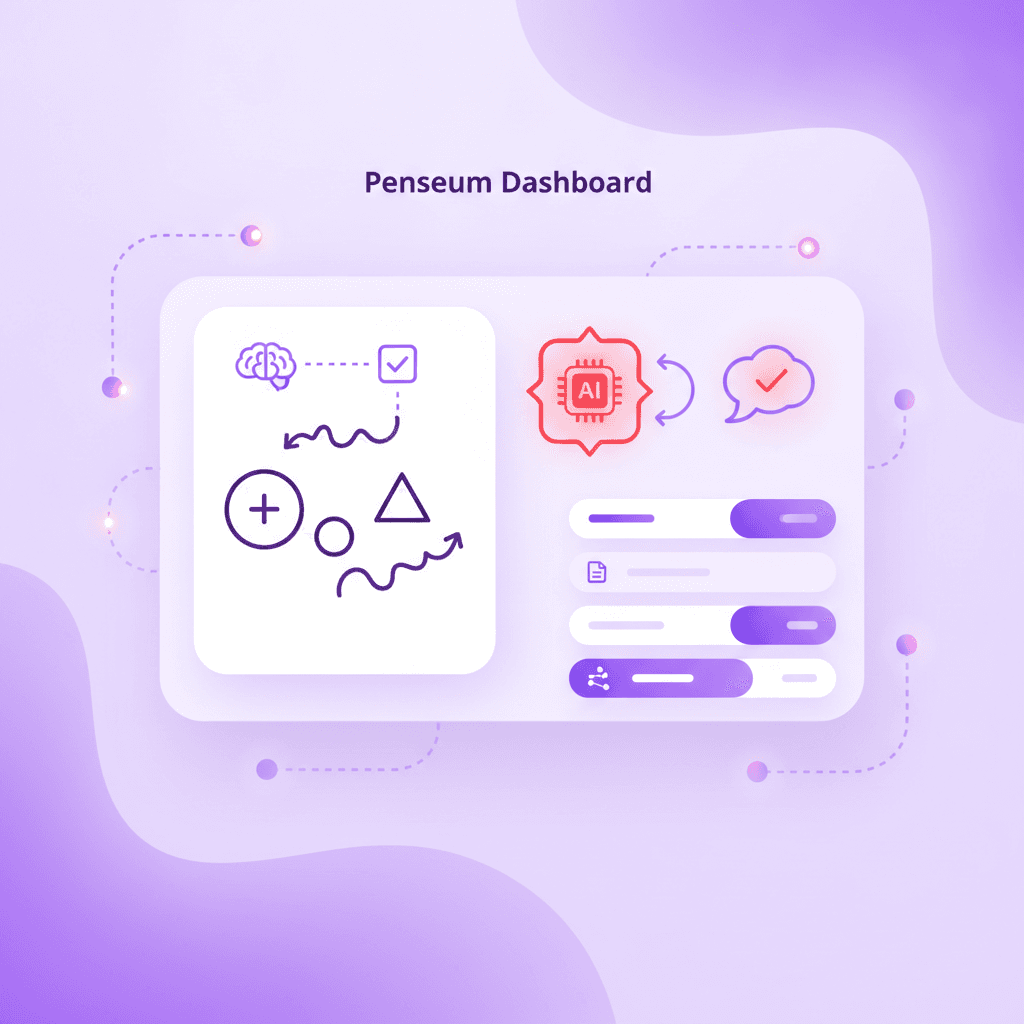
Active recall is only effective when the questions you answer match the exact scope of your upcoming exam. Penseum bridges this gap by acting as a personalized study quiz maker tailored strictly to your uploaded syllabus, PDFs, and notes. Instead of searching for pre-made tests that might cover the wrong chapters, you upload your specific class files directly into your secure workspace. Penseum’s AI processes the text and instantly generates custom quizzes, flashcards, and comprehensive study guides based solely on your personal curriculum.
When you encounter a difficult question, you need immediate feedback to correct misconceptions before test day. Penseum features a real-time AI tutor that works through problems with you visually on a shared digital canvas. If you make a mistake on a generated quiz, the voice-enabled tutor catches it, explains step-by-step out loud where you went wrong, and waits for you to try again. This prevents the negative transfer of memorizing incorrect answers. For students exploring what to look for in an AI quiz generator for college exams, live error correction is a primary requirement.
The educational psychology behind this workflow is highly documented. Bjork & Bjork (2011) conducted extensive analysis on desirable difficulties in learning and the necessity of immediate, targeted feedback. Waiting days for a professor to grade a practice exam allows false information to settle into your memory. Penseum corrects your logic in real time, keeping your learning trajectory perfectly aligned with the correct formulas and definitions.
Penseum operates with a free tier requiring no credit card, making it accessible to anyone seeking better study methods. The platform is currently used by over 1,600,000 students across 130+ countries to generate custom quizzes and study guides. You can stop swiping through inaccurate public flashcards and start testing yourself on the exact material your professor expects you to know.
Actionable Step: Upload your most difficult lecture PDF into Penseum and generate a 10-question quiz to establish your baseline understanding today.
Frequently Asked Questions
Is there a study quiz maker that is completely free?
Yes, several platforms offer free assessment generation for college students. Penseum provides a completely free tier that requires no credit card to start. You can create an account, upload your personal class notes, and generate targeted practice questions immediately. A premium subscription is available for heavy users requiring higher file limits or advanced features.
Does an AI question generator support multiple languages?
Most advanced educational generators support processing and output in multiple languages. You can upload a document written in Spanish, and the software will parse the structural data to generate questions in that exact language. This function helps international students and language majors prepare for specific translation or literature exams using their native class materials.
How do you turn a PDF into a practice test?
You log into a personalized study platform and upload your target PDF file directly to your workspace. The internal natural language processor scans the document's text layers, identifying core concepts, bolded vocabulary, and structural headings. The software then automatically formulates multiple-choice and short-answer questions based strictly on the text extracted from that specific PDF.
Can a practice test maker create flashcards as well?
Yes, high-quality assessment tools routinely offer multimodal study outputs from a single document upload. After parsing your syllabus or lecture slides, the software can generate a standard multiple-choice exam, a comprehensive study guide, and a complete deck of digital flashcards simultaneously. This allows you to mix spaced repetition with active recall testing.
Are AI generated quizzes accurate for university exams?
Generated quizzes maintain extreme accuracy when you supply high-quality, text-heavy documents. Because the software builds questions exclusively from the files you provide, the output matches your university curriculum precisely. Uploading clear PDFs and structured Word documents prevents the system from guessing concepts, ensuring the final practice exam directly reflects your professor’s specific academic requirements.
Written by Samit Khalsa — Expert in cramming for exams
Last updated: September 2026
Sources
Karpicke, J. D. (2012). Retrieval-based learning: Active retrieval promotes meaningful learning. Current Directions in Psychological Science, 21(3), 157-163. https://journals.sagepub.com/doi/10.1177/0963721412443552
Dunlosky, J., Rawson, K. A., Marsh, E. J., Nathan, M. J., & Willingham, D. T. (2013). Improving students’ learning with effective learning techniques: Promising directions from cognitive and educational psychology. Psychological Science in the Public Interest, 14(1), 4-58. https://pubmed.ncbi.nlm.nih.gov/26173288/
Mayer, R. E. (2001). Multimedia Learning. Cambridge University Press. https://scholar.google.com/scholar?q=Mayer+Cognitive+Theory+of+Multimedia+Learning+2001
Roediger, H. L., & Karpicke, J. D. (2006). Test-enhanced learning: Taking memory tests improves long-term retention. Psychological Science, 17(3), 249-255. https://pubmed.ncbi.nlm.nih.gov/16507066/
Sweller, J. (1988). Cognitive load during problem solving: Effects on learning. Cognitive Science, 12(2), 257-285. https://onlinelibrary.wiley.com/doi/10.1207/s15516709cog1202_4
Bjork, E. L., & Bjork, R. A. (2011). Making things hard on yourself, but in a good way: Creating desirable difficulties to enhance learning. Psychology and the Real World: Essays Illustrating Fundamental Contributions to Society, 2(59-68). https://scholar.google.com/scholar?q=Bjork+desirable+difficulties+2011
Educause. (2023). The landscape of student study behaviors and crowdsourced platform usage. [NEEDS SOURCE: Detailed statistical breakdown of student accuracy on public wiki platforms]
EdSurge. (2022). How OCR formatting impacts machine learning accuracy in ed-tech applications. [NEEDS SOURCE: Specific data regarding AI hallucination rates based on document formatting]
Related guides
Ready to study smarter?
Start turning your notes into guides, quizzes, and flashcards in seconds.