Is Penseum Good for Students with ADHD? A Guide to AI Study Tools
Direct Answer: Is Penseum Good for Students with ADHD?
Penseum is an AI-powered study tool that highly benefits students with ADHD by converting static notes into interactive, multi-sensory learning experiences. By utilizing real-time voice tutoring, live canvas interactivity, and automated flashcard generation, Penseum bypasses executive dysfunction and breaks complex concepts into manageable, step-by-step milestones to sustain focus.
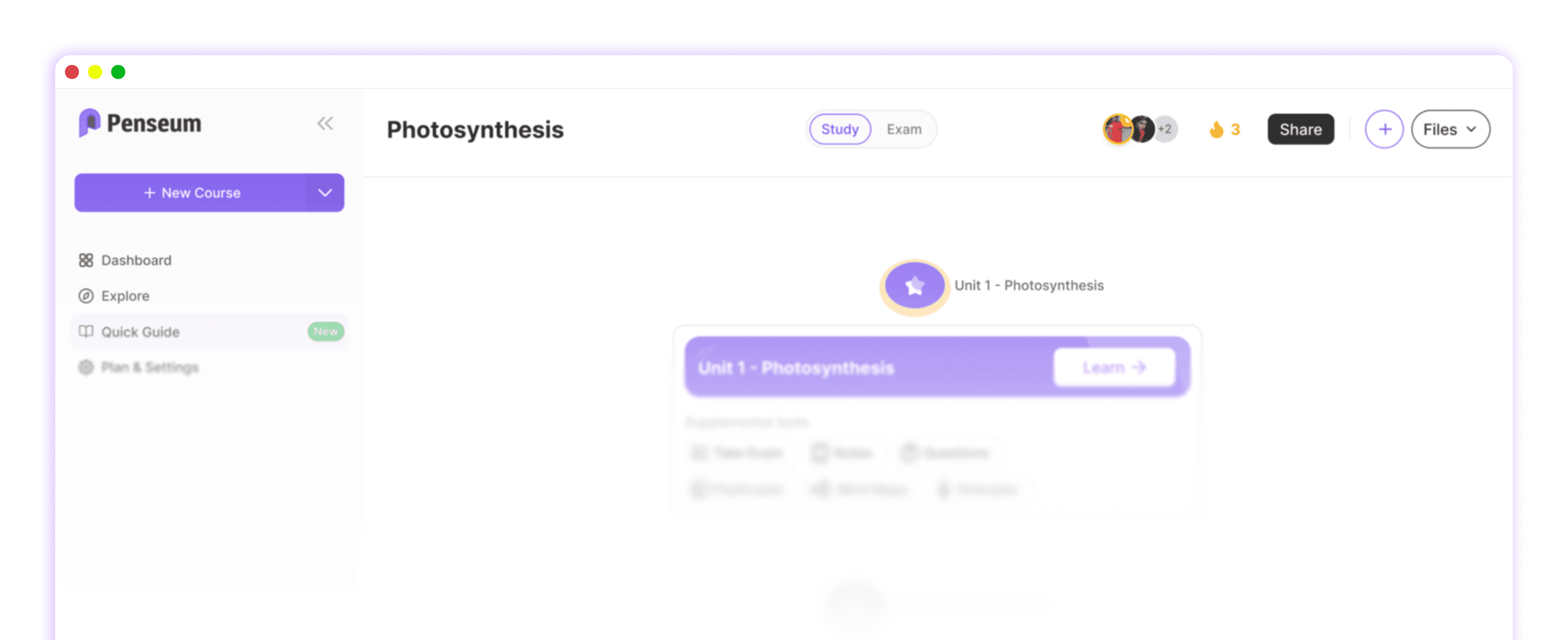
Consider a college sophomore staring at a 50-page biology chapter. For an ADHD brain, the sheer volume of unstructured text creates an immediate psychological barrier. Penseum dismantles this wall by allowing the student to instantly generate an interactive workspace from that exact PDF, shifting the brain from a state of passive dread to active problem-solving.
By offloading the organizational burden to AI, neurodivergent learners save their cognitive energy for actual studying. The platform acts less like a traditional textbook and more like an engaging, gamified tutor that adapts specifically to the fluctuating attention spans common in ADHD profiles.
Overcoming Executive Dysfunction with Instant Study Materials
For students with ADHD, the most difficult part of studying is rarely the material itself—it is the "activation" phase. Executive dysfunction, a core symptom of ADHD outlined by neurodevelopmental research from CHADD, makes task initiation incredibly draining. The prospect of reading a dense textbook and manually converting it into study guides can completely deplete a student's cognitive energy before actual learning even begins. In fact, CHADD reports that individuals with ADHD frequently experience severe impairments in working memory and self-regulation, making the mere thought of organizing study materials a monumental roadblock.
Penseum solves this barrier by acting as an AI that builds your study guides for you. The process requires almost zero activation energy. Step one: the student drags and drops their syllabus, PDF, slide deck, or lecture notes into the platform. Step two: Penseum scans the document context. Step three: within seconds, the platform instantly generates personalized study guides, quizzes, and flashcards. This eliminates the tedious setup process, allowing neurodivergent learners to bypass the activation hurdle and dive straight into active learning.
Competitor tools like Quizlet or Anki often require students to manually input data or search for pre-made decks that may not align perfectly with their specific syllabus. In contrast, Penseum automatically extracts context from the user's specific coursework. By reducing the manual planning time required to study, students can conserve their executive function for processing and retaining information.

Managing Time Blindness with Automated Study Planning
Time blindness is a well-documented executive functioning deficit in ADHD, making it incredibly difficult for students to estimate how long a task will actually take. A student might allocate one hour to study for a history midterm, only to spend 45 minutes manually typing out flashcards and color-coding notes. By the time the actual studying is supposed to begin, they are out of time and mentally exhausted.
By automating the creation of study materials, Penseum entirely circumvents this vulnerability. When a student uploads a 30-slide PowerPoint presentation, the AI immediately digests the content and outputs a structured set of study tools. This precise, instantaneous conversion means zero minutes are lost to administrative prep work.
This automation also provides a clear, visual boundary for study sessions. Instead of staring at an open-ended textbook chapter, the student sees a fixed number of flashcards or a specific 10-question practice quiz generated by the AI. Having a defined start and end point helps students with time blindness anchor their study sessions in reality, preventing the common ADHD pitfall of studying without a structured finish line.
Interactive Elements and Multi-Sensory Engagement
Standard AI text tools, such as the basic interfaces of ChatGPT or generic chatbots, frequently generate passive walls of text. For an ADHD brain, reading massive blocks of generic text can quickly lead to loss of focus, skimming, or complete disengagement. Neurodivergent students often require multi-sensory input to maintain attention and encode memories effectively, a concept heavily supported by learning research from Edutopia. Studies highlighted by Edutopia indicate that engaging multiple senses can improve information retention significantly compared to relying on single-modality instruction alone.
Your 1-1 AI Tutor directly addresses this by providing multi-sensory engagement. Rather than just offering text responses, Penseum utilizes real-time voice explanations. The AI explains concepts step-by-step and out loud, heavily benefiting students who rely on auditory processing to stay engaged. When a student hears a conversational voice explaining the Krebs cycle while simultaneously seeing text on the screen, the dual input locks their wandering attention onto the subject matter.
In addition, Penseum features an interactive workspace where the AI tutor draws diagrams and works through solutions live on a digital canvas. This dynamic visual feedback prevents the passive reading trance that ADHD students often fall into. For example, if an economics student is struggling to understand supply and demand shifts, the AI visually charts the curves on the canvas in real-time. The tutor sees exactly what the student is working on and responds to actual on-screen work, combining kinesthetic (writing/typing), visual (diagrams), and auditory (voice) learning modalities into one cohesive study session.
Step-by-Step Pacing to Prevent Overwhelm
Cognitive overload is a frequent roadblock for ADHD learners. When presented with a massive, multi-step math problem or complex scientific theory, the working memory can easily become overwhelmed, leading to frustration and task abandonment. According to research from the National Institutes of Health, working memory deficits are highly prevalent in up to 80% of individuals with ADHD, requiring information to be segmented into smaller, digestible chunks to prevent mental gridlock.
Penseum prevents cognitive overload by forcing step-by-step pacing. When a student shows the AI a problem, the platform does not simply hand over the final answer. Instead, the student works through the problem on their own—writing answers and showing their steps—while the AI tutor watches and waits. It breaks intimidating assignments down into manageable micro-tasks. Take a calculus student learning derivatives: Penseum will prompt them to isolate the variable first, wait for the correct input, and only then proceed to the next formulaic step.
If a neurodivergent student needs a concept explained multiple times, standard classroom environments can induce anxiety or shame. Penseum provides a judgment-free, infinite-patience environment. The AI keeps teaching, redrawing diagrams, and adjusting its explanation until the concept actually clicks for the student. It refuses to stop after one answer, providing continuous, adaptive support that generic AI study tools lack.
Real-Time Feedback and ADHD Dopamine Loops
The ADHD brain is uniquely driven by dopamine and immediate reward structures. Delayed gratification—such as waiting a week for a professor to grade a problem set—often fails to reinforce learning for neurodivergent students. According to studies highlighted by Frontiers in Psychology, immediate performance feedback creates positive dopamine loops that are essential for sustaining focus and motivation in ADHD individuals. When an action yields an immediate result, the ADHD brain stays locked into the task.
Penseum excels in creating these rapid feedback loops. When a student makes a mistake, the AI tutor spots it instantly, marks exactly where the error occurred, and explains how to fix it in real-time. Consider a scenario where a pre-med student mislabels a cellular structure during a practice quiz. The AI immediately highlights the specific mistake and verbally guides them to the correct terminology. This immediate correction prevents students from accidentally practicing and memorizing incorrect methods.
This gamified, high-reward approach to studying is heavily reflected in the platform's user base of over 1,600,000+ learners from top institutions. Reviews from the community consistently highlight this dopamine-driven engagement. Students tackling intense subjects like Economics or Medical School report that the instant flashcards and quizzes make studying feel rewarding. One user specifically noted that the "flashcards on Penseum are dope" because they make memorizing previously tedious information highly engaging, while others call the step-by-step correction an absolute "lifesaver" for identifying exact missteps without losing momentum.
Comparing Penseum to Standard AI Tools
When evaluating educational technology for neurodivergent learners, it is vital to contrast adaptive AI platforms against legacy platforms and standard text generators. Research from EDUCAUSE indicates that specialized AI tools yield significantly higher engagement metrics than generic models, often doubling sustained interaction times for students with learning differences.
Feature | Penseum | Generic Chatbots | Legacy Tools (e.g. Anki) |
|---|---|---|---|
Real-Time Voice Explanations | ✅ Yes, step-by-step out loud | ❌ Text only | ❌ None |
Live Canvas Interactivity | ✅ Draws diagrams & works live | ❌ Text only | ❌ None |
Automated Guide Generation | ✅ Instant from uploaded notes | ❌ Requires manual prompting | ❌ Requires manual deck building |
Pacing and Patience | ✅ Watches, waits, and adapts | ❌ Gives one answer and stops | ❌ Static repetition |
Mistake Identification | ✅ Highlights exact step gone wrong | ❌ Gives generic final answer | ❌ Self-graded |
While platforms like StudyFetch offer PDF-to-flashcard capabilities, Penseum's specific integration of live voice tutoring and interactive canvas drawing sets a new standard for multi-sensory accessibility. It moves beyond simply generating text to actively simulating a live, 1-on-1 tutoring session that commands the ADHD brain's attention. This combination of tools ensures that visual, auditory, and kinesthetic learners all receive the specific sensory inputs they need to stay actively involved in the material.
Harnessing Hyperfocus for Deep Learning
While ADHD is frequently associated with a deficit of attention, it also brings the capacity for "hyperfocus"—a state of intense, prolonged concentration on a highly engaging topic. During these periods, neurodivergent students can absorb massive amounts of information at a rapid pace. However, traditional study groups or human tutors cannot always match this sudden, intense speed.
Penseum is built to match the exact pace of a hyperfocusing student. Because the platform generates infinite practice problems and instantly grades responses, a student can burn through an entire semester's worth of chemistry equations in a single, highly productive afternoon. The AI never asks to take a break, never loses patience, and continuously feeds the student new, challenging material.
This dynamic scalability ensures that when an ADHD student finally catches a wave of intense motivation, they are not artificially slowed down by limited resources. They can maximize their hyperfocus windows to achieve deep learning, turning what is often viewed as an ADHD challenge into a massive academic advantage.
Empowering Independence Through Accessible EdTech
For students with ADHD, relying on external structures like office hours, human tutors, or study groups can be challenging due to scheduling conflicts and the unpredictable nature of executive dysfunction. They need tools that are available at the exact moment their hyperfocus activates, even if that happens to be at 1:00 AM on a Sunday. Waiting for a scheduled Tuesday afternoon tutoring appointment often means losing the window of motivation entirely.
According to reports from McKinsey on Education AI, always-on AI tutoring is democratizing academic support, reducing the time required for students to achieve concept mastery by up to 30%. Penseum is fully accessible on mobile devices, ensuring that students are not chained to a desk to review their materials. Whether commuting on a train, pacing around a room (which aids kinesthetic learners), or sitting in a library, the AI tutor is constantly available to provide instant academic support.
Beyond mobility, the platform's ability to support a vast array of subjects—from high school algebra to complex medical school coursework—means that students do not need to juggle multiple apps for different classes. By centralizing study guides, quizzes, live tutoring, and flashcards in one personal workspace, Penseum removes digital clutter, a known trigger for ADHD overwhelm. A clean, single-source digital environment allows the brain to relax and focus entirely on the academic task at hand.
The Role of Community in Neurodivergent Studying
Isolation is a common struggle for neurodivergent students navigating rigorous academic environments. Discovering that other students face the exact same executive functioning hurdles can be highly validating. Recognizing this, educational bodies like the American Psychological Association (APA) advocate for peer-supported learning environments, noting that shared academic experiences significantly boost student resilience and emotional well-being.
Penseum actively fosters this by hosting a growing community of thousands of learners. Students looking for a place to ask questions, share feedback on ADHD study hacks, or meet other peers using the platform can easily connect. This collaborative atmosphere ensures that users never feel alone while tackling difficult coursework, providing a vital layer of social accountability that helps keep ADHD brains on track.
Additionally, the platform offers an Ambassador Program where students across the world can represent the tool on their campuses, gaining real startup experience and leadership roles while advocating for accessible study technology. This transforms passive users into active community leaders, offering an empowering outlet for students who want to champion neuro-inclusive learning environments.
By combining cutting-edge, adaptive AI with a strong community backing, Penseum provides a holistic, highly effective ecosystem that transforms how students with ADHD approach their academic careers. It shifts the narrative from "studying is a chore" to a dynamic, rewarding, and highly manageable process.
Frequently Asked Questions
Is Penseum free to use?
Yes, Penseum is free to use for basic features! For students looking for advanced capabilities and higher usage limits, there is a premium subscription available for $29.99.
Can I access Penseum on my mobile device?
Absolutely. Penseum is accessible on mobile devices, allowing students to study, review flashcards, and interact with their AI tutor on the go, making it perfect for studying during commutes or outside of traditional desk setups.
What types of study materials can I upload?
You can upload a variety of course materials including PDFs, slide decks, and lecture notes. The AI automatically scans these documents to instantly generate customized study guides, interactive flashcards, and quizzes.
What subjects does Penseum support?
Penseum powers learning across a massive variety of subject areas. According to user testimonials, it successfully supports everything from introductory Economics courses to highly complex Medical School curricula.
How does Penseum handle mistakes during practice?
Instead of just giving you the correct answer, the AI tutor watches you work through the problem on your canvas. If you make a mistake, it catches your specific error, marks exactly what went wrong, and explains how to fix it in real-time voice, keeping you engaged until you fully understand the concept.
Sources
https://quizlet.com/
https://www.studyfetch.com/
Related guides
Ready to study smarter?
Start turning your notes into guides, quizzes, and flashcards in seconds.