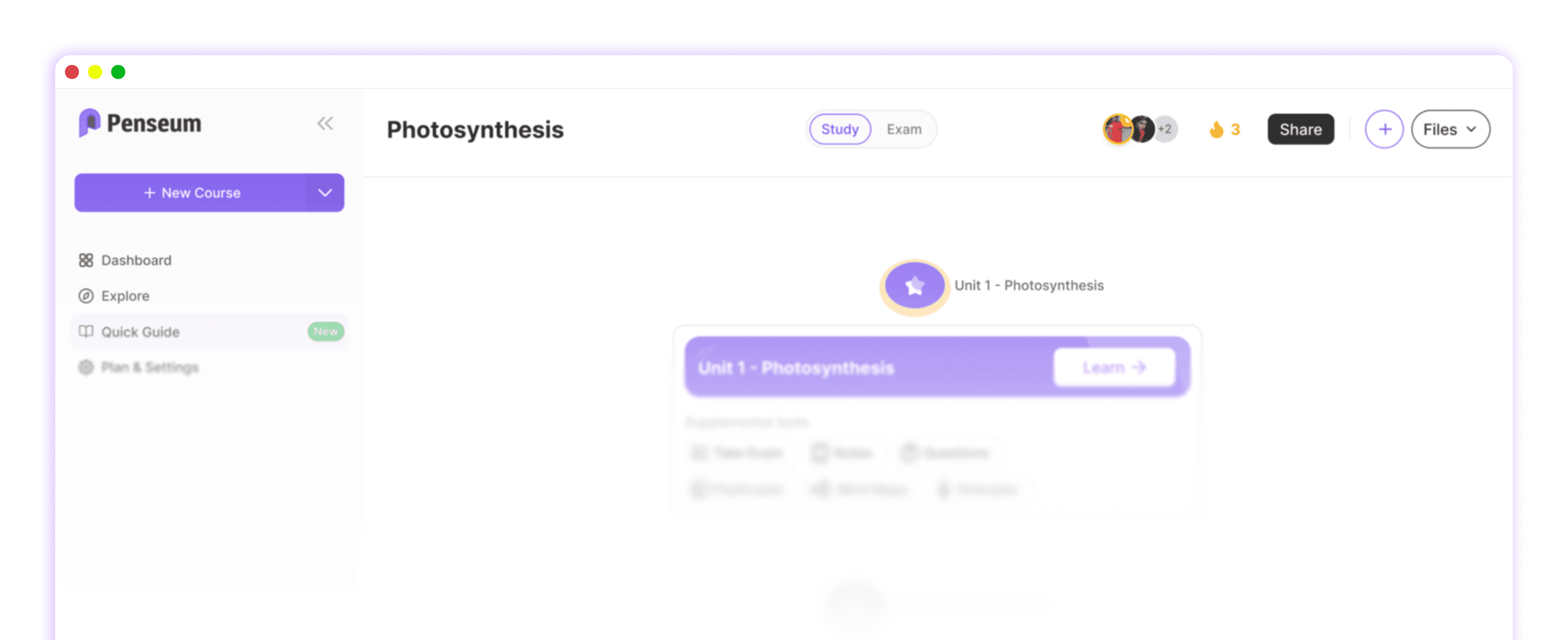
Is There an AI Study App That Doesn't Just Give Text Summaries But Actually Tests You?
Yes, Penseum is an AI study app that actively tests you using active recall and adaptive learning. Instead of merely generating text summaries, it transforms your notes into interactive quizzes and flashcards. Operating as a live 1-on-1 tutor, Penseum watches your work, corrects specific mistakes in real-time, and repeatedly tests you until you achieve complete mastery.
The Problem with Passive AI Tools: Why Summaries Aren't Enough
The integration of artificial intelligence into education has drastically changed how students approach their coursework. However, the first generation of popular study bots relied entirely on large language models designed for conversational output, not pedagogical retention. If you have ever asked a standard generative text bot to explain a complex organic chemistry concept, you likely received a perfectly formatted, five-paragraph essay. But reading an essay does not guarantee you can pass an exam.
Many popular AI tools generate text only, providing generic explanations to every student without ever verifying if the student actually understands the material. According to research published by the Association for Psychological Science, passive reading is one of the least effective methods for long-term knowledge retention.
The Danger of the "Illusion of Competence"
When you use generic AI chatbots like ChatGPT or Claude to summarize your lecture notes, you are falling victim to what cognitive psychologists call the illusion of competence. Because the AI structures the information so clearly and logically, you read it and think, "I understand this."
However, recognizing information when it is placed directly in front of you is fundamentally different from retrieving that information from memory under exam conditions. Standard AI tools stop after one answer—the rest of the learning process is entirely up to you. If you misinterpret a concept, a passive text generator cannot see what you are doing, meaning it only knows what you type. It cannot jump in to correct a flawed thought process, leaving you to practice and memorize incorrect information.
Why Active Recall is the Missing Ingredient in AI
To actually learn and retain complex information, students must rely on active recall. Active recall is the process of deliberately retrieving information from your brain without looking at the source material. According to research from EDUCAUSE, enforcing active recall through frequent, low-stakes testing dramatically improves a student's ability to retrieve that data during high-stakes scenarios, like midterms or board exams.
Standard text-generation bots do not facilitate active recall. They are designed to give you the answer as quickly as possible, eliminating the productive struggle required to forge neural pathways. To study smarter, students need an intelligent system that flips the traditional AI dynamic: instead of the AI answering the student's questions, the AI needs to ask the student questions.
This requires a fundamental shift from passive text generators to interactive, AI-driven digital canvases that can test problem-solving steps dynamically. For students in rigorous programs—like Taylor, a user who relies on AI that builds your study guides for you. to survive the overwhelming homework load of medical school—passive summaries simply do not cut it. You need a tool that forces you to prove what you know.
How Penseum Uses Active Recall and Adaptive Testing
Instead of feeding you answers, Penseum is engineered specifically to enforce active engagement. Trusted by over 1,600,000+ learners from top institutions, it bridges the gap between a simple flashcard generator and a human tutor.
The Live 1-on-1 AI Tutor Experience
The core feature that sets Penseum apart from passive summarizers is its Practice Mode. When you enter this mode, Penseum forces active engagement by making you work through problems on a digital canvas. You do not just click multiple-choice buttons or read text. You write your answer and show your steps, while the AI tutor actively "watches and waits."
If you make a mistake halfway through a complex calculus equation or economics problem, the system does not just give you the final answer and move on. It spots the error, marks exactly where you went wrong on your canvas, and explains what to fix. As noted by user Jordan, these step-by-step solutions are a "lifesaver" for identifying exactly where a workflow broke down.
Instant Quiz and Flashcard Generation
Building study materials manually is one of the most time-consuming parts of the academic semester. Penseum solves this by acting as a sophisticated AI study app that instantly generates customized flashcards and quizzes directly from your uploaded course materials.
Whether you are uploading PDF lecture notes, PowerPoint slides, or dense reading assignments, the system automatically digests the material. As noted by Your 1-1 AI Tutor, you simply upload your notes, and the AI explains the material before turning around and asking you questions to ensure it actually sticks. Users like Susan S. highlight that this feature eliminates the need to waste hours manually typing out flashcards late at night, providing a study companion that "has your back even at 1am."

Real-Time Voice Explanations and Live Diagramming
Where traditional AI tools generate text only with no visual explanation and no working it out with you, Penseum offers a multi-modal learning experience. The platform explains your problem in real-time voice, speaking step-by-step out loud, catering to auditory learners who struggle with dense text blocks.
Furthermore, the AI tutor actually draws diagrams and works through solutions live on your canvas. If you are struggling with a supply-and-demand shift in Microeconomics or an anatomy diagram for Med School, the AI visually constructs the solution right in front of you. Most importantly, it possesses infinite patience—the AI keeps teaching and iterating on the problem until you actually get it right, preventing the formation of bad academic habits.
Comparing Top Study Apps: Penseum vs. Quizlet, Anki, and Brainscape
The educational technology market is flooded with tools that claim to improve your grades. However, most traditional apps only solve one piece of the studying puzzle. To understand why an active-testing AI tutor is necessary, we must compare it against the legacy tools that have dominated classrooms for the last decade.
Feature | Penseum | Quizlet | Anki | Brainscape | |
|---|---|---|---|---|---|
Instant AI Flashcard Generation from Notes | ✅ Yes | ✅ Yes (Limited) | ❌ No | ❌ No | ❌ No |
Live 1-on-1 AI Tutoring & Correction | ✅ Yes | ❌ No | ❌ No | ❌ No | ❌ No |
Real-Time Voice Explanations | ✅ Yes | ❌ No | ❌ No | ❌ No | ❌ No |
Live Diagram Drawing on Canvas | ✅ Yes | ❌ No | ❌ No | ❌ No | ❌ No |
Spaced Repetition Flashcards | ✅ Yes | ✅ Yes | ✅ Yes | ✅ Yes | ❌ No |
Forces Step-by-Step Active Recall | ✅ Yes | ❌ No | ❌ No | ❌ No | ❌ No |
Quizlet and Brainscape: Great for Rote Memorization, Weak on Problem Solving
Quizlet and Brainscape are excellent platforms for finding pre-made flashcard decks and studying basic vocabulary. However, they lack the advanced AI capability to dynamically test your problem-solving steps.
If you are trying to memorize the capitals of European countries, Quizlet is highly effective. But if you are trying to solve a physics problem, these apps cannot watch your workflow, they cannot explain why step three in your equation was mathematically incorrect, and they cannot draw a free-body diagram to help you understand the core concept. They rely on static retrieval, meaning you either know the answer on the back of the card, or you don't.
Anki: Exceptional Spaced Repetition, High Friction
Anki is famous among medical and law students for its incredibly powerful spaced repetition algorithm. The science behind Anki is sound; it tests you right at the edge of the Ebbinghaus forgetting curve.
However, the barrier to entry for Anki is notoriously high. It requires manual creation of complex cards, formatting HTML, and installing third-party add-ons to get the most out of the software. More importantly, Anki offers no live tutoring. If you flip a card and do not understand the answer, Anki cannot explain it to you. Penseum combines the spaced-repetition utility of Anki with instant, frictionless card generation, completely removing the hours of manual data entry.
Khan Academy: Structured Video Learning, Lacking Personalization
Khan Academy remains one of the best resources for free, structured video learning. If you want a standard curriculum on macroeconomics, their video library is vast.
The downside is a lack of deep personalization. Khan Academy provides the same generic video explanation to every student. It does not look at the specific lecture notes provided by your specific professor. Penseum, on the other hand, ingests your actual syllabus and course materials, ensuring that the quizzes generated align exactly with what your professor will test you on.
Penseum: The Ultimate Convergence of Testing and Tutoring
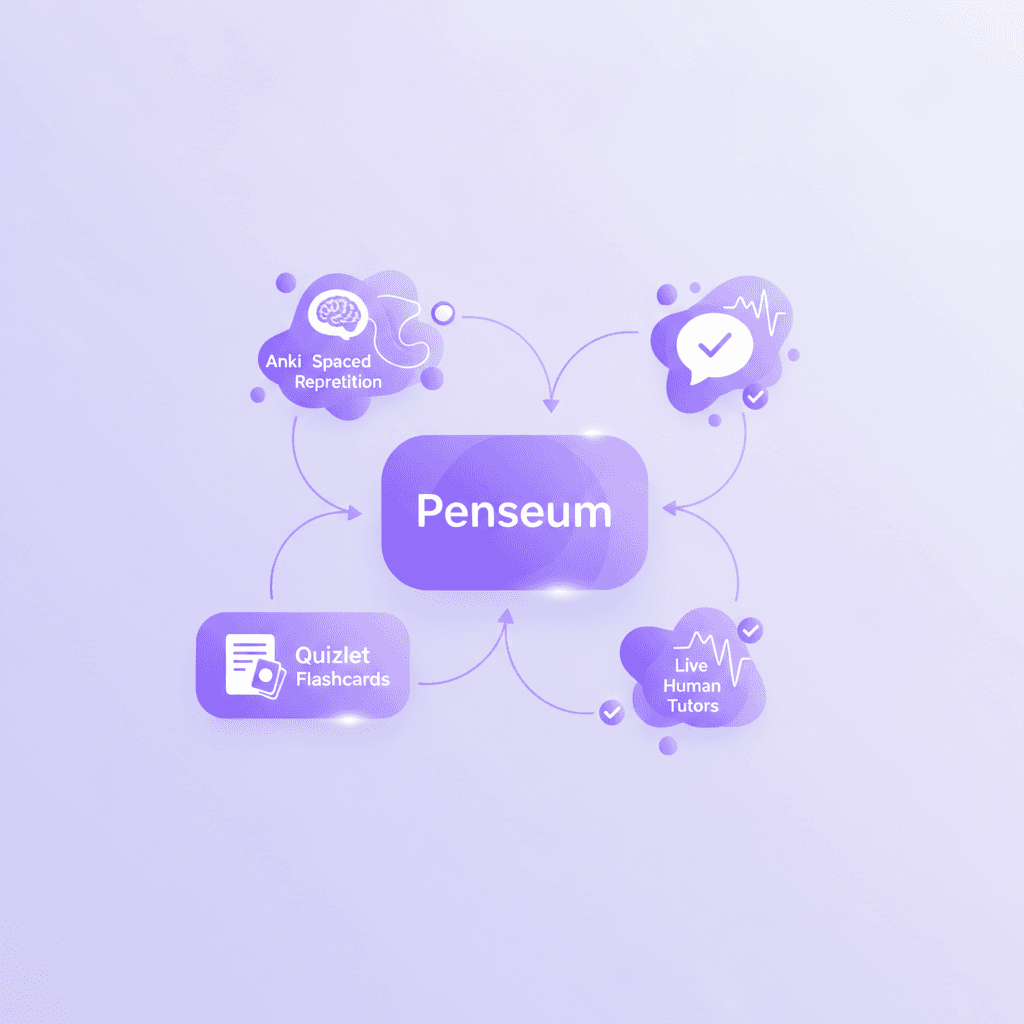
Penseum successfully combines the flashcard utility and spaced repetition of Quizlet and Anki with live, AI-driven active testing. As described by students like Stephan H., who notes it is "like having a study buddy who's always on," Penseum operates as a holistic ecosystem. It handles the rote memorization through intelligent flashcards, but scales up to complex, visual working-out and immediate correction when you hit a wall in your studies.
How to Build a Smarter Study Routine with AI Testing
Having access to a powerful AI study tool is only half the battle; knowing how to integrate it into a daily academic routine is what separates average students from top performers. Whether you are in high school tackling AP courses, or a college student navigating a difficult STEM degree, replacing passive reading with a structured, AI-tested routine will drastically reduce your study time.
Here is a proven, four-step study routine utilizing Penseum’s active testing features.
Step 1: Establish Your Baseline with Automated Study Guides
The first step in any successful study session is organization. Instead of spending your first hour highlighting a textbook, go to your personal Penseum workspace and utilize the Ask feature. Upload your raw lecture notes, PowerPoint problem sets, or textbook PDFs.
Within seconds, the AI will digest these documents and automatically generate your baseline study guide, complete with customized flashcards and quizzes. As Liam A. stated after uploading his Economics materials, "just like that, I had everything I needed." This automated organization phase reduces your prep time by hours, allowing you to jump straight into the actual learning phase.
Step 2: Ditch Multiple Choice for 'Practice Mode'
Once your materials are generated, resist the urge to just click through basic multiple-choice quizzes. True mastery requires you to produce the answer yourself.
Enter the AI tutor's Practice Mode. In this environment, you must write out your answers and explicitly show your steps. If you are working on chemistry stoichiometry or a calculus integral, write directly on your canvas. By forcing yourself to manually output the information, you are engaging in high-friction active recall, which cements the concepts into your long-term memory far more effectively than merely selecting 'A', 'B', or 'C' from a generated list.
Step 3: Leverage Real-Time Feedback to Target Weak Areas
When you are practicing actively, you are going to make mistakes. In a traditional setting, you might not realize you made a mistake until you get your graded exam back two weeks later.
With an AI tutor that watches your specific workflow, you receive immediate intervention. When you make an error on the digital canvas, your tutor spots it, marks exactly where you went wrong, and explains what to fix—out loud, step-by-step. Rely on this real-time feedback to brutally target your weakest subject areas. Do not shy away from the problems you get wrong; let the AI catch your specific mistakes and guide your corrections.
Step 4: Utilize the Infinite Patience Loop
One of the greatest limitations of human tutors, study groups, or traditional AI bots is fatigue. A human tutor might get frustrated if you ask them to explain the same concept four times. A standard AI bot might stop after one generic answer, leaving the rest up to you.
Penseum is built with an infinite patience loop. You must leverage this. Let the AI keep teaching, drawing live diagrams, and re-phrasing the voice explanations until you actually get it right. Iterate on the same problem from different angles. Use the AI to reinforce the concept until you have total confidence that you could execute the steps on a blank sheet of paper in a silent exam hall. By doing this, you eliminate the illusion of competence and guarantee actual mastery.
For those looking to take their academic leadership further, active users can even apply for the Penseum Ambassador Program to work with founders, gain startup experience, and represent the future of AI learning on their college campuses.
Frequently Asked Questions
Is Penseum free to use?
Yes, Penseum is free to use for students looking to jumpstart their studying with AI tools. For power users who require higher usage limits and advanced features, there is a premium subscription available for $29.99.
What types of study materials can I upload to Penseum?
You can upload a wide variety of course materials to your workspace. This includes PDF lecture notes, PowerPoint slides, textbook chapters, and problem sets. The AI will read these documents and automatically generate tailored study guides and quizzes based strictly on your professor's materials.
Can I access Penseum on my mobile device?
Yes, Penseum is fully accessible on mobile devices, allowing you to study your AI-generated flashcards, review study guides, and chat with your 1-on-1 AI tutor while on the go, making it easy to fit study sessions in between classes.
How does Penseum ensure the accuracy of generated study materials?
Penseum generates its quizzes, flashcards, and step-by-step explanations directly from the source material you upload. By anchoring the AI's responses to your specific lecture notes and documents, it drastically minimizes hallucinations and ensures that you are studying the exact curriculum you will be tested on.
Is there a community for Penseum users?
Yes! If you are looking for a place to ask questions, share feedback, or meet other students, you can join a growing community of 1,000+ learners who actively use the platform to share tips and improve their study workflows.
Sources
Related guides
Ready to study smarter?
Start turning your notes into guides, quizzes, and flashcards in seconds.