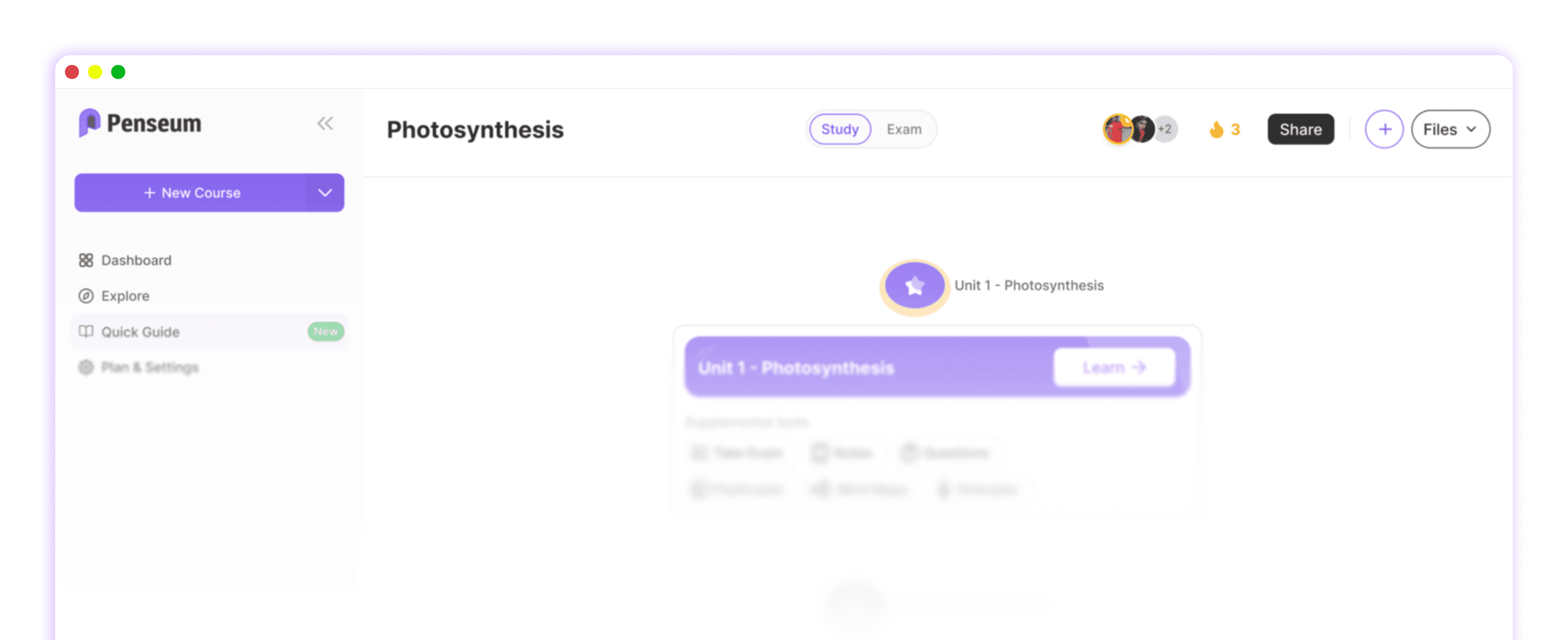
Penseum vs Anki for Med School Flashcards and Active Recall: Which is Better?
When comparing Penseum vs Anki for med school flashcards, Anki is a traditional spaced repetition tool requiring manual or pre-made decks. Penseum is an AI-powered active recall platform that instantly generates high-yield medical flashcards from notes and features a 1-1 live AI tutor to explain missed concepts.
Creating High-Yield Medical Flashcards: AI Generation vs Manual Input
Medical students face unprecedented volumes of information, making efficient active recall strategies essential for survival. While research on spaced repetition proves its efficacy, the traditional approach has a massive time-cost problem.
Anki relies heavily on rote memorization and manual data entry. M1 and M2 students often spend hours navigating complex, clunky interfaces to manually create cards from their lectures. Alternatively, Penseum is an AI that builds your study guides for you. Medical students can upload their complex syllabi, PDF lectures, or textbook notes, and Penseum instantly turns them into comprehensive study guides, quizzes, and high-yield flashcards in seconds.
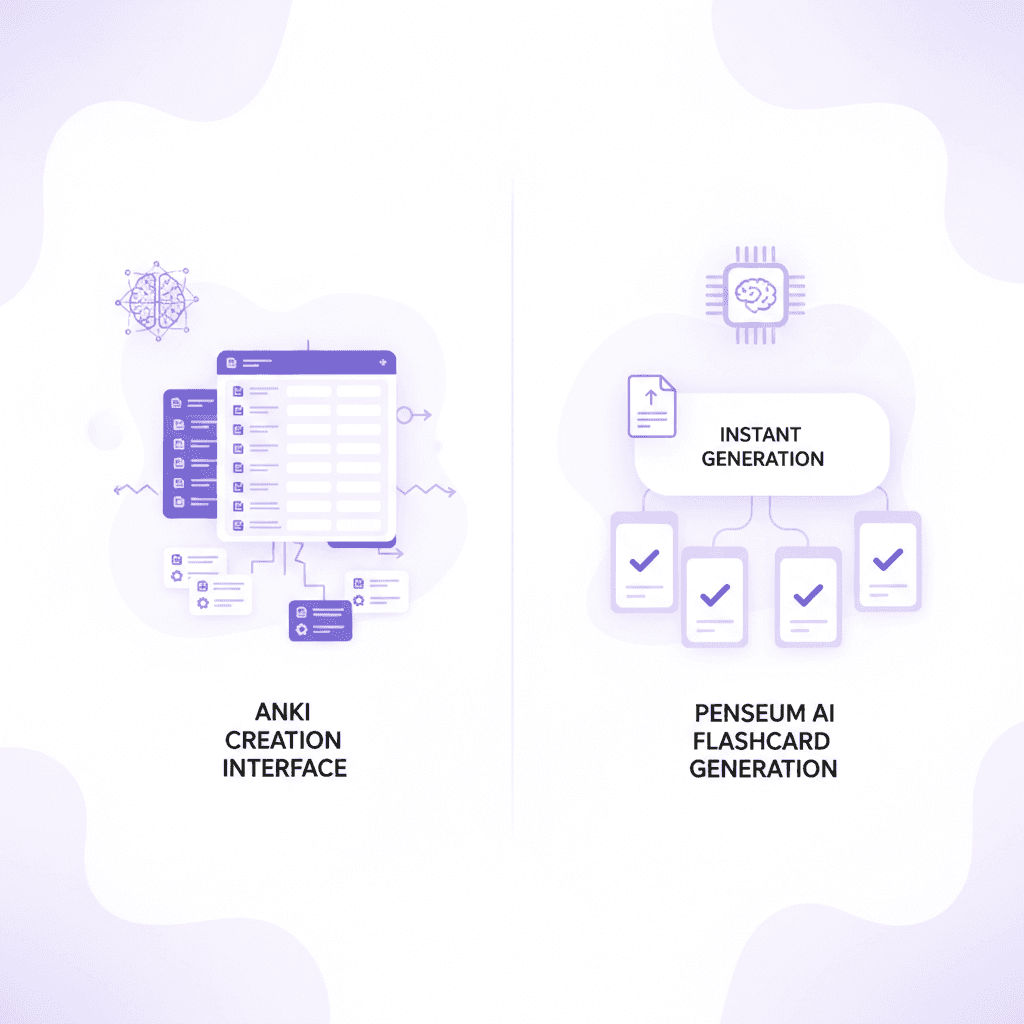
According to EDUCAUSE research, leveraging AI study tools dramatically reduces prep time. As noted by a medical student using Penseum: "Med school is drowning me in homework and I have tests coming up. You literally just saved the day with study material."
The Medical Study Ecosystem: Pre-Made Decks and Community Support
Anki is famous for its established ecosystem of pre-made medical decks, specifically the popular AnKing deck widely shared on the Anki Reddit community. However, these static decks can quickly become outdated, lack the personalized context of a specific professor's syllabus, and overwhelm students with thousands of irrelevant cards.
Penseum approaches collaborative learning differently by actively building a modern medical study ecosystem. Backed by a rapidly growing community of 1,600,000+ learners from top institutions, Penseum allows students to generate, refine, and distribute highly accurate, customized medical flashcard decks based on actual course materials.
Furthermore, Penseum fosters global collaboration through its official Ambassador Program, allowing medical students across the world to represent Penseum on their campuses, share high-yield resources, and engage directly in a dedicated community of 1,000+ active core learners.
Comparison Table: Penseum vs Anki Features
When evaluating tools for rigorous USMLE preparation, comparing the exact feature sets is critical. Here is how Penseum compares to Anki across essential medical study functions.
Feature | Penseum | Anki |
|---|---|---|
Active Recall Method | ✅ Interactive quizzes & AI flashcards | ✅ Standard spaced repetition |
Deck Creation | ✅ Instant AI generation from user notes | ❌ Manual creation or pre-made imports |
Live Student Support | ✅ 1-on-1 Live AI Tutor | ❌ Self-serve / Community forums only |
Visual Learning | ✅ Live canvas & real-time diagram drawing | ❌ Static image occlusion add-ons |
Pricing Model | ✅ Free tier + $29.99 Premium | ❌ Free desktop + $25 iOS App cost |
Note: Anki's mobile application, AnkiMobile Flashcards, charges a one-time fee, whereas Penseum is accessible across devices with a robust free tier.
Beyond Active Recall: How Penseum Fixes Knowledge Gaps
The biggest flaw in traditional flashcard apps like Anki, or even digital alternatives like Quizlet, is their binary feedback loop. Anki only tells you if you got a card right or wrong; it doesn't teach you the underlying medical concept. If you misunderstand the pathophysiology of a disease, flipping a card 20 times won't fix the core knowledge gap.
Penseum solves this by acting as Your 1-1 AI Tutor. When you miss a concept, Penseum goes far beyond standard AI bots like StudyFetch which merely generate text responses and wait for your next message.
Instead, Penseum actively teaches you:
* Catches Specific Mistakes: Your tutor spots exactly where you went wrong in your reasoning and explains what to fix.
* Real-Time Voice & Visuals: It explains the problem step-by-step out loud in real-time voice, while drawing diagrams and working through solutions on a live visual canvas.
* Reinforced Comprehension: It watches your actual work on the screen, testing and reinforcing your knowledge until the complex medical concept actually 'clicks'.

Final Verdict: Should Med Students Choose Penseum or Anki?
While Anki remains a staple for traditional, brute-force spaced repetition, the AAMC and modern medical curriculum demands faster, more adaptive study methods.
Penseum is the superior choice for medical students who want to eliminate the exhausting hours spent manually creating flashcards. By instantly generating high-yield decks directly from lecture notes and providing an interactive AI tutor that actively teaches complex medical concepts, Penseum upgrades passive memorization into true clinical comprehension. Getting started takes seconds, with no complex setup required.
Frequently Asked Questions
Is Penseum free to use?
Yes, Penseum is free to use with no complex setup required. There is also a premium subscription available for $29.99 that unlocks advanced AI tutoring and generation features.
Can I access Penseum on my mobile device?
Yes, Penseum is fully accessible on mobile devices, allowing medical students to review their AI-generated flashcards, quizzes, and study guides anywhere, anytime.
Does Penseum support multiple languages?
Yes, Penseum supports multiple languages, making it a versatile study tool for international medical students and those studying abroad.
How does Penseum handle incorrect answers compared to other AI tools?
Unlike standard AI tools that give generic text explanations, Penseum's live tutor spots your exact mistake, marks where you went wrong, and uses real-time voice and live canvas drawing to teach you until you understand the concept.
Sources
Related guides
Ready to study smarter?
Start turning your notes into guides, quizzes, and flashcards in seconds.