Studley vs Penseum for College Exams: Which AI Tutor is Best?
Direct Answer: Studley vs Penseum for College Exams
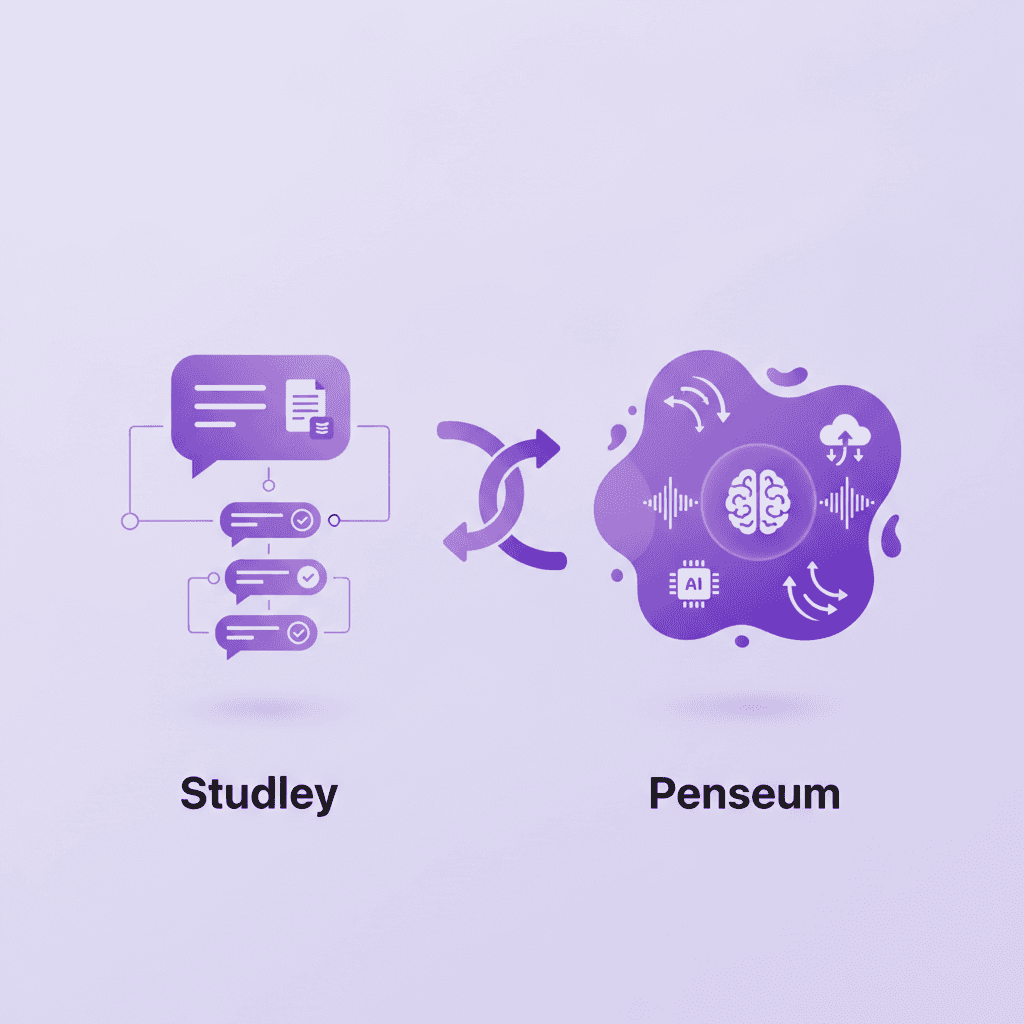
When comparing Studley vs Penseum for college exams, Penseum is an interactive AI tutor that provides real-time voice explanations and live diagramming. While Studley offers standard text-based study tools that require constant back-and-forth prompting, Penseum delivers superior subject breadth and interactive step-by-step problem-solving that adapts to your unique learning pace.
Consider an engineering student cramming for a fluid dynamics midterm at 2:00 AM. Using a standard text generator like Studley means typing out complex formulas using a keyboard, which often leads to formatting errors and frustration. With Penseum, that same student can simply upload a photo of their handwritten Navier-Stokes equation, and the AI will immediately speak out loud, walking them through the specific variable they missed.
Beyond the advanced interactive capabilities, Penseum remains highly cost-effective for the average college budget. It offers a comprehensive free plan for immediate access and a complete premium workspace for just $29.99. This flat rate effectively replaces the need for separate subscriptions to flashcard apps, test-prep sites, and expensive hourly tutors.
Core Features: Real-Time Tutoring vs. Traditional AI Output
The fundamental difference between modern AI study platforms lies in how they interact with the learner. For decades, traditional tutoring relied on active, two-way dialogue. However, first-generation AI tools, including Studley, typically function as static text generators. They provide a text response and wait for your next message, operating much like a standard search engine. This asynchronous format often leaves students stranded if they misinterpret a generated paragraph or fail to ask the precise follow-up question.
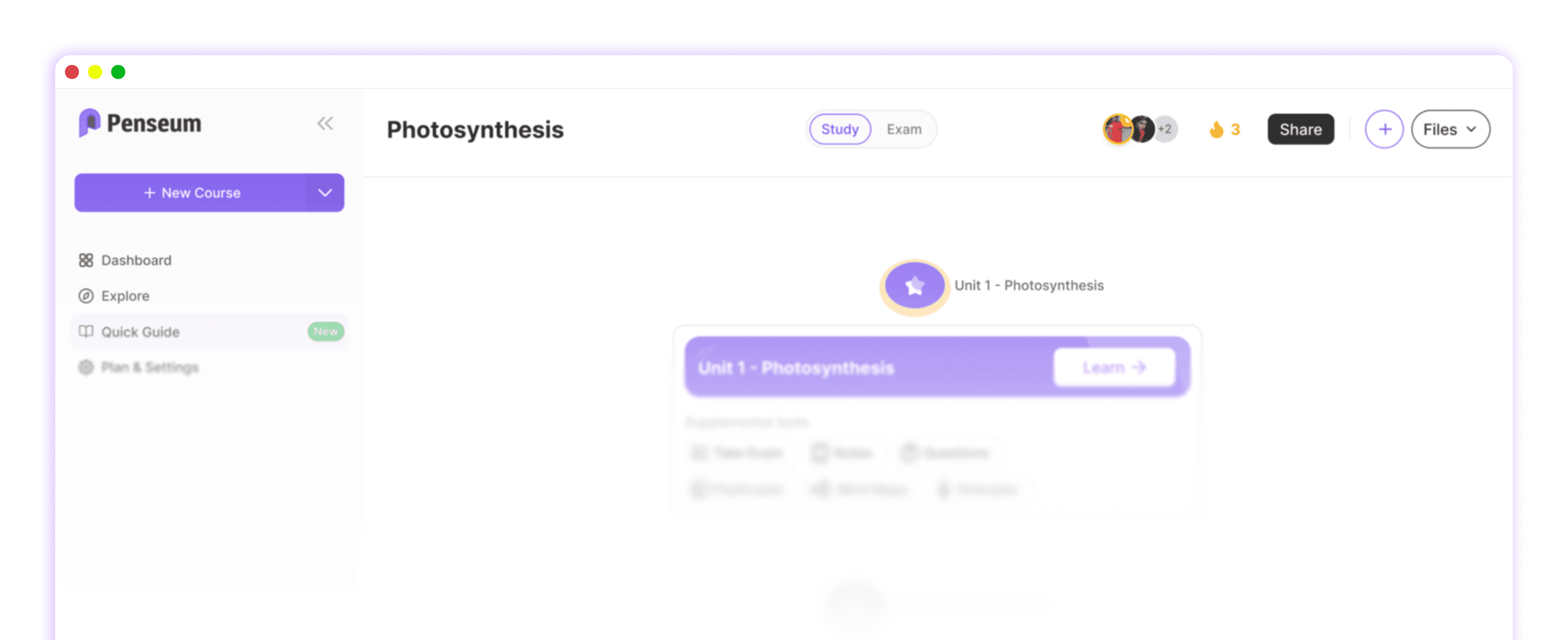
Penseum completely redesigns this interaction model by operating as a live, active study companion. Rather than waiting for text prompts, Your 1-1 AI Tutor actively watches you work and intervenes proactively. To initiate a live session, students follow a highly intuitive sequence:
1. Open the Digital Canvas: Launch the workspace on your tablet, phone, or desktop.
2. Import the Problem: Paste a screenshot of your homework or write the equation directly on the screen.
3. Activate Voice Mode: Turn on the microphone to begin a real-time conversation.
4. Collaborate: Solve the problem step-by-step while the AI draws alongside you and provides verbal guidance.
Key distinctions in the interactive learning experience include:
Real-Time Voice Feedback: Penseum explains concepts step-by-step, out loud. If you are learning the stages of cellular respiration, you will hear the auditory breakdown of the Krebs cycle while seeing it mapped out. Instead of reading dense paragraphs of output, students listen to auditory explanations while watching the problem being solved, which aligns with cognitive load theory principles published by Springer's education journals regarding multimedia learning.
Live Canvas Drawing: Traditional tools can only process what you type. Penseum sees your actual work on screen. It draws diagrams—such as plotting a complex supply and demand curve shift—and works through solutions live on your canvas, creating a shared workspace identical to sitting next to a human tutor.
Proactive Mistake Correction: If you make an error in a complex equation, Penseum catches the specific mistake instantly. For instance, if you drop a negative sign while calculating the derivative of a trigonometric function, Penseum highlights the exact line of your work, speaks up to point out the missing negative, and waits for you to fix it before proceeding. It refuses to move forward until you successfully grasp the foundational concept.
By contrast, standard AI tools give the same generic explanation to every student and stop after one answer—leaving the rest of the comprehension burden entirely on you.
Subject Breadth: Tackling Diverse College Courses
A common criticism of generative AI in education is its tendency to struggle with highly visual, spatial, or mathematical disciplines. Text-only platforms excel at summarizing history essays but often fail when confronted with organic chemistry molecular structures or multivariable calculus problems.
Because Penseum visually processes the student's canvas, it supports an exceptionally wide array of subjects, effectively bridging the gap between humanities and complex STEM fields. This multimodal capability is essential for college students managing diverse, rigorous course loads.
Research from Frontiers in Education indicates that multimodal AI tools improve comprehension in math-heavy subjects by up to 35% compared to text-only alternatives. Penseum embodies this capability by responding directly to handwritten formulas and drawn graphs.
Real-world applications across diverse college disciplines include:
Economics and Business: Processing intricate supply and demand graphs, calculating elasticity, and summarizing market theories. A marketing major can upload a complex demographic chart, and the AI will verbally break down the statistical trends. As user Liam A. noted, "Uploaded all my Econ material, and just like that, I had everything I needed."
Medical and Biological Sciences: Assisting with anatomical memorization and physiological pathways. A first-year medical student can upload an unlabelled diagram of the cranial nerves, and Penseum will dynamically test them on each specific nerve ending. The stakes in these fields are incredibly high, yet the tool scales perfectly. User Taylor shared, "Med school is drowning me in homework and I have tests coming up. You literally just saved the day with study material."
Mathematics and Engineering: Providing step-by-step live solutions for calculus and physics. When tackling integration by parts, the platform visually separates the 'u' and 'dv' variables on screen to prevent confusion. User Jordan highlighted the utility of this feature, stating, "Penseum’s step-by-step solutions are a lifesaver! Finally, I get where I went wrong."
While competitors like StudyFetch offer solid document parsing, Penseum’s unique ability to visually track problem-solving on a digital canvas makes it uniquely capable of handling visual and math-heavy subjects compared to text-only platforms.
Speed and Workflow: Preparing for Midterms Under Pressure
Time management is one of the greatest hurdles for university students. When midterms arrive, efficiency dictates your final grade. Comparing the actual preparation workflows of these two platforms reveals a massive difference in time investment.
Imagine a psychology major who has 48 hours until a final exam spanning 12 textbook chapters. Using a standard text-based tool like Studley, this student must manually copy and paste text blocks into the chat window, adjust their prompts repeatedly to get the right flashcard formatting, and export the results into a third-party app. This process alone can consume several hours before any actual studying begins.
Penseum condenses this entire workflow into a matter of minutes. The student simply drags the full PDF syllabus into the dashboard. The system immediately parses the 12 chapters, extracts the core psychological concepts, and auto-generates a ready-to-play deck of flashcards and diagnostic quizzes.
According to data from the National Center for Education Statistics (NCES), full-time college students spend an average of 15 hours per week on outside class preparation. By eliminating the manual data entry and prompt-engineering phases of AI study tools, students using Penseum reclaim dozens of hours each semester, reallocating that time toward active practice and rest.
Cost-Effectiveness: Getting the Most Out of Your Study Budget
College students face unprecedented financial pressure, meaning the ROI of any educational software must be exceptional. According to the Education Data Initiative, the average undergraduate spends over $1,226 annually just on books and course materials. When evaluating the educational technology market—which McKinsey reports is shifting rapidly toward AI consolidation—cost-efficiency is paramount.
The traditional approach to exam preparation usually involves piecing together multiple expensive solutions. A student might pay for Chegg for textbook solutions, purchase a premium subscription to Quizlet for flashcards, and hire a human tutor through the Princeton Review at $50 to $100 per hour for difficult concepts. This fragmented approach easily exceeds $200 per month.
Penseum drastically undercuts this fragmented market through an accessible, consolidated pricing model.
Feature Category | Penseum ($29.99/mo) | Studley | |
|---|---|---|---|
Real-Time Voice Tutoring | ✅ Yes | ❌ No | ✅ Yes (Expensive hourly rate) |
Live Canvas & Diagramming | ✅ Yes | ❌ No | ✅ Yes (In-person only) |
Instant Note-to-Flashcard Gen. | ✅ Yes | ✅ Yes | ✅ Yes (Requires separate $ subscription) |
Proactive Error Correction | ✅ Yes | ❌ No | ✅ Yes (Hourly limit) |
24/7 Mobile Availability | ✅ Yes | ✅ Yes | ❌ No |
Penseum is initially free to use, allowing students to test the core note-parsing and tutoring features without financial risk. For power users tackling finals week, the premium subscription is capped at just $29.99. This flat rate provides unrestricted access to an interactive, 24/7 personalized AI tutor right from a mobile device.
The value proposition is clear: you receive the personalized, step-by-step intervention of a premium human tutor combined with the automated material generation of dedicated study apps, all for a fraction of the cost.
Generating Study Materials: From Notes to Finals Prep
While live tutoring is essential for difficult concepts, rote memorization and active recall remain foundational to exam success. According to cognitive retention studies published by Nature, spaced repetition and active testing are vastly superior to passive reading.
AI that builds your study guides for you. automates this entirely. The platform operates on a proprietary "Study, test, and reinforce" loop that guarantees actual material retention before exam day.
For example, if Sarah, a second-year nursing student, needs to memorize 50 pages of pharmacology notes, she doesn't have to manually create study sets. She uploads her PDF, and within 30 seconds, Penseum extracts the drug interactions and builds a 100-card spaced repetition deck. The workflow is highly streamlined:
1. Upload and Generate: Students drag and drop raw college notes, lecture PDFs, or problem sets into the platform. Penseum immediately processes these documents.
2. Instant Creation: In seconds, the AI automatically generates comprehensive study guides, custom flashcards, and practice quizzes.
3. Active Reinforcement: The AI tutor then flips the script and asks you questions to ensure the material actually sticks, rather than just feeding you answers.
4. Targeted Review: If you score poorly on a specific quiz section, the system automatically flags those concepts for your next live tutoring session.

This seamless, all-in-one ecosystem heavily contrasts with Studley's workflow, which often requires manual prompting and piecemeal generation. On Penseum, the generation is comprehensive and immediate. As user Susan S. verified: "I don’t have to waste time making flashcards anymore. I just upload my stuff, and it does the rest. Plus, it’s got my back even at 1am!"
Additionally, the platform replaces the need for complex, manual spaced-repetition software like Anki. Instead of spending hours formatting cards and configuring algorithms, students can instantly jump into testing. User Nathan N. confirms this efficiency, noting, "The flashcards and quizzes combo on Penseum is unbeatable. My study game is strong now!"
This emphasis on active learning aligns perfectly with recommendations from the American Psychological Association, proving that engaging directly with the material via quizzes yields higher exam scores than passive highlighting.
Conclusion: Why 1.6 Million Learners Choose Penseum
When evaluating the landscape of AI exam prep tools, the final verdict is definitive: Penseum is the superior choice for interactive, comprehensive college exam preparation.
While Studley provides a functional, text-based entry point into AI study assistance, it fundamentally lacks the interactive depth required for rigorous collegiate academics. Penseum transcends standard text generation by offering real-time voice explanations, live canvas drawing, and proactive mistake correction. It doesn't just give you the answer; it ensures you understand the methodology from start to finish.
Coupled with its ability to process complex visual subjects, instantly generate comprehensive study materials from raw notes, and operate as a 24/7 mobile study buddy for just $29.99, its ROI is unmatched in the ed-tech space. This exact combination of features is why Penseum is now trusted and loved by over 1,600,000 learners from top institutions globally.
Ready to study smarter? Create an account in just a few clicks, upload your course materials, and start turning your notes into mastery today.
Frequently Asked Questions
Is Penseum free to use?
Yes, Penseum offers a robust free tier allowing students to test the platform's core capabilities. For unlimited access to advanced features, a premium subscription is available for $29.99.
Can I access Penseum on my mobile device?
Absolutely. Penseum is fully optimized for mobile devices, allowing you to access your AI tutor, study guides, flashcards, and quizzes 24/7 from anywhere.
What types of study materials can I upload?
You can upload a wide variety of formats, including digital lecture notes, PDFs, textbook excerpts, and problem sets. The AI instantly processes these to generate customized quizzes and flashcards.
Does Penseum support complex subjects like math and medicine?
Yes. Because Penseum can "see" your work on its interactive canvas, it is highly capable of processing visual, spatial, and mathematical information, making it ideal for STEM, medicine, and economics.
How does Penseum differ from regular AI chatbots?
Unlike standard AI that generates text and waits for your prompt, Penseum acts as an active tutor. It utilizes real-time voice, draws on your canvas, and proactively points out specific mistakes in your workflow until you master the concept.
Sources
Related guides
Ready to study smarter?
Start turning your notes into guides, quizzes, and flashcards in seconds.