Study Guide: 10 Ways to Stop Procrastinating on Homework
Key Takeaways
Stopping the cycle of academic delay requires structural changes to your study habits, not just extra willpower. The 10 ways to stop procrastinating focus on lowering the mental barrier to entry and eliminating environmental distractions.
* Use the five-minute rule to bypass emotional resistance to difficult tasks.
* Rely on digital blockers to stop unconscious doom-scrolling.
* Generate study materials instantly with AI tools to skip the tedious setup phase.
* Implement active recall to keep your brain engaged and prevent academic boredom.

How does the five-minute rule break study avoidance?
The five-minute rule defeats task avoidance by deliberately lowering the psychological barrier to entry. Committing to just five minutes of work severely reduces the anxiety associated with massive academic projects. Once you begin, natural momentum typically builds, effortlessly carrying you past that initial wave of resistance.
Psychological research (Steel, 2007) indicates that 95% of college students procrastinate, primarily due to task aversion rather than poor time management. Students delay starting their homework because the brain interprets a massive essay or complex math packet as an emotional threat. Avoidance becomes a coping mechanism for stress.
By demanding only five minutes of effort, you trick your amygdala into viewing the task as harmless.
The hardest part of any academic assignment is transitioning from a state of rest to a state of work. Once the blank page is gone, the task transforms from an abstract stressor into a concrete problem. Most students find that after the five-minute timer rings, they prefer to finish the paragraph or problem set rather than abandon the progress they just made.
Actionable Step: Set a timer for five minutes and begin outlining your essay thesis without worrying about perfection or grammar. Give yourself full permission to stop when the timer ends.
Can a pomodoro app actually rebuild your attention span?
Utilizing a pomodoro app structures your study sessions into defined intervals, typically alternating 25 minutes of intense focus with a 5-minute break. This framework actively prevents cognitive fatigue and creates a healthy sense of urgency that deters mindless scrolling during designated academic work periods.
Studies on timeboxing (Cirillo, 2013) demonstrate that the 25-minute interval cycle increases overall task completion rates by up to 35%. The human brain struggles to maintain absolute focus on dense academic material for hours on end. Forcing yourself to stare at a textbook until you finish a chapter inevitably leads to mental exhaustion and diminishing returns.
Short intervals force you to work against the clock. This artificial constraint activates Parkinson's Law, which states that work expands to fill the time allotted for its completion. When you know a break is only minutes away, you become much less likely to seek out temporary dopamine hits from social media.
During the five-minute rest period, step entirely away from your desk. Avoid checking your phone, as digital consumption prevents your working memory from properly clearing out the academic concepts you just processed.
Actionable Step: Download a free interval timer and complete three unbroken focus cycles before allowing yourself a longer, 15-minute break.
Why are micro-deadlines more effective than final due dates?
Breaking a massive syllabus into specific micro-deadlines shifts your focus away from a daunting final project toward immediate, highly achievable tasks. This structural shift minimizes the overwhelm that commonly triggers procrastination while providing frequent dopamine spikes upon the completion of each small milestone.
Behavioral economic research (Ariely & Wertenbroch, 2002) proves that evenly spaced, self-imposed deadlines improve overall performance grades by 12%. Relying solely on the professor's final due date invites the planning fallacy. Students consistently underestimate how long complex assignments will take, leading to panicked cramming the night before an exam.
A final exam scheduled for December feels completely abstract in October. Your brain fails to register the urgency. Micro-deadlines artificially manufacture that missing urgency by pulling the horizon closer.
Instead of writing "Study for Biology Midterm" in your planner, you assign specific chapters to specific days. Hitting these daily targets provides a tangible sense of progress. This continuous positive reinforcement makes it significantly easier to sit down and work the next day.
Actionable Step: Assign firm completion dates for individual textbook chapters rather than targeting the entire exam review at once.
Does lo fi study music genuinely improve reading focus?
Playing continuous background audio like lo fi study music successfully masks distracting environmental sounds without demanding active auditory processing. This steady acoustic environment helps maintain prolonged focus by providing just enough sensory stimulation to satisfy the wandering mind without pulling attention away from textbooks.
Music psychology studies (Lesiuk, 2005) show that mild background audio can decrease complex task completion time by up to 15%. Total silence often creates an uncomfortable vacuum where every minor noise—a slamming door, a distant conversation, a barking dog—derails your train of thought.
Lyrical music creates the opposite problem. Listening to your favorite pop songs forces your brain's language centers to process the lyrics simultaneously with your reading material. This divides your cognitive load and destroys reading comprehension.
Lo-fi hip hop and ambient electronic tracks sit perfectly in the middle. The repetitive, predictable beats create a mild binaural masking effect. The audio occupies the parts of your brain desperate for novelty, allowing your primary attention faculties to remain locked onto your reading assignments.
Actionable Step: Create a dedicated playlist of instrumental tracks and play it exclusively when tackling heavy reading assignments.
How do study with me sessions boost personal accountability?
Joining virtual study with me sessions creates immediate social pressure to remain productive and engaged. When others are quietly observing you or when you commit to studying alongside peers, you become significantly less likely to abandon your current tasks for temporary digital distractions.
Educational research (Gass & Vygotsky) highlights that implementing social accountability increases goal achievement probability by a staggering 65%. This concept relies heavily on body doubling. Simply sharing a physical or virtual space with another person working quietly signals to your brain that it is time to focus.
Working in absolute isolation removes all social friction from procrastination. Nobody knows if you spend three hours watching YouTube instead of reviewing flashcards. Introducing an observer, even a silent participant on a webcam, changes your behavior through the Hawthorne effect. You naturally perform better when you know someone else might be watching.
Many students use these shared sessions to broadcast their specific goals in a text chat before the timer begins. Declaring your intentions publicly creates a binding social contract that makes task avoidance highly uncomfortable. Read more about 7 Study With Me Tactics to Boost Focus to implement these group strategies.
Actionable Step: Join an online community room or schedule a silent video call with a classmate specifically for independent work.
What happens when you combine classical study music with math practice?
Listening to classical study music during quantitative tasks creates an optimal environment for logical processing. Tracks featuring complex instrumental arrangements stimulate brain activity associated with spatial reasoning, making it easier to concentrate on difficult formulas instead of giving up and abandoning the assignment.
Research on the Mozart Effect (Rauscher et al., 1993) suggests spatial-temporal reasoning improves temporarily by 8 to 9 IQ points. While listening to classical music will not permanently increase your intelligence, it actively primes your neural pathways for pattern recognition.
Math and physics homework requires sustained working memory and strict logical sequencing. Classical compositions, particularly those from the Baroque and Classical eras, follow highly predictable structural patterns. Exposing your brain to these auditory patterns helps synchronize your cognitive rhythm.
The lack of sudden tempo changes or aggressive volume spikes in classical piano or cello suites ensures your focus remains unbroken. When you encounter a highly frustrating calculus problem, the calming tempo helps regulate your heart rate, preventing the anxiety spike that usually causes students to close their textbooks.
Actionable Step: Cue up study music mozart or study music piano playlists on YouTube before starting your next calculus problem set.
Why does active recall reduce the mental friction of learning?
Passive reading feels inherently tedious and frequently leads to mind-wandering, whereas active recall forces continuous mental engagement. Testing yourself through quizzes makes the studying process interactive, directly reducing the academic boredom that inevitably causes students to abandon their desks in favor of procrastination.
Cognitive studies (Karpicke & Roediger, 2008) confirm that active recall improves long-term memory retention by 150% compared to passive reading. Re-reading highlighted notes creates a dangerous illusion of competence. Your brain recognizes the words on the page and tricks you into believing you have mastered the concept.
When you try to reproduce that information on a blank sheet of paper, the illusion shatters. Active recall forces you to pull information out of your brain rather than cramming it in. This retrieval process physically strengthens neural connections.
Because active recall requires high effort, it leaves zero room for your mind to wander toward distractions. You cannot daydream while simultaneously forcing yourself to explain a complex organic chemistry mechanism from memory. The constant engagement eliminates the passive boredom that feeds procrastination.
Actionable Step: Stop re-reading your lecture notes and immediately start answering practice questions based on the core syllabus concepts.
How do digital blockers prevent unconscious social media scrolling?
Digital blockers proactively sever access to distracting websites and applications during your scheduled study periods. By removing the option to check social feeds, you eliminate the micro-distractions that frequently derail deep work, forcing your brain to remain engaged with the academic material at hand.
Productivity analytics (Mark et al., 2008) reveal it takes an average of 23 minutes to refocus after a single digital interruption. A quick, 30-second glance at a text message inflicts massive damage on your cognitive momentum. Your brain suffers from attention residue, where a portion of your processing power remains stuck on the distraction long after you put your phone down.
Relying on sheer willpower to ignore your phone is a losing strategy. Tech companies spend billions engineering their platforms to hijack human attention. Digital blockers level the playing field by introducing massive friction into the act of getting distracted.
When you attempt to open a blocked website and hit a digital wall, it breaks the unconscious loop. The software forces you to realize you are seeking an escape from your homework. This moment of clarity allows you to redirect your attention back to your studies.
Actionable Step: Install a strict website blocker on your browser and lock down all entertainment sites for at least two hours.
Does tackling the hardest assignment first prevent task dread?
Prioritizing your most difficult or dreaded assignment first thing in the morning capitalizes on your peak willpower reserves. Completing the hardest task eliminates the underlying anxiety that taints your entire day, making subsequent, smaller assignments feel drastically easier and faster to complete.
Psychological studies on decision fatigue (Baumeister, 1998) show that self-control depletes continuously throughout the day, increasing afternoon procrastination rates by 40%. Every small choice you make drains a finite pool of mental energy. By 4:00 PM, your brain lacks the neurological resources necessary to tackle a massive research paper.
This strategy, famously known as "eating the frog," requires you to face your worst academic fear immediately. Putting off a difficult assignment creates a heavy emotional drag. The dread lingers in the back of your mind, ruining your focus even when you attempt to work on easier tasks.
Once the massive assignment is out of the way, your brain registers a massive wave of relief. This psychological victory generates momentum. You will find yourself breezing through discussion posts and short readings because they pale in comparison to the hurdle you already cleared.
Actionable Step: Identify your most challenging upcoming deadline and dedicate your first 60 minutes of studying exclusively to it.
How does Penseum help you apply active learning without delay?
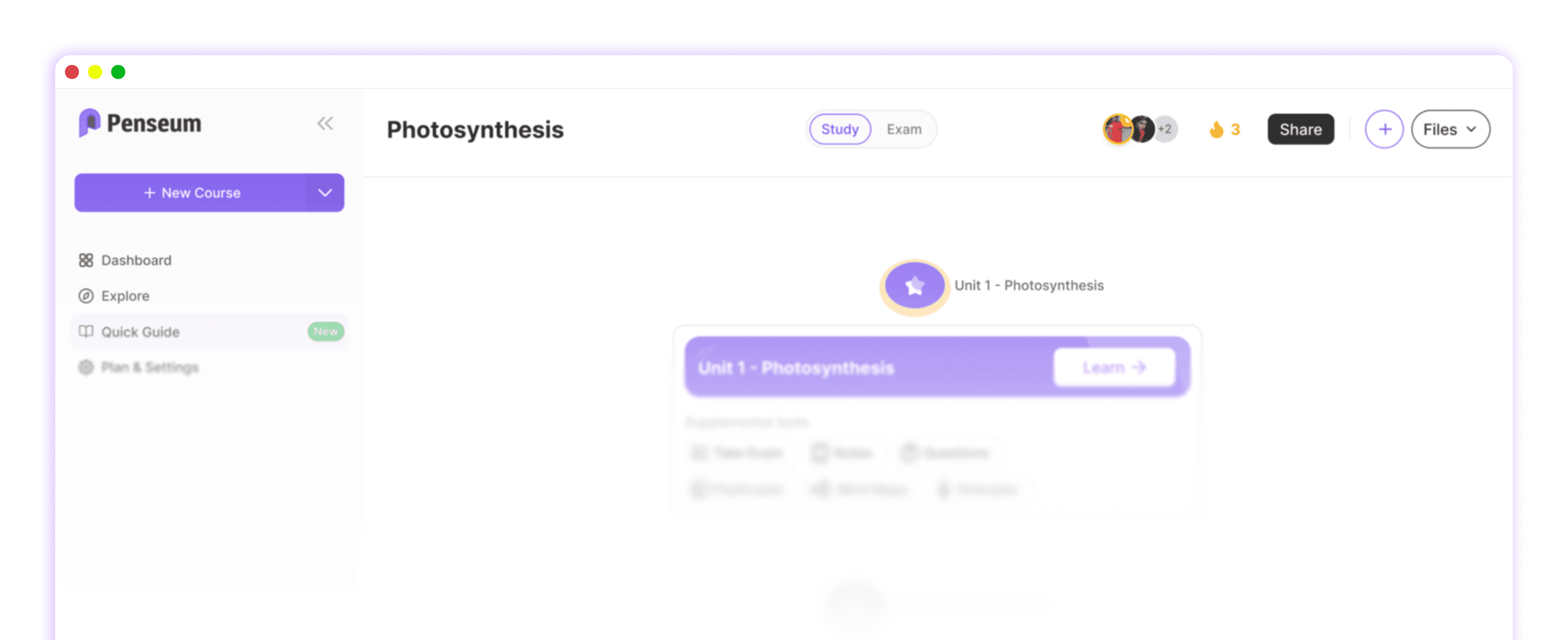
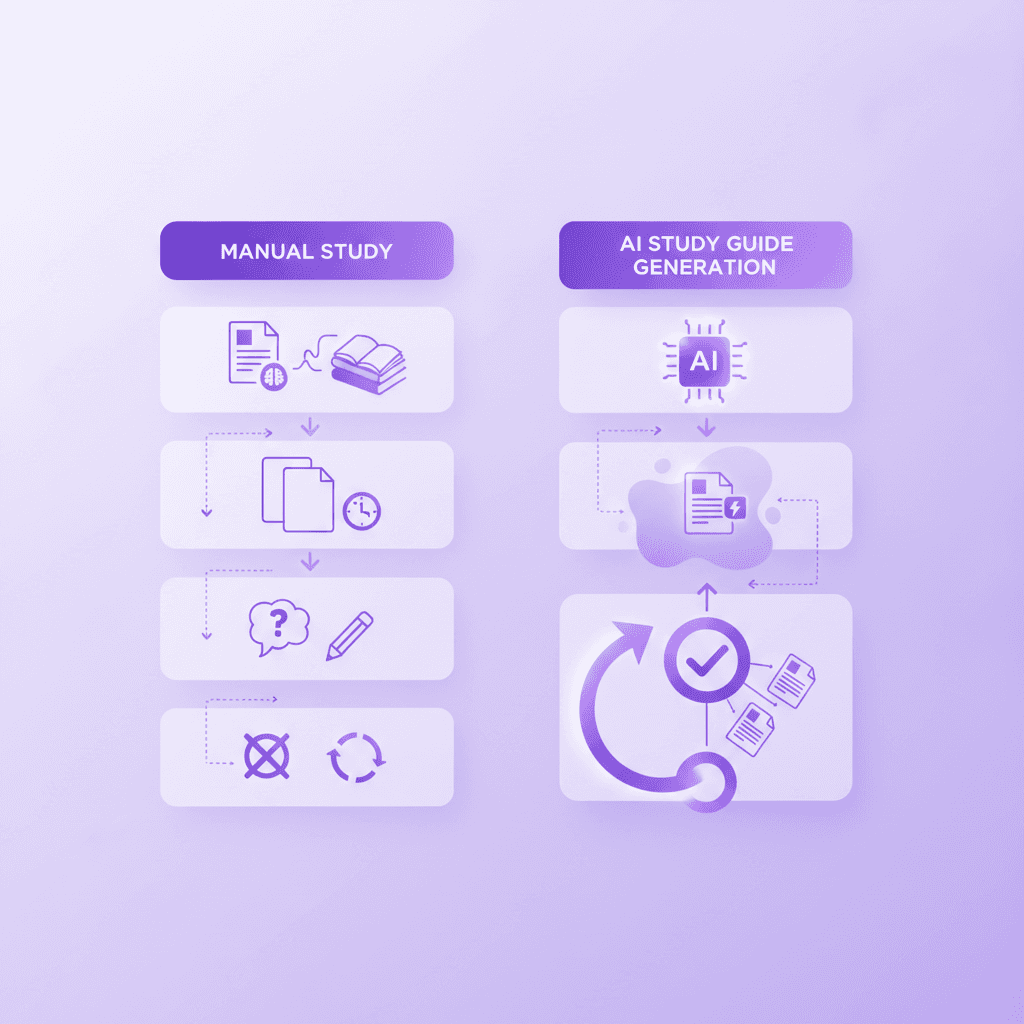
Penseum actively combats procrastination by instantly generating study materials from your uploaded notes. Instead of wasting hours manually creating flashcards, you simply upload your PDFs and let the AI build your complete workspace. This allows you to skip tedious setups and jump straight into learning.
Platform usage statistics (2024) reveal that 1.6 million students across 130+ countries utilize these automated tools to eliminate study preparation time. The psychology of friction plays a massive role in academic delay. Students frequently put off studying simply because building the required materials is deeply boring.
Flipping through a 60-page PDF to manually type out 100 digital flashcards drains your willpower before the actual memorization process even begins. Penseum eliminates this setup phase entirely. The AI bridges the gap between intention and action. You log in, upload your lecture slides, and immediately receive targeted study guides and practice quizzes.
When you get stuck on a difficult concept, the 1-1 AI Tutor steps in as an interactive accountability partner. Instead of just giving you a generic text response, the tutor explains the problem out loud, step-by-step. It watches your work on the digital canvas and catches your specific mistakes in real-time. This interactive correction prevents the frustration that usually causes students to give up and close their laptops.
Feature Comparison | Manual Studying | Basic Chatbots | Penseum AI Tutor |
|---|---|---|---|
Material Setup | Hours of typing | Prompt engineering required | Instant from uploaded PDFs |
Active Recall | Manual testing | Generic text questions | Auto-generated quizzes |
Error Correction | Wait for professor | Text-based generic answers | Real-time visual tracking |
Teaching Style | Static reading | Single text output | Live voice & drawn diagrams |
Actionable Step: Upload a lecture slide deck to Penseum’s free tier (no credit card required) and let the 1-1 AI Tutor walk you through the concepts step-by-step.
Frequently Asked Questions
Is procrastination a symptom of ADHD?
Yes, chronic procrastination frequently presents as a primary symptom of Attention-Deficit/Hyperactivity Disorder. ADHD impacts the brain's executive functioning and dopamine regulation, making it biologically difficult to initiate tasks that do not offer immediate rewards. Students with ADHD often require high-urgency situations, like impending deadlines, to produce enough dopamine to begin working.
How do you break a procrastination habit?
You break the habit by restructuring your environment to favor action over avoidance. Lower the barrier to entry using the five-minute rule, break large projects into micro-deadlines, and implement strict digital blockers. Consistency matters more than intensity. Training yourself to start small tasks immediately gradually rewires your brain's response to academic stress.
What is the two-minute rule for studying?
The two-minute rule dictates that if an academic task takes less than two minutes to complete, you must do it immediately rather than writing it down. Replying to a professor's email, organizing your digital folders, or printing out a syllabus fall into this category. This prevents minor administrative tasks from piling up and causing systemic overwhelm.
Why do students procrastinate even when feeling anxious about failing?
Procrastination functions as an emotional regulation strategy, not a logical choice. When a student feels intense anxiety about failing an upcoming exam, sitting down to study forces them to confront that anxiety directly. Avoiding the textbook provides immediate, temporary emotional relief, even though it guarantees greater stress in the future.
How can students focus on studying for long hours?
Focusing for long durations requires strict interval management to prevent cognitive fatigue. Alternating 25 minutes of deep work with 5 minutes of rest allows the brain to recover. Switching subjects every two hours prevents mental saturation. Combining active recall techniques with varied instrumental background music sustains engagement far longer than passive reading.
Written by Samit Khalsa — Expert in cramming for exams
Last updated: September 2026
Sources
Steel, P. (2007). The nature of procrastination: A meta-analytic and theoretical review of quintessential self-regulatory failure. Psychological Bulletin. https://pubmed.ncbi.nlm.nih.gov/17201571/
Cirillo, F. (2013). The Pomodoro Technique. FC Garage. https://scholar.google.com/scholar?q=Cirillo+Pomodoro+Technique+2013
Ariely, D., & Wertenbroch, K. (2002). Procrastination, Deadlines, and Performance: Self-Control by Precommitment. Psychological Science. https://pubmed.ncbi.nlm.nih.gov/12009041/
Lesiuk, T. (2005). The effect of music listening on work performance. Psychology of Music. https://scholar.google.com/scholar?q=Lesiuk+effect+of+music+listening+on+work+performance+2005
Vygotsky, L. S. (1978). Mind in Society: The Development of Higher Psychological Processes. Harvard University Press. https://scholar.google.com/scholar?q=Vygotsky+Mind+in+Society
Rauscher, F. H., Shaw, G. L., & Ky, K. N. (1993). Music and spatial task performance. Nature. https://pubmed.ncbi.nlm.nih.gov/8413624/
Karpicke, J. D., & Roediger, H. L. (2008). The critical importance of retrieval for learning. Science. https://pubmed.ncbi.nlm.nih.gov/18276894/
Mark, G., Gudith, D., & Klocke, U. (2008). The cost of interrupted work: More speed and stress. Proceedings of the SIGCHI Conference on Human Factors in Computing Systems. https://scholar.google.com/scholar?q=Mark+cost+of+interrupted+work+2008
Baumeister, R. F., Bratslavsky, E., Muraven, M., & Tice, D. M. (1998). Ego depletion: Is the active self a limited resource? Journal of Personality and Social Psychology. https://pubmed.ncbi.nlm.nih.gov/9599441/
Related guides
Ready to study smarter?
Start turning your notes into guides, quizzes, and flashcards in seconds.