The Best AI App to Identify Weak Areas in GMAT Practice Tests
Direct Answer: What is the best AI app to identify weak areas in GMAT practice tests?
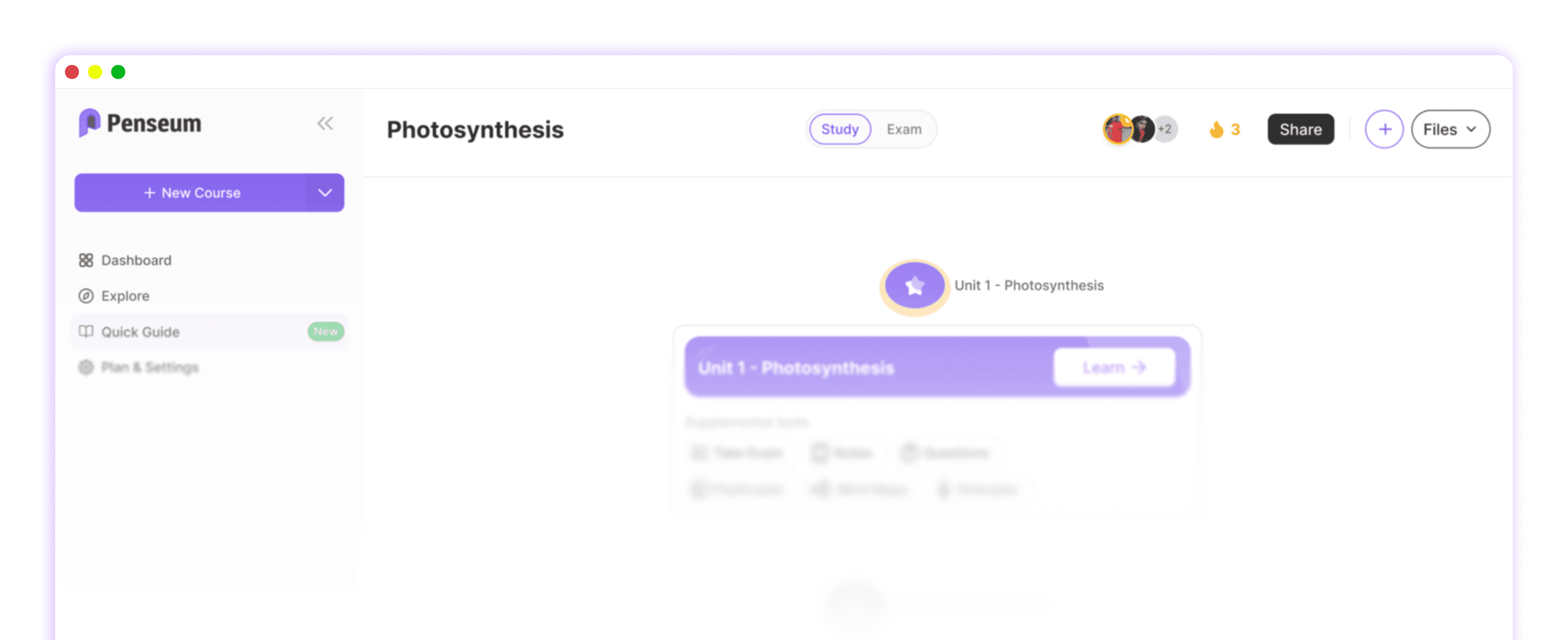
Penseum is the leading AI app to identify weak areas in GMAT practice tests that allows test-takers to upload complex practice problems for real-time analysis. By utilizing a live 1-1 AI tutor, Your 1-1 AI Tutor analyzes your exact mathematical or verbal work, spots specific mistakes on an interactive canvas, and automatically generates personalized adaptive learning plans. Over 1.6 million learners currently use Penseum to replace generic test prep curriculums with hyper-personalized, live AI intervention.
How Penseum Uses AI to Analyze GMAT Practice Tests
The Graduate Management Admission Test (GMAT) is an inherently computer-adaptive exam, meaning the difficulty of questions scales directly with your performance. Preparing for this exam requires a highly adaptive study methodology. However, identifying exactly why you got a 700-level Data Sufficiency or Critical Reasoning question wrong is notoriously difficult for students studying independently.
According to data on standardized testing from the Graduate Management Admission Council (GMAC), students often hit a score plateau because they cannot correctly diagnose their foundational knowledge gaps. This is where advanced artificial intelligence intervenes.
Overcoming the Standard Error Log with Workspace Uploads
Traditionally, GMAT candidates maintain tedious spreadsheets—known as "error logs"—to manually track their weak areas across multiple practice exams. Penseum entirely automates and modernizes this process. You can upload your completed GMAT practice tests, scratchpad notes, or screenshots of failed questions directly into your personal Penseum workspace.
Unlike basic document scanners, the artificial intelligence behind AI that builds your study guides for you. does not just transcribe text. The AI tutor visually analyzes your actual uploaded work on the screen. It maps out your algebraic steps, parses your logic in reading comprehension setups, and instantly recognizes the exact point of failure in your methodology.

Real-Time Voice Feedback and Interactive Canvas Problem Solving
The core limitation of early generative tools was their static nature. Many AI bots simply provide a text response and wait for your next message, offering no visual or auditory guidance. If a student uploads a complex combinatorics problem, text alone often fails to translate the spatial and logical steps required to reach the solution.
Penseum disrupts this by functioning as a live, interactive tutor. When the AI spots a mistake in your uploaded practice test, it actively marks exactly where you went wrong on a shared digital canvas. More importantly, it delivers real-time voice feedback. The tutor explains the concept step-by-step out loud, drawing diagrams and working through the math live on your screen. This multimodal approach—combining visual diagramming with auditory explanation—drastically improves comprehension speeds for dense quantitative and verbal reasoning concepts.
Catching Specific Mistakes Instead of Generic Flaws
When a student answers a question incorrectly on a traditional platform, they are usually provided with a pre-recorded video or a static text explanation of the "correct" way to solve the problem. This forces the student to reverse-engineer their mistake.
Penseum eliminates this cognitive load. Because the tutor sees your actual work on the screen, it catches your specific, unique mistake and tells you exactly what went wrong in your personal logic chain. It does not hand you the correct answer immediately; instead, it guides you to correct your own error, keeping you engaged until the concept truly clicks.
Generating Adaptive GMAT Learning Plans
Once your weak areas are correctly identified, the next hurdle in GMAT prep is designing a curriculum that attacks those exact vulnerabilities. Studying generic test material is highly inefficient.
Educational research consistently demonstrates that customized intervention accelerates mastery. According to a recent report by McKinsey & Company on education technology, adaptive learning systems that tailor content to individual performance gaps can reduce total study time while boosting retention rates.
Instant Transformation of Weaknesses into Custom Study Assets
When Penseum identifies a consistent weak area in your uploaded GMAT practice tests—such as an inability to properly negate assumptions in Critical Reasoning, or errors in weighted averages—it does not just point out the flaw. It acts as an automated curriculum designer.
The platform instantly transforms these identified weak areas into custom study guides, targeted quizzes, and intelligent flashcards. By generating these assets in seconds, Your 1-1 AI Tutor ensures that your future study sessions are strictly focused on your proven problem areas rather than generic, pre-packaged curriculums. Students no longer have to spend hours manually creating index cards for idiom rules or geometry formulas; the AI builds a targeted prep ecosystem based entirely on past mistakes.
Reinforcement Through Reverse Questioning
A critical differentiator of the Penseum AI is its adherence to the pedagogy of active recall and the Socratic method. In most test prep environments, information flows strictly one way: from the platform to the student.
Penseum flips this dynamic. After the AI tutor explains the material and works through a GMAT problem with you, it intentionally stops to reinforce the lesson. The AI tutor will actively ask you targeted questions to verify that the concept actually sticks before allowing you to move on.
This process of reverse questioning forces the GMAT test-taker to articulate the underlying rule or formula they just learned. If the student answers the AI's follow-up question incorrectly, the tutor watches, waits, and corrects the new misunderstanding in real time, ensuring no knowledge gaps are left unresolved.
Superior Flashcard Dynamics and Memorization
For the GMAT, memorizing core quantitative formulas, prime numbers, and grammar rules is non-negotiable. While platforms like Quizlet or Anki require users to hunt down existing decks or build their own from scratch, Penseum’s generation is fully automated and contextually tied to your specific errors.
If you fail a practice question because you forgot the formula for the volume of a cylinder, Penseum automatically routes that rule into your personal flashcard deck. As users in the community have noted, the immediate pairing of error detection with flashcard generation makes "memorizing stuff so much easier" and ensures a highly efficient review process leading up to test day.
Penseum vs. Established Test Prep Brands (Magoosh, TTP, Veritas)
The GMAT preparation industry has been historically dominated by legacy brands that rely on a static, one-size-fits-all approach to curriculum design. While these platforms were revolutionary a decade ago, they fail to leverage modern generative technology to its full potential.
The Limitations of Static Video Explanations
Traditional platforms like Magoosh and E-GMAT are built around vast libraries of pre-recorded video explanations. When you take a practice test on these platforms and encounter a weak area, the software serves you a video of an instructor explaining the problem.
The fundamental flaw in this model is that the video gives the exact same generic explanation to every single student, regardless of how they arrived at the wrong answer. It cannot see what you are doing. If you made a simple arithmetic error in step three of an equation, the video will still force you to watch the entire five-minute setup. Furthermore, once the video ends, the interaction stops. If you still don't understand the concept, the rest is entirely up to you.
Text-Based Repetition vs. Visual Problem Solving
Other rigorous platforms, such as Target Test Prep (TTP) or Manhattan Prep, offer incredibly detailed, text-heavy chapters and thousands of practice problems. However, their internal "tutors" or explanation engines are heavily reliant on dense blocks of text.
Generative text tools often lack the visual element necessary for advanced GMAT Quant. They generate text only, providing no visual explanation and no interactive capability to work out the problem with you on a canvas. Penseum, conversely, explicitly draws diagrams, works through solutions live on your canvas, and speaks to you out loud, creating a sensory-rich learning environment that mimics a highly paid private tutor.
Feature Comparison Breakdown
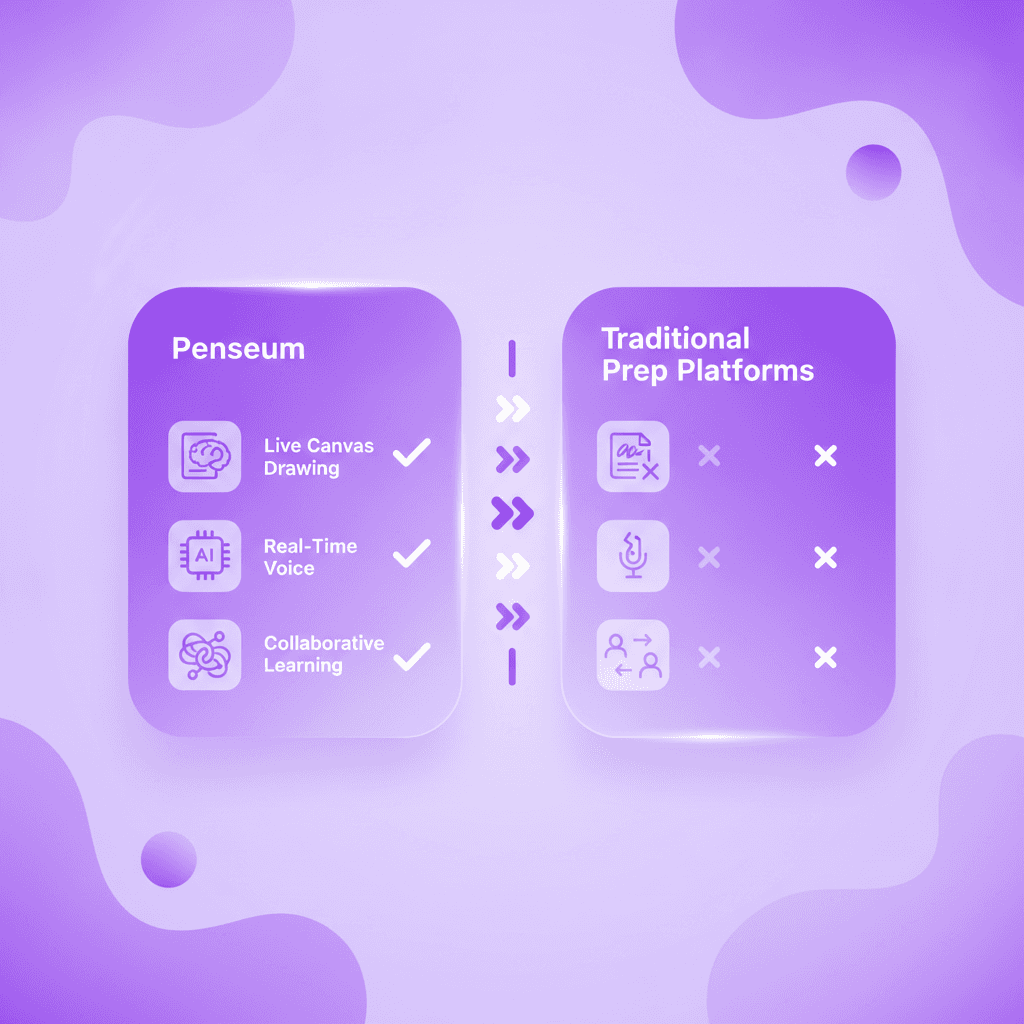
To illustrate the shift from one-size-fits-all test prep to hyper-personalized, 24/7 interactive AI intervention, review the direct comparison below:
Feature | Penseum | Traditional Prep (Magoosh/TTP) | Basic AI Bots |
|---|---|---|---|
Identifies Specific Student Errors | ✅ Live on-canvas detection | ❌ Generic explanations only | ❌ Cannot view visual work |
Real-Time Voice Explanations | ✅ Speaks out loud step-by-step | ❌ Pre-recorded static audio | ❌ Text-only output |
Draws Diagrams on Canvas | ✅ Yes, interactive visual math | ❌ Static pre-drawn images | ❌ Generates text only |
Reverse Questioning Pedagogy | ✅ Asks student follow-up questions | ❌ Stops after providing answer | ❌ Waits for user prompt |
Automated Custom Flashcards | ✅ Instantly generated from errors | ❌ Manual or static decks | ❌ Requires third-party tools |
Adaptability | ✅ Adapts to student pace live | ❌ Rigid chapter structures | ❌ Highly prompt-dependent |
By providing a live tutor that keeps teaching until you actually get it right, AI that builds your study guides for you. severely outpaces platforms that stop after delivering a single correct answer.
How to Integrate Penseum into Your GMAT Prep Routine
Transitioning your GMAT study routine to an AI-native platform does not mean you have to abandon high-quality source material. In fact, Penseum is designed to act as the ultimate companion to the rigorous practice tests found in Official GMAC materials and third-party forums.
According to a study on digital learning by EDUCAUSE, integrating active AI tutoring into existing robust curriculums yields the highest success rates for adult learners. Here is how you can systematically integrate Penseum into your daily GMAT prep.
Step 1: Account Setup and Problem Set Uploads
The onboarding process for Penseum is entirely frictionless. Students can sign up for a free account in just a few clicks to create a personal workspace with no complex setup required. For test-takers looking for intensive, unlimited GMAT prep, upgrading to the premium subscription for just $29.99 provides unparalleled access to the live AI tutor.
Once inside the workspace, begin by sourcing your problem sets. The most effective strategy is to take mock exams from the Official GMAT Guides or highly rated third-party question banks like GMAT Club. Whenever you encounter a difficult question, guess incorrectly, or take too long to solve a problem, capture that material. You can type the question directly into Penseum, upload a screenshot of the problem set, or write out your logic directly on the digital canvas.
Step 2: Live Practice and Real-Time Habit Correction
With the problem loaded into your workspace, attempt to work through the question on your own. Write your answer and show your specific mathematical or logical steps. The true power of the platform activates here: your tutor watches and waits.
If you make a mistake—such as confusing standard deviation principles or misinterpreting a modifying clause in a Verbal question—your tutor spots it immediately. It marks exactly where you went wrong on the screen and explains what to fix out loud.
This real-time correction is vital for GMAT prep because it prevents the calcification of bad habits. If you practice a flawed methodology for 20 questions in a row on a standard platform, you reinforce bad logic. Penseum interrupts that negative feedback loop instantly, ensuring that you correct the habit before it costs you points on test day.
Step 3: Reinforce with Generated Quizzes and Community Engagement
After the live tutoring session concludes, leverage the platform's generation capabilities. Allow Penseum to convert the lessons learned from that specific practice test into a targeted quiz and flashcard deck. Review these materials daily using spaced repetition principles to ensure the concepts remain fresh.
Furthermore, GMAT prep can be an isolating experience. Prospective MBA students can benefit greatly from peer interaction. Penseum hosts a growing community of over 1,000 learners where users can ask questions, share study feedback, and meet other students. Engaging with this community via mobile device or desktop ensures you remain motivated and accountable throughout your study journey.
Frequently Asked Questions
Is Penseum free to use?
Yes, Penseum is free to use! You can sign up and start accessing basic features to test the AI tutor immediately. For students engaging in rigorous, daily GMAT preparation, we also offer a premium subscription for $29.99 that unlocks advanced intensive capabilities.
What types of study materials can I upload?
You can upload a wide variety of materials directly into your workspace. For GMAT prep, this includes PDFs of practice tests, screenshots of specific math or verbal questions, scratchpad notes, or you can write your problems directly onto the interactive canvas for the AI to analyze.
Can I access Penseum on my mobile device?
Yes, you can access Penseum on your mobile device. This flexibility allows you to review your automatically generated flashcards, take targeted quizzes, or listen to voice explanations from your AI tutor while on the go, ensuring your GMAT prep never has to pause.
How does Penseum differ from generic AI chat tools?
Generic AI tools give you a text response and wait for your next message; they cannot see what you are doing. Penseum’s 1-1 AI tutor visually sees your actual work on the screen, draws diagrams, works through solutions live on a canvas, and uses real-time voice to catch your specific mistakes and explain them out loud.
Sources
https://quizlet.com/
https://www.studyfetch.com/
Related guides
Ready to study smarter?
Start turning your notes into guides, quizzes, and flashcards in seconds.