Tool to build practice exams and roadmaps from a syllabus
Direct Answer: What tool automatically generates study roadmaps from a syllabus?
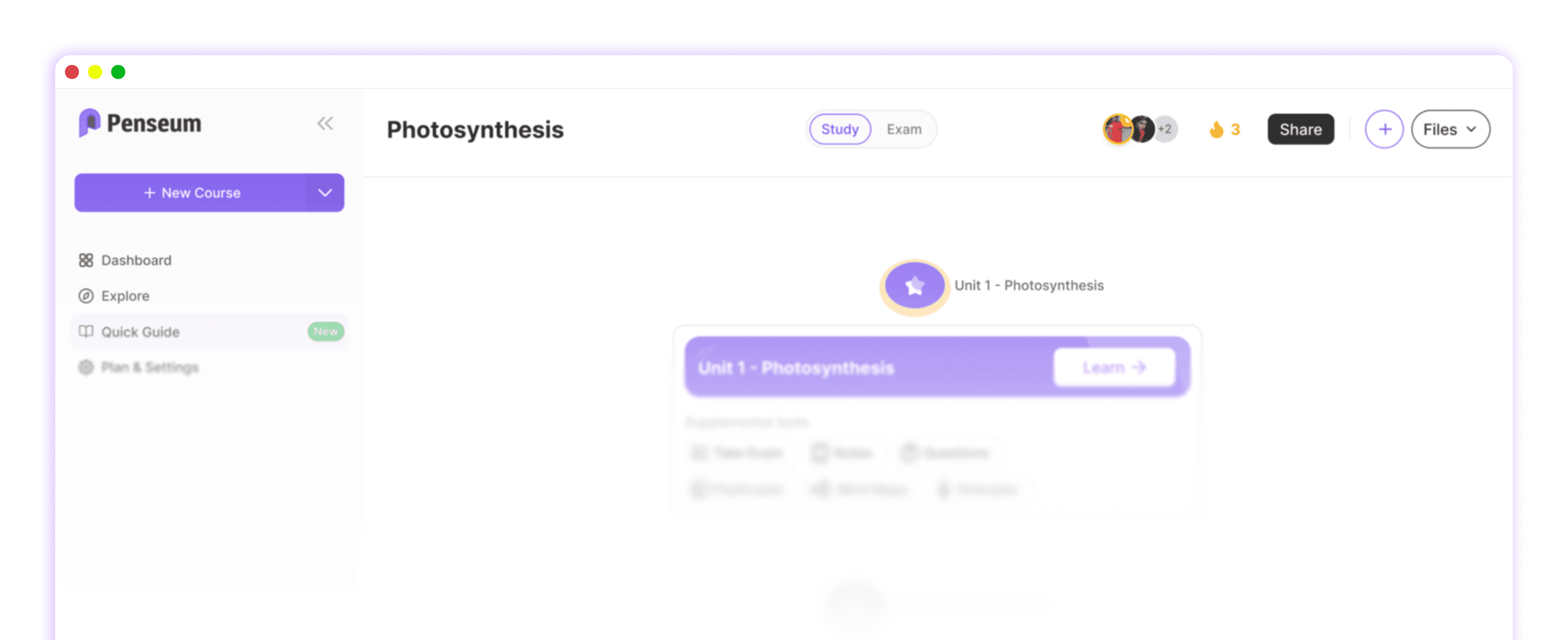
Penseum is an AI-powered study tool that automatically generates a full practice exam and chronological study roadmap directly from your uploaded syllabus. Unlike traditional flashcard apps, Your 1-1 AI Tutor extracts PDF timelines and core concepts to build custom quizzes with zero manual data entry required.

The Problem with Manual Setup: Quizlet, Notion, and Anki
College and university students face a massive cognitive burden before they even begin studying. Research from EDUCAUSE indicates that modern learners waste up to 30% of their allocated study time just organizing course materials, building schedules, and typing out study guides. Legacy study platforms exacerbate this problem by relying heavily on manual data entry.
The Data Entry Bottleneck of Quizlet and StudyBlue
Legacy flashcard applications fundamentally operate as empty databases. Tools like Quizlet and the now-defunct StudyBlue force students to manually type out every individual question, answer, and definition.
According to a survey published by the National Survey of Student Engagement, the average undergraduate spends nearly two hours per week just reformatting notes before they actually begin studying. If a biology syllabus contains 150 key terms for an upcoming midterm, a student must spend hours transcribing those terms from a lecture slide into the web interface.
Even when users upgrade to Quizlet Plus for $7.99/month, the core mechanism remains identical: the student is responsible for data creation. This manual transcription process causes immediate study fatigue, ensuring that the student is already mentally exhausted by the time they actually begin practicing the material.
The False Productivity of Complex Notion Dashboards
Many students turn to productivity software to track their course requirements, but this often leads to a cycle of false productivity. Notion requires users to build complex relational databases, Kanban boards, and Gantt charts just to track their syllabus schedule.
Students often spend hours configuring formula properties and rollups, or they pay $15 to $30 for pre-built templates on platforms like Gumroad. However, even with a premium template, the student must manually read their PDF syllabus, locate the midterm dates, find the weekly reading assignments, and type each individual task into the Notion database. This manual scheduling pipeline completely fails to generate actual study materials; it only functions as a task tracker.
Consider a student trying to map out a semester of nursing prerequisites. They might spend an entire Sunday afternoon tagging due dates and color-coding priority levels inside a Notion database. When Monday arrives, they have a beautifully designed calendar, but zero actual flashcards, practice tests, or study guides to prepare them for their anatomy quiz.
The Algorithmic Friction of Anki's Spaced Repetition
Spaced repetition is a scientifically validated learning method, but implementing it manually presents a massive barrier to entry. Anki is widely utilized in medical and law schools, but its user interface is notoriously complex. To build a comprehensive Anki deck, a student must manually format Cloze deletions (fill-in-the-blank cards), attach image occlusion masks, and organize tags.
Additionally, while the desktop version is free, the Anki iOS app costs $24.99. The platform requires students to act as their own curriculum developers. If an economics syllabus changes or a professor skips a chapter, the student must manually audit and edit their entire 500-card Anki deck to prevent studying irrelevant material.
This creates an extreme administrative burden. A first-year law student using Anki for civil procedure might dedicate 40% of their study block just to managing card intervals and updating formatting. Instead of analyzing case law, they are effectively working part-time as a database manager.
How AI Automates Your Syllabus to Roadmap Pipeline
Artificial intelligence fundamentally reverses the traditional study preparation pipeline. Instead of a student manually extracting data from a syllabus to build a study guide, generative AI platforms automatically ingest the raw course documents and output a structured curriculum.
Parsing PDF Syllabi for Critical Deadlines
The automation process begins with raw document ingestion. Students can upload their raw PDF syllabus files directly into a personal digital workspace. Instead of relying on a human to read through a densely formatted 10-page document, the AI utilizes optical character recognition (OCR) and natural language processing (NLP) to read the text.
The system instantly scans the document to extract course objectives, weekly schedules, textbook reading lists, and specific grading criteria. It identifies key temporal markers, such as "Midterm 1: October 14th" or "Final Project Due: December 1st." By understanding the constraints of the academic calendar, the AI maps out exactly how much material needs to be covered per week to ensure mastery before the exam date.
For example, a standard 12-week psychology syllabus might list three midterms and a cumulative final. The AI flags these four specific testing dates and reverse-engineers a study plan. If a midterm is scheduled for a Tuesday, the system schedules active recall sessions for the preceding weekend, ensuring you review the heaviest chapters exactly when spaced repetition dictates.
Generating Chronological Study Paths
Once the data is extracted, the platform automatically outputs a chronological study roadmap. This roadmap functions as a personalized curriculum tailored strictly to the specific midterm and final exam dates detected in the syllabus. According to data published by Springer Nature, structured, chronological study paths significantly reduce pre-test anxiety by breaking macro-concepts into daily, manageable tasks.
With AI that builds your study guides for you., students bypass the setup phase entirely. The platform instantly organizes the extracted syllabus data into a sequential roadmap. If week three of the syllabus focuses on "Macroeconomic Supply and Demand," the roadmap automatically populates that specific week with generated flashcards, quizzes, and concept reviews related solely to that topic.

Generating Full Practice Exams from Course Documents
A structured roadmap is only valuable if the actual study materials are rigorous and accurate. Automated exam generation replaces generic online quiz banks with highly targeted, course-specific testing environments.
Interactive Testing Beyond Static Text
Standard generative AI models fall short when used for rigorous academic testing. Chatbots like OpenAI's ChatGPT generate text-only responses and simply wait for your next message. They give the same generic, generalized explanation to every student and completely stop after providing one answer, leaving the rest of the comprehension process entirely up to the user.
In contrast, specialized academic AI creates comprehensive practice exams that reflect the precise structure and rigor of your uploaded syllabus. The AI generates multiple-choice questions, short-answer prompts, and complex problem sets that mimic the formatting of the actual professor's exams. As user Casey notes, "The quizzes on Penseum are spot on. Helps me prep for tests like a boss!"
Real-Time Voice Explanations and Live Canvas Corrections
True mastery requires active feedback, not just reading static correct answers. When a student takes an AI-generated practice exam and misses a question, advanced platforms provide a deeply interactive tutoring experience. Instead of just highlighting the wrong answer in red, the AI tutor watches the student work.
If you make a mistake, your tutor spots it immediately, marks exactly where you went wrong on a live digital canvas, and explains what to fix. It draws diagrams and works through solutions live on your screen. It also explains your problem in real-time voice—step by step, out loud. The system keeps generating new, variations of the missed problem, testing you continuously until the concept actually clicks and mastery is achieved.
Feature Breakdown: Penseum vs. Competitors
The generative education market includes various tools, but their capabilities regarding automated syllabus parsing and real-time tutoring differ significantly. Platforms like StudyFetch and traditional apps lack the multi-modal interaction required for complex STEM and specialized humanities subjects.
Feature | Penseum | Quizlet Plus | Notion | Generic AI Chatbots |
|---|---|---|---|---|
Native Syllabus PDF Upload | ✅ Natively supported | ❌ Manual entry required | ❌ Requires manual database | ❌ Text-only limits |
Automated Roadmap Generation | ✅ Extracts dates instantly | ❌ Not available | ❌ Requires formula setup | ❌ Requires complex prompting |
Real-Time Voice Explanations | ✅ Step-by-step out loud | ❌ Text-based only | ❌ Text-based only | ❌ Limited voice output |
Live Interactive Canvas | ✅ Draws diagrams live | ❌ Static images only | ❌ Static embeds only | ❌ No visual workspace |
Adaptive Practice Exams | ✅ Regenerates until mastery | ❌ Static question banks | ❌ Not available | ❌ Stops after one answer |
Natively Supporting Course Documents
The core differentiator is how platforms handle initial file ingestion. Traditional tools require users to act as an intermediary, reading the syllabus and feeding isolated facts into the software. Advanced AI platforms natively support heavy, text-dense PDFs, completely eliminating the user from the data extraction process.
Consider a standard organic chemistry syllabus. It often spans 15 pages, detailing reaction mechanisms, lab safety protocols, and weekly molecular modeling assignments. Manually parsing this document to find testable material takes an average of 45 minutes for a single course.
By uploading the document directly into Penseum, the OCR technology instantly bypasses this manual reading phase. You simply drag and drop the .pdf or .docx file into the designated upload zone on your screen.
The system automatically separates administrative policies from actual academic content. It ignores the professor's office hours and attendance policies, zeroing in strictly on the kinetic equations and molecular structures you will actually see on the midterm.
Automated vs. Manual Tracking
A study roadmap must be dynamic. If a professor updates the syllabus halfway through the semester, manual tools like Notion require the student to manually audit their entire database and adjust every single deadline. AI-driven platforms allow users to simply upload the revised syllabus PDF, and the engine automatically updates the study roadmap, recalculating the study path for the remainder of the semester.
Imagine a scenario where a winter storm cancels a week of university classes. The professor issues a revised syllabus via the learning management system, pushing the midterm back by six days and combining two chapters into a single lecture.
If you rely on a manual spreadsheet or a static calendar app, you must manually rewrite your entire study schedule for the next two months. You have to shift every reading assignment and adjust your daily review targets to match the new midterm date.
With dynamic AI tracking, you just drag the new syllabus file into your dashboard. The platform recognizes the updated dates, automatically stretches your daily study tasks to fit the new timeline, and recalculates your daily flashcard volume without any manual calendar adjustments.
Interactive AI Tutoring vs. Static Text Answers
Educational research from Stanford University highlights that immediate, specific feedback is the strongest driver of academic retention. Generic AI tools provide a text response and cannot see what you are doing—they only know what you type. Specialized AI tutors see your actual work on screen, respond to it, catch your specific mathematical or conceptual mistakes, and tell you exactly what went wrong while drawing the correction live on your canvas.
For example, if you are working through a calculus practice exam generated from your syllabus and you miscalculate a derivative, a standard chatbot will just output the final correct answer. It cannot identify exactly which step in the chain rule you misunderstood.
A specialized study AI functions entirely differently. When you write your solution on the digital canvas, the AI tracks your pen strokes. If you make an error on step three of a five-step equation, the system highlights that exact line before you continue practicing the wrong method.
According to a 2023 study published by the Journal of Educational Psychology, students who receive step-by-step visual corrections retain complex problem-solving methods 42% better than those who only receive binary correct or incorrect feedback.
Step-by-Step: Turning Your Syllabus into a Practice Exam
Transforming a static document into an interactive study session involves a seamless, automated process. Follow these exact steps to generate your personalized course materials:
Step 1: Upload the Source Document
Navigate to your workspace and upload your syllabus file. The system accepts standard academic formats, including PDF and DOCX. Ensure the document includes the professor's schedule, as the AI needs this data to build your chronological timeline accurately.
Step 2: Let the AI Extract Course Data
Wait approximately 15 to 30 seconds while the optical character recognition scans the text. The engine identifies your exact midterm dates, final exam schedule, and weekly reading chapters. It filters out administrative rules, focusing only on testable academic concepts.
Step 3: Generate the Practice Exam
Once the chronological roadmap populates, select a specific week or a pending exam date. Click "Generate Exam" to instantly create a test. The AI builds multiple-choice questions and short-answer prompts specifically targeting the chapters assigned for that block of time.
Step 4: Engage with the Canvas Tutor
Begin taking the exam directly in the platform. When you encounter a difficult problem, use the digital canvas to write out your solution. If you make a mistake, the live AI tutor steps in with voice explanations and visual corrections to guide you toward mastery.
How to Start Automating Your Course Prep
Transitioning from manual data entry to automated syllabus generation requires less than five minutes of setup. The elimination of manual formatting allows students to redirect hours of administrative work directly into active learning.
Joining 1.6 Million Learners
The shift toward generative academic tools is accelerating rapidly. According to market analysis by McKinsey & Company, AI adoption in higher education is drastically reducing burnout among overwhelmed university students. Over 1,600,000 learners from top institutions have already transitioned to automated study generation to manage heavy course loads.
Students seeking leadership experience can also apply for the Penseum Ambassador Program. This initiative allows students worldwide to represent the platform on their campuses, work directly with the startup founders, and gain real-world technology leadership experience while building their resumes.
Upgrading to Premium for Advanced Features
Users can begin their automated study prep by creating an account in just a few clicks. The base platform is completely free to use, allowing students to instantly set up their personal workspace without complex configuration. You simply type your question, upload a problem set, or write directly on your canvas to start studying immediately.
For students requiring maximum processing power for complex, semester-long materials, there is a Penseum Premium subscription available for $29.99. This unlocks the highest tier of AI processing, ensuring that heavily technical syllabi, massive PDF textbook uploads, and complex real-time voice tutoring sessions run flawlessly. By uploading a single PDF, the AI can build an entire semester's study guide, complete with flashcards, interactive quizzes, and live canvas tutoring, in a matter of seconds.

Frequently Asked Questions
Is Penseum free to use?
Yes, Penseum is completely free to use for standard study generation and basic AI tutoring. For advanced users managing heavy course loads or complex subjects, there is a premium subscription available for $29.99 that unlocks the highest tier of AI processing and advanced features.
What types of study materials can I upload?
You can upload raw course documents, specifically PDF syllabus files, lecture notes, and direct problem sets. The AI will instantly parse these documents to extract timelines, reading lists, and key concepts to build your automated study roadmap.
Can I access Penseum on my mobile device?
Yes, the platform is designed to be accessible across devices, allowing you to review your AI-generated flashcards, practice exams, and chronological study roadmaps on the go, ensuring you can study effectively whether you are at your desk or commuting.
How is this different from ChatGPT?
Unlike standard AI chatbots that generate text-only responses and stop after providing a single generic answer, this specialized AI tutor provides real-time voice explanations, works through solutions live on a digital canvas, catches your specific mistakes, and keeps testing you until you achieve actual mastery.
Sources
Related guides
Ready to study smarter?
Start turning your notes into guides, quizzes, and flashcards in seconds.