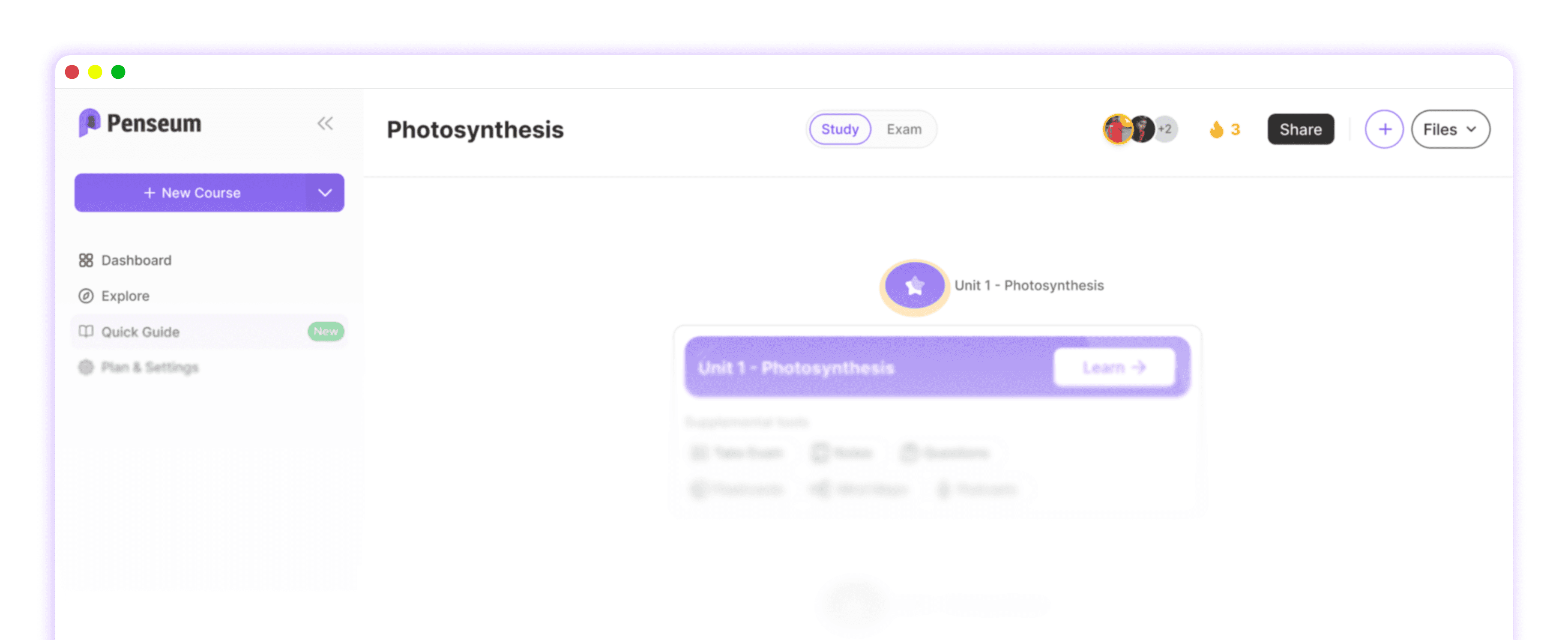
Turn course PDFs into exams with an ai question generator
Key Takeaways
* An ai question generator processes your specific university documents to create highly relevant practice tests in seconds.
* Uploading your own PDFs ensures you study exact syllabus material rather than outdated public flashcard decks.
* Automated systems generate mixed-format assessments, testing your knowledge through multiple-choice, short-answer, and essay prompts.
* Connecting diagnostic quiz results to visual maps helps pinpoint and resolve specific academic knowledge gaps.

What is an ai question generator?
An ai question generator is a software tool that analyzes raw text, documents, or lecture notes to automatically produce relevant test questions. It identifies key definitions and relationships within the material to build custom assessments tailored entirely to your specific university syllabus.
Many students waste hours trying to format index cards instead of actively retrieving information. Natural language processing algorithms read through complex academic texts and extract the most essential facts. The software then reformulates these facts into structured prompts. This process mirrors how professors build their midterm exams.
Educational research confirms the effectiveness of this approach. Karpicke & Roediger (2008) demonstrated the fundamental role of retrieval practice in long-term retention, showing that repeated testing improves final exam scores by up to 150% compared to repeatedly reading the text. A generative tool forces you into this active retrieval state immediately. Instead of passively scanning highlighted lines, you must actively recall the answer.
The technology distinguishes between main themes and supporting details. If you upload a chapter on cellular respiration, the software identifies the Krebs cycle as a primary entity. It then drafts questions specifically targeting the inputs and outputs of that cycle. You spend zero time formatting the test and maximum time taking it. Automated generation turns passive reading assignments into active testing sessions.
Actionable step: Gather your syllabus and lecture slides for a specific module before generating your first quiz. Consolidating all source files ensures the resulting assessment covers the entire topic comprehensively.
Why test your own notes instead of crowdsourced quizzes?
Relying on public flashcards means studying outdated or irrelevant information. Uploading your own materials ensures the software generates questions based exclusively on what your professor emphasized. This alignment prevents you from wasting study hours on textbook concepts that will not appear on the final.
Every university course undergoes syllabus drift. A professor teaching macroeconomics in 2024 assigns different readings than they did in 2021. If you search online databases for pre-made study sets, you risk memorizing obsolete data. Public decks also lack context. Another student might have created questions focused heavily on a textbook chapter your professor specifically told the class to skip.
Automated tools process exactly what you feed them. Finding a study quiz maker that tests exact course notes eliminates the risk of studying the wrong material. By uploading your exact slides, you create a closed-loop study system. The resulting exam tests your specific class framework, not a generic overview of the subject.
Studying misaligned material drains mental energy. Dunlosky et al. (2013) examined the inefficiency of studying low-utility materials, concluding that distributed practice of highly relevant content boosts academic performance by nearly 35% compared to generic highlighting. Focusing solely on your professor's exact wording maximizes your study return on investment. Custom generated tests keep your attention locked on the parameters of your actual upcoming exam.
Actionable step: Export your digital notes as a PDF to ensure formatting remains intact during the upload process. Clean formatting helps the algorithm parse headers, bullet points, and definitions more accurately.
What types of questions can AI extract from your materials?
Modern educational tools create a variety of assessment formats, including multiple-choice, true-false, fill-in-the-blank, and complex short-answer queries. Advanced systems can even simulate essay prompts based on overarching themes found within your uploaded chapters or lecture transcripts to prepare you for written exams.
Basic algorithms often default to simple recall tasks. They spot a vocabulary word, hide the definition, and create a basic digital flashcard. More sophisticated processing engines go deeper. They analyze the cause-and-effect relationships within your document. If you upload a history PDF about the Industrial Revolution, the system asks you to explain the economic impacts of textile manufacturing rather than just asking for the date the cotton gin was invented.
This variety prevents format fatigue. Relying solely on recognizing the right answer out of four options does not guarantee you can explain the concept from scratch. McDaniel et al. (2007) highlighted how mixed-format testing enhances conceptual understanding over single-format testing, proving that mixing short-answer and multiple-choice questions increases final exam retention by an average of 16%.
Constructed response questions force deeper cognitive processing. When the software prompts you to type out a two-sentence explanation, it mimics the pressure of a real written exam. You must organize your thoughts coherently without relying on visual cues. The generator acts as a comprehensive examiner, challenging your knowledge from multiple angles.
Actionable step: Configure the generator to produce short-answer questions for complex theories rather than just multiple-choice recognition. This ensures you can articulate the concept independently.

Comparing PDF-to-quiz conversion methods
Students historically relied on manual data entry to create practice tests. Writing out flashcards by hand or typing them into spaced repetition software demands hours of administrative work before the actual studying begins. An ai question generator automates the administrative phase entirely.
This shift in workflow fundamentally changes how you prepare for midterms. Below is a breakdown of how different assessment generation methods compare across key academic metrics.
Generation Method | Time Required | Content Alignment | Question Variety |
|---|---|---|---|
Automated AI Generator | Seconds per chapter | 100% matched to uploaded files | High (MCQ, Short Answer, Essay) |
Manual Flashcard Entry | Hours per chapter | 100% matched (if transcribed accurately) | Low (Primarily front/back recall) |
Public Test Banks | Instant availability | Low (Generic subject material) | Medium (Usually strictly MCQ) |
Automated tools bridge the gap between speed and specificity. You get the instant availability of a public test bank combined with the precise alignment of manually typing out your own notes. This efficiency allows you to spend a larger percentage of your weekend actively testing your knowledge rather than preparing to test it. Manual transcription often creates a false sense of productivity. Generating the test automatically forces you to confront the material directly.
How automated self-testing identifies your knowledge gaps
Generating a custom test reveals exactly which syllabus concepts you have not yet mastered. By reviewing the questions you answer incorrectly, you can map out a targeted study plan that focuses solely on your weakest academic areas instead of rereading entire textbook chapters.
Most students suffer from the illusion of competence. When you read a beautifully highlighted set of notes, your brain easily recognizes the words. You assume this recognition equals mastery. A generated exam shatters this illusion by removing the source material. Confronted with a blank short-answer field, you quickly discover whether you actually understand the underlying mechanics of the concept.
This friction is academically necessary. Bjork & Bjork (2011) documented the principle of desirable difficulties, proving that identifying illusions of competence through self-testing increases long-term recall probability by over 40%. The struggle to retrieve an answer signals to your brain that the information holds high value.
Diagnostic testing transforms how you approach revision. If a generated quiz shows you scored 90% on chapter four but 30% on chapter five, your next steps become obvious. You stop reviewing chapter four entirely. This targeted triage prevents you from wasting energy reviewing comfortable material just to feel productive. The ai question generator acts as a diagnostic mirror for your brain.
Actionable step: Take the AI-generated quiz blind without your notes, then highlight the textbook sections corresponding to incorrect answers. Review only those highlighted sections during your next session.
Connecting an AI question generator to visual study aids
Assessment tools become more effective when paired with visual breakdowns. After generating a custom test, mapping the relationships between the questions you missed gives you a spatial understanding of how different course concepts connect, ensuring you comprehend the broader context of the module.
Text-based questions isolate specific facts. While this helps with memorization, complex university subjects require synthesizing multiple ideas. If you fail three consecutive questions about supply and demand elasticity, looking at a visual graph of those formulas will help contextualize the failure better than rereading a text paragraph. Linking your weak points visually bridges the gap between isolation and integration.
Spatial organization forces your brain to categorize information hierarchically. Nesbit & Adesope (2006) investigated the cognitive benefits of concept mapping for complex academic subjects, demonstrating that students who visually map relationships experience a 15% increase in knowledge retention compared to those studying standard text. Creating a visual web of your missed questions builds lasting mental scaffolding.
You can use software to assist with this process as well. After the generator identifies your weak points, physically draw a diagram connecting the core entity of the failed question to the broader chapter theme. This dual-coding approach locks the information into your memory through both linguistic and visual pathways.
Actionable step: Generate a mind map from your notes immediately after identifying your weakest quiz topics. Place the missed concept in the center and draw branches connecting it to related syllabus themes.

How Penseum helps you apply automated question generation
Penseum functions as an educational platform where you upload PDFs to instantly create targeted study materials. Instead of stopping at a text response, its AI tutor explains problems in real-time voice, works through steps on a live canvas, and catches specific mistakes.
Many basic study tools simply output a list of multiple-choice options and leave you to figure out why you selected the wrong answer. What to look for in an AI quiz generator for college exams usually involves seeking platforms that close this feedback loop completely. When you upload your course materials to Penseum, the software transforms static readings into interactive teaching sessions. If you miss a generated question about a complex chemistry equation, the system does not just display the correct answer text. It draws diagrams and works through the math on screen, speaking aloud step by step.
This interactive methodology significantly outperforms passive review. Chi et al. (2001) researched the effectiveness of interactive tutoring over passive reading, concluding that interactive step-by-step tutoring yields a standard deviation learning gain of up to 1.5. A tool that stops after one generic explanation forces the student to guess where their logic failed. By seeing your actual work on the screen and responding specifically to where a calculation went wrong, the platform ensures you truly comprehend the mechanic before moving forward.
The platform continuously teaches until the concept clicks. Rather than handing you a static flashcard deck, it builds a dynamic learning environment tailored to your specific university files. The AI waits for your input, watches your steps, and guides you to the correct conclusion.
Actionable step: Create a free Penseum workspace without a credit card and upload your hardest week of lecture slides to generate a diagnostic quiz. Let the real-time tutor walk you through your first missed question.
Frequently Asked Questions
Is an AI question generator accurate?
Artificial intelligence tools base their generated questions directly on the text provided to them. If a student uploads accurate and comprehensive university lecture notes, the resulting assessment will logically reflect that same level of accuracy. Tools designed specifically for education prioritize the exact context of the uploaded documents.
Can I make an exam from a PDF?
Yes, many educational platforms allow users to upload PDF documents directly into their systems. The software reads the text within the file and extracts the core academic concepts to formulate custom practice tests. This method ensures students study exactly what is contained in their assigned reading materials.
Are AI study tools free to use?
Many educational platforms offer foundational features at no cost to students. Penseum provides a free tier without requiring a credit card to generate study materials. Premium subscriptions are typically available for learners who require advanced, real-time voice tutoring and extended mathematical problem-solving capabilities.
How many questions can AI generate at once?
The exact volume depends on the length of the uploaded document and the specific software limits of the platform. Most educational tools can instantly create dozens of multiple-choice and short-answer questions from a single chapter, allowing students to build comprehensive full-length exams in seconds.
Do these generators support math and science?
Advanced educational platforms process technical subjects effectively. Systems equipped with live canvas features and step-by-step problem-solving capabilities are specifically designed to handle complex mathematics, chemistry, and physics equations. These specialized tutors evaluate student work line by line to identify exactly where a calculation went wrong.
Written by Samit Khalsa — Expert in cramming for exams
Last updated: October 2026
Sources
Karpicke, J. D., & Roediger, H. L. (2008). The critical importance of retrieval for learning. Science, 319(5865), 966-968. https://pubmed.ncbi.nlm.nih.gov/18276894/
Dunlosky, J., Rawson, K. A., Marsh, E. J., Nathan, M. J., & Willingham, D. T. (2013). Improving students' learning with effective learning techniques: Promising directions from cognitive and educational psychology. Psychological Science in the Public Interest, 14(1), 4-58. https://pubmed.ncbi.nlm.nih.gov/26173288/
McDaniel, M. A., Anderson, J. L., Derbish, M. H., & Morrisette, N. (2007). Testing the testing effect in the classroom. European Journal of Cognitive Psychology, 19(4-5), 494-513. https://scholar.google.com/scholar?q=Testing+the+testing+effect+in+the+classroom+McDaniel
Bjork, E. L., & Bjork, R. A. (2011). Making things hard on yourself, but in a good way: Creating desirable difficulties to enhance learning. In M. A. Gernsbacher, R. W. Pew, L. M. Hough, & J. R. Pomerantz (Eds.), Psychology and the real world: Essays illustrating fundamental contributions to society (pp. 56-64). Worth Publishers. https://scholar.google.com/scholar?q=Making+things+hard+on+yourself+but+in+a+good+way+Bjork
Nesbit, J. C., & Adesope, O. O. (2006). Learning with concept and knowledge maps: A meta-analysis. Review of Educational Research, 76(3), 413-448. https://scholar.google.com/scholar?q=Learning+with+concept+and+knowledge+maps+Nesbit
Chi, M. T., Siler, S. A., Jeong, H., Yamauchi, T., & Hausmann, R. G. (2001). Learning from human tutoring. Cognitive Science, 25(4), 471-533. https://scholar.google.com/scholar?q=Learning+from+human+tutoring+Chi
Related guides
Ready to study smarter?
Start turning your notes into guides, quizzes, and flashcards in seconds.