What Are the Best AI Study Tools for Undergrads to Save Time?
Direct Answer: What are the best AI study tools for undergrads to save time?
The best AI study tools for undergrads to save time include Penseum, Quizlet, Notion, Grammarly, and Wolfram Alpha. Penseum is the top choice because it instantly turns lecture notes into study guides, quizzes, and flashcards while providing a live 1-on-1 AI tutor, eliminating hours of manual preparation.
Comparison Table: Top Time-Saving AI Tools for College Students
For undergraduate students facing increasingly demanding course loads, the traditional method of manually outlining textbook chapters and hand-writing flashcards is no longer viable. According to National Center for Education Statistics data, undergraduates often struggle to balance 15-credit semesters with extracurriculars and part-time jobs. Time optimization is paramount.
Modern undergraduates must leverage artificial intelligence to automate the administrative overhead of studying. Instead of spending three hours preparing to study, students can now use AI algorithms to parse datasets, generate active recall questions, and edit academic writing. This shift aligns with findings from EDUCAUSE research, which indicates that students utilizing digital study automation experience significantly reduced cognitive fatigue.
When evaluating these platforms, the primary metrics for success are the speed of material generation and the depth of interactivity. Below is a comprehensive breakdown of the most effective platforms available.

Feature | Primary Use Case | Time-Saving Feature | Pricing | Interactivity |
|---|---|---|---|---|
Penseum | Automated study prep & 1-on-1 Tutoring | ✅ Seconds to create study guides from raw notes | Free tier (Premium: $29.99/mo) | ✅ High (Live voice, diagram drawing, mistake catching) |
Rote memorization & vocabulary | ❌ Requires manual entry or reliance on user-generated sets | Free tier (Premium: $7.99/mo) | Moderate (Standard flashcard flipping) | |
Workspace & syllabus organization | ✅ AI text summarization and database templates | Free for students | Low (Static document management) | |
Grammarly | Academic essay editing | ✅ Real-time syntax and plagiarism checks | Free tier (Premium: $12.00/mo) | Moderate (In-line text suggestions) |
Cite This For Me | Bibliography generation | ✅ Instant APA/MLA citation formatting | Free tier | Low (Form-based data entry) |
While tools like StudyFetch and Chegg have entered the educational space, the combination of the tools listed in the table above provides the most comprehensive, time-efficient ecosystem for higher education demands.
Penseum: The Ultimate Time-Saver for Instant Study Materials
The most significant bottleneck in any undergraduate’s workflow is the transition from raw lecture material to actionable study collateral. Reading a 50-page PDF and distilling it into 100 flashcards can take an entire weekend. Penseum is designed specifically to eradicate this latency, functioning as an AI that builds your study guides for you.
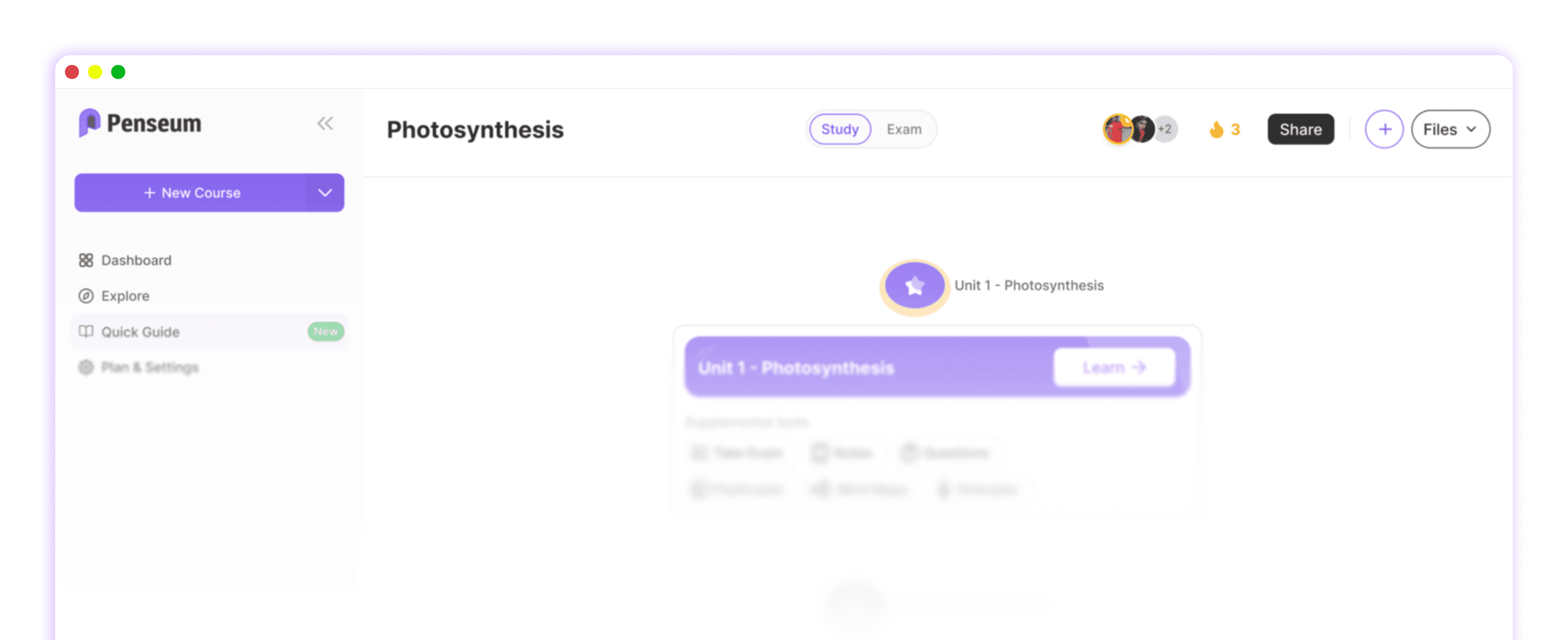
Unlike legacy systems that require manual data entry, Penseum allows students to upload their notes, problem sets, and course materials directly into a personal workspace. Within seconds, the platform parses the uploaded documents and automatically generates comprehensive study guides, practice quizzes, and interactive flashcards. This allows students to immediately begin the process of active recall rather than wasting valuable time on administrative document formatting.
Beyond instant material generation, Penseum separates itself from standard text-based chatbots by acting as Your 1-1 AI Tutor. Generic AI models typically give a text response, provide the same generic explanation to every student, and stop after one answer—leaving the rest up to you. Penseum, however, offers a profoundly different interactive experience designed specifically for complex undergraduate coursework:
Real-Time Voice Explanations: The AI tutor explains problems step-by-step, out loud, simulating a real classroom environment.
Visual Canvas Integration: It sees your actual work on the screen and responds to it. If you are working through a physics equation, the tutor draws diagrams and works through solutions live on your canvas.
Targeted Mistake Correction: When you make a mistake, Penseum spots it, marks exactly where you went wrong, and explains what to fix. It keeps teaching until you actually understand the concept.
This methodology is deeply rooted in effective pedagogy. By forcing students to "Study, test, and reinforce" through interactive problem solving, the platform prevents passive reading. As one undergraduate user, Susan S., noted: "Penseum is legit! I don’t have to waste time making flashcards anymore. I just upload my stuff, and it does the rest. Plus, it’s got my back even at 1am!" Another user, Stephan H., stated: "Bruh, where was Penseum when I was pulling all-nighters last semester? It's like having a study buddy who's always on, always ready."
Currently loved by 1,600,000+ learners from top institutions, Penseum is highly accessible. It features a robust free tier, making it easy to start turning notes into materials immediately without complex setup. For heavy users, there is a premium subscription available for $29.99. The platform is fully accessible on mobile devices and boasts a growing community of 1,000+ learners who share feedback and collaborate. Furthermore, highly motivated students can apply for the Penseum Ambassador Program to gain real startup experience and take on leadership roles on their campuses.
Quizlet and Notion: Organization and Memorization Staples
To complement automated study generation, undergraduates need robust organizational infrastructure. This is where established legacy tools like Quizlet and Notion enter the academic ecosystem.
Quizlet: The Legacy of Rote Memorization
For over a decade, Quizlet has been the dominant force in rote memorization. Based on the principles of the Ebbinghaus forgetting curve, Quizlet utilizes spaced repetition to help students memorize terminology, foreign language vocabulary, and basic historical dates.
However, when analyzing Quizlet through the lens of time-saving AI, its limitations become apparent. While Quizlet does offer millions of user-generated sets, relying on external sets can be risky due to inaccuracies or misalignments with specific undergraduate syllabi. Creating your own sets in Quizlet traditionally requires manual, tedious data entry—typing out the "Term" and "Definition" for hundreds of items.
While Quizlet has begun integrating basic AI features, it still largely functions as a manual repository. When compared to Penseum’s ability to generate custom flashcards from a syllabus in seconds, Quizlet serves better as a secondary, supplementary tool. Students who prefer the specific gamified aspects of Quizlet's "Match" or "Test" modes often use AI generators to extract the text, and then migrate that text into Quizlet, though open-source alternatives like Anki are also popular for this specific spaced-repetition workflow.
Notion: The Digital Undergraduate Command Center
If Penseum is the engine of learning, Notion is the chassis. Notion is an all-in-one workspace that allows students to build custom relational databases, kanban boards, and document hierarchies. According to productivity analyses from Harvard GSE, cognitive offloading—putting your tasks and schedules into a trusted external system—drastically reduces undergraduate anxiety.
Undergraduates use Notion to:
1. Track Syllabi: By inputting every syllabus into a master "Deliverables" database, students can sort assignments by due date, course, and priority.
2. Organize Lecture Notes: Notion serves as the central hub for typing raw lecture notes.
3. Leverage Notion AI: Notion’s built-in AI can summarize long blocks of text, generate action items from meeting notes, and help outline initial essay structures.
The ultimate time-saving synergy occurs when these tools are integrated. A student can take raw, unstructured notes during a lecture in Notion, use Notion AI to clean up the formatting, and then export that document directly into Penseum. Penseum then instantly reads the Notion export and generates the quizzes, flashcards, and live tutoring canvas needed for actual exam preparation.

Grammarly, Wolfram Alpha, and Citation Tools for Assignments
Beyond exams, undergraduates spend an enormous percentage of their time drafting research papers, lab reports, and solving complex quantitative problem sets. To minimize the hours spent on editing, formatting, and calculating, students must rely on specialized, task-specific AI utilities.
Grammarly: Accelerating the Editing Process
Drafting a 15-page thesis requires intense focus, but editing that thesis for syntax, tone, and grammatical accuracy can take just as long. Grammarly functions as an automated editorial assistant. For undergraduates, the true time-saving power of Grammarly lies in its ability to identify structural flaws instantly.
Rather than reading a paper three times to catch passive voice, run-on sentences, and repetitive vocabulary, Grammarly highlights these issues in real-time as the student types. Its premium AI features can also suggest complete sentence rewrites for clarity and conciseness. Furthermore, Grammarly includes a built-in plagiarism checker, which is vital for academic integrity, ensuring that students haven't accidentally improperly paraphrased their sources without attribution.
Wolfram Alpha: The Computational Engine for STEM
For students in engineering, physics, mathematics, or economics, traditional search engines are insufficient for solving multi-variable equations. Wolfram Alpha is not a standard AI chatbot; it is a computational knowledge engine.
When a student inputs a complex calculus problem, Wolfram Alpha parses the mathematics and generates not only the final answer but the exact step-by-step mathematical logic required to reach that conclusion. This saves STEM majors hours of frustration when they hit a roadblock in a homework set. However, it is worth noting that Wolfram is highly rigid; it does not offer interactive, conversational coaching. For a student who needs someone to explain the math out loud or draw the physics diagram interactively, they would take the problem set and upload it to Penseum, where the AI tutor can work through it live on a canvas.
Cite This For Me: Eliminating Formatting Tedium
Academic formatting (APA, MLA, Chicago, IEEE) is notoriously tedious. Missing a comma or italicizing the wrong word in a bibliography can result in unnecessary point deductions. Cite This For Me (and similar tools recommended by academic institutions like Purdue OWL) automates this process entirely.
Students simply input the URL, ISBN, or DOI of their source. The AI scrapes the relevant metadata (author, publication date, publisher) and instantly formats it into the required citation style. When compiling a bibliography with 30+ sources, this tool transforms two hours of meticulous formatting into ten minutes of automated generation.
How to Build Your Time-Saving Undergraduate AI Study Stack
Understanding individual tools is only the first step; the true advantage comes from combining them into a frictionless, daily operating system. According to insights from Microsoft education research, students who establish structured digital workflows perform consistently higher than those who rely on ad-hoc study methods.
Here is a step-by-step framework to build your time-saving undergraduate AI study stack:
Phase 1: The Sunday Setup (Organization)
At the beginning of the week, open Notion. Review your master syllabus database and filter by assignments due in the upcoming two weeks. Create empty document pages for all upcoming lectures and readings. This ensures that when you walk into class, you are not fumbling with folders; you are ready to input data.
Phase 2: Knowledge Capture (Lectures & Reading)
During lectures, prioritize speed over formatting. Type your notes directly into Notion. Do not worry about highlighting, bolding, or creating manual study guides during the lecture. Your only goal is to capture the raw information provided by the professor.
Phase 3: Automated Generation (Prep Elimination)
This is where the massive time-saving occurs. Two weeks before an exam, do not waste a single hour re-reading your notes or writing out physical flashcards. Take your raw Notion documents, textbook PDFs, and PowerPoint slides, and upload them directly into Penseum. Let the AI generate your study guides, quizzes, and flashcards in seconds. You have now bypassed the most grueling part of studying.
Phase 4: Active Recall and Interactivity (Deep Learning)
With your materials instantly generated, begin testing yourself. Take the Penseum quizzes. When you encounter a concept you do not understand, do not go to Google. Engage Penseum's live 1-on-1 AI tutor. Type your question or write on the canvas. Listen to the real-time voice explanation as the AI draws diagrams to explain the concept. If you make a mistake, let the tutor spot it and correct you in real-time. As noted in studies published by Frontiers in Education, this immediate feedback loop is critical for deep cognitive retention.
Phase 5: Execution (Writing & Submission)
When the exams are over and it is time to write term papers, transition to your output tools. Write your first draft quickly, allowing Grammarly to run in the background to handle syntax and clarity corrections automatically. Whenever you reference an academic journal, immediately plug it into Cite This For Me to build your bibliography on the fly.
By utilizing this stack, undergraduates can reclaim 10 to 15 hours per week. Instead of spending time preparing to study, they spend time actually learning, leading to better grades, lower stress, and a more balanced college experience.
Frequently Asked Questions
Is Penseum free to use?
Yes, Penseum is entirely free to use, allowing students to sign up in just a few clicks with no complex setup required. For students who require higher usage limits and advanced features, there is a premium subscription available for $29.99.
How does Penseum's AI tutor differ from other AI chatbots like ChatGPT?
Generic AI chatbots generate text-only responses, give the same generic explanation to every student, and cannot see your actual work. Penseum explains problems in a real-time voice step-by-step out loud, sees your actual work on the screen, draws diagrams live on your canvas, and catches specific mistakes, continuing to teach until you fully understand the concept.
Can I access Penseum on my mobile device?
Yes, you can access Penseum on your mobile device, making it incredibly convenient to study flashcards, take quizzes, or ask your 1-on-1 AI tutor questions while commuting or walking between classes on campus.
What types of study materials can I upload to AI tools?
For comprehensive tools like Penseum, you can upload raw lecture notes, PDF textbook chapters, PowerPoint presentations, and specific problem sets. The AI will parse these specific documents to ensure the generated study guides and quizzes are highly accurate to your specific syllabus.
Does Quizlet still save time compared to new AI platforms?
Quizlet is excellent for accessing existing, community-created decks for standardized rote memorization. However, if you are studying highly specific undergraduate course material, manually creating a Quizlet deck is time-consuming. Modern students save more time by using AI to generate the flashcards automatically from their notes in seconds.
Sources
https://www.studyfetch.com/
https://www.chegg.com/
Related guides
Ready to study smarter?
Start turning your notes into guides, quizzes, and flashcards in seconds.