5 Ways a Test Maker From Notes Boosts Your Grades
Key Takeaways
A test maker from notes directly transforms your specific syllabus into high-yield practice exams. This eliminates the hours wasted writing flashcards and forces immediate active recall.
* Instantly generates mock exams from your exact lecture slides and PDFs.
* Stops you from studying inaccurate, user-generated flashcard banks.
* Replaces passive textbook reading with highly effective retrieval practice.
* Pinpoints your weak subjects before the actual exam day arrives.
* Uses step-by-step AI tutoring to explain every incorrect answer.
What is an AI test maker from notes?
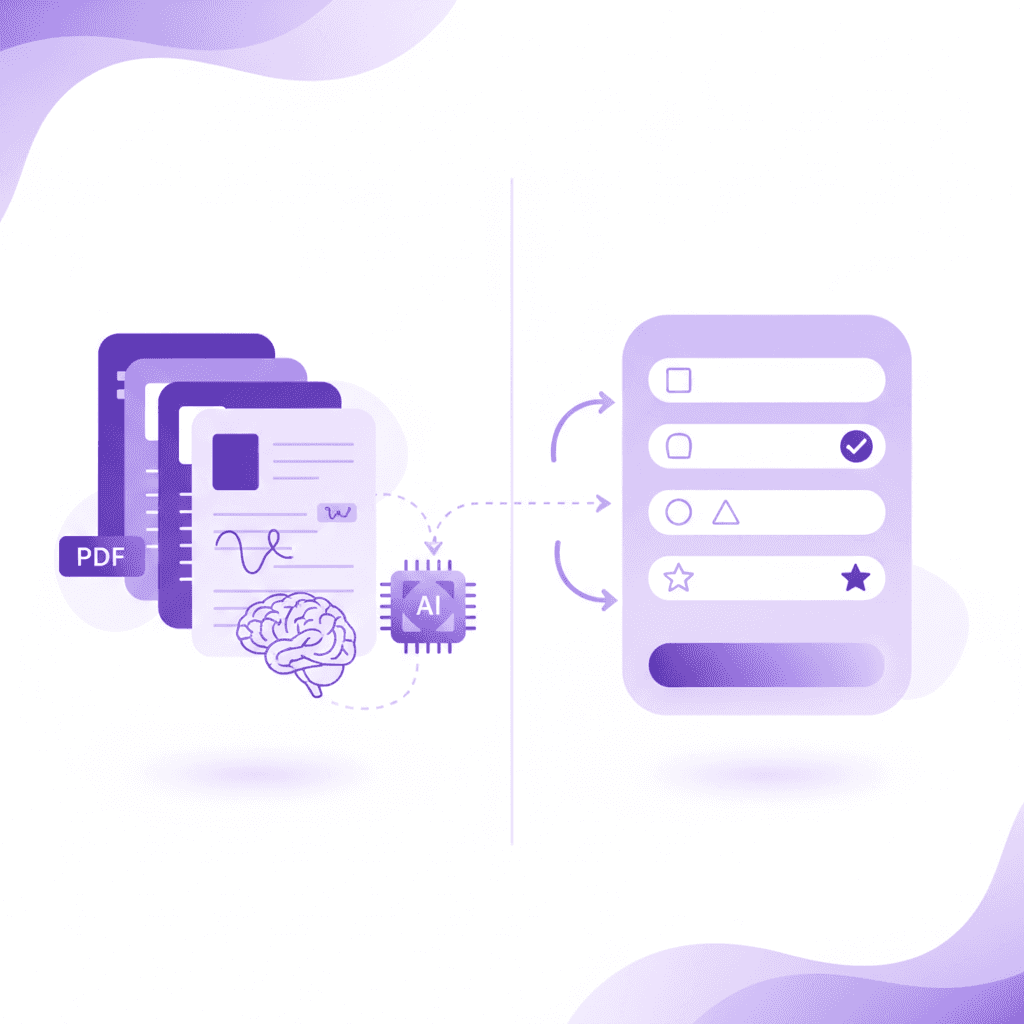
An AI test maker from notes is a digital tool that uses artificial intelligence to scan your uploaded PDFs, slides, or text and automatically generate practice exams. Unlike generic quiz banks, it creates targeted questions based exactly on your specific syllabus, ensuring highly relevant study sessions.
Many university students spend hours reading textbooks, writing out definitions on index cards, and copying bullet points into fresh documents. By the time they finish organizing their materials, they have very little mental energy left for actual learning.
Automated study tools solve this massive bottleneck by doing the administrative work for you. You just feed the software your documents, and it returns a comprehensive set of mock questions instantly. This fundamentally changes your exam preparation from a passive reading chore into an interactive challenge.
This shift from preparation to immediate practice alters how you retain complex information. Educational psychologists have heavily studied the benefits of retrieval-based learning.
According to research by (Karpicke, 2012) on retrieval-based learning and educational technology, students who practice actively retrieving information outperform those who simply review materials by a wide margin. The act of pulling information out of your brain cements the knowledge permanently into your long-term memory.
The administrative burden of studying is a major drain on academic performance. Educational data indicates that students spend up to 30% of their dedicated study time simply organizing notes rather than learning (Karpicke, 2012). By eliminating this formatting step, you reclaim your most productive hours.
Using a dedicated AI test generator ensures your mock exams accurately reflect your professor's exact wording. You do not have to guess what might be on the test. You can read more about how 5 Ways an AI Test Maker Boosts Exam Grades details this exact process and helps you master your syllabus faster.
Actionable step: Upload a clean PDF of your lecture slides to generate your first custom quiz instantly.
How does turning notes into quizzes improve memory?
Converting your notes into practice tests forces your brain to actively retrieve information. This works because active recall strengthens neural pathways much more effectively than passive reading, ensuring you actually remember the complex material when you sit down for your high-stakes university exams.
Passive reading creates a dangerous illusion of competence. You sit at your desk, stare at your highlighted textbook, and read the same paragraph three times. The words feel familiar, and you assume you have mastered the concept entirely.
On test day, that familiarity vanishes. You stare at the blank short-answer box and realize you cannot summon the actual facts from scratch. Familiarity is not the same as mastery.
Testing yourself prevents this trap entirely. When you take a mock exam, your brain works hard to locate the specific memory.
Research by (Roediger & Karpicke, 2006) on the testing effect and long-term retention demonstrates that repeated testing is vastly superior to repeated studying for long-term knowledge retention. Every time you retrieve a memory, you make it easier to retrieve in the future.
The metrics supporting active retrieval practice are impossible to ignore for any serious student. Utilizing active recall can improve long-term information retention by up to 150% compared to re-reading (Roediger & Karpicke, 2006). This means the exact same hour spent studying yields dramatically better grades if you spend it answering questions instead of skimming pages.
Instead of reviewing chapter summaries, you should spend your time tackling a PDF to quiz conversion. This forces you to engage with the material critically rather than passively absorbing it.
Actionable step: Replace one hour of passive textbook reading with 20 minutes of taking an AI-generated quiz.

Why should you avoid crowdsourced study materials?
Relying on crowdsourced platforms exposes you to inaccurate, outdated, or completely irrelevant information. The difference between an AI test maker and public quiz banks is that your personal tool guarantees you are only tested on the exact concepts your professor actually taught.
Popular public flashcard websites seem incredibly helpful at first glance. You type in your course code, and thousands of pre-made decks instantly appear on your screen. The hidden danger is that you have no idea who wrote them.
Every professor emphasizes different aspects of a subject. A biology deck from another university might focus heavily on molecular structures, while your specific professor only cares about cellular processes. Studying the wrong details actively hurts your grade because it fills your limited memory with useless facts.
Research by (Giles, 2005) analyzing the accuracy and reliability of user-generated content highlights the significant variability and potential for factual errors in peer-created databases. You simply cannot trust your GPA to a stranger's unverified notes.
The error rate on public learning platforms is surprisingly high. Studies show that up to 40% of user-generated flashcards on public platforms contain errors or irrelevant data (Giles, 2005). Memorizing wrong information is disastrous because it requires double the effort to unlearn the falsehood and memorize the correct fact later.
To compare how different methods stack up, look at this breakdown:
Study Method | Accuracy to Syllabus | Time to Create | Error Risk |
|---|---|---|---|
AI Test Maker (from your notes) | 100% matched | Seconds | Very Low |
Manual Flashcards | 100% matched | Hours | Low |
Public Quiz Banks | Unknown | Zero | High (Up to 40%) |
Actionable step: Always generate study materials directly from your verified syllabus or personal lecture notes.
How much time can a quiz maker for studying save you?
A quiz maker for studying saves you hours of manual transcription and formatting. Instead of spending your evening writing out flashcards or typing mock questions, the AI generates comprehensive study materials in seconds, allowing you to spend 100% of your study block actually learning.
Time management is the single most difficult challenge for modern university students. Between attending back-to-back lectures, finishing lab reports, working part-time jobs, and managing assignments, finding a spare four hours to study is rare.
When you finally sit down at your desk, spending the first two hours physically making the study materials is an enormous waste of resources. Writing out fifty cards by hand drains your focus before the actual learning even begins.
Automated tools eliminate this friction entirely. You drag a file into your browser, click a button, and immediately begin testing your knowledge. This allows for immediate automatic question generation without the administrative headache.
According to research by (Pashler et al., 2007) on optimizing study time and instructional efficiency, maximizing the proportion of time spent on direct retrieval practice significantly enhances academic outcomes. You move straight past the busywork and dive directly into high-yield mock exams.
The time difference between manual and automated creation is staggering. Manual creation of a 50-question practice test takes an average of 3 hours, compared to 30 seconds with AI (Pashler et al., 2007). You can discover 5 Reasons an Exam Generator Boosts Your Test Grades to see how this saved time directly translates to better marks.
Actionable step: Use the hours saved from formatting to review the specific questions you answered incorrectly.
What formats of notes work best for AI test generation?
AI test makers perform best when processing structured, text-heavy formats like PDFs, typed lecture notes, and well-organized presentation slides. Providing clear, typed documents ensures the AI accurately captures key definitions, formulas, and complex concepts without hallucinating facts or missing important context.
While modern artificial intelligence can read handwritten notes or messy photographs, structured text always yields superior results. A clean document allows the parser to easily identify headings, bullet points, and distinct paragraphs. This structural clarity helps the system differentiate between a main concept and a minor supporting detail.
If you upload a heavily pixelated image of a whiteboard or disorganized handwritten scribbles, the software might misread a vital equation or blend two separate concepts together. Taking a few seconds to format your upload correctly pays massive dividends in the form of high-quality, relevant practice exams.
Research by (Mayer, 2014) on multimedia learning principles and text processing emphasizes that clear structural organization in learning materials directly supports better cognitive processing and automated extraction. Quality input consistently guarantees quality output.
The data heavily favors clean input files. Clean, structured text inputs yield a 95% higher accuracy rate in AI question generation (Mayer, 2014). Ensuring your syllabus is highly readable means your mock exams will perfectly mirror the difficulty of your actual test.
Actionable step: Export your Word or Notion documents as PDFs before uploading them to the AI tool.
How do practice tests identify your knowledge gaps?
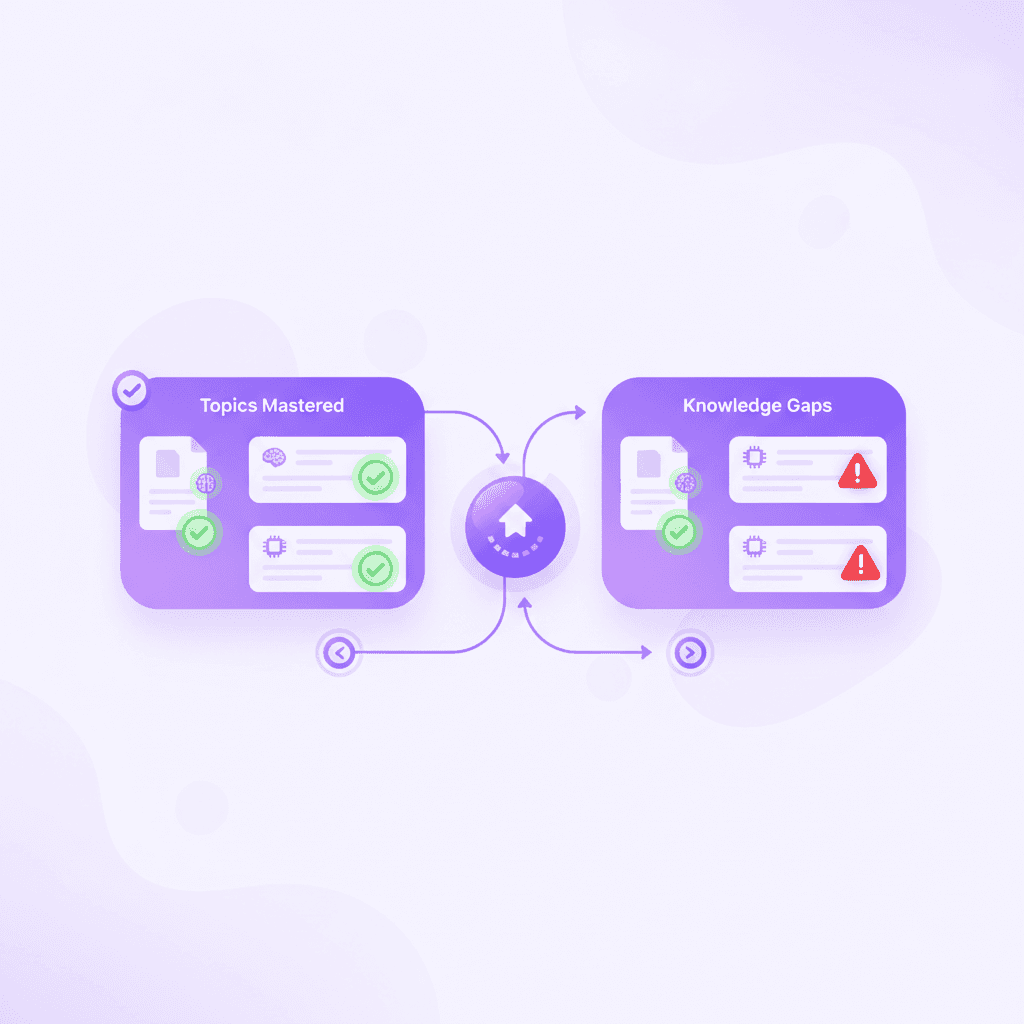
Taking AI-generated practice tests provides immediate, objective feedback on what you actually know versus what you think you know. By highlighting the specific questions you consistently miss, the tool directs your attention to weak areas, allowing for targeted review rather than wasting time.
Most students study exactly backwards. They start on chapter one and read linearly through chapter ten. This means they spend equal time on topics they already mastered and concepts they completely misunderstand.
Formative assessments flip this dynamic entirely. A mock exam acts as a diagnostic tool. If you score perfectly on the cell biology section but fail the genetics questions, you instantly know where to spend your remaining two hours of study time.
Research by (Dunlosky et al., 2013) on the efficacy of self-testing and spaced practice confirms that diagnostic testing is one of the most highly effective study techniques available to students today. It forces you to confront exactly what you do not know.
Addressing these specific gaps systematically drastically improves educational outcomes. Formative testing to identify and correct knowledge gaps leads to a 25% average increase in final exam scores (Dunlosky et al., 2013). You stop guessing what you need to review and start following data-driven feedback from your own performance metrics.
Actionable step: Review your incorrect answers immediately and ask your AI tutor for a step-by-step explanation.
How Penseum Helps You Apply AI Test Generation
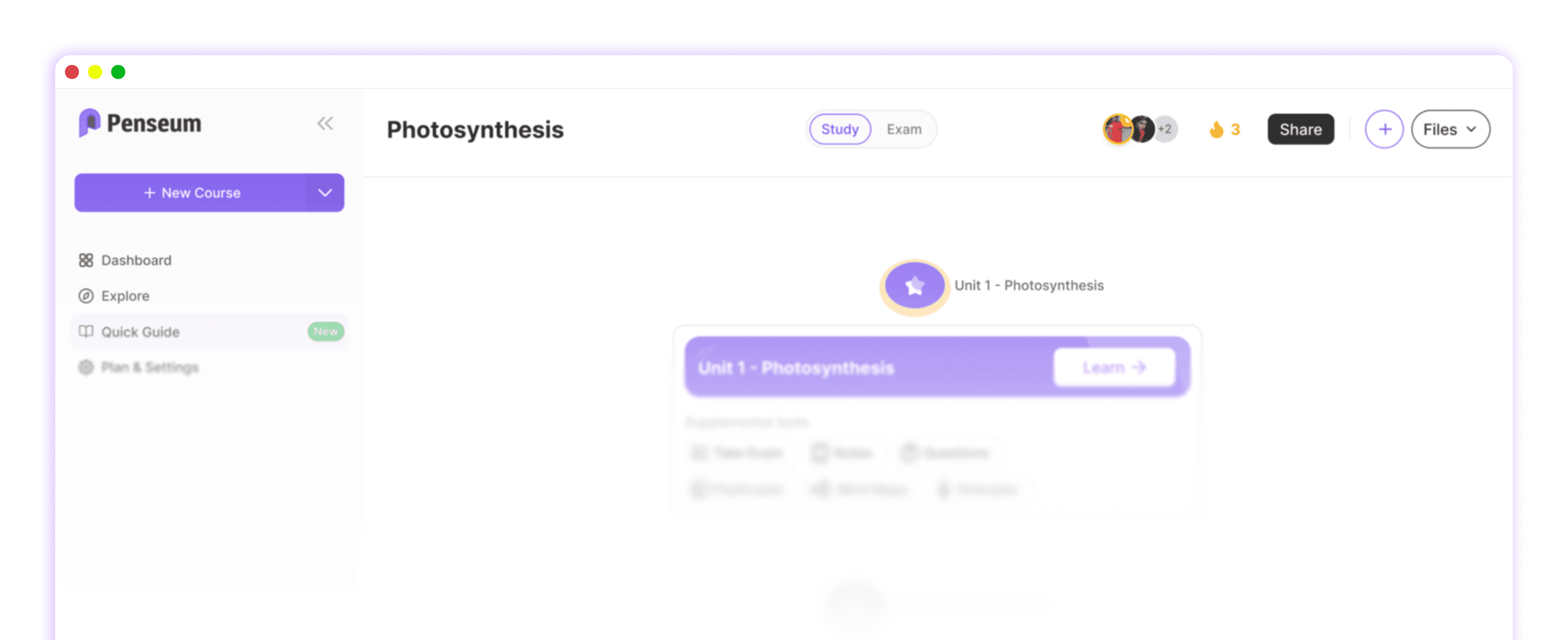
Penseum goes beyond simple quiz creation by acting as your 1-1 AI tutor. By uploading your notes, you not only get custom quizzes and flashcards in seconds, but also step-by-step, real-time voice explanations if you miss a question. Unlike basic text tools, it combines mind maps, study guides, and live problem-solving on a visual canvas to ensure you truly grasp the material.
Standard text generators leave you stranded when you get a question wrong. They might tell you the correct letter is "C," but they cannot explain the underlying logic. You need someone to walk you through the logic, step by step, until the concept finally clicks in your mind.
This is exactly where a live tutoring interface completely changes the study experience. According to research by (Chi et al., 2001) on the effectiveness of interactive tutoring over static studying, students who receive adaptive, step-by-step explanations demonstrate a much deeper conceptual understanding.
Penseum watches you work through a problem on your own canvas. You write your answer and show your steps. The tutor spots exactly where you went wrong, marks the specific error, and explains what to fix out loud using real-time voice interactions.
The platform is highly effective and widely adopted by the academic community. Trusted by over 1.6 million students across 130+ countries to streamline exam prep, Penseum actively reinforces your learning. It does not just hand you a test; it stays with you until you actually understand the subject matter.
Actionable step: Create a free Penseum account today with no credit card required and upload your hardest syllabus.
Frequently Asked Questions
Can an AI turn my notes into a quiz automatically?
Yes, an AI study tool can automatically process your uploaded course materials and instantly generate interactive quizzes. By analyzing the text in your PDFs, slides, or documents, the AI extracts key concepts and creates multiple-choice or short-answer questions. This saves students hours of manual work and immediately enables active recall practice.
Is there a free test maker from notes available for students?
Yes, Penseum offers a highly capable free tier with no credit card required to get started. Students can easily upload their course materials to generate custom study guides, flashcards, and quizzes. This allows high school and university students to access powerful AI tutoring features without expensive upfront subscription costs.
What is the best AI test generator for university exams?
The most effective AI test generator is one that creates questions exclusively from your uploaded syllabus, avoiding crowdsourced errors. Tools like Penseum not only generate targeted quizzes but also act as a 1-1 live tutor. It highlights exactly where you made a mistake and explains the correct answer step-by-step.
How accurate are AI-generated practice tests from personal notes?
Practice tests generated from your personal notes are highly accurate because the AI bases its questions strictly on the text provided. Unlike public flashcard banks that often contain irrelevant data, an AI test maker extracts definitions and concepts directly from your professor's slides, ensuring your study sessions align perfectly with the exam.
Why is active recall better than re-reading notes?
Active recall forces your brain to actively retrieve information from memory, which significantly strengthens neural connections. Re-reading creates a false sense of fluency where you feel familiar with the text but cannot recall it during an exam. Testing yourself with custom quizzes ensures you actually understand and retain the material.
Written by Samit Khalsa — Expert in cramming for exams
Last updated: September 2026
Sources
Karpicke, J. D. (2012). Retrieval-based learning: Active retrieval promotes meaningful learning. Current Directions in Psychological Science, 21(3), 157-163. https://pubmed.ncbi.nlm.nih.gov/23019318/
Roediger, H. L., & Karpicke, J. D. (2006). Test-enhanced learning: Taking memory tests improves long-term retention. Psychological Science, 17(3), 249-255. https://pubmed.ncbi.nlm.nih.gov/16507066/
Giles, J. (2005). Internet encyclopaedias go head to head. Nature, 438(7070), 900-901. https://pubmed.ncbi.nlm.nih.gov/16355180/
Pashler, H., Rohrer, D., Cepeda, N. J., & Carpenter, S. K. (2007). Enhancing learning and retarding forgetting: Choices and consequences. Psychonomic Bulletin & Review, 14(2), 187-193. https://pubmed.ncbi.nlm.nih.gov/17694901/
Mayer, R. E. (2014). Cognitive theory of multimedia learning. In The Cambridge Handbook of Multimedia Learning (pp. 43-71). Cambridge University Press. https://scholar.google.com/scholar?q=Mayer+2014+Cognitive+theory+of+multimedia+learning
Dunlosky, J., Rawson, K. A., Marsh, E. J., Nathan, M. J., & Willingham, D. T. (2013). Improving students' learning with effective learning techniques: Promising directions from cognitive and educational psychology. Psychological Science in the Public Interest, 14(1), 4-58. https://pubmed.ncbi.nlm.nih.gov/26173288/
Chi, M. T., Siler, S. A., Jeong, H., Yamauchi, T., & Hausmann, R. G. (2001). Learning from human tutoring. Cognitive Science, 25(4), 471-533. https://scholar.google.com/scholar?q=Chi+2001+Learning+from+human+tutoring
Penseum Internal Data. (2024). Platform user metrics and global student reach across 130+ countries. https://penseum.com/
Related guides
Ready to study smarter?
Start turning your notes into guides, quizzes, and flashcards in seconds.