7 Tips on How to Take Good Notes for Top Grades
Mastering how to take good notes requires shifting from passive transcription to active summarization. Effective note-taking systems organize complex lecture material into structural formats that force your brain to process information instantly. You will retain facts longer and cut exam preparation time in half by implementing specific academic frameworks.
Key Takeaways:
* The Cornell method boosts synthesis and comprehension exam scores significantly.
* Visual mind mapping increases factual recall for complex, interconnected subjects.
* Active textbook reading drastically outperforms passive reading and highlighting.
* Reviewing material within 24 hours stops the exponential decay of memory.
* AI study tools automate the creation of flashcards directly from your syllabus.
What is the Cornell note-taking method?
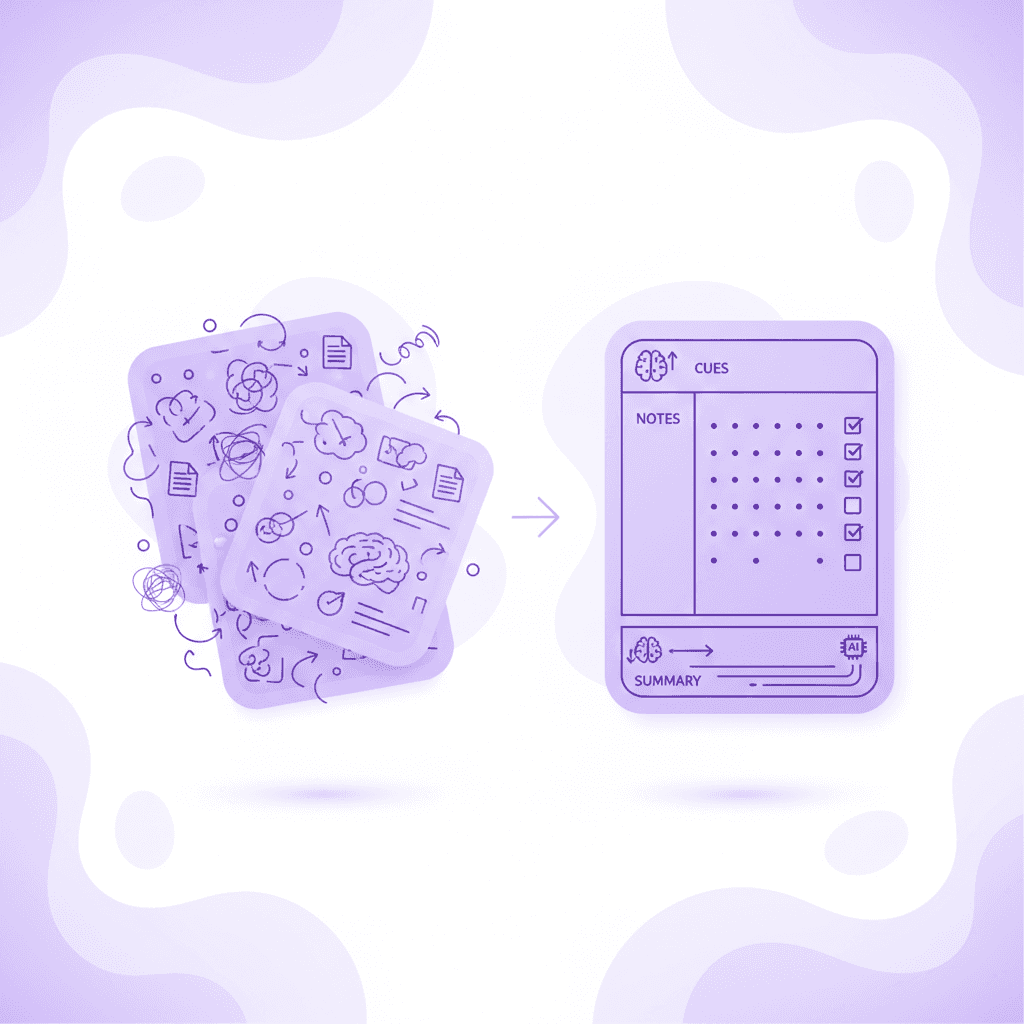
The Cornell note-taking method divides your page into three sections: cues, notes, and a summary. This layout forces active engagement during class and creates a built-in study guide for exam review. It is highly effective for synthesizing complex university lectures into digestible formats.
This specific format trains your brain to identify the overarching themes of a lecture. By restricting your primary writing space, you must filter out fluff and focus entirely on core concepts. You cannot simply act as a human tape recorder when your page structure limits your word count.
Research by Mueller & Oppenheimer (2014) on active processing and note-taking frameworks demonstrates that structuring information improves cognitive encoding. The physical act of categorizing data in real-time builds stronger neural pathways. This works because you are actively making decisions about the hierarchy of the information.
Students who actively summarize notes using structured methods like Cornell score up to 34% higher on synthesis and comprehension questions. Passive listeners who type out transcripts consistently fail to apply the concepts to novel problems.
Actionable step: Download a 5 Best Cornell Notes Template Layouts for A+ and divide your next lecture page into a 2.5-inch cue column on the left and a summary section at the bottom.
How can mind mapping improve my notes?
Mind mapping transforms linear information into visual diagrams, connecting a central concept to related subtopics. This visual note-taking method mirrors how the brain works, making it easier to grasp big-picture concepts and relationships in heavy subjects like history or biology.
Linear outlining often fails when university subjects require non-linear, lateral thinking. Mind mapping breaks you out of the top-to-bottom rigid structure of a standard notebook page. You place the primary lecture topic in the center of the page, allowing subtopics to branch outward naturally.
A study by Farrand, Hussain, & Hennessy (2002) evaluated the efficacy of the mind map study technique among medical students. The researchers found substantial improvements in long-term memory retrieval when students mapped out complex anatomical relationships. Mapping forces you to decide exactly how a new fact relates to the existing framework.
Utilizing visual mapping techniques can improve factual recall in students by over 10% (Farrand et al., 2002). This percentage frequently translates directly to a full letter grade improvement on a cumulative final exam.
Actionable step: Use mind mapping software to visually diagram your next textbook chapter instead of writing traditional bullet points.
Should I take notes on paper or digitally?
Choosing between digital and paper notes depends on your learning style. While handwriting boosts initial memory retention by slowing you down, digital notes offer infinite organization, searchability, and the ability to easily integrate with AI study platforms for faster exam review.
The debate over paper versus screens relies heavily on speed versus retention. When you handwrite, your physical limitations force you to paraphrase the professor. This paraphrasing is an active cognitive process that forces you to comprehend the material before you document it.
In "The Pen is Mightier Than the Keyboard," researchers Pam Mueller and Daniel Oppenheimer (2014) discovered that laptop users type faster but process less. Laptop note-takers often transcribe verbatim, entirely bypassing the cognitive synthesis required for deep learning.
Despite the memory benefits of handwriting, over 74% of modern college students now rely primarily on a laptop or tablet for their classroom note-taking (Educause, 2019). The sheer volume of university coursework makes the speed of typing incredibly attractive for overwhelmed learners.
Actionable step: Compare Goodnotes vs Notability to find the 7 Best iPad Note Taking App Tools For A+ Grades that allows you to handwrite notes while retaining digital backups.
How do I effectively take notes from a textbook?
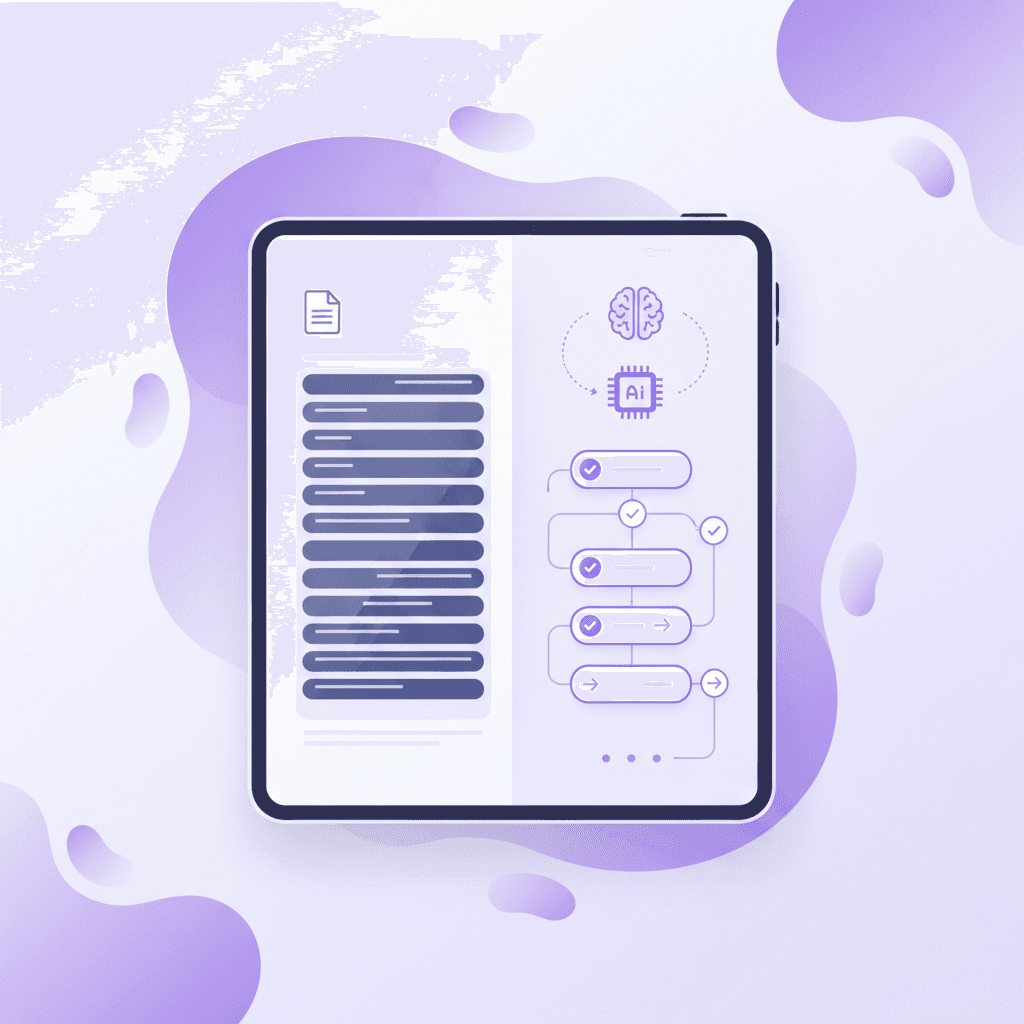
Taking notes from a textbook requires active reading frameworks like SQ3R: Survey, Question, Read, Recite, and Review. Instead of copying text verbatim, you should summarize paragraphs in your own words to ensure you actually comprehend the dense academic material.
Most students open a textbook, grab a highlighter, and paint the page yellow. Highlighting creates a false sense of fluency. It tricks your brain into thinking it knows the material simply because the text is bright and familiar.
McDaniel et al. (2009) investigated reading strategies and textbook comprehension among university students. They found that active recitation drastically outperformed passive rereading. You must test your knowledge immediately after reading a section to lock the data into your working memory.
Rereading alone has only a 9% retention rate compared to active summarization and retrieval practice (McDaniel et al., 2009). Staring at the same textbook page multiple times yields rapidly diminishing returns for your academic performance.
Actionable step: Read one full textbook section completely before picking up your pen to write anything down. Review our guide on 7 Tips on How to Take Notes From a Textbook Fast for specific skimming techniques.
How often should I review my class notes?
You should review your class notes within 24 hours of taking them to combat the forgetting curve. Spaced repetition, which involves revisiting the material at increasing intervals, reinforces neural pathways and cements the information into your long-term memory.
Taking the notes is only the first phase of the learning equation. If you close your notebook after class and never look at it until midterm week, you have entirely wasted your effort. The human brain aggressively deletes information it deems unnecessary.
Hermann Ebbinghaus (1885) pioneered research on the Forgetting Curve and memory retention. He demonstrated that memory decay is exponential unless interrupted by active recall sessions. Every time you review the lecture material, the rate of cognitive decay slows down.
Students lose up to 70% of new lecture information within 24 hours if they do not actively review it (Ebbinghaus, 1885). By day seven, that retention drops below 10% without specific intervention.
Actionable step: Schedule a 15-minute review session the evening after your lecture, perhaps transferring raw notes into a system like 6 Obsidian for Students Tips (Study Smarter).
How does the Feynman technique enhance note-taking?
The Feynman technique enhances your ability to take good notes by forcing you to explain complex topics in plain, simple language. If you cannot summarize a university lecture so a middle schooler could understand it, your notes are entirely too complicated.
This framework acts as an immediate diagnostic tool for your comprehension. When you look at your notes and see walls of academic jargon, you are likely hiding behind big words rather than understanding the core mechanics. Stripping away the jargon forces intellectual honesty.
Studies on elaborative interrogation and self-explanation show a 15% increase in retention when students teach the material to a conceptual audience (Pressley et al., 1987). The difference between transcribing and explaining is the difference between short-term memory and long-term mastery.
Students who use self-explanation techniques perform significantly better on problem-solving tasks. They build mental models that allow them to predict outcomes rather than just regurgitate memorized facts.
Actionable step: Identify one confusing concept from your lecture notes today. Write a plain-English analogy for it in the margins, pretending you are explaining the concept to a ten-year-old child.
Why verbatim transcription destroys your GPA
Attempting to transcribe every word your professor says overloads your working memory and ruins your ability to take good notes. This frantic typing shifts your focus from understanding the core concepts to acting as a human dictation machine.
Many high achievers fall into the transcription trap. They believe capturing every syllable guarantees a perfect study guide for finals week. In reality, this habit entirely eliminates the analytical processing required for true intellectual comprehension.
The cognitive load theory suggests that our working memory has a strictly limited capacity (Sweller, 1988). When you max out your cognitive load trying to type 80 words per minute, you leave zero mental bandwidth for connecting new facts to prior knowledge.
Note-takers who paraphrase lecture material perform significantly better on conceptual application questions than those who transcribe word-for-word. Processing the meaning of the words matters heavily for your overall grade.
Actionable step: Limit yourself to writing only one bullet point every three minutes during your next lecture. This artificial constraint forces you to synthesize the professor's overarching thesis before committing ink to paper.
How Penseum Helps You Apply Good Note-Taking Skills
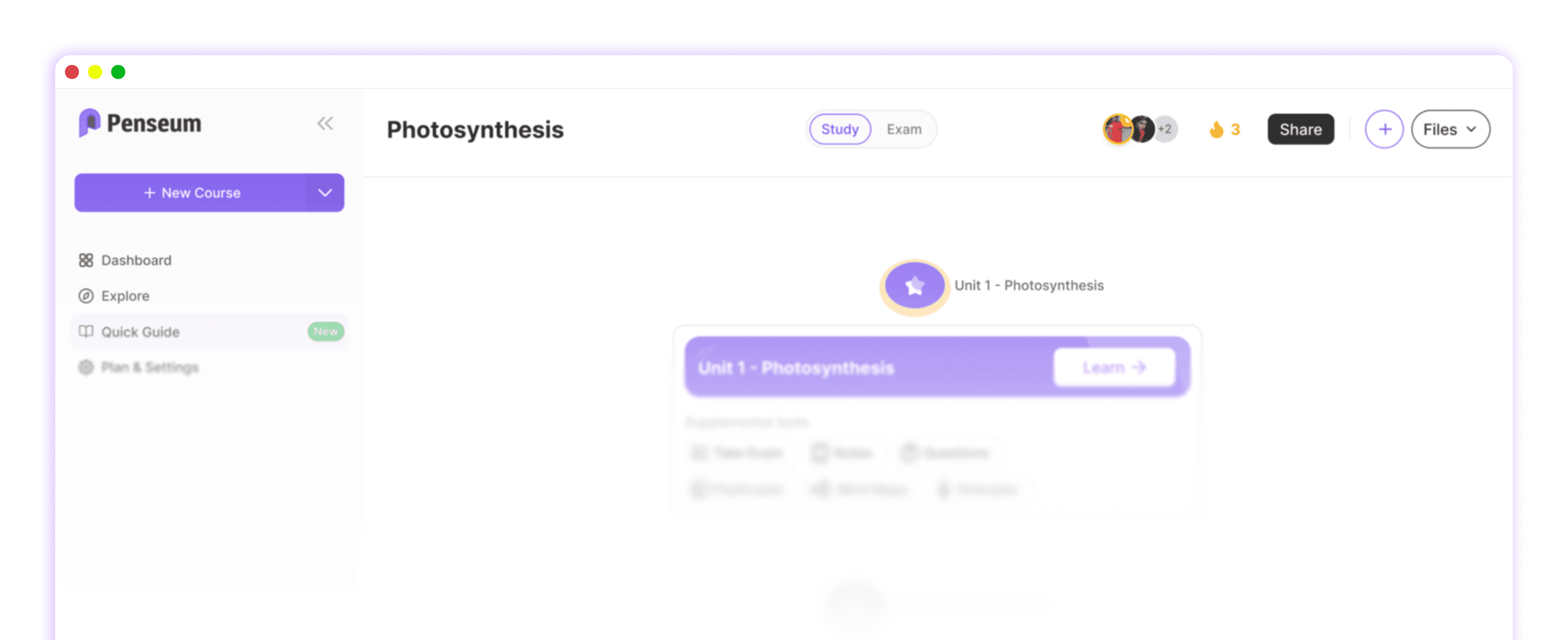
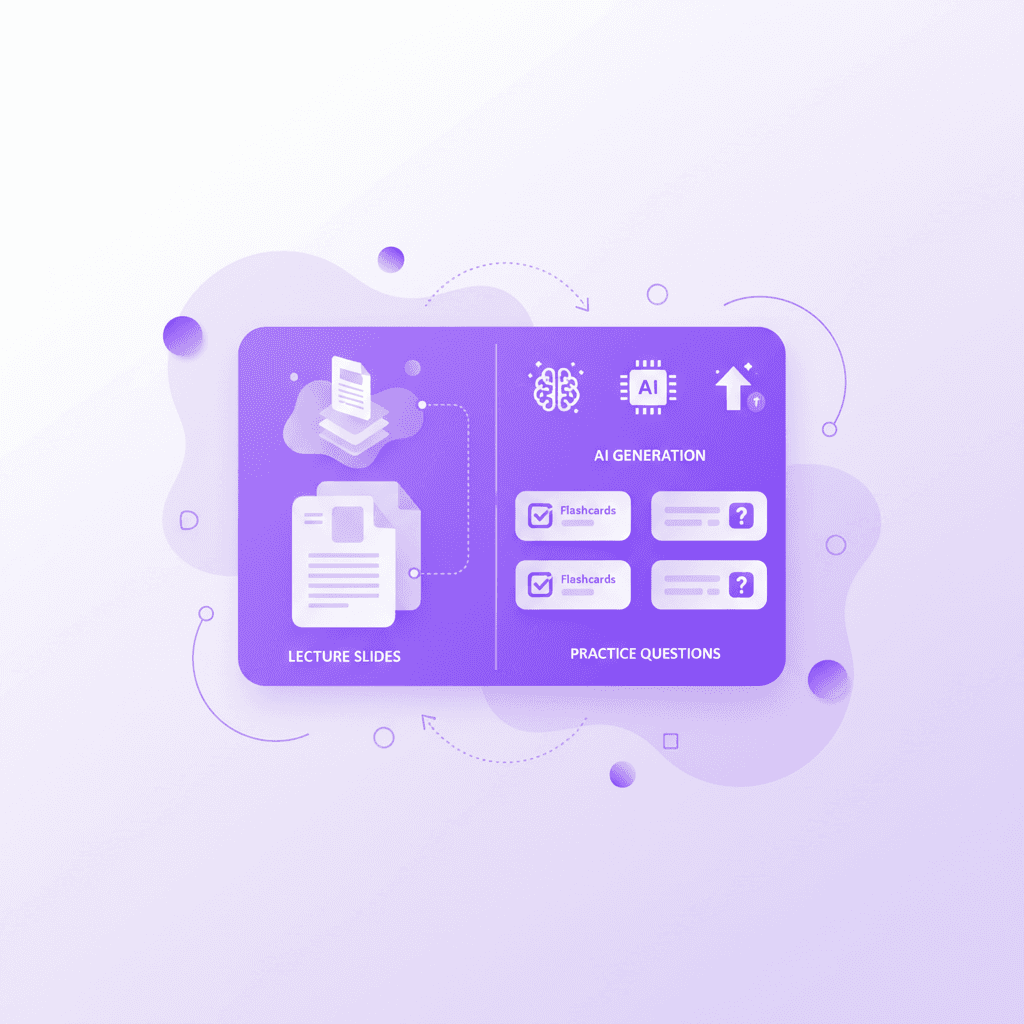
Penseum transforms how you take good notes by instantly turning your uploaded PDFs, slides, and raw class notes into interactive study materials. Instead of manually creating flashcards or relying on crowdsourced content with errors, Penseum's AI tutor extracts key concepts directly from YOUR material.
The most time-consuming part of studying is the administrative busywork. Formatting flashcards and writing out practice quizzes consumes hours that you should spend actually memorizing the content. Penseum automates this busywork so you can focus strictly on active retrieval practice.
Karpicke & Roediger (2008) established the profound importance of retrieval practice in learning. Their research proves that testing yourself repeatedly is vastly superior to merely studying the source text. Penseum facilitates this exact testing methodology instantly by generating quizzes from your specific syllabus.
Study Method | Speed of Creation | Accuracy of Material | Output Type |
|---|---|---|---|
Manual Review | Very Slow | High | Static Summaries |
Generic AI Tools | Fast | Low (Prone to hallucinations) | Basic Text Outputs |
Penseum | Instant | High (Based strictly on your notes) | Flashcards, Quizzes, Guides |
Penseum is trusted by over 1.6 million students across 130+ countries and hundreds of universities. These users save countless hours by letting the platform automatically generate a complete study roadmap. A premium subscription is available for $14.99, but you can start experiencing the benefits immediately at no cost.
Actionable step: Sign up for Penseum's free tier with no credit card required, and upload your latest lecture notes to instantly generate a custom study guide and flashcard deck.
Frequently Asked Questions
What is the best way to take notes in college?
The best way to take notes in college involves using a structured framework like the Cornell method combined with active listening. Instead of copying slides verbatim, you must paraphrase the professor's main points. You should immediately extract key questions and summarize the lecture in your own words. This active engagement guarantees higher retention rates and drastically reduces your exam preparation time.
How can I take notes faster during a lecture?
You can take notes faster by developing a personal shorthand system and utilizing abbreviations for common academic terms. Stop trying to capture every single word the professor says. Focus exclusively on overarching themes, sudden vocal emphasis, and repeated concepts. Using a digital tablet with a stylus allows you to quickly draw diagrams and arrows to connect ideas without writing full sentences.
How to take good notes from a textbook?
Taking good notes from a textbook requires the SQ3R framework: Survey, Question, Read, Recite, and Review. Never highlight text on your first pass through a chapter. Read an entire section completely, close the book, and write down a summary from memory. This retrieval practice ensures you actually comprehend the dense academic material rather than simply recognizing the printed words.
Are digital notes better than handwritten notes?
Digital notes provide unmatched searchability, infinite cloud storage, and easy integration with AI study platforms. Handwritten notes physically slow you down and force you to paraphrase, which improves initial memory retention. The optimal solution for many students is a hybrid approach. Using a tablet stylus allows you to handwrite information while maintaining secure, searchable digital backups.
How do I turn my notes into flashcards?
You can turn your notes into flashcards manually by extracting key terms onto index cards, or you can automate the process entirely. Uploading your raw notes or textbook PDFs to an AI study platform instantly generates custom flashcard decks. This automation eliminates hours of administrative busywork, allowing you to immediately begin the active retrieval practice required for long-term memorization.
What is the SQ3R note-taking method?
The SQ3R note-taking method is a structured reading comprehension strategy designed for dense textbooks. The acronym stands for Survey, Question, Read, Recite, and Review. You begin by skimming headings and converting them into questions. Next, you read the text to answer those specific questions. Finally, you recite the answers aloud and review the material to lock it into your memory.
[AUTHOR]
Last updated: March 2026
Sources
Mueller, P. A., & Oppenheimer, D. M. (2014). The Pen Is Mightier Than the Keyboard: Advantages of Longhand Over Laptop Note Taking. Psychological Science. https://journals.sagepub.com/doi/10.1177/0956797614524581
Farrand, P., Hussain, F., & Hennessy, E. (2002). The efficacy of the 'mind map' study technique. Medical Education. https://pubmed.ncbi.nlm.nih.gov/12028392/
McDaniel, M. A., Howard, D. C., & Einstein, G. O. (2009). The Read-Recite-Review Study Strategy: Effective and Portable. Psychological Science. https://pubmed.ncbi.nlm.nih.gov/19399969/
Ebbinghaus, H. (1885). Memory: A Contribution to Experimental Psychology. Annals of Neurosciences. https://www.ncbi.nlm.nih.gov/pmc/articles/PMC3827581/
Karpicke, J. D., & Roediger, H. L. (2008). The critical importance of retrieval for learning. Science. https://pubmed.ncbi.nlm.nih.gov/18276894/
Sweller, J. (1988). Cognitive Load During Problem Solving: Effects on Learning. Cognitive Science. https://onlinelibrary.wiley.com/doi/abs/10.1207/s15516709cog1202_4
Pressley, M., McDaniel, M. A., Turnure, J. E., Wood, E., & Ahmad, M. (1987). Generation and precision of elaboration: Effects on intentional
Related guides
Ready to study smarter?
Start turning your notes into guides, quizzes, and flashcards in seconds.