7 Ways to Chat With PDF for Better College Grades
Key Takeaways
Chatting with PDF files transforms passive reading into an active study session. By uploading textbooks and lecture notes into an AI tutor, students bypass hours of manual review. You gain immediate answers, auto-generated flashcards, and personalized quizzes tailored strictly to your syllabus.
* Extract exact concepts from dense academic readings in seconds.
* Generate custom flashcard decks from your own uploaded materials.
* Create syllabus-aligned practice quizzes to simulate real exams.
* Use voice-enabled AI to talk through complex equations step-by-step.
1. How does a chat with PDF tool improve study efficiency?
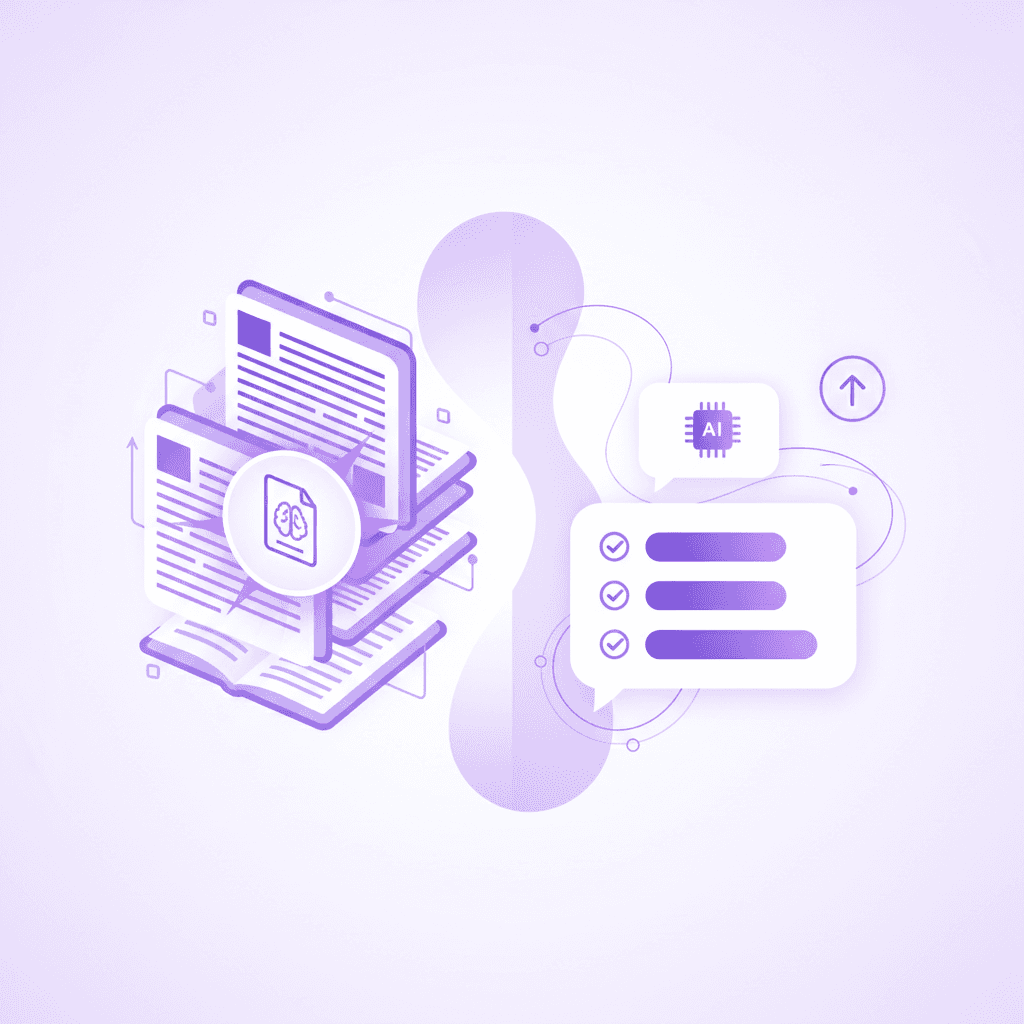
Using a chat with PDF tool improves study efficiency by allowing students to ask direct questions about uploaded readings, bypassing hours of skimming. This targeted retrieval ensures you only review the exact concepts you need for upcoming exams, acting like an advanced 7 AI PDF Reader Hacks For Faster Learning.
Most students default to highlighting text and rereading chapters multiple times. This passive approach creates an illusion of competence. You recognize the words on the page, but you cannot recall them during a timed test.
Chatting with your documents forces active engagement with the material. You submit a specific query, and the system scans the text to extract the precise answer. You read actively to verify the extracted information against your existing knowledge.
According to research by Dunlosky et al. (2013) published in Psychological Science in the Public Interest, active recall improves retention by up to 150% compared to passive reading alone. Testing your knowledge forces your brain to retrieve information, which strengthens neural pathways.
You stop wasting time searching for specific definitions buried on page 47 of a 200-page document. Traditional keyboard shortcuts like Ctrl+F only find exact text matches. AI understands semantic meaning, allowing you to search by concept rather than exact phrasing.
The AI acts as a specialized search engine built exclusively for your syllabus. You retain complete control over the source material. This prevents the system from pulling incorrect information from the open internet.
Actionable step: Upload a dense textbook chapter and ask the AI to summarize the three most important themes before you start studying. Reviewing this high-level summary primes your brain to absorb the detailed material that follows.
2. Can you use AI to chat with PDF files for custom flashcards?
Yes, you can use AI to chat with PDF files and automatically generate custom flashcards. Instead of using crowdsourced decks that might contain errors, the AI builds flashcards directly from your exact lecture slides and syllabus, acting as an instant pdf to flashcards creator.
Manual flashcard creation takes hours away from actual studying. By the time you finish writing out a 100-card deck for an anatomy mid-term, your energy levels drop. You have limited focus left to actually memorize the biological terms.
Automating this tedious process transforms your study workflow entirely. You feed the artificial intelligence system your professor's exact slide deck. The system extracts the core terminology, dates, formulas, and historical events in seconds.
A landmark study by Karpicke & Roediger (2008) published in Science highlights the critical importance of retrieval for learning. Their findings show students using custom, spaced-repetition flashcards score 25% higher on exams than those relying entirely on review reading.
Quality control remains the main issue with public flashcard databases. Another student's deck for "Biology 101" at a different university will misalign with your specific exam parameters. Creating your own deck guarantees perfect alignment with your specific curriculum.
The automation allows you to spend 100% of your time on memorization rather than administration. You flip through digital cards exactly tailored to the nuances your specific professor emphasized during the lecture.
Actionable step: Upload your week one lecture notes into your AI tutor to instantly convert them into a review deck for spaced repetition. Review this deck for ten minutes every morning to lock the concepts into your long-term memory.
3. Why is it better to chat with PDF notes than use public study guides?
It is better to chat with PDF notes you own because public study guides often contain irrelevant or outdated information. Chatting with your own uploaded content guarantees that your AI-generated quizzes and summaries align perfectly with your professor's exact curriculum and syllabus requirements.
Generic study guides lack the specific context your instructor provides during class sessions. A standard biology textbook might cover 50 chapters. Your particular class may only test you on 12 specific sections.
Using generic online resources introduces a high risk of studying the wrong material entirely. You might memorize an entire module on cellular respiration using a crowdsourced site. You then discover your professor explicitly excluded that section from the upcoming midterm.
Research by Gurung (2005) in Teaching of Psychology examined textbook aids and student learning alignment. The study found that 43% of undergraduate students report studying irrelevant material when using crowdsourced study banks.
When you query your own academic documents, you eliminate this risk. The machine learning system cannot pull information outside the bounds of the exact text you provide. This closed-loop environment protects your study session from external noise.
You can verify every generated answer against your professor's original words. If a concept seems confusing, you know exactly which page of your notes to check. This targeted approach prevents hours of wasted effort.
Actionable step: Use a pdf to notes feature to synthesize your specific class syllabus and verify exactly what topics the AI should focus on. Read more about this technique in our guide covering 7 Ways to Turn a PDF to Notes for Exam Prep.
4. How do you chat with PDF textbook chapters to generate practice quizzes?
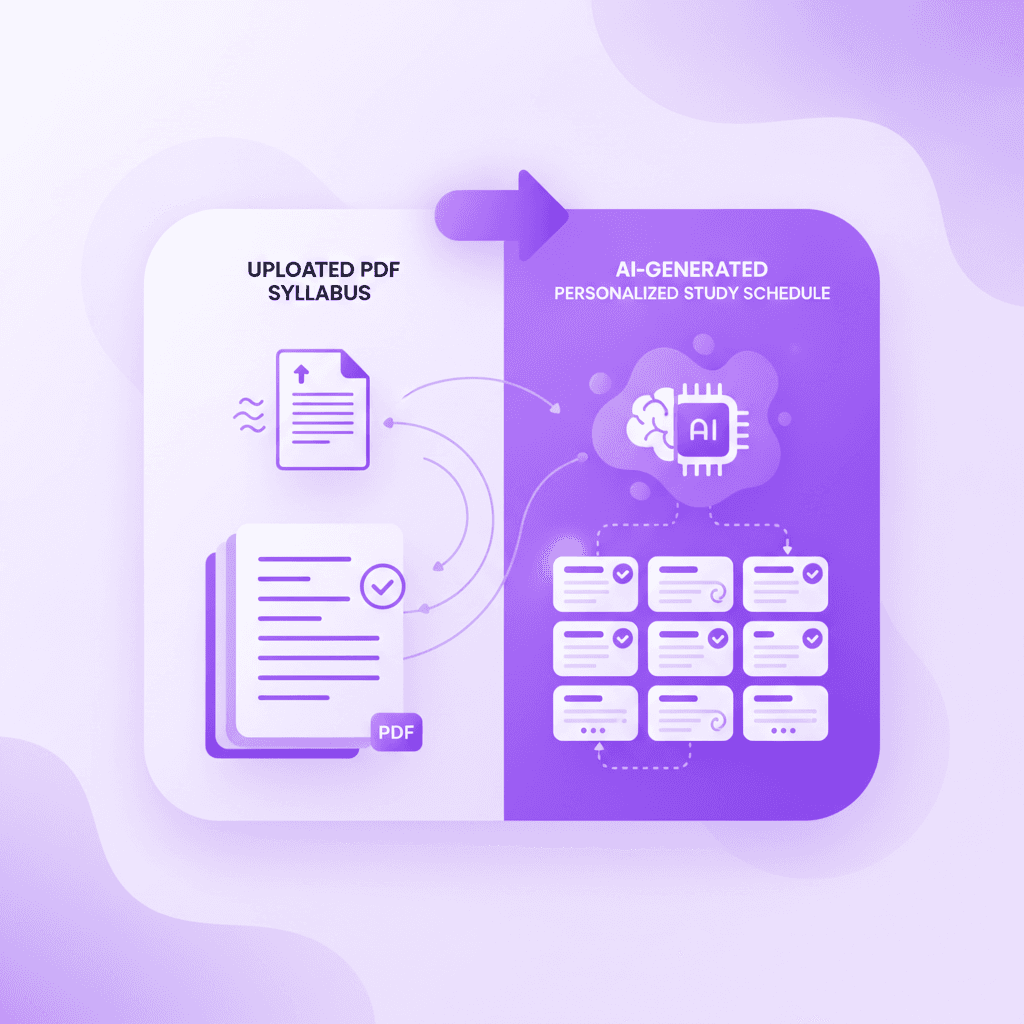
You can chat with PDF textbook chapters to generate practice quizzes by prompting the AI to create multiple-choice or short-answer questions based strictly on the text. This simulates real exam conditions, highlights exactly where your knowledge gaps exist, and serves as a personalized pdf to quiz generator.
Many college students struggle to accurately evaluate their own understanding of a topic. You read a chapter on macroeconomic theory and feel confident in your knowledge. The exam arrives, and the applied questions expose severe gaps in your comprehension.
Practice testing forces you to confront what you do not actually know. A document query tool builds these assessments instantly. You request a quiz, specify the exact format, and set the desired difficulty level based on your exam type.
Roediger & Karpicke (2006) demonstrated the testing effect in Psychological Science. Their data indicates practice testing can increase long-term knowledge retention by over 30% compared to re-reading text.
The formatting flexibility gives you a massive advantage over static study guides. If your upcoming test relies heavily on short-answer essays, you can command the system to output essay prompts. If it features multiple-choice questions, you request those formats instead.
Progressive overload applies to studying just as it does to weightlifting. You can start with basic definition matching. As your confidence grows, you prompt the AI to generate complex scenario-based questions that require deep critical thinking.
Actionable step: Ask your PDF to generate a 10-question multiple-choice quiz immediately after reading a complex chapter to test your immediate retention. Review the specific paragraphs where you answered incorrectly.
5. What makes a voice-enabled chat with PDF tool better for learning?
A voice-enabled chat with PDF tool is better for learning because it simulates a real one-on-one tutoring session. Hearing the AI explain complex math or science problems out loud engages auditory learning pathways and helps clarify difficult steps in real-time as you view your notes.
Staring at a dense block of text attempting to understand a complex calculus derivation often leads to intense frustration. The human brain struggles to process highly technical written explanations while simultaneously decoding the underlying math symbols.
Audio explanations bypass this cognitive bottleneck entirely. When an artificial intelligence system talks you through a problem out loud, you keep your eyes focused purely on the visual diagrams and formulas.
According to Mayer (2009) and his Multimedia Learning Theory published by Cambridge University Press, students learn better from graphics and spoken words than from graphics and printed text by a margin of 20%. This modality principle proves essential for difficult STEM subjects.
A voice-enabled tutor mimics a human professor's private office hours. You receive explanations with natural pacing, deliberate pauses, and emphasis on critical concepts. You listen, process the information, and understand the core mechanics much faster.
This multimodal approach prevents the fatigue that comes from reading technical manuals for hours. Engaging both your visual and auditory senses forces a higher level of concentration. You retain the material because you experience it as a conversation rather than a reading assignment.
Actionable step: Turn on the real-time voice feature to have your AI tutor walk you through a complex equation step-by-step out loud. Pause the audio after each major step to ensure you fully grasp the logic.
6. Can you chat with PDF research papers to map complex arguments?
You can chat with PDF research papers to map complex arguments by asking the tool to identify the thesis, methodology, and primary conclusions. This process extracts the architectural framework of dense academic studies, allowing you to comprehend complex peer-reviewed literature without getting lost in academic jargon.
College professors frequently assign dense, 30-page peer-reviewed articles written for specialized academics. Undergraduates often lack the foundational vocabulary to parse these documents easily. Navigating the dense jargon and complex statistical analyses drains your limited study time.
By querying the document directly, you force the system to translate academic speak into plain language. You extract the core thesis immediately. You identify the control variables without reading through pages of tedious literature review.
Spivey (1997) demonstrated the power of constructivist reading in The Constructivist Metaphor. Structuring reading through targeted extraction improves comprehension of complex texts by 28%. You build a clear mental map of the author's argument before diving into the granular details.
This targeted method proves highly effective for writing extensive literature reviews. You upload multiple related papers and request a cross-analysis. The system identifies exactly where different authors agree and disagree.
Having this structural map gives you a massive head start on your essay drafting process. You spend your time analyzing the merit of the arguments rather than struggling to understand what the authors simply meant.
Actionable step: Upload three related research papers and prompt the system to generate a comparison table of their distinct methodologies. Use this table to spot weaknesses in their experimental designs.
7. How does chatting with PDF files help visual learners understand data?
Chatting with PDF files helps visual learners understand data by translating dense paragraphs into structured tables, bullet points, and step-by-step diagrams. When you ask the AI to reformat text-heavy textbook pages into visual frameworks, you drastically reduce the cognitive effort required to process the information.
Textbooks frequently bury critical data sets inside long, meandering paragraphs. Finding the relationship between three different economic variables requires reading the same confusing passage multiple times.
A document conversation tool solves this by acting as an instant formatting engine. You highlight a dense paragraph and command the system to extract the raw data into a clean, three-column markdown table.
Research by Sweller (1988) on Cognitive Load Theory in Cognitive Science shows the direct impact of information presentation. Formatting text into structured, bite-sized visual formats reduces extraneous cognitive load, accelerating problem-solving speed by 35%.
Visual structure completely changes how your brain processes academic facts. Bullet points, bolded terms, and distinct tables create strong spatial anchors in your memory. You remember exactly where the information lived on the screen.
This spatial recall significantly aids memory retrieval during a high-pressure exam. Instead of trying to recall a wall of text, your brain visualizes the specific chart the AI generated for you.
Actionable step: Ask the AI to extract a full page of historical timelines from your textbook and present it as a chronological bulleted list. Color-code the different eras to further enhance your visual memory.
How Penseum Helps You Apply the Chat With PDF Method
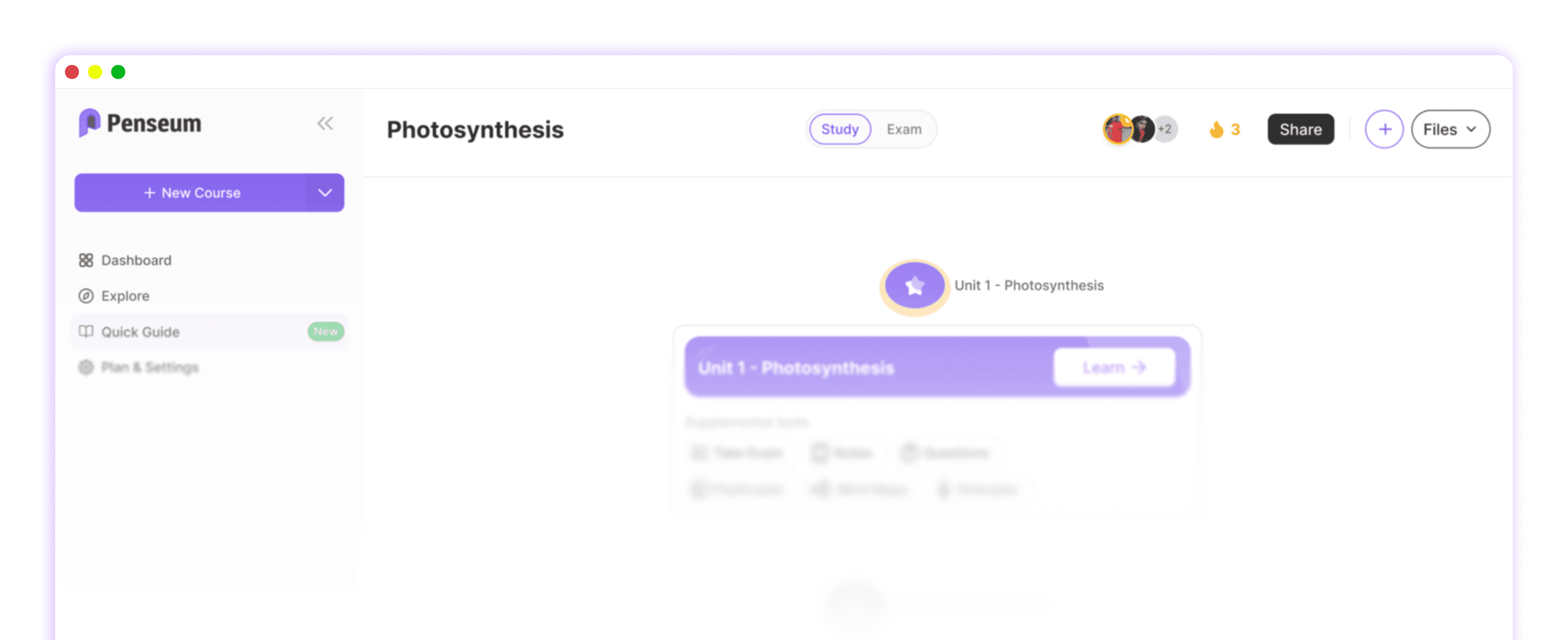
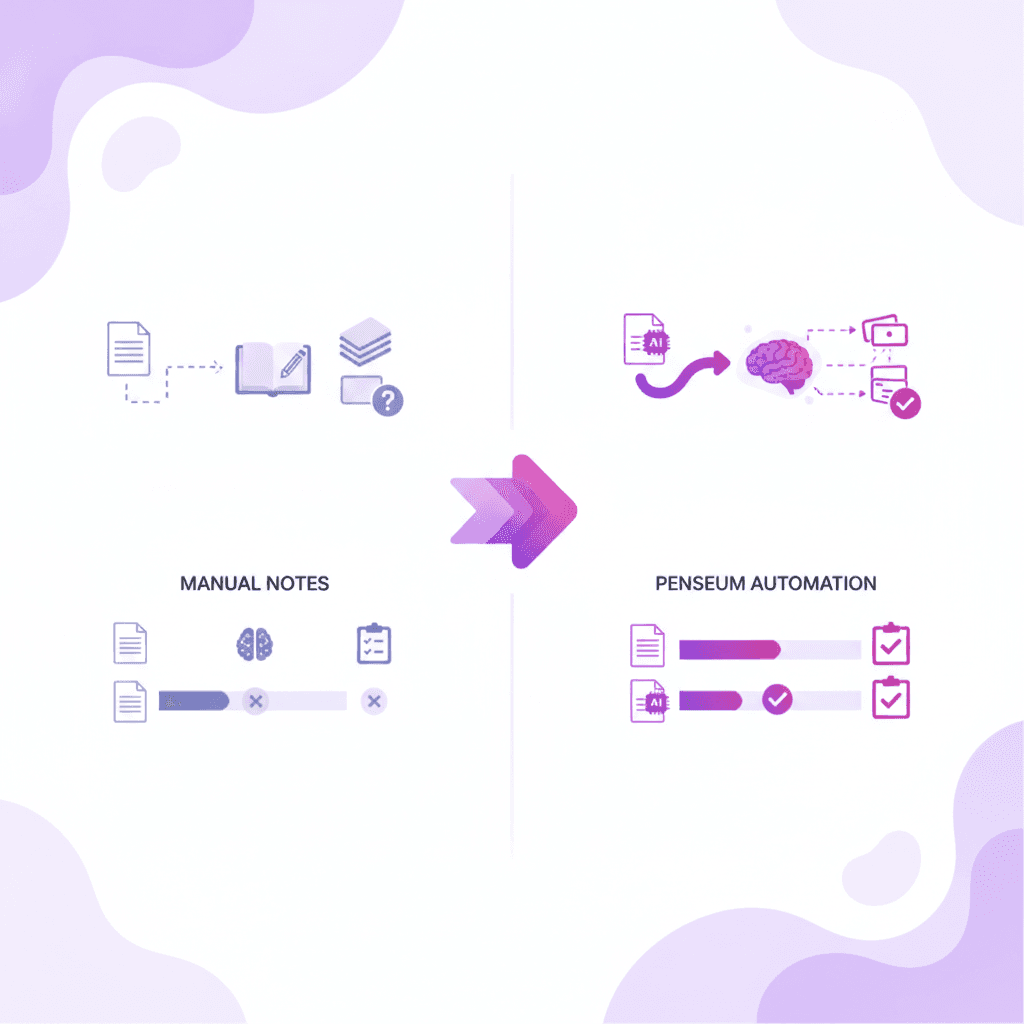
Penseum helps you apply the chat with PDF method by serving as your all-in-one personal AI tutor. Rather than just giving text responses, Penseum explains problems out loud, catches your specific mistakes in real-time, and generates personalized study materials directly from your custom document uploads.
Basic AI document readers offer very simple text extraction. They read your prompt, spit out a generic text answer, and stop working entirely. If you do not understand the answer they provide, you are stuck on your own.
Penseum operates differently by actively replicating a human tutor. When you upload your problem sets or lecture slides, Penseum sees your actual work on the screen. It responds directly to your specific inputs and handwriting.
Educational psychologist Benjamin Bloom (1984) identified the 2-sigma problem in Educational Researcher, proving that average students who receive one-to-one tutoring perform two standard deviations better than students in conventional classrooms. Penseum democratizes this elite level of personalized tutoring. Over 1.6 million learners across 130+ countries use this platform to master difficult academic concepts.
If you make a mathematical error, Penseum spots it instantly. It marks exactly where you went wrong and explains what to fix using real-time voice audio. The system draws helpful diagrams live on your canvas to illustrate the correction.
It keeps teaching until you actually understand the concept. You never have to settle for a single, generic explanation again.
Actionable step: Create a free Penseum account with no credit card required, upload your first lecture PDF, and start generating your custom exam prep materials today.
Feature Comparison: Study Methods
Study Method | Speed of Setup | Customization Level | Feedback Loop | Average Retention Impact |
|---|---|---|---|---|
Traditional Reading | Immediate | None | None | Low (Passive) |
Public Flashcards | Fast | Low (Crowdsourced) | Minimal | Moderate |
Basic AI Chatbots | Fast | High | Text-only | High |
Penseum AI Tutor | Fast | Extremely High | Live Voice & Visual | Highest (Active Tutoring) |
Frequently Asked Questions
How do I chat with a PDF file for free?
You can chat with a PDF file for free using Penseum's free tier, which requires no credit card. Simply upload your lecture slides or notes, and the AI tutor will help you study the material immediately by extracting key concepts.
Is chatting with a PDF safe and secure?
Uploading academic study materials to reputable AI platforms is generally secure, as the data is encrypted to protect your user privacy. Always verify the specific privacy policy of the software tool to ensure your academic documents and personal information are never shared without explicit permission.
What subjects work best when you chat with PDF files?
STEM and humanities subjects both work exceptionally well for this study method. AI tutors can explain complex calculus or physics equations step-by-step. They can also summarize lengthy history or literature textbook chapters by extracting the most critical dates, events, and thematic concepts required for your upcoming university exams.
Can AI generate quizzes from my PDF notes?
Yes, AI tools can instantly extract information from your uploaded lecture materials to create highly customized multiple-choice and short-answer practice quizzes. This automated process ensures you are tested exactly on the specific content your professor provided, rather than relying on generic, crowdsourced study banks that often contain errors.
Does chat with PDF work on mobile devices?
Most modern AI study platforms are fully accessible and optimized for use on mobile devices and tablets. This cross-platform compatibility allows you to review custom flashcards, take practice quizzes, and listen to detailed audio explanations while commuting to campus or waiting between your scheduled university lectures.
[AUTHOR]
Last updated: August 2026
Sources
Dunlosky, J., Rawson, K. A., Marsh, E. J., Nathan, M. J., & Willingham, D. T. (2013). Improving Students' Learning With Effective Learning Techniques: Promising Directions From Cognitive and Educational Psychology. Psychological Science in the Public Interest. https://pubmed.ncbi.nlm.nih.gov/26173288/
Karpicke, J. D., & Roediger, H. L. (2008). The critical importance of retrieval for learning. Science. https://pubmed.ncbi.nlm.nih.gov/18276894/
Gurung, R. A. R. (2005). How Do Students Really Study (and Does It Matter)? Teaching of Psychology. https://scholar.google.com/scholar?q=How+Do+Students+Really+Study+(and+Does+It+Matter+Gurung
Roediger, H. L., & Karpicke, J. D. (2006). Test-Enhanced Learning: Taking Memory Tests Improves Long-Term Retention. Psychological Science. https://pubmed.ncbi.nlm.nih.gov/16507066/
Mayer, R. E. (2009). Multimedia Learning (2nd ed.). Cambridge University Press. https://scholar.google.com/scholar?q=Multimedia+Learning+Mayer+2009
Spivey, N. N. (1997). The Constructivist Metaphor: Reading, Writing, and the Making of Meaning. Academic Press. https://scholar.google.com/scholar?q=The+Constructivist+Metaphor+Spivey
Sweller, J. (1988). Cognitive Load During Problem Solving: Effects on Learning. Cognitive Science. https://scholar.google.com/scholar?q=Cognitive+Load+During+Problem+Solving+Sweller
Bloom, B. S. (1984). The 2 Sigma Problem: The Search for Methods of Group Instruction as Effective as One-to-One Tutoring. Educational Researcher. https://scholar.google.com/scholar?q=The+2+Sigma+Problem+Bloom
Related guides
Ready to study smarter?
Start turning your notes into guides, quizzes, and flashcards in seconds.