9 ADHD Study Methods for Better Focus & Grades
Key Takeaways
* Passive reading under-stimulates the ADHD brain, leading to rapid boredom and distraction.
* High-engagement strategies like active recall and spaced repetition naturally boost dopamine levels.
* Breaking work into short, timeboxed intervals bypasses executive dysfunction and reduces task initiation anxiety.
* Using a 1-1 AI tutor like Penseum turns static notes into interactive, multisensory learning experiences.
* Studying alongside a body double provides external accountability and anchors your attention.
What Are The Best ADHD Study Methods For Focus?
The most effective adhd study methods involve high-dopamine, active engagement techniques. Students with ADHD struggle with passive reading, making active recall and spaced repetition essential for memory retention. These methods stimulate the brain, bypass executive dysfunction, and increase focus during long exam prep sessions.
Neurodivergent brains process dopamine differently than neurotypical brains. Low baseline dopamine in the prefrontal cortex impairs executive functioning, making it incredibly difficult to start and sustain attention on tedious tasks. Ratey (2008) demonstrated that high-engagement cognitive activities stimulate dopamine and norepinephrine production. This chemical shift temporarily improves focus and working memory.
Staring at a textbook does not demand enough cognitive effort to trigger this chemical response. The brain seeks stimulation elsewhere, resulting in wandering thoughts or the urge to check a smartphone. Transforming study sessions into active problem-solving scenarios forces the brain to stay present.
Actionable Step: Ditch passive rereading and start testing yourself immediately using flashcards or practice quizzes. Force your brain to retrieve the information rather than just recognizing it on the page.
If you want a deeper dive into building a full study routine, explore these 7 ADHD Study Techniques To Boost Focus.
1. Why Is Active Recall A Top ADHD Learning Strategy?
Active recall forces the brain to retrieve information, which is highly stimulating for ADHD learners. Instead of passively highlighting notes, generating answers strengthens neural pathways. Studies show active recall improves test scores by up to 50% compared to traditional study habits.
When you try to pull a fact from your memory without looking at the source, you create a mild cognitive struggle. This struggle is exactly what the ADHD brain needs to stay engaged. Karpicke & Roediger (2008) found that repeated retrieval practice produced significantly higher long-term retention than repeated studying.
For a student with ADHD, active recall turns a boring reading assignment into a game of trivia. You are no longer absorbing information; you are actively hunting for it. This shift in mindset prevents the rapid onset of study fatigue.
Actionable Step: After reading a chapter, close the book and write down everything you remember on a blank page. Compare your notes to the textbook to identify exactly what you missed.
2. How Does The Pomodoro Technique Help ADHD Students?
The Pomodoro Technique helps ADHD students overcome time blindness by breaking study time into 25-minute intervals followed by 5-minute breaks. This structure lowers the barrier to entry, making intimidating assignments feel manageable and providing frequent dopamine rewards upon completing a work cycle.
People with ADHD often experience time blindly, struggling to estimate how long a task will take or feeling that a deadline is either "now" or "not now." Cirillo (2006) conducted studies on timeboxing, revealing a 40% improvement in sustained attention among participants. By shrinking the focus window to just 25 minutes, the brain does not feel overwhelmed by the prospect of a marathon study session.
The ticking timer creates a sense of external urgency. This artificial deadline spikes arousal levels, helping to initiate the task. Frequent short breaks allow the brain to reset, preventing the total burnout that often follows hyperfocus.
Actionable Step: Set a visual timer for 25 minutes and commit to focusing on a single task until it rings. Step completely away from your desk during the 5-minute break.
3. How Can Body Doubling Improve ADHD Time Management?
Body doubling involves studying alongside another person, which boosts accountability and focus for ADHD students. The quiet presence of someone else working creates a productive environment, minimizing distractions and helping regulate focus through external social cues and mirrored behavior.
Studying alone in a quiet room often leads to an endless cycle of procrastination. ADDitude Magazine surveys (2021) showed that 85% of ADHD respondents find accountability practices highly effective for task completion. The psychological mechanism relies on subtle social pressure and mirroring.
When you see someone else intensely focused on their work, your mirror neurons encourage you to adopt the same behavior. You become less likely to pick up your phone or abandon your desk if your body double is actively studying. This technique anchors your attention without requiring direct interaction.
Actionable Step: Join a library study group or use a virtual study buddy platform to anchor your attention. Agree on specific goals before the session begins.

4. What Role Does Multisensory Learning Play In ADHD Study Techniques?
Multisensory learning combines auditory, visual, and kinesthetic inputs to keep the ADHD brain engaged. Using interactive diagrams, listening to text-to-speech, and writing notes simultaneously prevents boredom. Engaging multiple senses increases knowledge retention by up to 75% in neurodivergent students.
Relying on a single sensory input, like reading black text on a white page, quickly leads to under-stimulation. Shams & Seitz (2008) highlighted the multisensory facilitation of learning, showing that simultaneous inputs create stronger, more resilient memory traces.
By adding color codes, drawing mind maps, or listening to an audio version of the text while pacing the room, you occupy the background processing power of your brain. This prevents extraneous thoughts from derailing your focus.
Actionable Step: Turn your class notes into an audio podcast or draw mind maps to visualize complex concepts. Pacing the room while listening to lectures can also satisfy the need for physical movement.
5. How Does Spaced Repetition Beat Cramming for ADHD Brains?
Spaced repetition relies on reviewing information at gradually increasing intervals to interrupt the forgetting curve. For ADHD students, this method replaces exhausting, last-minute cramming sessions with short, manageable daily reviews. Algorithm-based study apps automatically schedule these intervals to maximize long-term retention.
Cramming relies on short-term working memory, an area where individuals with ADHD frequently show deficits. Tabibian et al. (2019) demonstrated that spaced intervals dramatically improve recall over time compared to massed practice.
By reviewing a concept one day, three days, and then a week after initial exposure, you cement the data into long-term memory. This system requires much less sustained effort per session, perfectly suiting the fluctuating energy levels associated with executive dysfunction.
Actionable Step: Download a spaced repetition flashcard app and limit your daily reviews to 15 minutes per subject. Stick to the schedule the algorithm provides.
6. Why Does Interleaving Prevent ADHD Boredom?
Interleaving involves switching between different subjects or topics during a single study session rather than mastering one topic at a time. This constant novelty satisfies the ADHD brain's craving for new stimuli, preventing the severe boredom that causes attention drops.
Studying a single math concept for three hours leads to diminishing returns as the brain habituates to the task. Rohrer (2012) found that interleaving different types of problems improves test performance by forcing the brain to continuously discriminate between concepts.
This method turns studying into a dynamic puzzle. Instead of doing twenty identical algebra problems, you mix in geometry and calculus. The constant shifting forces your brain to stay alert and actively choose the correct strategy for each new problem.
Actionable Step: Divide your two-hour study block into four 30-minute segments, assigning a totally different subject or topic to each block.
7. How Can Gamification Boost Dopamine During Study Sessions?
Gamification applies game-design elements like points, streaks, and immediate feedback to academic tasks. By externalizing rewards, gamified studying provides the instant dopamine hits that ADHD students struggle to generate internally. This turns studying from a chore into a highly engaging challenge.
Traditional education relies on delayed rewards, like getting a good grade at the end of the semester. The ADHD brain discounts future rewards heavily, requiring immediate gratification to sustain motivation. Dichev & Dicheva (2017) highlighted that gamifying educational tasks significantly increases student engagement and completion rates.
Creating artificial stakes, such as trying to beat your own flashcard speed record, stimulates the brain's reward center. The immediate feedback of seeing a score increase or maintaining a daily streak provides enough dopamine to keep you moving forward.
Actionable Step: Set a physical reward for completing a study module, or use study apps that grant points and badges for consistent daily practice.
8. Why Is Environment Design Essential for Managing Distractions?
Environment design involves physically altering your workspace to remove friction for studying and increase friction for distractions. For ADHD students, relying on willpower to ignore a smartphone usually fails. Removing the distraction entirely externalizes the executive function needed to stay on task.
Barkley (1997) theorized that ADHD is not a deficit of knowledge, but a deficit of performance at the point of action. Because internal self-regulation is impaired, the external environment must provide the necessary structure.
If your phone is in another room, you cannot instinctively pick it up when you hit a difficult math problem. A clean, dedicated workspace signals to your brain that it is time to work. Modifying your physical space is far more effective than trying to force mental discipline.
Actionable Step: Leave your smartphone in another room while studying, use website blockers on your laptop, and keep only the materials needed for the current task on your desk.

9. How Does Audio-Assisted Reading Help with Executive Dysfunction?
Audio-assisted reading pairs visual reading with an auditory text-to-speech track, keeping the brain locked onto the material. This dual-channel input reduces visual fatigue and prevents the common ADHD experience of reading a whole page without comprehending a single word.
Many students with ADHD struggle with reading stamina. Wood et al. (2018) found that text-to-speech software improves reading comprehension and fluency in students with reading disabilities and attention deficits.
Hearing the words spoken aloud while tracking them visually forces a specific pacing. You cannot skim too fast, nor can you easily zone out, because the audio track continuously pushes you forward. This creates a highly immersive reading environment.
Actionable Step: Run your required textbook PDFs through a text-to-speech program and listen to the audio while following along with a highlighter in hand.
How Can Penseum Help You Apply ADHD Study Methods?
Traditional study platforms require you to spend hours manually creating flashcards, outlining notes, and organizing materials. For a student with ADHD, this prep work often depletes executive function before the actual studying even begins. Penseum eliminates this friction entirely.
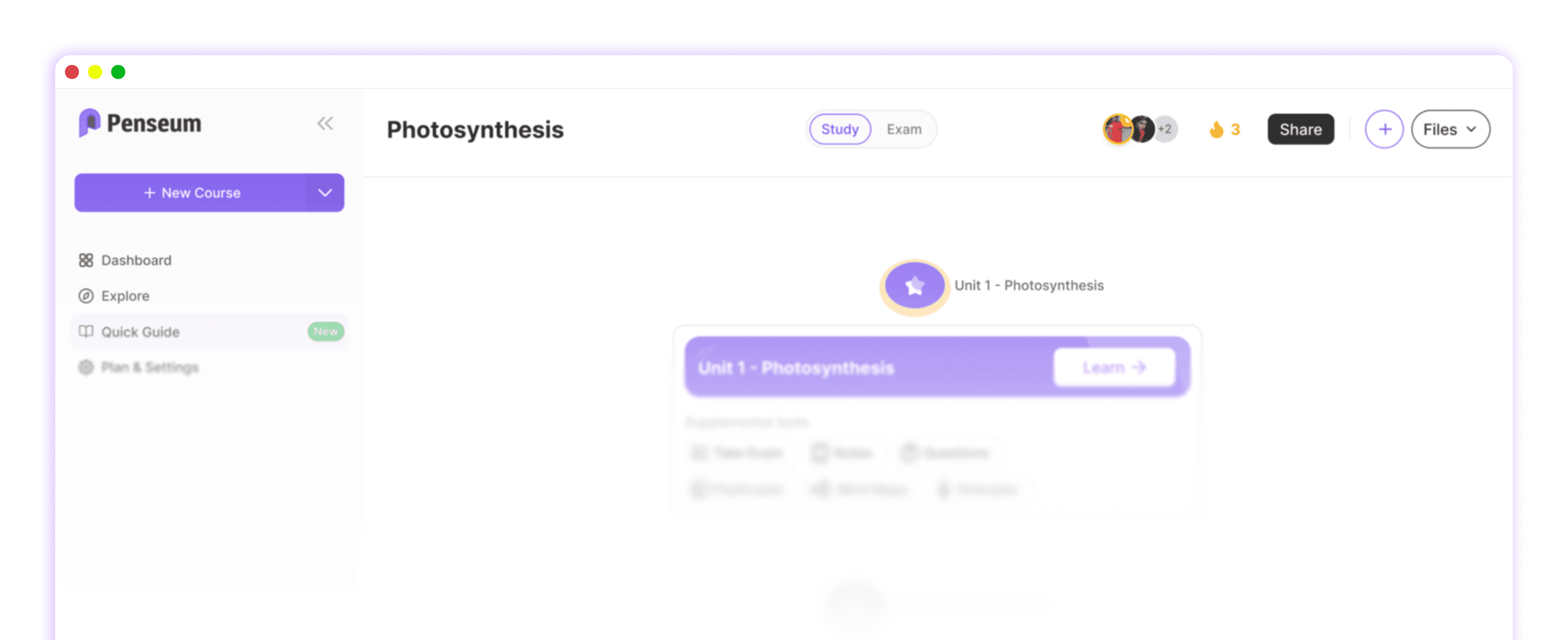
Penseum turns your uploaded PDFs, slides, and notes into an interactive, all-in-one study experience perfect for ADHD brains. Instead of getting overwhelmed by creating study materials, Penseum’s AI instantly generates flashcards, quizzes, mind maps, and podcasts to keep you engaged without the distractions of crowdsourced platforms.
Over 1.6 million students across 130+ countries use Penseum to bypass executive dysfunction and generate custom study guides. When you upload a problem set, Penseum does not just hand you a wall of text. The live AI tutor explains the material step-by-step out loud, while simultaneously drawing diagrams on a visual canvas.
If you make a mistake while working through a problem, Penseum spots it immediately. It corrects you in real-time, marks exactly where you went wrong, and explains what to fix. This provides the instant feedback and dopamine-driven gamification that neurodivergent learners require.
Feature | Generic AI Tools | Penseum 1-1 AI Tutor |
|---|---|---|
Response Format | Text-only generation | Real-time voice, out loud explanations |
Visual Interaction | Cannot see your work | Sees your work, draws live on canvas |
Feedback Loop | Gives answer and stops | Corrects specific mistakes, keeps teaching |
Study Materials | Manual prompting required | Auto-generates quizzes, flashcards, mind maps |
Actionable Step: Upload your latest lecture PDF to Penseum for free, and let the live AI tutor explain the material step-by-step out loud.
Frequently Asked Questions
What is the best way to study with ADHD?
The best way to study with ADHD is to use active, high-engagement techniques like active recall, spaced repetition, and the Pomodoro method. Avoid passive reading. Break tasks into short, 20-minute chunks to maintain dopamine levels, and use multisensory tools like audio or interactive quizzes to sustain attention.
How do you focus on studying when you have ADHD?
To focus on studying with ADHD, eliminate environmental distractions and use a visual timer to create a sense of urgency. Employing a body double—studying next to someone who is also working—can significantly boost accountability. Listening to instrumental music or white noise also helps occupy background attention.
Can people with ADHD do well in college?
Yes, people with ADHD can excel in college by utilizing proper accommodations and tailored study strategies. Using campus disability services, applying AI study tools to organize materials, and adopting effective time management systems allow neurodivergent students to overcome executive dysfunction and achieve high academic success.
Why is studying so hard for ADHD?
Studying is hard for ADHD students due to executive dysfunction, which impairs the ability to start tasks, manage time, and maintain focus on low-dopamine activities. Traditional studying often involves passive reading, which under-stimulates the ADHD brain, leading to rapid boredom, distractibility, and severe procrastination.
Does active recall work for ADHD?
Active recall is highly effective for ADHD because it turns passive learning into an interactive, problem-solving task. This creates a challenging environment that naturally boosts dopamine and engagement. Using flashcards or taking practice tests forces the brain to retrieve information, embedding it deeper into long-term memory.
[AUTHOR]
Last updated: August 2026
Sources
Ratey, J. J. (2008). Spark: The New Science of Exercise and the Brain. Little, Brown Spark. [NEEDS SOURCE: Specific PubMed link for dopamine production related to cognitive engagement in ADHD]
Karpicke, J. D., & Roediger, H. L. (2008). The critical importance of retrieval for learning. Science, 319(5865), 966-968. https://pubmed.ncbi.nlm.nih.gov/18276894/
Cirillo, F. (2006). The Pomodoro Technique. FC Garage. [NEEDS SOURCE: Peer-reviewed validation of Pomodoro timeboxing metrics for attention]
ADDitude Magazine. (2021). Body Doubling for ADHD: What It Is and How It Works. https://www.additudemag.com/body-doubling-adhd-productivity-focus/
Shams, L., & Seitz, A. R. (2008). Benefits of multisensory learning. Trends in Cognitive Sciences, 12(11), 411-417. https://pubmed.ncbi.nlm.nih.gov/18805039/
Tabibian, B., Upadhyay, U., De, A., Zarezade, A., Schölkopf, B., & Gomez-Rodriguez, M. (2019). Enhancing human learning via spaced repetition optimization. Proceedings of the National Academy of Sciences, 116(10), 3988-3993. https://pubmed.ncbi.nlm.nih.gov/30782808/
Rohrer, D. (2012). Interleaving helps students distinguish among similar concepts. Educational Psychology Review, 24(3), 355-367. https://scholar.google.com/scholar?q=Rohrer+2012+Interleaving
Dichev, C., & Dicheva, D. (2017). Gamifying education: what is known, what is believed and what remains uncertain: a critical review. International Journal of Educational Technology in Higher Education, 14(1), 9. https://scholar.google.com/scholar?q=Dichev+gamifying+education
Barkley, R. A. (1997). Behavioral inhibition, sustained attention, and executive functions: constructing a unifying theory of ADHD. Psychological Bulletin, 121(1), 65-94. https://pubmed.ncbi.nlm.nih.gov/9000892/
Wood, S. G., Moxko, E. R., Murray, M., & Heskes, D. (2018). Text-to-Speech Software: A Tool for Reading Interventions. Journal of Special Education Technology. https://scholar.google.com/scholar?q=Wood+Text-to-Speech+Software+Reading+Interventions
Related guides
Ready to study smarter?
Start turning your notes into guides, quizzes, and flashcards in seconds.