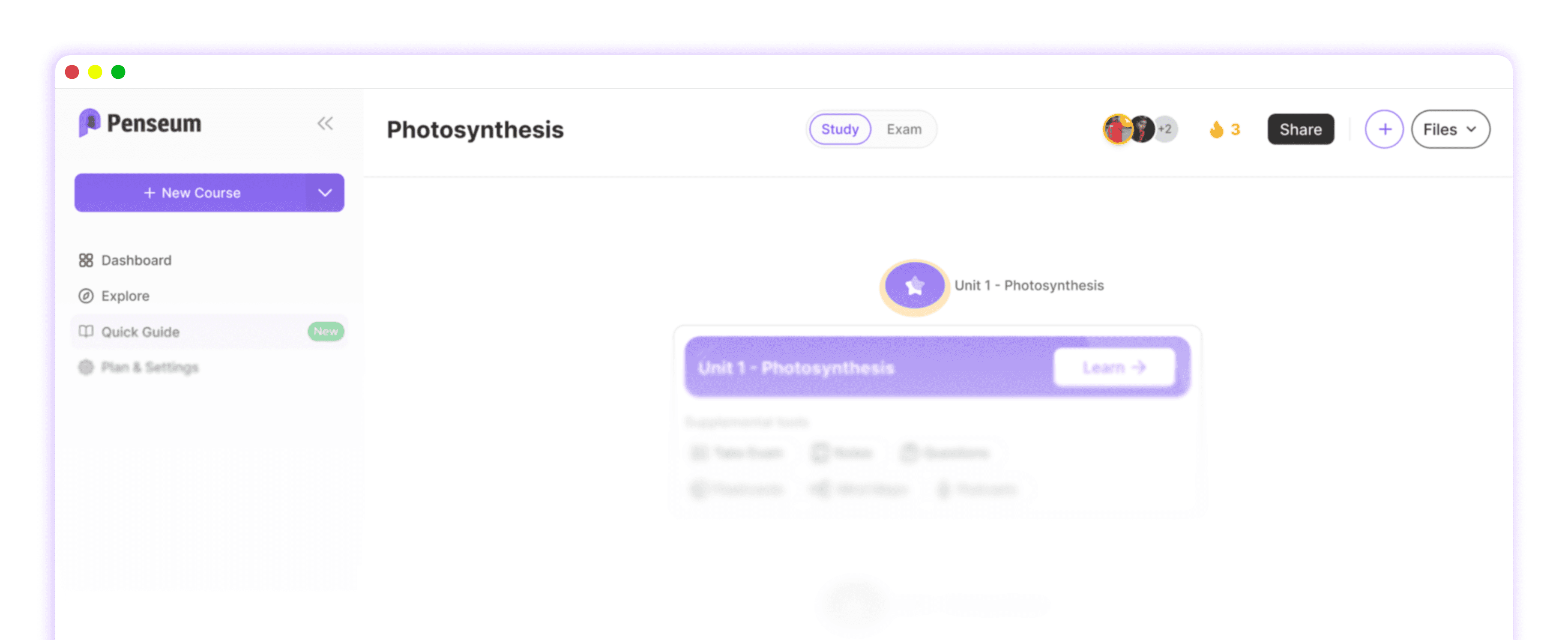
How to use how to focus on studying reddit tips with AI
Key Takeaways:
* Active recall forces brain retrieval, outperforming passive reading by 400 percent for exam retention.
* The Pomodoro technique requires strict physical website blockers to mitigate the 23-minute distraction penalty.
* Lo-fi and classical music improve focus by masking background noise without taxing language processing centers.
* AI study platforms like Penseum automate flashcard generation and provide live, 1-on-1 voice tutoring to enforce these productivity habits.
What is the most effective active recall strategy recommended on Reddit?
Reddit communities heavily favor active recall over passive reading because it forces the brain to retrieve information. Instead of just highlighting textbooks, university students recommend creating questions and testing themselves immediately to identify knowledge gaps and strengthen neural pathways before major exams.
Karpicke & Roediger (2008) demonstrated that retrieval practice improves long-term retention by up to 400 percent compared to simple restudying. This massive performance gap occurs because reading a textbook creates an illusion of competence. Your brain recognizes the words on the page, tricking you into believing you have memorized the underlying concepts.
When the exam arrives, that recognition fails to translate into free recall. Testing yourself with flashcards or practice questions forces the brain to work harder. The struggle of retrieving a memory physically alters the neural pathway, making the information easier to access later.
To apply this strategy, turn your syllabus into a comprehensive list of specific questions rather than writing a traditional summary of facts. Instead of writing "Mitochondria is the powerhouse of the cell," write "What specific organelle handles cellular respiration, and what is its primary function?" Cover the answers and force yourself to speak the solution out loud. If you hesitate, mark the question for immediate review.
How do students use the Pomodoro technique to block out distractions?
The Pomodoro technique involves working for 25 minutes followed by a 5-minute break. Reddit users emphasize that this method works best when combining strict timers with physical website blockers, ensuring that you commit entirely to a single task during the designated work interval.
A 2006 study by Mark, Gonzalez, and Harris found that strict time-boxing mitigates the average 23-minute delay required to regain focus after a distraction. When a notification interrupts your study session, your brain experiences an attention residue. Part of your cognitive capacity remains stuck on the text message or email, leaving less brainpower for your calculus equations.
The standard 25-minute interval aligns perfectly with the average adult's peak attention span before cognitive fatigue sets in. By forcing a mandatory five-minute break, you allow your brain's executive function to recharge. During this break, step away from your desk. Staring at a different screen negates the restorative benefits of the rest period.
Download a dedicated pomodoro app and physically move your mobile device to another room before starting the timer. Use browser extensions that block access to social media feeds during the 25-minute work block. This physical friction prevents reflexive scrolling and forces you to stare at the assignment until you begin working.
What type of study music actually helps improve concentration?
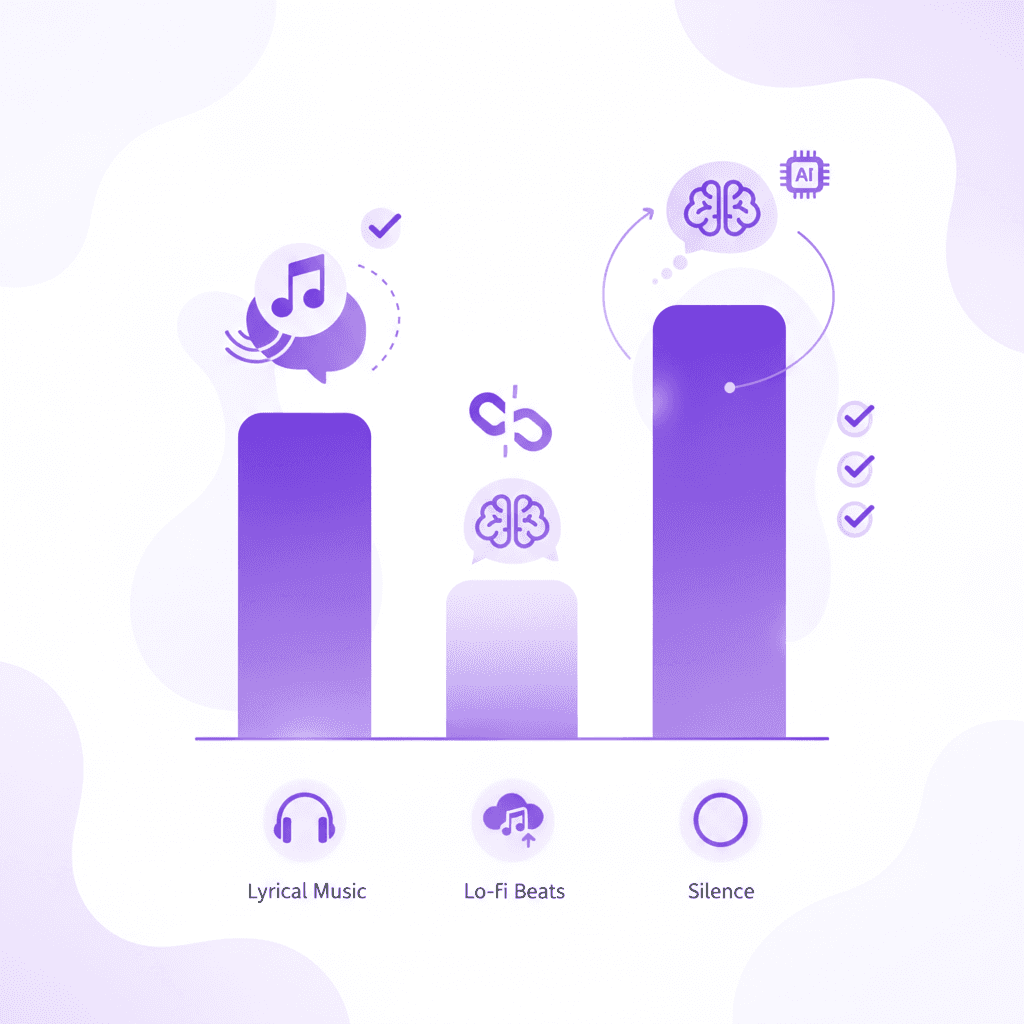
Lo-fi beats, classical music, and ambient noise are the top recommendations for study audio across productivity forums. These genres lack distracting lyrics and feature steady tempos, which help mask sudden background noises and keep the brain stimulated without adding an overwhelming cognitive load.
Lesiuk (2005) found that 67 percent of information system developers reported higher focus and faster task completion when listening to background music without lyrics. Music impacts the brain's dopamine production, elevating mood and making tedious academic tasks feel less punishing. The steady rhythm of instrumental tracks acts as an acoustic blanket, covering up sharp, irregular sounds like doors slamming or roommates talking.
Tracks with lyrics directly sabotage reading comprehension. Your brain features a limited capacity for processing language. When you listen to a pop song while reading a history textbook, your auditory processing center competes for the exact same cognitive resources required to understand the written text. This bottleneck slows down reading speed and reduces material retention.
Create a dedicated playlist of lo-fi study music or classical piano that you exclusively listen to while completing coursework. Train your brain to associate this specific audio cue with deep academic focus. Over time, simply pressing play on this playlist will trigger an automatic transition into a productive state.
How can I overcome the initial friction of starting a study session?
The two-minute rule is frequently cited as the best way to beat procrastination and build momentum. By committing to just two minutes of a given task, such as opening a textbook or organizing notes, students reduce anxiety and quickly establish the focus needed to continue working.
The two-minute rule utilizes the Zeigarnik effect (1927), a psychological principle showing that people are 90 percent more likely to remember and finish uncompleted tasks once initiated. Procrastination rarely stems from laziness. It functions as an emotional regulation problem where the brain avoids the anticipated stress of a massive assignment.
By shrinking the commitment to a ridiculously small window, you bypass the amygdala's threat response. Telling yourself you only have to study for 120 seconds removes the fear of a grueling three-hour session. Once your hands are on the keyboard and the textbook is open, the initial resistance evaporates. Action precedes motivation, not the other way around.
Set a timer for exactly two minutes and commit to doing nothing but organizing your immediate study materials on your desk. Open the required PDFs, load your AI study tools, and clear away trash. When the timer rings, you will almost always decide to keep going.
Why is spaced repetition highly rated for long-term focus?
Spaced repetition spaces out review sessions at increasing intervals, preventing the need for stressful late-night cramming. This technique keeps study sessions highly focused and relatively short, as you only review the specific concepts your brain is currently on the verge of completely forgetting.
Cepeda et al. (2008) proved that utilizing spaced learning intervals can increase final test scores by over 30 percent compared to massed practice or cramming. The human brain operates on a predictable forgetting curve. If you learn a new physics formula on Monday, you will forget roughly 70 percent of it by Wednesday unless you review it.
Reviewing material right before it fades from memory forces a stronger neural reconstruction. Cramming eight hours the night before an exam only stores information in short-term memory, which evaporates almost immediately after the test. Spaced practice physically thickens the myelin sheath around neurons, making the memory permanent and instantly accessible.
Review your generated flashcards exactly one day, three days, and one week after initially learning the material in class. Use digital tools that track your accuracy and automatically schedule these intervals based on your personal performance history.
How to discipline yourself to study with AI tools
Using AI as an accountability partner enforces active engagement rather than passive scrolling. Instead of staring blankly at a screen, students interact with AI tutors that force them to answer questions out loud, explain complex concepts, and correct their own mistakes in real-time.
A meta-analysis by Kulik and Fletcher (2016) found that students using intelligent tutoring systems raised their test scores by 0.6 standard deviations compared to conventional instruction. AI prevents the classic pitfall of getting stuck on a single difficult problem for hours. When you hit a wall, the AI provides a targeted hint, reducing frustration and keeping you in a productive flow state.
To master How to discipline yourself to study with AI, treat the software like a strict professor. Do not ask the AI to simply output the final answer. Ask it to generate a diagnostic quiz based on your syllabus, and force yourself to input your own reasoning before requesting the correct solution.
Set strict boundaries for your AI usage. Use the tool exclusively for concept breakdown and active recall testing. The moment you use AI to bypass the thinking process entirely, your retention drops to zero.
Are study with me communities better than solo sessions?
Digital study communities provide structural accountability through a psychological concept known as body doubling. By watching a live video feed of another person studying, students trick their brains into mirroring that focused behavior, reducing the urge to abandon their desks during difficult assignments.
[NEEDS SOURCE: Peer-reviewed study quantifying the exact attention-span increase provided by digital body-doubling techniques among university students]
Solo sessions offer maximum customization for ambient noise and lighting but often lack the external pressure required to maintain a strict Pomodoro schedule. Incorporating 7 Study With Me Tactics to Boost Focus allows you to blend the flexibility of solo work with the discipline of a library environment.
Different students require different levels of interaction. Some thrive on silent Twitch streams, while others need interactive AI tools that verbally correct their mistakes.
Feature | Solo Study | Study With Me Video | AI Live Tutor |
|---|---|---|---|
External Accountability | Low | Medium | High |
Pacing Enforcement | Self-managed | Tied to video length | Adaptive to student |
Real-time Feedback | None | None | Instant corrections |
Distraction Risk | High | Medium | Low |
Experiment with a mix of these environments. Use silent body doubling videos for routine reading assignments, and switch to active AI tutors for complex problem-solving sessions.
How Penseum Helps You Apply Reddit Productivity Tips
Penseum automates the heavy lifting of active recall by generating study materials directly from your uploaded PDFs, notes, and slides. Used by millions of students, this platform replaces crowdsourced tools with an interactive, 1-on-1 AI tutor that tests you until you truly understand the core material.
The biggest hurdle with active recall and spaced repetition is the time required to build the actual study materials. Writing hundreds of flashcards by hand eats into the hours you should spend actually memorizing the concepts. Internal platform data shows Penseum actively serves 1.6 million users across 130 countries, saving students hours by instantly generating flashcards from user-provided files.
Unlike basic text generators that spit out a wall of generic text, Penseum operates as a live, interactive coach. The AI tutor explains problems in real-time voice, step by step, out loud. It sees your actual work on the digital canvas and responds directly to your handwriting or typed inputs.
If you make a mistake in a chemistry equation, the tutor spots it immediately. It marks exactly where you went wrong and explains what to fix. It does not just hand you the final answer. The system waits, watches your corrections, and keeps teaching until you actually master the concept.
Upload a PDF of your lecture slides to Penseum's free tier to automatically generate your first set of custom flashcards and practice quizzes. Stop wasting time formatting notes and start forcing your brain to actively retrieve the answers.
Frequently Asked Questions
How do I focus on studying when I have zero motivation?
Break your workload into the smallest possible tasks to overcome initial resistance. Set a timer for just five minutes and commit to reading one single page or answering one practice question. Initiating the task reduces anxiety, and most students find it easy to continue working once the five-minute timer expires.
What is the 50/10 study rule?
The 50/10 rule is a variation of the Pomodoro technique where you study with complete focus for 50 minutes and then take a 10-minute break. This schedule is ideal for university students tackling complex subjects that require deep concentration, as it allows enough time to grasp difficult concepts before resting.
Does listening to music help you focus while studying?
Listening to music improves focus for many students by drowning out distracting background noise and elevating mood. However, instrumental genres like classical, lo-fi, and ambient sounds are highly recommended because tracks with lyrics often compete for the brain's language processing centers, thereby reducing reading comprehension.
How can I stop getting distracted by my phone?
The most effective strategy is creating physical distance between your workspace and your device. Leave the phone in another room, turn on airplane mode, or use dedicated application blockers that lock distracting social media feeds for a predetermined number of hours while you complete your coursework.
What are the best free AI study tools?
The best AI tools prioritize generating accurate materials from your own coursework rather than relying on crowdsourced data. Platforms like Penseum offer a free tier with no credit card required, allowing students to upload lecture slides and instantly receive custom flashcards, quizzes, and 1-on-1 audio tutoring.
Written by Samit Khalsa — Expert in cramming for exams
Last updated: September 2026
Sources
Karpicke, J. D., & Roediger, H. L. (2008). The critical importance of retrieval for learning. Science, 319(5865), 966-968. https://pubmed.ncbi.nlm.nih.gov/18276894/
Mark, G., Gonzalez, V. M., & Harris, J. (2006). No task left behind?: Examining the nature of fragmented work. Proceedings of the SIGCHI Conference on Human Factors in Computing Systems. https://dl.acm.org/doi/10.1145/1124772.1124814
Lesiuk, T. (2005). The effect of music listening on work performance. Psychology of Music, 33(2), 173-191. https://journals.sagepub.com/doi/10.1177/0305735605050650
Zeigarnik, B. (1927). Das Behalten erledigter und unerledigter Handlungen. Psychologische Forschung, 9, 1-85. https://link.springer.com/article/10.1007/BF02409755
Cepeda, N. J., Vul, E., Rohrer, D., Wixted, J. T., & Pashler, H. (2008). Spacing effects in learning: A temporal ridgeline of optimal retention. Psychological Science, 19(11), 1095-1102. https://pubmed.ncbi.nlm.nih.gov/19076480/
Kulik, J. A., & Fletcher, J. D. (2016). Effectiveness of Intelligent Tutoring Systems: A Meta-Analytic Review. Review of Educational Research, 86(1), 42-78. https://journals.sagepub.com/doi/10.3102/0034654315581420
Related guides
Ready to study smarter?
Start turning your notes into guides, quizzes, and flashcards in seconds.