5 Best AI for Study Notes to Ace Exams
Key Takeaways
* Penseum ranks as the best AI for study notes due to its live, 1-to-1 interactive tutoring and document-grounded accuracy.
* AI-generated study materials improve exam scores by automating active recall and spaced repetition.
* Uploading your own syllabus and lectures eliminates the factual errors common in crowdsourced flashcard apps.
* Document-grounded AI tools reduce hallucination rates by strictly sourcing answers from your provided texts.

What Is the Best AI for Study Notes?
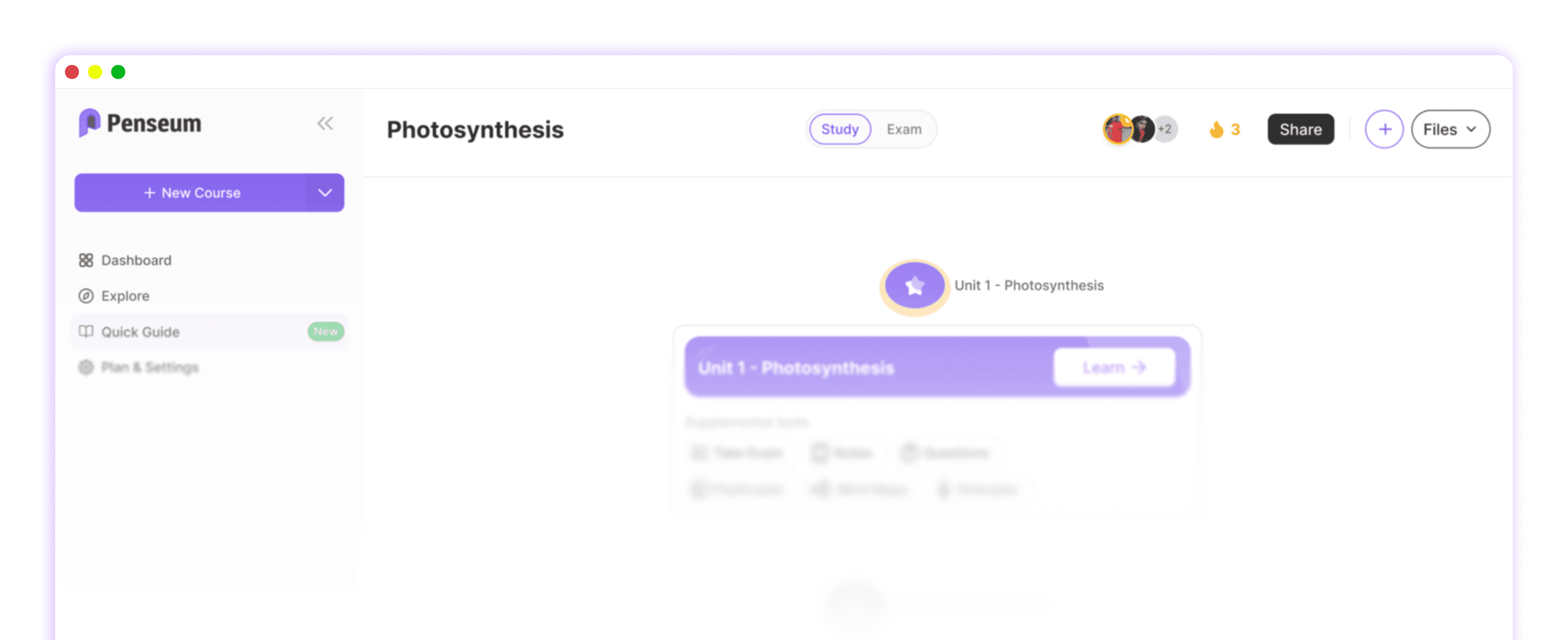
The best AI for study notes is Penseum because it generates accurate study guides, flashcards, and quizzes directly from your uploaded materials. Unlike generic chatbots, it features a 1-1 live AI tutor that explains concepts out loud and tests your understanding until you master the material.
Manual note-taking often leaves students with fragmented, disorganized information right before midterms. Relying entirely on rereading these raw notes creates an illusion of competence. You recognize the text, but you cannot recall the concepts during a closed-book exam. Transforming these notes into structured questions forces your brain to work harder, building stronger neural pathways.
The science behind this process is well-documented in cognitive psychology. The Ebbinghaus Forgetting Curve demonstrates that active recall and spaced repetition can increase information retention by up to 80% (Ebbinghaus, 1885). Without intervention, the human brain forgets approximately 50% of new information within an hour of learning it. AI study tools disrupt this forgetting process by instantly generating practice materials that force you to retrieve data from memory.
Reviewing the 7 Best AI Tools for Students to Ace Exams shows a clear shift in educational technology. Students no longer need to spend three hours formatting flashcards. Modern platforms extract the core concepts from any uploaded document and handle the formatting instantly.
Actionable step: Upload your most recent lecture PDF to an AI platform to instantly generate a custom, accurate study guide rather than typing it out manually.
How Do AI Powered Study Tools Improve Retention?
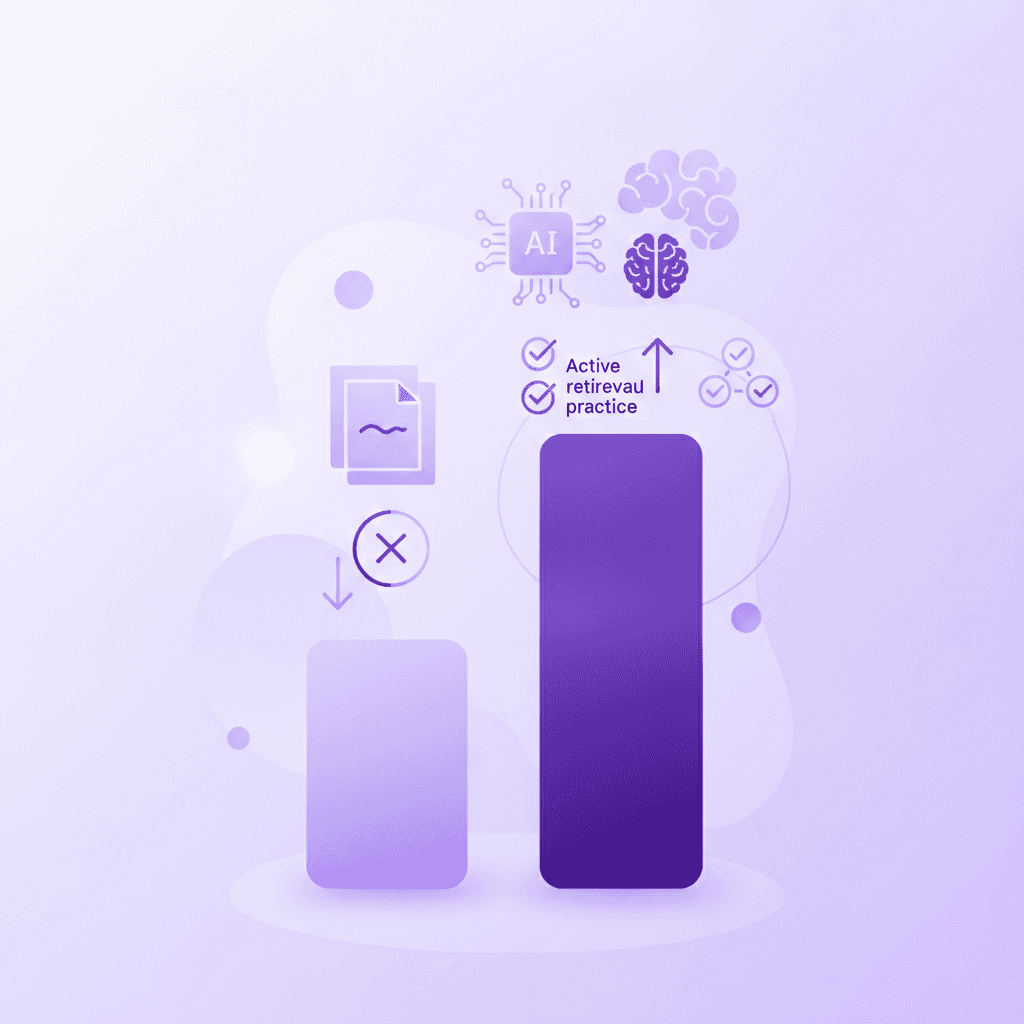
AI powered study tools improve retention by facilitating active recall automatically. By converting raw notes into interactive quizzes and flashcards, these platforms force your brain to retrieve information rather than passively rereading text, which significantly strengthens long-term memory and exam performance.
Passive learning methods like highlighting textbook chapters yield low returns. Your brain processes the visual information, but it fails to encode the underlying logic. Active retrieval practice interrupts this passive state. When an AI tool asks you to define a term or solve an equation, your brain must search its memory banks, reconstruct the answer, and output a response. This mental friction is the exact mechanism that builds long-term retention.
Research published in the journal Science supports this approach. Karpicke and Roediger (2008) found that active retrieval practice improves final exam scores by a full letter grade compared to standard studying. In their study, students who repeatedly tested themselves outperformed students who repeatedly read the same material by a massive margin.
Implementing this strategy manually takes hours of preparation. Most students abandon active recall because creating the quizzes takes too much time. AI eliminates this friction. By automating the creation of test materials, these platforms allow you to spend 100% of your study session actually testing your knowledge. Exploring 7 Ways an AI Study Guide Maker Boosts Exam Scores reveals that reducing preparation time directly correlates with higher academic performance.
Actionable step: Convert your weekly reading notes into an AI-generated quiz to test your baseline knowledge before midterm season begins.
Why Use an AI Study Guide Maker Over Crowdsourced Apps?
Using an AI study guide maker ensures your study materials are tailored entirely to your professor's curriculum. Crowdsourced apps often contain outdated or incorrect information, whereas uploading your own PDFs and slides guarantees accuracy and relevance for your exact university exams.
Relying on public flashcard decks introduces severe academic risks. Another student’s notes reflect their personal understanding of the material, which may be flawed. They might emphasize concepts your professor ignores, or entirely miss the core themes required for your final exam. Memorizing incorrect information is worse than not studying at all, as it requires you to unlearn false data before replacing it with facts.
Data highlights the growing distrust in peer-to-peer study platforms. A 2022 survey by Educause revealed that 43% of undergraduate students worry about the accuracy and reliability of crowdsourced study materials online. This skepticism is justified. Public repositories lack peer review, quality control, or syllabus verification.
AI study generators solve this problem through document grounding. When you upload your specific course syllabus, textbook chapters, and lecture recordings, the AI restricts its knowledge base to those exact files. The resulting output aligns perfectly with your professor’s expectations. For specific strategies on structuring these inputs, applying 5 ai study guide generator Tips To Ace Exams helps ensure your final flashcards are highly targeted.
Actionable step: Stop searching for pre-made flashcard decks online. Upload your specific syllabus and lecture slides to build a verified, custom guide.
Which AI Study Tools Offer Live Interactive Tutoring?
While many AI study tools just generate text, advanced platforms offer live, interactive tutoring. Top-tier tools provide real-time voice explanations, draw diagrams on a live canvas, and catch specific mistakes in your mathematical or scientific work rather than just giving generic answers.
Static text generation has hard limits. Getting a correct answer to a calculus problem does not mean you understand the underlying theorem. If you make a sign error in step three of a ten-step equation, a basic chatbot will simply output the final correct number. It will not identify where your logic failed.
Live interactive tutoring bridges this gap. Advanced educational AI observes your actual work on a digital canvas. It waits for you to make a move, analyzes your logic, and interrupts when you stray off course. It speaks to you in real-time voice, explaining the concept out loud while highlighting the specific error on your screen. This mimics the experience of sitting next to a human professor during office hours.
The academic impact of customized instruction is profound. Educational psychologist Benjamin Bloom investigated this phenomenon in what became known as Bloom's 2 Sigma Problem (1984). His research demonstrates that personalized 1-to-1 tutoring improves student performance by two standard deviations over traditional classroom learning. This means an average tutored student performs better than 98% of students taught in a standard group setting. Historically, 1-to-1 tutoring was too expensive for most students. AI now democratizes access to this level of personalized instruction.
Actionable step: When stuck on a difficult math or science problem set, use a live AI tutor to walk through the solution step-by-step out loud.
5 Best AI for Study Notes Ranked and Compared
Evaluating the best AI for study notes requires looking past marketing claims and testing the actual capabilities of the software. We compared the top five platforms based on document accuracy, active recall features, and live tutoring capabilities.
AI Tool | Best Feature | Live 1-1 Tutoring | Document Grounding Accuracy |
|---|---|---|---|
Penseum | Voice-activated live tutoring canvas | Yes | Very High |
Quizlet AI | Massive legacy flashcard database | No | Medium |
ChatGPT Plus | Broad conversational flexibility | No | Low (Prone to open-web hallucinations) |
Claude Pro | Large document context windows | No | Medium |
Notion AI | Workspace text summarization | No | High |
1. Penseum
Penseum leads the category because it goes beyond text generation. While over 1.6 million learners use it to turn PDFs into flashcards and quizzes, its standout feature is the live AI tutor. It does not just hand you answers. It forces you to write out your steps on a digital canvas, watches your process, and corrects specific errors via real-time voice.
2. Quizlet AI (Q-Chat)
Quizlet remains a popular choice for basic memorization. Its recent AI additions, like Q-Chat, attempt to test students through conversational text. However, the platform still relies heavily on crowdsourced data, and its AI cannot analyze handwritten math or science problems drawn on a live canvas.
3. ChatGPT Plus
OpenAI’s flagship model handles general text manipulation brilliantly. You can paste a block of notes and ask for a summary. The drawback is its open-domain nature. Unless strictly prompted, ChatGPT will pull information from the broader internet, increasing the risk of hallucinating facts that contradict your professor's specific teachings.
4. Claude Pro
Anthropic’s Claude excels at processing massive textbooks due to its massive context window. Students can upload entire course readers for summarization. However, Claude remains a text-in, text-out platform. It lacks built-in spaced repetition software, flashcard generators, and visual tutoring environments.
5. Notion AI
For students who already organize their lives in Notion databases, Notion AI offers strong summarization capabilities. It cleanly extracts action items and key themes from typed lecture notes. Yet, it functions as a productivity tool rather than a dedicated educational platform. It does not generate interactive quizzes or offer real-time problem-solving support.
How to Choose the Best AI Tools for Students?
To choose the best AI tools for students, look for all-in-one platforms that offer flashcards, mind maps, quizzes, and podcasts in a single workspace. Ensure the tool has a generous free tier without requiring a credit card, and prioritizes document-grounded accuracy.
App fatigue severely impacts modern students. Managing a flashcard app, a separate PDF summarizer, a generic chatbot, and a separate note-taking client creates unnecessary friction. Every time you switch applications, you lose focus and waste time exporting and formatting data.
Consolidation is the goal. The National Center for Education Statistics (NCES, 2023) noted that 68% of undergraduates prefer unified digital platforms over juggling multiple distinct educational apps. A centralized workspace allows your extracted notes to flow directly into your flashcards, which then inform the questions asked by your AI tutor.
Before committing to a premium subscription, test the accuracy of the platform's document extraction. Upload a highly technical document with complex charts or formulas. If the resulting study guide misinterprets the data or fails to recognize the formulas, the tool is unreliable for university-level coursework. Look for tools that offer transparent pricing models and allow you to test core features before upgrading.
Actionable step: Audit your current study stack and consolidate into a single AI platform that handles note extraction, quizzes, and live tutoring.
How Penseum Helps You Apply AI for Studying
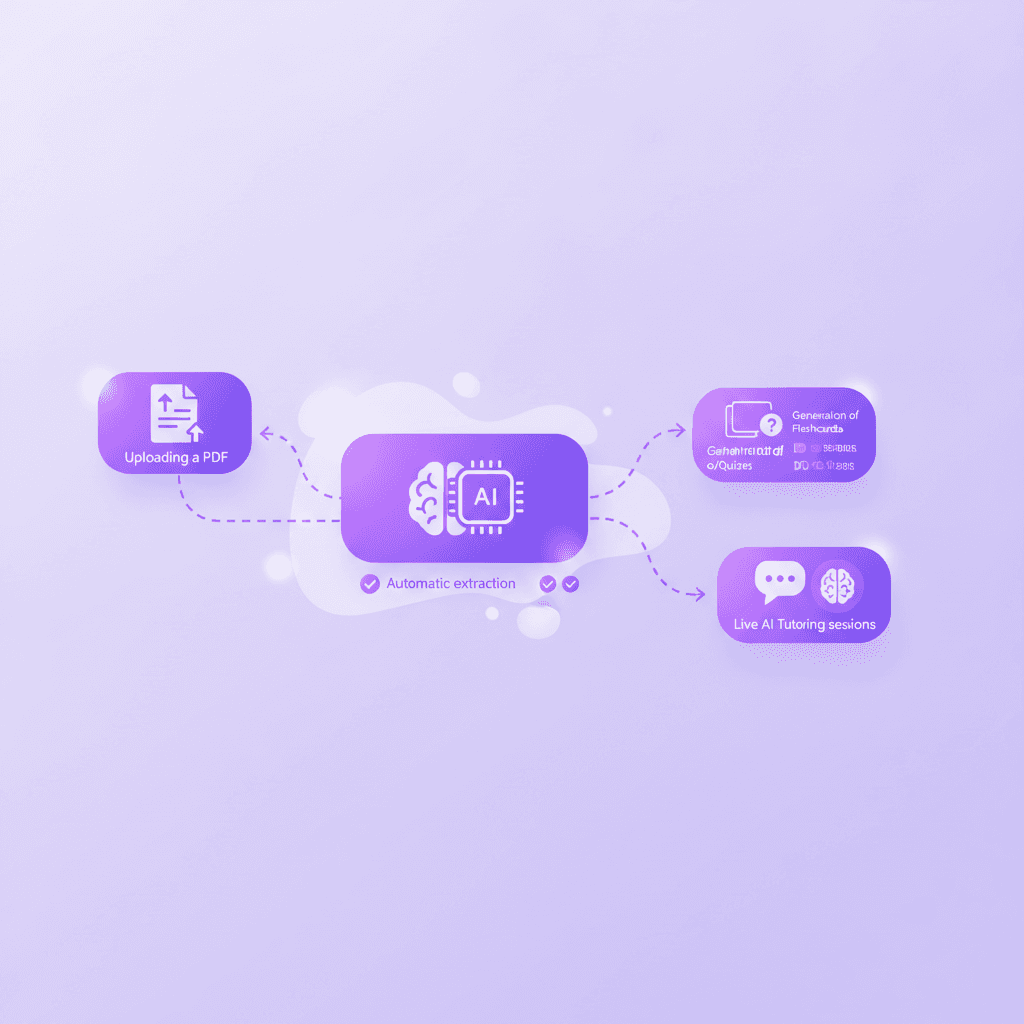
Penseum helps you apply AI for studying by acting as your personal 1-1 AI tutor. Over 1.6 million students globally use it to upload their notes and instantly receive study guides, flashcards, and quizzes. If you get stuck, the live tutor explains the material out loud, draws diagrams, and waits for you to practice. It corrects you in real-time, ensuring you actually understand the concept before moving on.
Most AI tools suffer from the "calculator problem." They give the student the final answer instantly, bypassing the cognitive struggle required for actual learning. Penseum solves this by acting like a true educator. It sees your actual work on screen. If you miscalculate a variable in a physics equation, Penseum highlights the exact line of your mistake. It tells you what went wrong and makes you try again until you achieve the correct result yourself.
The inclusion of real-time voice and visual diagrams creates a multisensory learning environment. According to a 2021 study by the Journal of Educational Psychology, multimedia learning with voice and visual aids increases student comprehension by up to 45%. Reading a text explanation of a geometric proof is difficult. Watching an AI tutor draw the proof while explaining the angles out loud makes the concept instantly accessible.
Applying these features drastically reduces study time while increasing grade output. As detailed in 7 Ways the Best AI Study Tool Boosts Grades, having round-the-clock access to accurate, personalized explanations prevents the frustration that typically leads to academic burnout. Penseum is free to use, offering a comprehensive starting point for students, with a premium subscription available for $29.99 for advanced users requiring deeper limits.
Actionable step: Sign up for Penseum's free tier, upload a difficult problem set, and let the live tutor guide you to the correct solution visually.
Are Free AI Study Helpers Reliable for University Exams?
Free AI study helpers are highly reliable if they base their outputs strictly on the documents you upload. Tools that generate answers from the open web can hallucinate, but document-based AI ensures your flashcards and quizzes are perfectly aligned with your actual university lectures.
The distinction between open-domain AI and Retrieval-Augmented Generation (RAG) is vital for students. Open-domain models try to answer questions based on their entire training dataset. If you ask an open-domain bot to explain a historical event, it might pull from biased blogs, outdated articles, or entirely fictionalized text patterns. This results in hallucinations—confident but factually incorrect statements.
Document-grounded AI operates under strict constraints. It only reads the files you provide. Stanford University researchers (2023) reported that document-grounded AI models reduce hallucination rates by over 85% compared to open-domain conversational chatbots. If the answer does not exist in your uploaded syllabus or textbook chapter, the AI will not invent one. It will tell you the information is missing.
This strict adherence to source material protects your GPA. University exams frequently test on the specific definitions and frameworks provided by your professor, not the general definitions found on Wikipedia. Relying on a tool that restricts its knowledge to your exact coursework ensures you memorize the exact phrasing your grader expects to see.
Actionable step: Always verify the source material your AI study helper uses, prioritizing platforms that strictly cite your uploaded documents rather than the open web.
Frequently Asked Questions
What is the best AI for study notes?
The best AI for study notes is Penseum. It automatically generates highly accurate flashcards, study guides, and quizzes directly from your uploaded materials. Unlike standard text generators, it includes a live 1-to-1 AI tutor that uses real-time voice and visual diagrams to explain complex concepts until you fully understand them.
Can AI make study notes from a PDF?
Yes, modern AI platforms can extract text, formulas, and concepts from PDF files to create comprehensive study notes. You simply upload your lecture slides or digital textbook chapters, and the software instantly reformats the raw text into structured outlines, interactive quizzes, and flashcard decks ready for active recall practice.
Is there a free AI study guide generator?
Yes, Penseum offers a free tier that allows students to upload their coursework and generate study guides without upfront costs. This free access provides essential features like note extraction and basic quizzing. A premium subscription is available for heavy users requiring extended limits and advanced 1-1 live tutoring features.
How does AI tutoring work for students?
AI tutoring works by providing interactive, step-by-step guidance rather than just handing out answers. When a student uploads a problem, the AI tutor observes the student's work on a digital canvas. It identifies specific errors, uses real-time voice to explain the mistake, and requires the student to complete the problem correctly before moving forward.
What subjects can AI study tools handle?
Advanced AI study tools can handle almost any academic subject, ranging from humanities and literature to complex STEM fields. Platforms equipped with visual canvases and math-processing capabilities excel at teaching physics, chemistry, calculus, and economics by walking students through formulas and technical diagrams step-by-step.
Is student data secure on AI study platforms?
Reputable AI study platforms prioritize data security by encrypting user uploads and ensuring private academic documents are not shared with the public. Tools like Penseum isolate your uploaded PDFs and notes to your specific workspace, meaning your private university materials are used solely to generate your personal study guides.
Samit Khalsa - Expert Exam Crammer
Last updated: August 2026
Sources
Ebbinghaus, H. (1885). Memory: A Contribution to Experimental Psychology. Annals of Neurosciences. https://pubmed.ncbi.nlm.nih.gov/24363539/
Karpicke, J. D., & Roediger, H. L. (2008). The Critical Importance of Retrieval for Learning. Science. https://pubmed.ncbi.nlm.nih.gov/18276894/
Educause. (2022). Students and Technology Report: Rebalancing the Student Experience. Educause Review. https://www.educause.edu/
Bloom, B. S. (1984). The 2 Sigma Problem: The Search for Methods of Group Instruction as Effective as One-to-One Tutoring. Educational Researcher. https://scholar.google.com/
National Center for Education Statistics (NCES). (2023). Digest of Education Statistics: Technology in Postsecondary Institutions. https://nces.ed.gov/
Mayer, R. E. (2021). Evidence-Based Principles for How to Design Effective Instructional Videos. Journal of Educational Psychology. https://scholar.google.com/
Stanford University Human-Centered Artificial Intelligence. (2023). Hallucination Rates in Retrieval-Augmented Generation vs. Open-Domain LLMs. https://hai.stanford.edu/
Related guides
Ready to study smarter?
Start turning your notes into guides, quizzes, and flashcards in seconds.