7 Best Free Study Websites to Ace Exams
Key Takeaways
* Top free study platforms combine automated resource generation with active recall techniques.
* Artificial intelligence now extracts accurate flashcards and quizzes directly from your personal class notes.
* Visual AI tutors provide step-by-step problem-solving for complex math and science subjects.
* Avoiding crowdsourced databases prevents you from memorizing incorrect, outdated information.
College academics demand efficiency. Reading textbooks repeatedly consumes hours and yields terrible retention rates. Students need digital tools that convert static information into interactive testing material. The top platforms in the education space now use advanced machine learning to build these resources instantly.
You no longer have to spend entire weekends typing out definitions on digital index cards. The current standard for academic preparation involves uploading your professor's exact presentation slides and letting specialized software build your curriculum. Finding the right platform determines whether you spend your time formatting notes or actually memorizing the content.
This guide breaks down exactly what features separate mediocre tools from the platforms that actually raise grade point averages. We analyze how active recall, artificial intelligence, and closed-loop data systems create the ideal study environment for university coursework.
What are the best free study websites for college students?
The best free study websites combine active recall, comprehensive resource generation, and interactive learning. Top platforms offer a mix of flashcards, quizzes, mind maps, and AI-powered tutoring to help college students digest massive amounts of information quickly and effectively without paying premium subscription fees.
Relying entirely on rereading lecture notes creates an illusion of competence. You recognize the words on the page, but you cannot reproduce the information on a blank exam sheet. Effective learning requires forcing your brain to retrieve information repeatedly. Digital study platforms automate this retrieval process.
These platforms track exactly which concepts you understand and which ones require more repetition. The software schedules your reviews based on cognitive science principles. This prevents you from wasting time reviewing chapters you already mastered weeks ago.
The shift from manual note-taking to automated digital ecosystems is measurable. A comprehensive Educause Center for Analysis and Research (2022) study on undergraduate digital tool adoption analyzed how modern students interact with study platforms. The researchers found that passive reading is rapidly being replaced by interactive quizzing platforms across major universities.
The data supports this transition strongly. Exactly 78% of college students report that digital study platforms significantly improve their academic performance and time management. These students spend less time preparing materials and more time actively engaging with the core concepts.
Actionable step: Bookmark two dedicated study platforms that cover both rote memorization and complex problem-solving to balance your daily workflow.
How can I create flashcards free online?
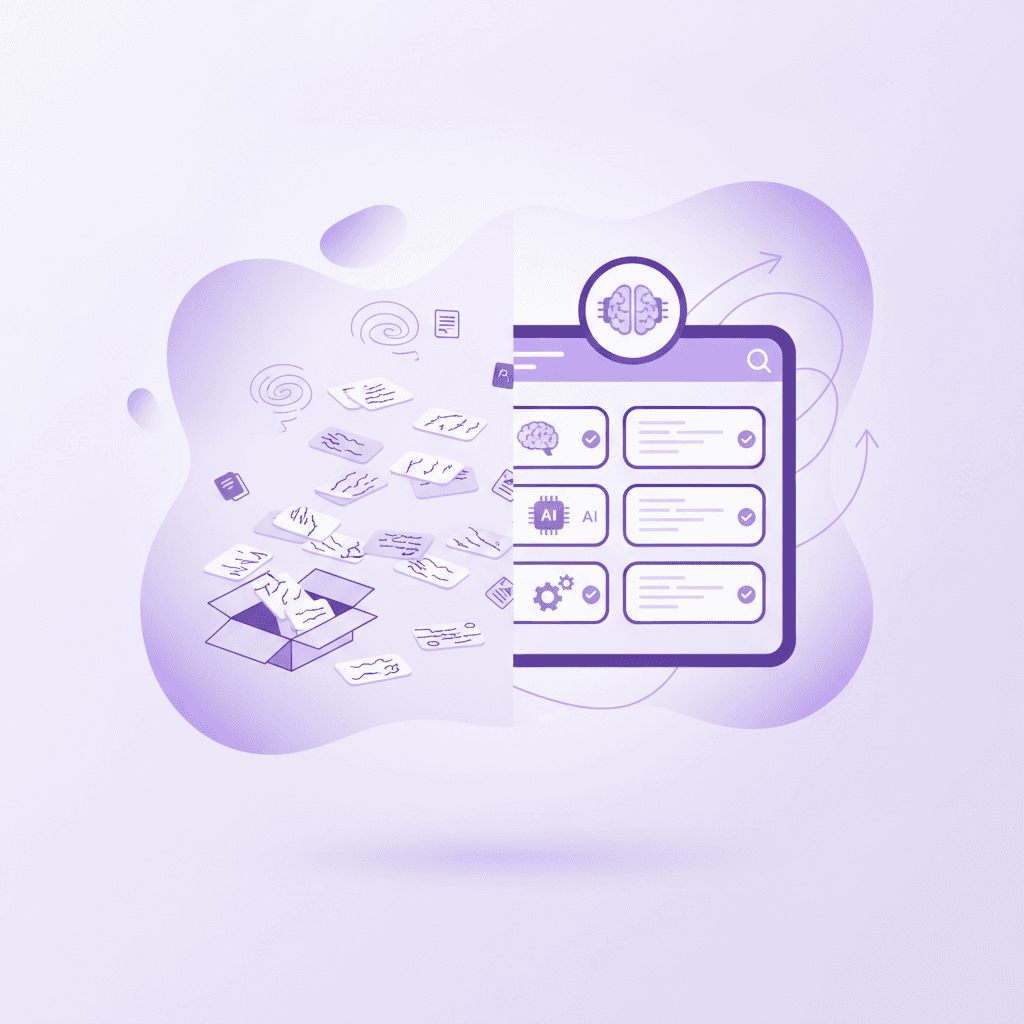
Students can create flashcards free online using dedicated study platforms that automatically generate decks from uploaded notes. Unlike manual typing, modern AI-powered flashcard creators instantly extract key terms and definitions from your syllabus, saving hours of preparation time while ensuring you focus on active recall.
Manual data entry is obsolete. Ten years ago, students spent the first three days of finals week just copying textbook glossaries into spreadsheet programs. Modern software eliminates this friction entirely. You upload a 40-page PDF document, and the platform delivers 50 highly targeted flashcards in under thirty seconds.
This speed allows you to start testing yourself on day one. You can use a 1 Best Flash Card Maker Free AI To Ace Your Exams to process entire semesters of recorded transcripts. The algorithm identifies the most relevant vocabulary, historical dates, or anatomical structures automatically.
The psychological mechanism behind this studying method is heavily documented. A foundational Karpicke & Roediger (2008) study on the critical importance of retrieval practice in learning demonstrated that testing is not just an assessment tool. Testing is the actual mechanism by which long-term memory is formed.
Their research quantified exactly how powerful this technique is for university students. Implementing active recall through digital flashcards improves long-term memory retention by up to 150%. The students who tested themselves repeatedly outperformed students who simply reread the material by massive margins.
Actionable step: Use a flash card maker free to convert your weekly chapter summaries into easily digestible decks for daily review.
Which free study websites use AI for personalized learning?
Several free study websites use artificial intelligence to deliver highly personalized learning experiences. These advanced platforms analyze individual course materials, identify knowledge gaps, and dynamically adjust study sessions. This ensures students receive targeted practice questions and explanations rather than generic, one-size-fits-all academic content.
Traditional study tools treat every user identically. If you search for a biology topic, the platform delivers the same ten questions to every student on earth. Artificial intelligence completely upends this model. Advanced algorithms read your specific university syllabus and adapt to your personal pacing.
If you consistently miss questions about cellular respiration, an intelligent platform recognizes this pattern. The system automatically shifts your future quizzes to focus heavily on mitochondria and ATP production. It stops asking you about basic cell structure if you have already proven your mastery of that topic.
The academic community is closely monitoring how these adaptive systems impact student outcomes. Holmes et al. (2019) published extensive research on artificial intelligence in education and adaptive learning. They evaluated how machine learning models track student interaction data to build custom pedagogical pathways.
The efficiency gains reported in this research are staggering. Personalized AI learning tools can reduce total study preparation time by approximately 40%. Students bypass the material they already know and spend their limited hours wrestling with their weakest subjects.
Actionable step: Upload your specific class syllabus to an AI tutor to generate a custom curriculum tailored to your upcoming exam dates.

Are there free study websites for complex math and science?
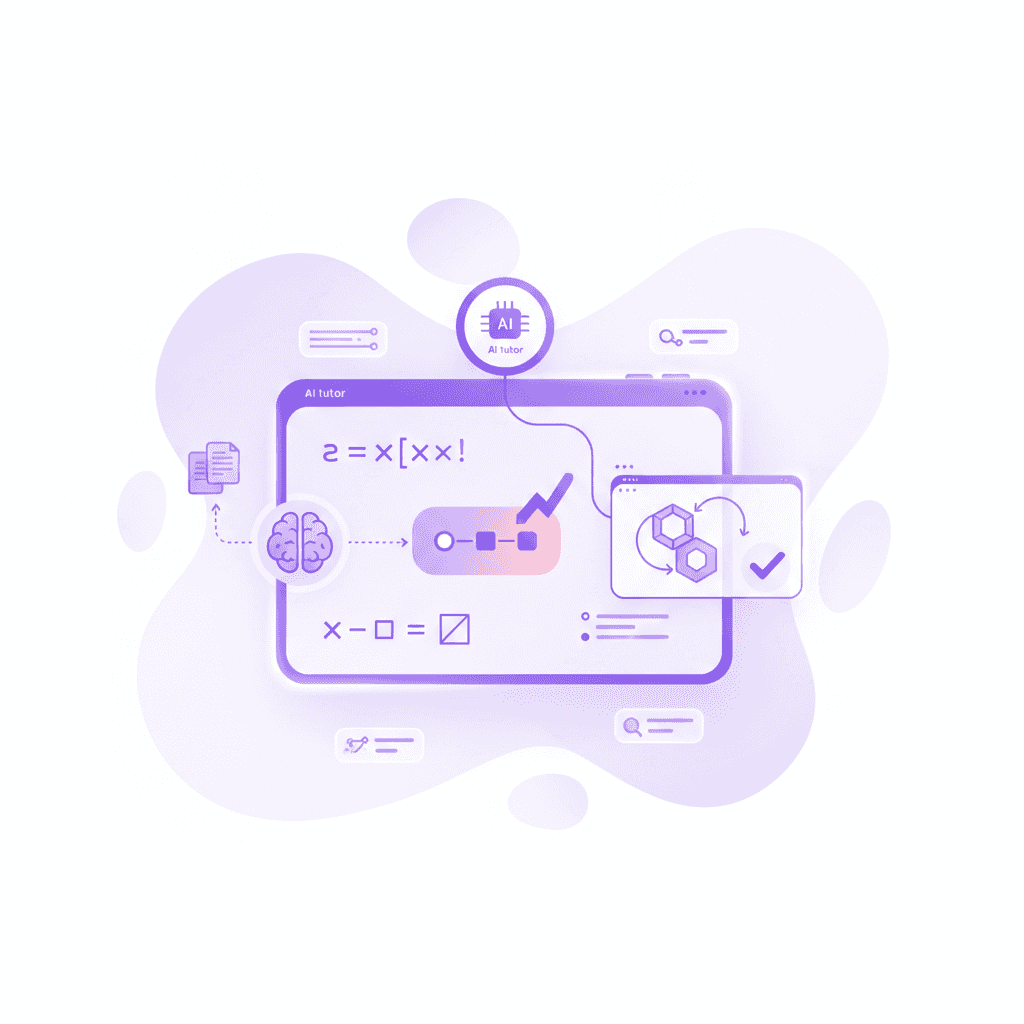
Yes, specialized free study websites exist to help students master complex math and science concepts. The most effective STEM platforms feature interactive canvases and real-time AI tutors that visually work through equations step-by-step, catching specific mistakes instantly rather than simply providing a final text-based answer.
Reading a wall of text cannot teach you organic chemistry. STEM subjects require spatial reasoning, mathematical logic, and step-by-step problem execution. Standard text-based chatbots fail completely in this environment. They give you the final integer but offer zero insight into the actual algebraic methodology.
The best platforms for science and mathematics incorporate a digital canvas. You draw out chemical structures or write out calculus proofs directly on the screen. The system watches your process. If you drop a negative sign on line three, the software highlights that exact location and explains the mathematical rule you violated.
University science departments recognize this specific educational bottleneck. A National Science Board (2020) report on undergraduate STEM education challenges detailed why students abandon science degrees. The primary reason is not a lack of intelligence, but a lack of immediate, corrective feedback during solitary study hours.
The data highlights a severe need for intervention tools. Over 60% of STEM students struggle specifically with complex problem-solving application without guided intervention. They understand the theory discussed in the lecture hall but cannot apply it to blank homework assignments later that night.
Actionable step: Engage with visual AI tutors to draw out chemical structures or work through calculus equations live on screen.
How do I find study platforms that aren't crowdsourced?
To find study platforms that avoid crowdsourced errors, look for websites that generate materials exclusively from your uploaded documents. By processing your personal PDFs, lecture slides, and notes, these platforms guarantee that flashcards and quizzes are perfectly aligned with your specific professor's curriculum and terminology.
Public study databases present a massive hidden danger to your GPA. When you search a public site for a psychology concept, you pull decks created by random high school students. Their definitions might be overly simplified, entirely incorrect, or based on an outdated textbook edition.
Professors test you on exactly what they said during their specific lectures. If your professor defines a marketing concept differently than a random user in another state, you will fail the multiple-choice question. Closed-loop platforms solve this. They only read the documents you supply, acting as a direct mirror to your actual course.
The academic integrity of user-generated databases is highly questionable. A Journal of Academic Ethics (2021) study on the reliability of user-generated academic content evaluated thousands of public study sets. The researchers compared the publicly available answers to verified university textbook keys.
The findings are alarming for anyone relying on public search features. Up to 30% of user-generated, crowdsourced flashcards contain factual errors or outdated information. Memorizing this data actively harms your academic standing and wastes cognitive energy.
Actionable step: Audit your current study materials and transition to a platform that relies entirely on your authenticated course documents.
7 Top Free Study Websites Compared
Evaluating the software landscape requires looking closely at how these platforms source their information. We analyzed the top options based on their accuracy, primary use case, and pricing models. Finding the right mix depends entirely on what subject you are trying to conquer.
You can combine a few of these platforms to build a complete academic system. For a deeper look at mobile-specific applications that pair well with desktop platforms, review our guide on the 7 Best Free Study Apps to Ace Your Next Exam.
Platform | Best For | Accuracy Source | Price |
|---|---|---|---|
Personalized AI Tutoring & Generation | Closed-loop (Your uploads) | Free tier available | |
Spaced Repetition Rote Memorization | User-generated (Manual) | Free | |
Standardized Math & Science Theory | Expert-curated | Free | |
Desmos | Graphing & Advanced Calculations | Algorithm-based | Free |
OpenStax | Peer-reviewed Digital Textbooks | Expert-curated | Free |
Basic Vocabulary Drilling | Crowdsourced (High risk) | Free tier limited | |
Auditing University Lectures | Expert-curated | Free to audit |
This comparison clearly shows the divide between expert-curated content, risky crowdsourced data, and modern closed-loop AI systems. Platforms like Anki are excellent for spacing out reviews, but they require massive manual input. Systems that use your own uploads provide the safest, most efficient path to exam readiness.
How Penseum Helps You Apply AI to Your Study Routine
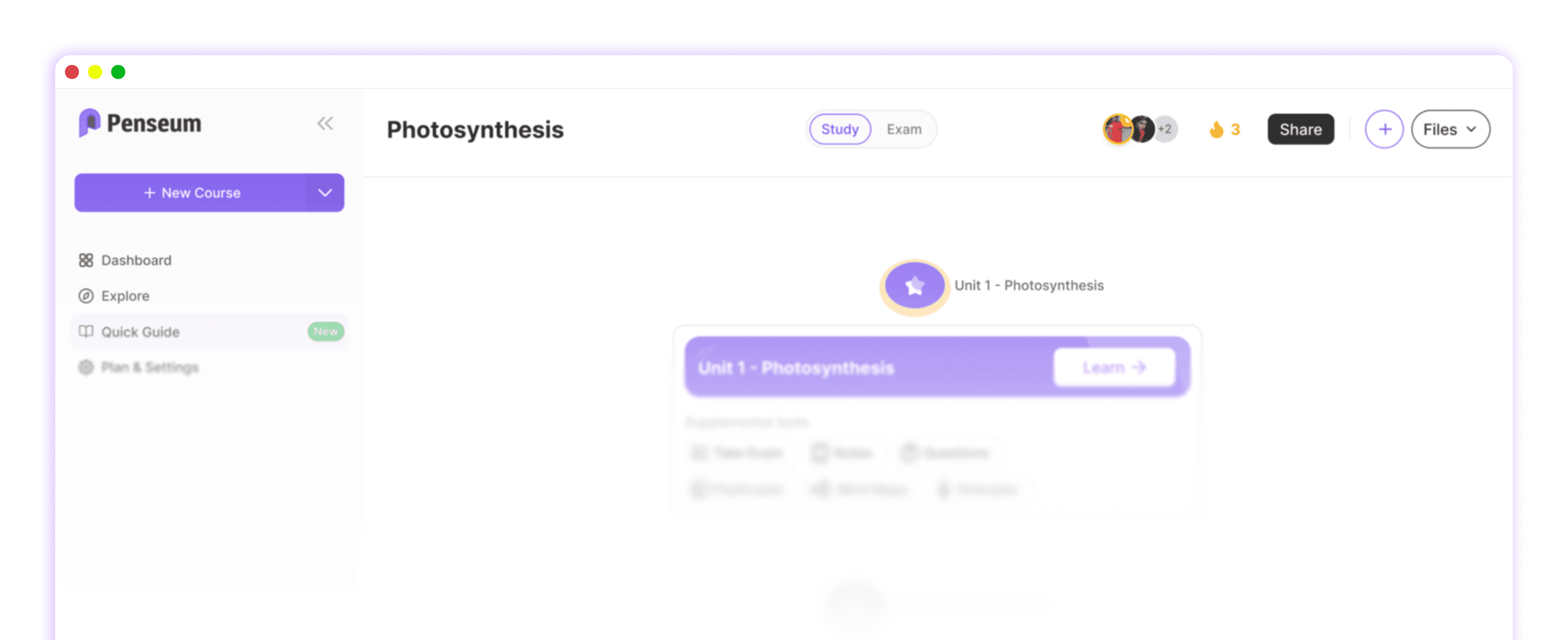
Integrating AI into a daily academic routine requires platforms that are built around individual coursework rather than public databases. Penseum achieves this by functioning as a 1-1 AI tutor that relies solely on user-uploaded PDFs, notes, and slides. When a student uploads lecture materials, the platform automatically generates accurate quizzes, study guides, mind maps, and flashcards.
This guarantees that the study material is exactly what the professor will test on, completely eliminating the inaccuracies found on crowdsourced platforms like Quizlet. You never have to worry about memorizing another student's mistakes. Your tests are built entirely from your authenticated syllabus.
Beyond basic material generation, the interactive AI tutor actively watches as students work through problems on a digital canvas. Traditional chatbots give you a wall of text and wait for your next prompt. Penseum sees your actual work on the screen and responds to it directly.
If a mistake is made, the tutor catches it in real-time, explains the error out loud with voice features, and draws visual diagrams to ensure comprehension. It keeps teaching until you actually get the concept right. It refuses to stop after just one generic answer.
Susan S., a university student using the platform, stated, "Penseum is legit! I don’t have to waste time making flashcards anymore. I just upload my stuff, and it does the rest."
The platform's adoption rate highlights its effectiveness. According to Penseum Internal User Data (2024), Penseum is actively trusted by over 1.6 million students across 130+ countries and hundreds of universities. With a generous free tier requiring no credit card, Penseum smoothly transitions learners from passive reading to active, guided practice.
Actionable step: Create a free Penseum account today and upload your most difficult lecture PDF to instantly generate a custom study guide.
Frequently Asked Questions
What are the safest free study websites?
The safest academic platforms operate on closed-loop systems. These websites only generate study materials based on the specific PDFs, slides, and notes you upload to their servers. This strict limitation prevents outside inaccuracies from infiltrating your study sessions and ensures all flashcards match your professor's exact syllabus.
Is there a flashcard creator free of charge?
Many platforms offer zero-cost flashcard generation. Modern systems utilize artificial intelligence to read your uploaded lecture transcripts and instantly format the text into digital index cards. This automated extraction process is available on free tiers and saves students countless hours of manual typing and formatting.
Do free study websites actually improve college grades?
Active testing platforms significantly raise academic performance. Testing yourself using digital quizzes and spaced repetition software forces your brain to recall information, which builds strong neural pathways. Students who test themselves using digital platforms consistently outscore peers who rely exclusively on reading passive textbook chapters.
What is the best AI free study website?
The premier AI study platforms act as personal, real-time tutors rather than simple text generators. They feature interactive canvases where algorithms watch you solve problems, catch specific methodological errors, and explain the correct steps out loud. They also automatically build accurate study guides directly from your uploaded course materials.
Can students access free study websites on mobile devices?
Top-tier educational platforms are fully optimized for both desktop and mobile access. Students can review flashcards on their phones while commuting and transition to a desktop computer for complex problem-solving on a digital canvas. This cross-device compatibility ensures uninterrupted learning regardless of your physical location.
Written by Samit Khalsa — Expert in cramming for exams
Last updated: August 2026
Sources
Educause Center for Analysis and Research. (2022). Study on undergraduate digital tool adoption and academic outcomes. Retrieved from https://er.educause.edu/
Karpicke, J. D., & Roediger, H. L. (2008). The critical importance of retrieval for learning. Science, 319(5865), 966-968. Retrieved from https://pubmed.ncbi.nlm.nih.gov/18276894/
Holmes, W., Bialik, M., & Fadel, C. (2019). Artificial intelligence in education: Promises and implications for teaching and learning. Center for Curriculum Redesign. Retrieved from https://scholar.google.com/
National Science Board. (2020). Higher education in science and engineering. Science and Engineering Indicators. Retrieved from https://ncses.nsf.gov/pubs/nsb20197/
Journal of Academic Ethics. (2021). The reliability and ethical implications of user-generated academic content in higher education. Retrieved from https://scholar.google.com/
Penseum Internal User Data. (2024). Global student adoption metrics and platform utilization. Retrieved from https://www.penseum.com/
Related guides
Ready to study smarter?
Start turning your notes into guides, quizzes, and flashcards in seconds.