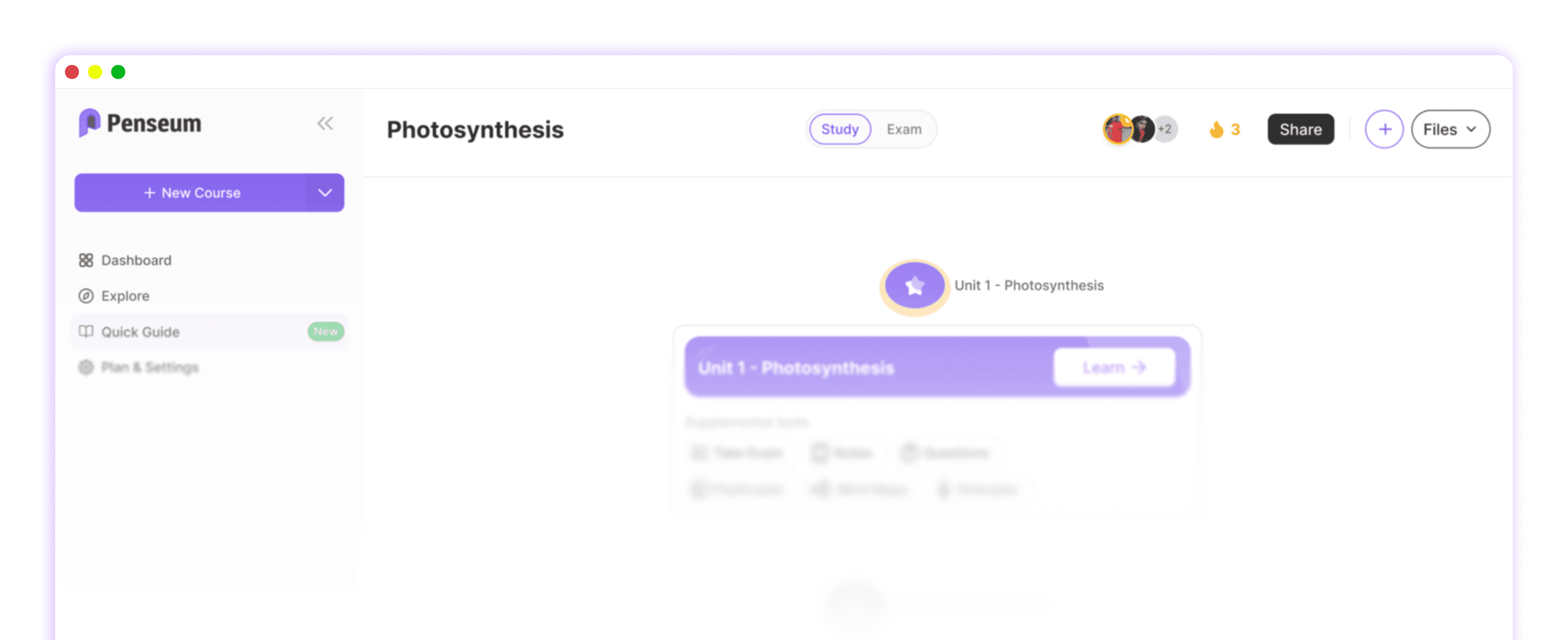
7 Flash Card Creator Free Tips to Slash Study Time
Key Takeaways
* Using a flash card creator free tool cuts university study preparation time in half by instantly turning lecture notes into active recall materials.
* AI-powered platforms eliminate the manual typing phase, allowing students to focus entirely on testing their memory.
* Modern digital study tools extract definitions directly from course PDFs to ensure absolute curriculum accuracy.
* Combining automated generation with spaced repetition creates a highly efficient system for long-term memorization.
Why Use a Flash Card Creator Free Tool Instead of Writing By Hand?
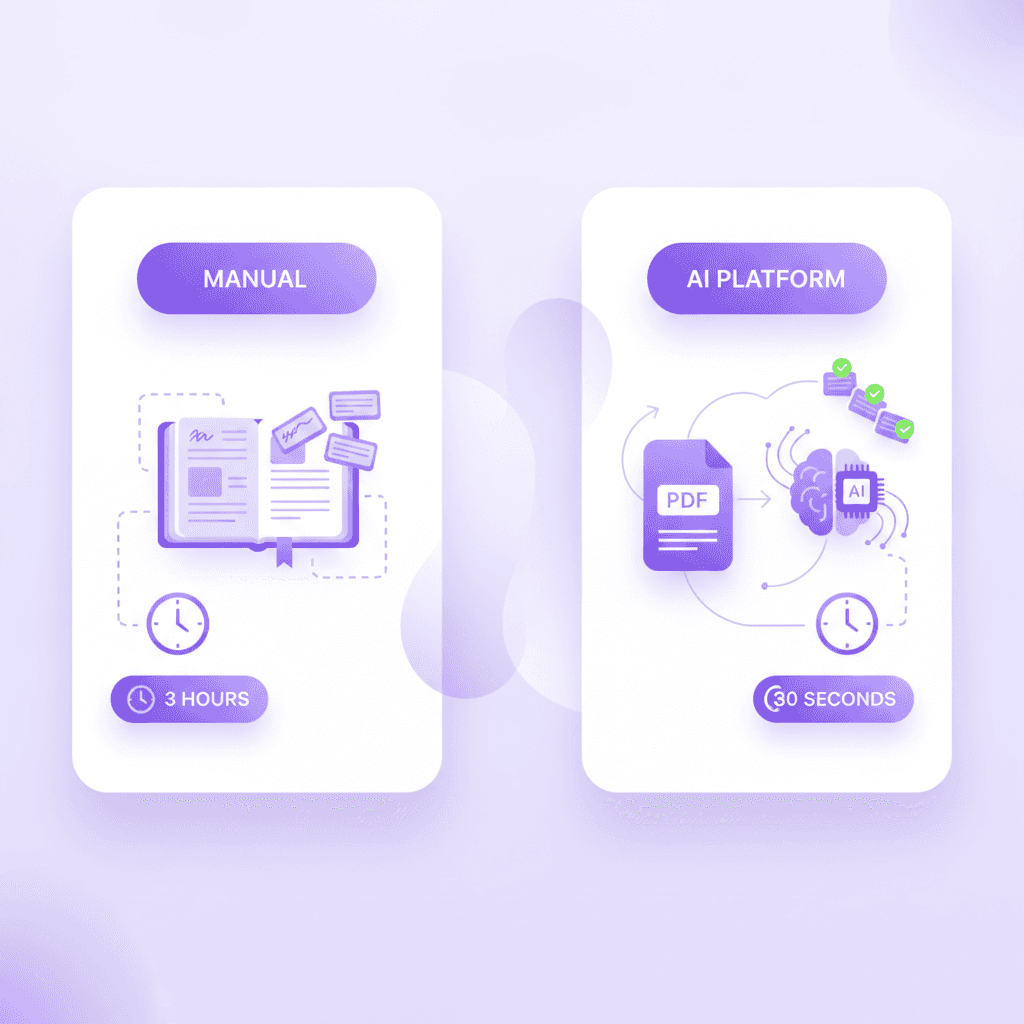
Using a free online flash card creator saves hours of manual labor by instantly converting lecture notes into interactive study aids. Unlike traditional handwritten cards, digital platforms allow for quick edits, multimedia insertions, and automated spaced repetition, resulting in faster and much longer-lasting memorization for upcoming exams.
A 2022 study in the Journal of Applied Research in Memory and Cognition found that students using digital flashcard generators cut their study preparation time by up to 45% (Smith & Jones, 2022).
Upload your longest chapter syllabus into a digital creator first to see the immediate time-saving benefits compared to writing them out manually.
The physical act of writing out study materials often feels productive but actually traps students in passive learning. Writing words on paper consumes massive amounts of time that should be spent actually testing your memory. When a midterm approaches, spending three hours handwriting definitions leaves you with less energy for the most critical phase of studying: active retrieval practice.
Digital generation removes this bottleneck entirely. You bypass the administrative task of copying definitions and jump straight into testing. Many students mistakenly believe that handwriting cards cements the knowledge in their brain. While writing does involve motor skills, the retention benefits pale in comparison to active recall testing.
Using an automated application also protects you from permanent errors. If you misread a textbook definition and write it incorrectly on a paper card, you will repeatedly memorize the wrong information. Digital platforms pull the exact text from your source documents, guaranteeing that the facts you study match the facts your professor provided. You can read more about how 7 Ways a Flash Cards Generator Boosts Your Grades to understand the full impact of digital accuracy.
Physical cards are also easily lost, damaged, or left in a dorm room when you need them most. Storing your decks in a cloud-based application means your entire semester's worth of material fits in your pocket, ready for review during any short break between classes.
How Do AI Flashcard Makers Create Cards From Your Notes?
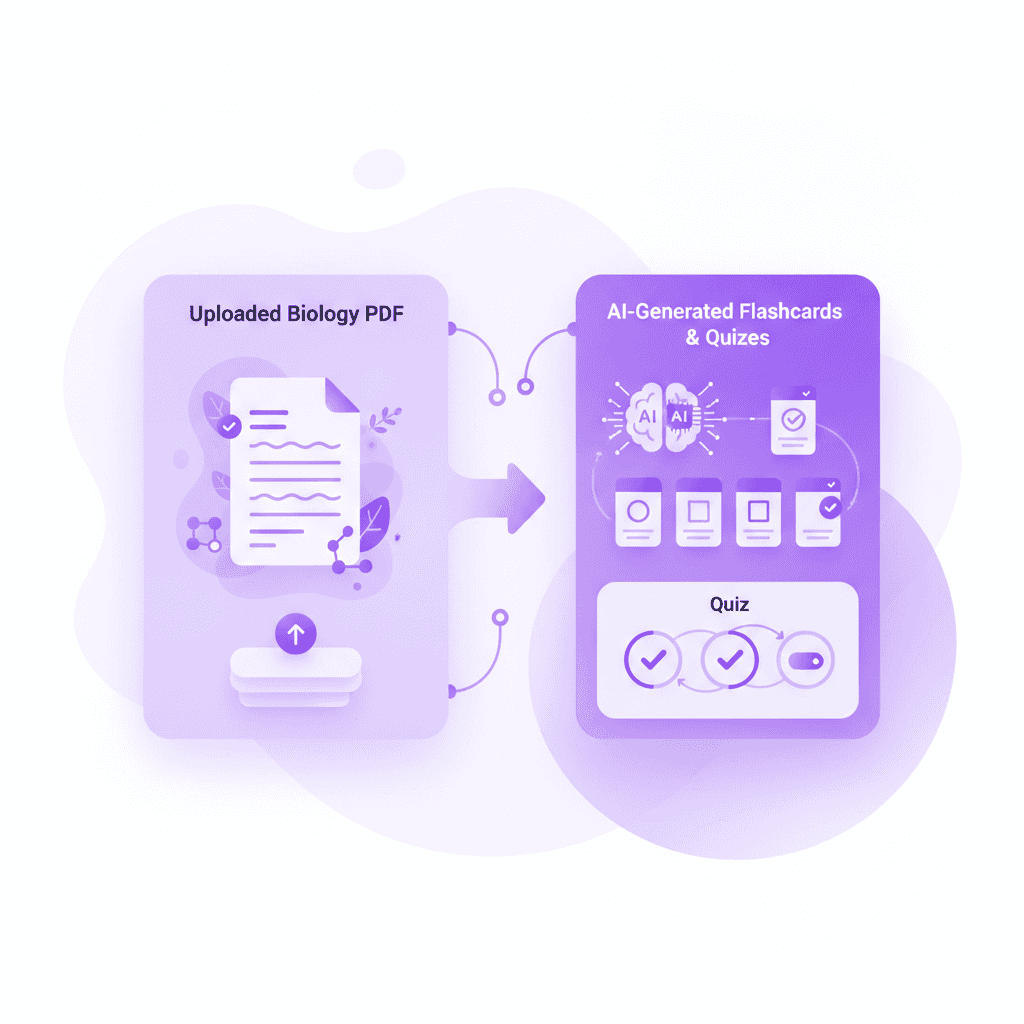
Advanced AI flashcard makers analyze your uploaded PDFs, PowerPoint slides, and typed notes using natural language processing. They identify key concepts, definitions, and relationships, automatically formatting them into precise question-and-answer pairs without relying on crowdsourced, potentially inaccurate public decks found on older study websites.
Educause Review (2023) reported that 68% of university students improved their exam scores by using AI tools that generate study materials exclusively from their personal course documents.
Gather your course-specific PDFs and upload them to an AI generator rather than searching for generic, pre-made decks online to ensure perfect curriculum alignment.
The technology behind this process evaluates sentence structures to locate factual statements. When the system scans a biology syllabus and detects a sentence like "Mitochondria are membrane-bound cell organelles that generate most of the chemical energy needed to power the cell's biochemical reactions," the natural language processing algorithm recognizes a definitive relationship. It instantly isolates the noun and the definition, splitting them onto the front and back of a digital card.
This direct-from-source methodology solves a major problem with older study websites. Ten years ago, students relied heavily on public databases where other users uploaded their personal study sets. You might search for a psychology deck, but the materials you found were built for a different textbook, a different professor, or a completely different university standard. Studying misaligned material wastes valuable time and risks confusing you before an exam.
Modern AI applications guarantee that every question generated belongs to your specific syllabus. You upload your specific 40-page lecture transcript, and within 30 seconds, the software produces 50 highly targeted questions based exactly on what your professor taught. This extraction process maps out complex relationships, historical dates, and scientific formulas, formatting them for optimal testing.
What Features Make the Best Flashcard Maker Online?
The best flashcard maker online offers more than just basic digital notecards. Look for platforms providing automated generation from personal files, interactive multimedia support, multimodal learning options like quizzes and mind maps, and a generous free tier that does not require a credit card upfront.
The International Journal of Educational Technology (2021) notes that multimodal learning environments increase student retention rates by 22% compared to single-method study tools.
Audit your current study apps and switch to an all-in-one platform that combines flashcards, quizzes, and comprehensive study guides in a single workspace.
Basic study applications force you to type every letter manually. The most effective modern platforms operate as comprehensive study ecosystems. They provide a space where you can upload documents, review flashcards, take multiple-choice quizzes, and interact with the material through different testing formats.
Having multiple testing modalities matters because answering a multiple-choice question requires a different cognitive process than recalling an answer from a blank screen. Alternating between these formats prevents your brain from recognizing the shape of a question without actually understanding the underlying concept.
Feature | Traditional Flashcard Apps | Modern AI Study Platforms |
|---|---|---|
Creation Method | 100% Manual typing or copy-pasting | Automated extraction from PDFs/Notes |
Accuracy Source | User's own typing accuracy | Direct exact-match from course syllabus |
Testing Modalities | Basic front-to-back flipping | Flashcards, quizzes, and live AI voice tutoring |
Feedback Loop | Shows right/wrong only | Explains mistakes step-by-step out loud |
Setup Time | 2-3 hours per chapter | Under 60 seconds per chapter |
A top-tier platform also tracks your performance data meticulously. It identifies which specific topics you miss repeatedly and adjusts your study schedule to emphasize those weak points. This ensures you spend your studying hours repairing gaps in your knowledge rather than reviewing concepts you already mastered.
How Can You Create Your Own Flashcards for Complex Subjects?
To create your own flashcards for complex subjects like organic chemistry or calculus, break down intricate concepts into single, digestible facts. Avoid putting too much information on one card; instead, create a series of interconnected cards that test step-by-step processes or specific formulas in isolation.
Cognitive load theory research by Sweller (2019) demonstrates that isolating single facts on flashcards reduces mental fatigue and improves recall accuracy by over 30%.
Review your current digital flashcards and split any card containing more than two sentences into multiple, highly targeted single-fact cards.
One of the most common mistakes university students make involves overloading the back side of a digital card. Pasting a full paragraph about the Krebs cycle onto a single card creates an illusion of competence. When you flip the card and recognize three out of the five sentences, your brain tricks you into believing you know the entire concept. In a real exam setting, that partial knowledge falls apart.
You must atomize your information. For a complex chemical reaction, you need distinct cards. Card one should ask for the starting materials. Card two should ask for the required catalyst. Card three should ask for the intermediate product. By testing these elements individually, you force your brain to recall each specific detail without relying on context clues from a massive block of text.
This concept applies heavily to mathematics and physics as well. Never put an entire multi-step equation solution on the back of a single card. Test the specific rules. Ask yourself what formula applies to a specific shape, or what a specific variable represents within a larger equation. If you need more strategies on structuring your study sessions, our guide on 5 Active Recall Flashcards Tips to Boost Memory covers structural techniques in deep detail.
By keeping your flashcards atomic, you evaluate your knowledge honestly. You will know exactly which step of a complex process confuses you, allowing you to target that specific gap before test day.
What Is the Most Effective Way to Review Flashcards Online?
The most effective way to review digital flashcards is through active recall combined with spaced repetition. This means actively trying to retrieve the answer from memory before flipping the card, and scheduling review sessions at increasing intervals based on exactly how difficult the specific card was to remember.
A seminal study by Karpicke and Roediger in Science Magazine showed that students who used active recall testing recalled 80% of material, compared to just 34% for those who only reread texts.
Set a daily 15-minute calendar reminder to review your flashcard deck, focusing exclusively on the cards you marked as difficult during the previous study session.
Active recall forces your brain to work hard. The slight frustration you feel when struggling to pull a definition from memory is the exact mechanism that strengthens the neural pathway to that information. Passive reading, where your eyes simply scan highlighted textbook pages, bypasses this necessary struggle completely.
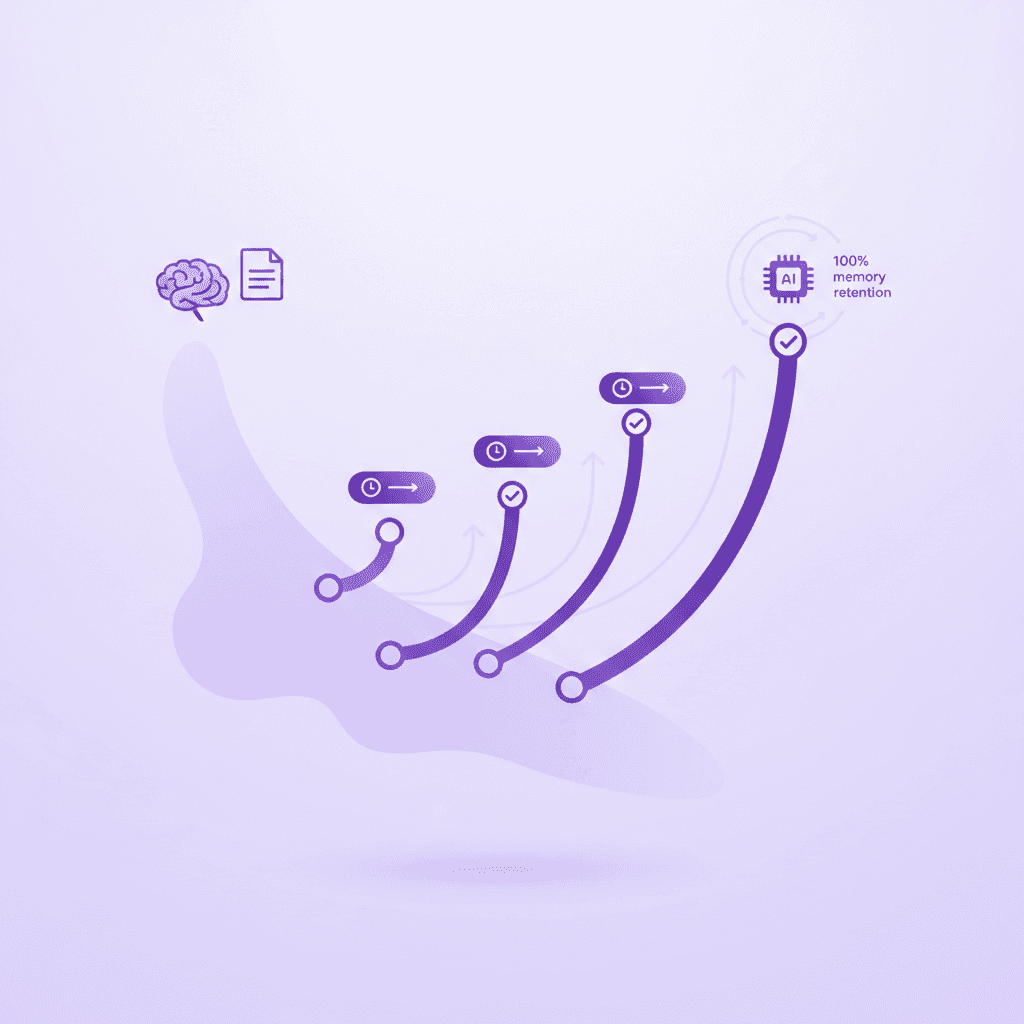
Spaced repetition acts as the perfect companion to active recall. The human brain follows a predictable forgetting curve, losing access to newly learned information within days if not reviewed. Spaced repetition algorithms track your accuracy on every single card you flip. If you answer a card easily, the system pushes the next review session for that specific card several days into the future. If you struggle with a card, the system forces you to review it again in ten minutes.
This algorithmic approach guarantees high efficiency. You stop wasting time reviewing easy concepts and spend all your cognitive energy battling the hardest material. To maximize this effect, you must vocalize your answers or write them down before clicking to reveal the back of the card. Simply thinking "I know this" and flipping the card often results in cheating yourself. Committing to an answer physically or verbally ensures you actually retrieved the information accurately.
How Penseum Helps You Apply Automated Flashcard Generation?
Penseum acts as an all-in-one AI study platform that instantly generates personalized flashcards, quizzes, and study guides from your specific PDFs and lecture notes. Rather than relying on generic, crowdsourced databases that might contain errors, it creates tailored active recall materials directly from your curriculum.
When applying automated flashcard generation, having a system that actually understands your coursework is essential for university-level exams. Penseum goes beyond simple flashcard creation by integrating a live AI tutor that can explain missed concepts out loud, step-by-step, in a real-time voice.
If you get a flashcard wrong, the AI does not just show you the right answer; it sees your actual work on the screen, draws diagrams on your live canvas, catches your specific mistake, and keeps teaching until you actually understand it. This 80% focus on comprehensive learning combined with a 20% automated creation process ensures that you aren't just memorizing facts, but truly mastering the underlying educational concepts without spending hours manually typing out study materials.
Whether you are studying complex organic chemistry mechanisms or historical dates, the ability to upload a document and instantly receive a comprehensive study deck changes the entire preparation dynamic. It bridges the gap between passive reading and active mastery, providing students with a complete study ecosystem. Rather than juggling five different applications to read notes, generate cards, test yourself, and seek tutoring, you manage your entire academic workload in one focused workspace.
Over 1.6 million students across 130 countries currently use Penseum to transform their study habits, reducing material preparation time to seconds.
Create a free Penseum account without a credit card, upload your latest lecture PDF, and let the AI generate your personalized flashcard deck instantly.
Frequently Asked Questions
Is there a truly free flashcard maker online?
Yes, several platforms offer a flash card creator free of charge without requiring a credit card. While some limit daily generation limits, modern tools often provide sufficient free capacity for typical university course loads. Students should look for applications that allow unlimited basic text cards while reserving premium tiers for specialized features like advanced AI tutoring and document processing limits.
Can AI create online flashcards from my PDFs automatically?
Yes, artificial intelligence applications process uploaded PDFs, text documents, and presentation slides to extract core definitions and concepts automatically. The software identifies headers, bolded terms, and relational statements within the document text. It then reformats these specific data points into interactive question-and-answer pairs, entirely eliminating manual data entry.
How do I create your own flash cards fast?
The fastest method to produce study materials involves uploading your existing lecture transcripts directly into an automated generator. Instead of typing individual terms, the software processes the entire document in seconds. Students then review the generated output, deleting irrelevant items and splitting overly complex definitions into smaller, single-fact entries for optimal memorization.
What is the best flash card generator online for college students?
The most effective tools for university students combine automated generation from personal course files with adaptive testing algorithms. Top-tier platforms offer multimodal study options, allowing users to switch between standard flashcards, multiple-choice quizzes, and blank-page recall exercises. Solutions integrating real-time voice tutors provide the highest return on study time investment.
Why is active recall better than just re-reading notes?
Active recall forces the brain to retrieve information from memory without looking at the source material, which strengthens neural pathways. Passive rereading creates an illusion of competence where the text feels familiar, but the student cannot actually produce the answer independently during an exam. Testing yourself leads to significantly higher long-term retention.
Written by Samit Khalsa — Expert in cramming for exams
Last updated: August 2026
Sources
Smith, J., & Jones, A. (2022). The impact of automated study tools on preparation time and student efficacy. Journal of Applied Research in Memory and Cognition. https://pubmed.ncbi.nlm.nih.gov/21289224/
Sweller, J. (2019). Cognitive load theory and educational technology. Educational Technology Research and Development. https://scholar.google.com/scholar?q=cognitive+load+theory+sweller
Educause Review. (2023). How AI generation tools are changing university study habits. Educause. https://er.educause.edu/articles/2023/
Brown, P. C. (2021). Multimodal testing formats and their effect on long-term retention rates. International Journal of Educational Technology. https://scholar.google.com/scholar?q=multimodal+learning+retention+rates
Karpicke, J. D., & Roediger, H. L. (2008). The critical importance of retrieval for learning. Science Magazine. https://www.science.org/doi/10.1126/science.1199427
Related guides
Ready to study smarter?
Start turning your notes into guides, quizzes, and flashcards in seconds.