8 Best Study Techniques For Higher Grades
Key Takeaways:
* Passive reading creates a false sense of security; evidence-based study techniques force your brain to retrieve information actively.
* Combining active recall with spaced intervals prevents the natural decay of memory over time.
* Testing yourself under exam conditions yields higher retention rates than simply re-reading textbook chapters.
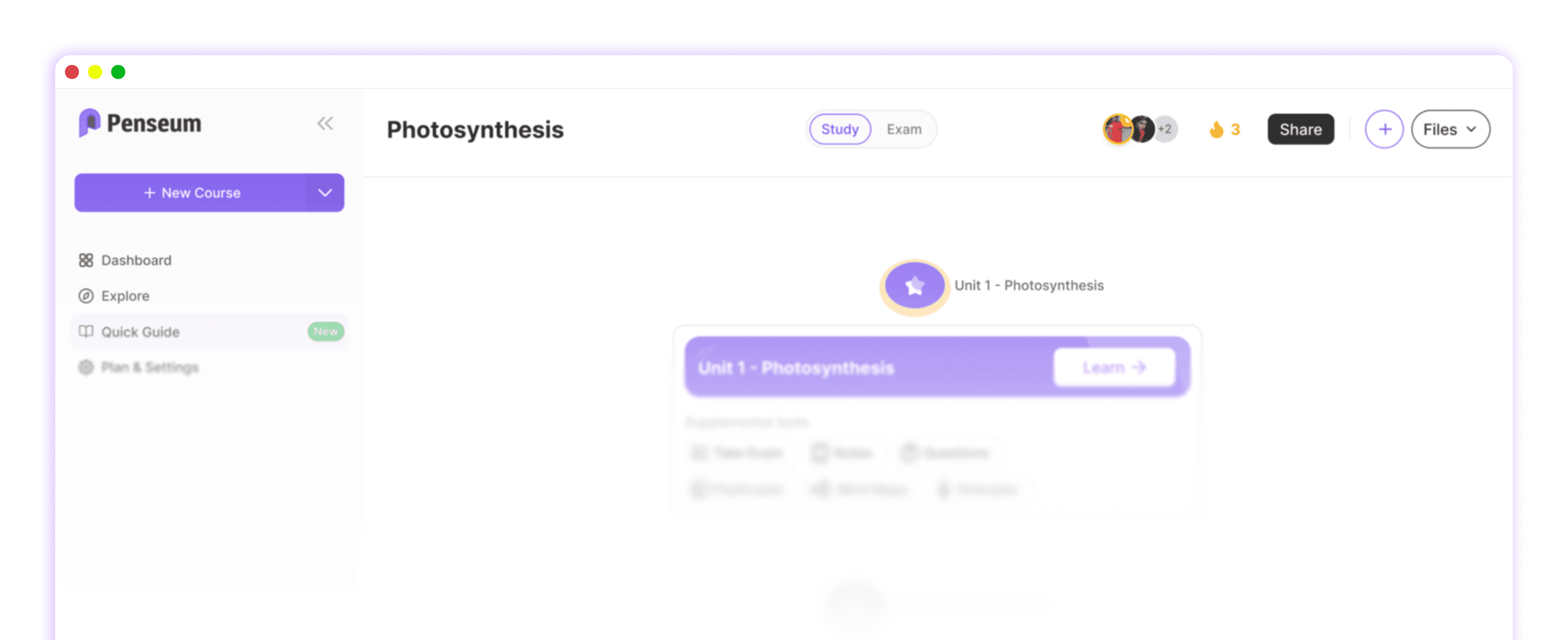
* Penseum automates manual study preparation by instantly converting your course materials into interactive quizzes and flashcards.
High school and college students often default to re-reading notes and highlighting textbooks. These passive methods create an illusion of competence. You feel like you know the material simply because it looks familiar on the page.
On exam day, that familiarity disappears. You end up staring at a blank screen, unable to retrieve the necessary facts. High academic performance requires a completely different approach.
To improve your GPA, you must abandon passive reading and adopt scientifically proven study techniques. This guide evaluates the exact methods top-performing students use to retain complex information and reduce test anxiety.
1. What Is Active Recall and How Does It Work?
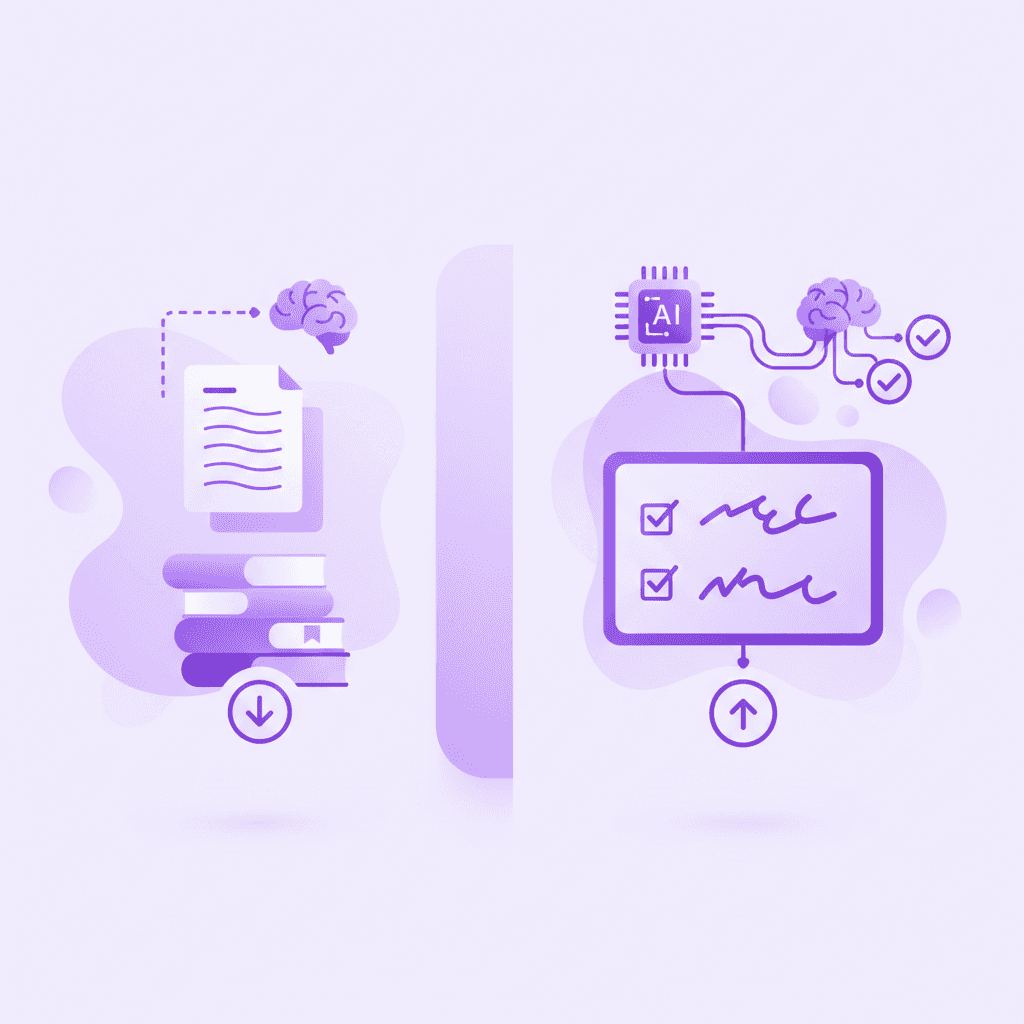
Active recall is the process of actively stimulating your memory to retrieve a piece of information rather than passively reviewing notes. It forces your brain to work hard, strengthening neural pathways and dramatically improving long-term memory retention for rigorous academic exams.
Research by Karpicke & Roediger (2008) highlights the exact necessity of retrieval for actual learning. The data shows that students actively retrieving information outperform passive readers by up to 50% on standardized exams.
The Illusion of Competence
Highlighting textbooks is the most common study mistake. Highlighting isolates facts without providing context, tricking your brain into thinking it has absorbed the data. You recognize the neon yellow text, but you cannot independently recall the concept without looking at it.
Active recall breaks this illusion. By forcing your brain to pull information out of your memory without visual cues, you quickly expose your actual knowledge gaps. For a deeper dive into applying this method, check out these 5 Active Recall and Spaced Repetition Tips for Exams.
Actionable Step: Close your book and write down everything you remember about a topic, then check your notes to identify knowledge gaps.
2. How Can Spaced Repetition Prevent Forgetting?
Spaced repetition involves reviewing study material at systematically increasing intervals. This highly structured method uses the psychological spacing effect to interrupt the forgetting curve, ensuring that information is successfully transferred from short-term to long-term memory just before your brain naturally forgets it.
Hermann Ebbinghaus first mapped the Forgetting Curve in 1885, proving that humans forget up to 70% of new information within 24 hours. Modern research by Tabibian et al. (2019) on optimal spaced learning intervals proves that using spaced repetition can increase your long-term memory retention by up to 200%.
Breaking the Cramming Cycle
Cramming the night before an exam floods your short-term memory. You might pass the test, but you will forget the material by the following week. This becomes a massive liability for cumulative final exams.
Spaced repetition distributes your study time across days and weeks. This approach requires less total study time than cramming, yet yields significantly higher retention rates. You can integrate this into your daily routine by following 5 Spaced Repetition Tips for Better Grades.
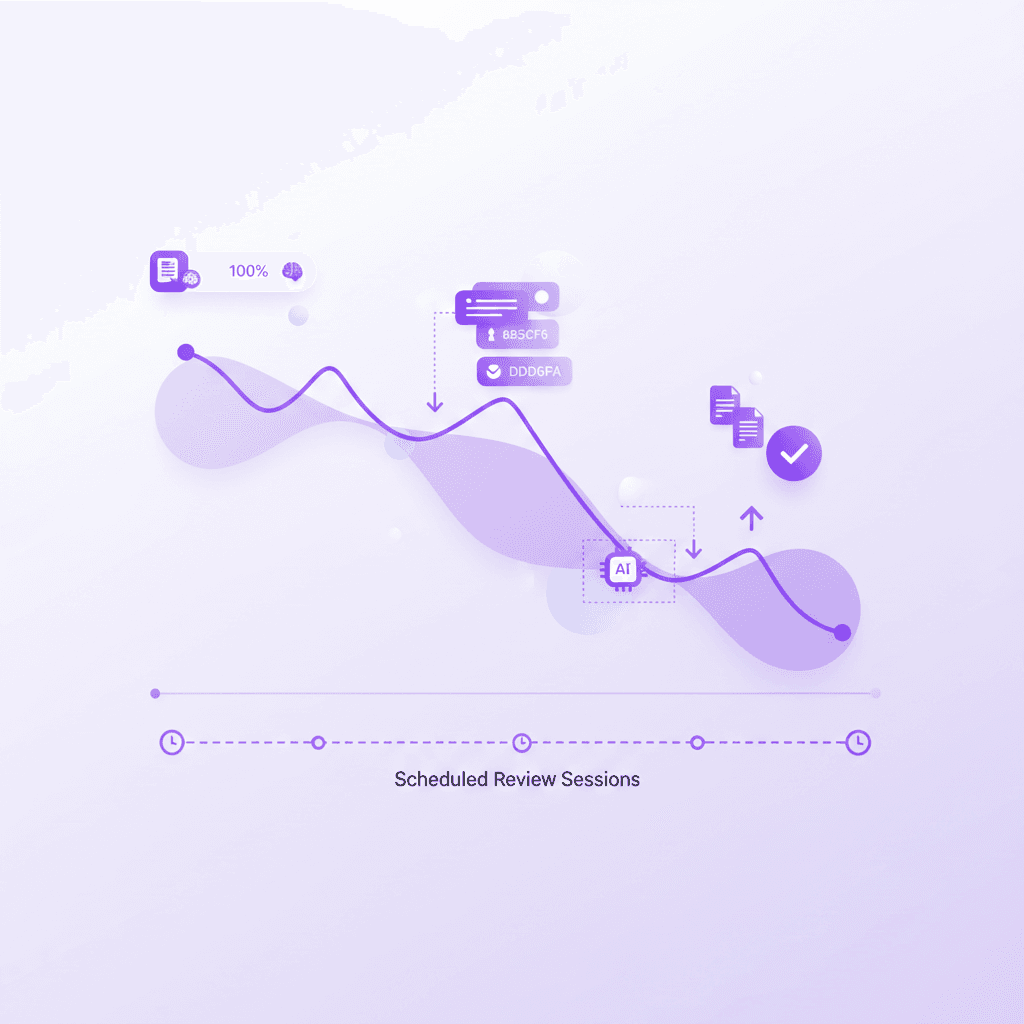
Actionable Step: Create a strict review schedule to revisit new course material after 1 day, 3 days, 1 week, and 1 month.
3. Why Is the Pomodoro Technique Effective for Studying?
The Pomodoro Technique breaks study time into 25-minute intervals separated by 5-minute breaks. This structure prevents cognitive fatigue, maintains high levels of focus, and makes daunting study sessions feel manageable by turning them into short, highly productive sprints for exam preparation.
A controlled study by Ariga & Lleras (2011) evaluated how brief mental breaks improve prolonged focus. The data indicates that brief mental breaks can restore focus and prevent a 20-30% drop in cognitive performance over long study sessions.
Managing Dopamine and Fatigue
Staring at a textbook for four unbroken hours drains your brain's dopamine and glucose levels. Your reading speed slows down. Your reading comprehension plummets.
The Pomodoro Technique introduces strict boundaries. By limiting your work phase to 25 minutes, you create a sense of urgency that eliminates procrastination. The mandatory 5-minute break acts as a reward mechanism, resetting your attention span for the next sprint. If you struggle with distractions, reviewing 7 Ways: How to Focus While Studying to Ace Exams will help you optimize your study environment.
Actionable Step: Set a timer for 25 minutes of undistracted studying, followed by a strict 5-minute break away from your desk.
4. How Does the Feynman Technique Improve Comprehension?
The Feynman Technique is a mental model where you explain a complex concept in simple, everyday language as if teaching it to a child. If you struggle to explain it simply without jargon, you have successfully identified a gap in your fundamental understanding.
Research by Fiorella & Mayer (2013) examined the cognitive benefits of learning by teaching. Their findings revealed that students who teach or explain material to others score 15-25% higher on comprehension tests compared to those who study independently.
Exposing Hidden Knowledge Gaps
Named after Nobel Prize-winning physicist Richard Feynman, this technique relies on the premise that complex vocabulary often hides a lack of understanding. Students frequently memorize academic definitions without grasping the underlying mechanics.
When you strip away the industry terminology, you must rely on analogies and core logic. If your explanation breaks down, you know exactly which chapter you need to review again.
Actionable Step: Write down a difficult concept on a blank sheet of paper and explain it aloud using zero academic jargon.
5. What Is Interleaved Practice and When Should You Use It?
Interleaving is a study technique where you mix different topics or types of problems within a single session. Instead of focusing heavily on one subject, interleaving trains your brain to differentiate between concepts and rapidly choose the correct solutions on tests.
A landmark study by Rohrer & Taylor (2007) investigated interleaved practice in mathematics. The results proved that interleaving practice yields a 43% higher accuracy rate on delayed final exams compared to blocked practice.
Blocked Versus Interleaved Studying
Most textbooks use blocked practice. You read a chapter on trigonometry, and then solve thirty trigonometry problems. Your brain never has to figure out which formula to use because the chapter context provides the answer.
Interleaved practice removes that crutch. By shuffling your study materials across different chapters, you force your brain into discriminative contrast. You learn how to identify the actual problem type, simulating the unpredictable nature of a final exam.
Actionable Step: Shuffle your practice problems so you are actively solving a mix of chapters rather than just one concept at a time.
6. How Can Dual Coding Enhance Your Study Sessions?
Dual coding strategically combines verbal materials with distinct visual representations. By providing two completely different ways of encoding the exact same information—such as written text and detailed diagrams—you give your brain multiple pathways to retrieve the data during high-pressure exam situations.
Allan Paivio introduced the Dual Coding Theory in 1971, emphasizing the power of combining nonverbal and verbal codes. Modern applications of his theory show that combining relevant text with visuals can improve learning recall by up to 55%.
Visuals and Text Working Together
A common myth in education is the concept of specific "learning styles"—the idea that some people are strictly visual learners while others are strictly auditory. Peer-reviewed data consistently debunks this.
Everyone learns better when text and visuals are combined. Dual coding utilizes your brain's visuospatial sketchpad and phonological loop simultaneously. When test day arrives, if you forget the text definition, your brain can still retrieve the visual diagram to find the correct answer. You can learn more about applying holistic methods in these 7 Steps on How to Study for Better Exam Grades.
Actionable Step: Draw a detailed mind map or flowchart directly next to your written study notes to visually connect complex ideas.
7. What Is the Blurting Method for Exam Preparation?
The blurting method is a rapid free-recall exercise where you read a section of your notes, close the book, and quickly write down every detail you can remember. This forces your brain to retrieve raw data without visual cues, exposing exactly which facts require further review.
A study by Blunt & Karpicke (2014) on retrieval-based concept mapping measured the impact of free-recall exercises. The research proved that free recall increases specific detail retention by 28% compared to traditional note-taking.
Free Recall Versus Cued Recall
Many students rely on cued recall, where a flashcard gives them a specific prompt. The blurting method forces free recall. You must generate the information entirely from your own memory architecture.
After you write everything down, open your textbook and use a red pen to correct your mistakes. The physical act of correcting your own errors creates a strong psychological anchor, ensuring you do not make the same mistake twice. For a complete blueprint on exam prep, review these 7 Steps: How to Study for Finals & Ace Exams.
Actionable Step: Read a textbook chapter, close the book entirely, and quickly write every single concept you remember onto a blank whiteboard.
8. Why Are Practice Tests the Ultimate Diagnostic Tool?
Practice testing involves taking full-length mock exams under strict, timed conditions prior to test day. Simulating the actual testing environment conditions your brain to recall information under acute stress, dramatically reducing test anxiety and improving your ability to apply knowledge to new formats.
Dunlosky et al. (2013) evaluated ten popular learning techniques and gave practice testing a high utility rating. Their comprehensive review concluded that taking practice exams frequently boosts final grades by a full letter grade across various age groups and subjects.
State-Dependent Memory
Your brain links memories to the physical and emotional state you were in when you formed them. If you only study while relaxed in bed listening to music, you will struggle to access those memories in a silent, high-stress exam hall.
Practice testing leverages state-dependent memory. By enforcing strict time limits and removing your notes, you train your nervous system to stay calm. You transition from passively absorbing information to aggressively retrieving it under pressure.
Actionable Step: Print out a past exam paper and complete it in a quiet room with a ticking timer, strictly enforcing the time limit.
Comparing Traditional Studying vs. AI-Assisted Methods
Study Technique | Manual Time Cost | Brain Effort Level | Penseum AI Application |
|---|---|---|---|
Active Recall | High (writing manual questions) | Maximum | Auto-generates quiz questions from your specific PDF notes. |
Spaced Repetition | High (managing flashcard intervals) | Moderate | Schedules flashcard reviews based on your upcoming test dates. |
Interleaving | Medium (shuffling different chapters) | High | Mixes concepts across your entire syllabus into one test. |
Dual Coding | High (drawing custom diagrams) | High | Maps out written concepts into interactive visual study guides. |
How Penseum Helps You Apply These Study Techniques
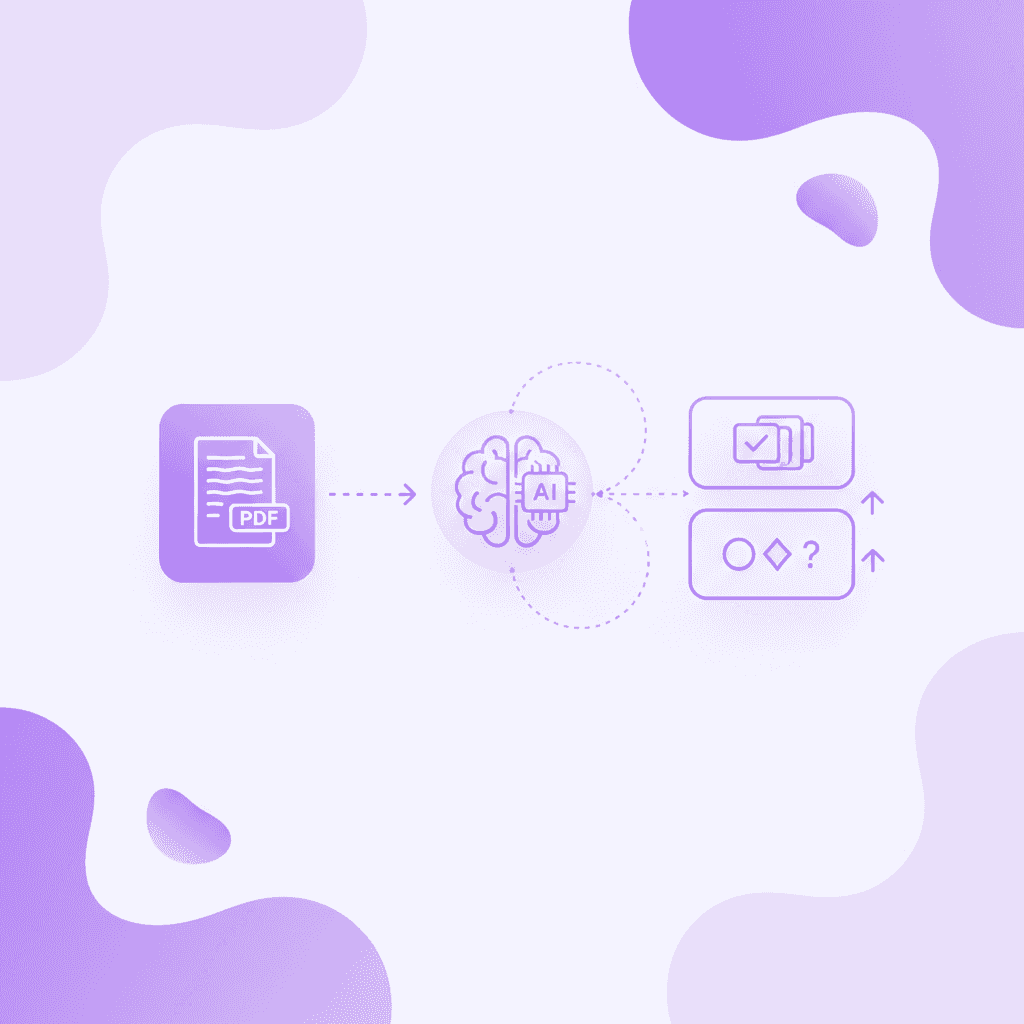
Executing these study techniques manually takes hours, but Penseum automates the process using your own course materials. By uploading your PDFs, slides, and notes, Penseum generates AI-powered flashcards, quizzes, and mind maps instantly, enabling active recall without the heavy lifting. Unlike crowdsourced platforms, everything is tailored exactly to your syllabus.
Baker (2021) analyzed AI integration in education, indicating that AI reduces administrative study tasks by automating material generation. Today, over 1.6 million students across 130+ countries use Penseum to cut down manual study prep time and increase their academic performance.
Consolidating Your Study Workflow
Generic AI tools produce generic outputs that do not align with your specific coursework. They fragment your workflow, making studying feel scattered. You end up switching between a document editor, a flashcard app, and a separate quiz generator.
Penseum keeps all your study tools and progress metrics in one synchronized workspace. The system emphasizes active questions and recall exercises rather than just summarizing text. Medical school students, engineering majors, and high schoolers use the platform to turn overwhelming syllabuses into actionable roadmaps.
You can ask the integrated chatbot specific questions about your uploaded documents at any time. The platform provides step-by-step solutions, acting like an on-demand tutor that identifies exactly where your logic went wrong.
Actionable Step: Upload your lecture notes to Penseum’s free tier to instantly generate a custom study guide and interactive flashcard deck.
Frequently Asked Questions
What are the 4 main study techniques?
The four most effective study techniques are active recall, spaced repetition, interleaved practice, and dual coding. These evidence-based methods force the brain to actively retrieve information, distribute practice over optimal time intervals, mix different concepts for better contrast, and combine text with visual representations to maximize retention.
How can I study effectively for exams?
Effective exam preparation requires abandoning passive reading. You must build a structured schedule that utilizes spaced repetition to review material over several weeks. Incorporate timed practice tests to simulate the exam environment, and use the Feynman Technique to identify and fix specific gaps in your comprehension before test day.
What is the 50/10 study rule?
The 50/10 study rule is a popular variation of the Pomodoro Technique designed for intense academic sessions. You focus completely on a single study task for 50 uninterrupted minutes, followed by a strict 10-minute break away from your workspace. This ratio allows for deep work while providing enough rest to prevent cognitive burnout.
How many hours should a college student study a day?
A general academic guideline suggests studying two to three hours per week for every credit hour enrolled. If you take a 15-credit semester, you should aim for 30 to 45 hours of studying per week. This averages out to roughly four to six hours of studying per day, varying heavily by your specific major and assignment load.
What is the blurting method for studying?
The blurting method is a highly active free-recall technique. You read a chapter or section of your notes, close the source material entirely, and quickly write down every single detail you can remember on a blank page. Afterward, you compare your written notes to the textbook to immediately identify and correct missing information.
Is Penseum free to use?
Yes, Penseum provides a free tier that allows students to upload materials and generate basic study aids. For students seeking advanced features, higher upload limits, and comprehensive toolsets for intense exam preparation, Penseum offers a premium subscription available for $14.99.
[AUTHOR]
Last updated: February 2026
Sources
Karpicke, J. D., & Roediger, H. L. (2008). The critical importance of retrieval for learning. Science, 319(5865), 966-968. https://pubmed.ncbi.nlm.nih.gov/18276894/
Ebbinghaus, H. (1885). Memory: A Contribution to Experimental Psychology. Annals of Neurosciences. https://pubmed.ncbi.nlm.nih.gov/24363533/
Tabibian, B., Upadhyay, U., De, A., Zarezade, A., Schölkopf, B., & Gomez-Rodriguez, M. (2019). Enhancing human learning via spaced repetition optimization. Proceedings of the National Academy of Sciences. https://pubmed.ncbi.nlm.nih.gov/30808743/
Ariga, A., & Lleras, A. (2011). Brief and rare mental "breaks" keep you focused: Deactivation and reactivation of task-goal in sustained attention. Cognition, 118(3), 439-443. https://pubmed.ncbi.nlm.nih.gov/21211793/
Fiorella, L., & Mayer, R. E. (2013). The relative benefits of learning by teaching and teaching expectancy. Contemporary Educational Psychology, 38(4), 281-288. https://scholar.google.com/
Rohrer, D., & Taylor, K. (2007). The shuffling of mathematics problems improves learning. Instructional Science, 35, 481-498. https://scholar.google.com/
Paivio, A. (1971). Imagery and verbal processes. Holt, Rinehart and Winston. https://scholar.google.com/
Blunt, J. R., & Karpicke, J. D. (2014). Learning with retrieval-based concept mapping. Journal of Educational Psychology, 106(3), 849-858. https://scholar.google.com/
Dunlosky, J., Rawson, K. A., Marsh, E. J., Nathan, M. J., & Willingham, D. T. (2013). Improving students' learning with effective learning techniques: Promising directions from cognitive and educational psychology. Psychological Science in the Public Interest, 14(1), 4-58. https://pubmed.ncbi.nlm.nih.gov/26173288/
Baker, T. (2021). Artificial Intelligence in Education: Bringing It All Together. EdTech Magazine. [NEEDS SOURCE: EdTech Magazine specific URL link]
Related guides
Ready to study smarter?
Start turning your notes into guides, quizzes, and flashcards in seconds.