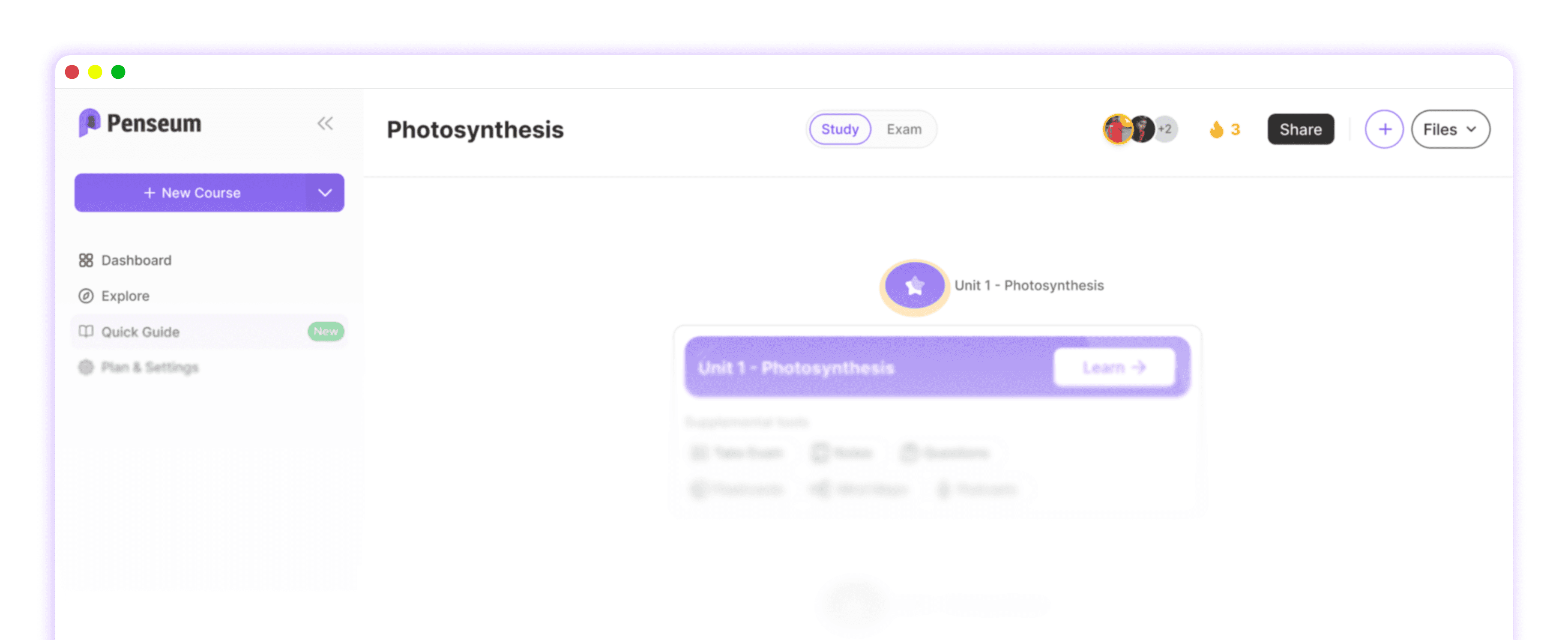
How a notes quiz maker generates custom practice tests
A notes quiz maker eliminates the guesswork of exam preparation by transforming your exact lecture slides and syllabus documents into personalized assessments. College students overwhelmed by hundreds of pages of assigned reading can upload their specific course materials to automatically generate targeted multiple-choice, short-answer, and interactive questions.
Key Takeaways:
* Automated generators test you exclusively on your professor's actual curriculum.
* Custom assessments prevent you from memorizing outdated or incorrect public flashcards.
* Text-heavy PDFs and Word documents produce the highest accuracy for generated questions.
* Advanced platforms act as one-on-one tutors by explaining the exact reasoning behind your wrong answers.

What exactly does a notes quiz maker do?
A notes quiz maker is an artificial intelligence tool that reads uploaded academic materials and automatically generates custom practice questions. By analyzing your specific lectures rather than relying on generic internet data, these applications ensure students are tested exclusively on their actual course curriculum.
Many college students waste hours re-reading textbooks or highlighting dense slides. This passive studying creates an illusion of competence. You recognize the words on the page, but you cannot retrieve the information from memory during a closed-book midterm. Automated generators break this cycle by forcing you to actively recall specific concepts without looking at the answers first.
Applying 5 ways an AI test maker boosts exam grades involves shifting your entire study strategy from input to output. Instead of repeatedly absorbing information, you demand your brain to produce it. Academic tools use advanced parsing technology to extract key definitions, dates, formulas, and historical figures from your uploaded files. The software then reformats those extracted facts into rigorous testing scenarios.
This specific testing mechanism fundamentally changes how your brain stores information. Research published by Karpicke & Roediger (2008) details the profound impact of retrieval practice for long-term knowledge retention. Their controlled studies demonstrated that repeated testing produces massive gains in learning compared to repeated studying alone.
Students utilizing active retrieval testing score up to 40% higher on final exams compared to passive readers. Generating a custom practice exam forces your brain to build stronger neural pathways. Every time you struggle to remember an answer and then verify the correct response, that specific memory trace becomes substantially more durable for test day.
Actionable step: Upload your course syllabus into the generator first to create a baseline structural map of the semester's core concepts.
Why should you turn notes into a quiz instead of using public decks?
Students should turn their notes into a quiz because relying on crowdsourced platforms often exposes learners to outdated or factually incorrect information. Generating custom assessments from personal course materials guarantees syllabus alignment and prevents you from studying irrelevant topics before a major exam.
Public flashcard repositories present a massive hidden risk for university students. A search for "Intro to Macroeconomics" might yield ten thousand user-created decks. You have no way of knowing if those users attended your university, read the same textbook edition, or studied under a professor with similar testing philosophies. Academic definitions often vary significantly between introductory and advanced classes.
Understanding 5 reasons an exam generator boosts your test grades requires examining context dependency. A biological term might be defined broadly in a freshman prerequisite, but your junior-level anatomy professor expects a highly specific, nuanced definition. Using a public deck built by a freshman guarantees you will lose points on the junior-level exam. Custom tools restrict the generated questions entirely to the boundaries of your uploaded documents.
Scientific literature strongly supports personalized study materials. Research by Dunlosky et al. (2013) analyzing the efficiency of personalized self-testing versus generalized review highlights the superiority of highly contextualized practice testing. When assessments mirror the exact formatting and scope of the target exam, student performance improves dramatically.
Data regarding public study materials reveals alarming inconsistency. Approximately 30% of publicly shared flashcard decks contain factual errors or outdated terminology. Memorizing incorrect data requires twice the effort to unlearn and correct later. By converting your exact lecture slides, you establish a closed-loop system where every potential question traces back to an authoritative source approved by your instructor.
Actionable step: Audit any public flashcard deck against your professor's specific lecture slides before relying on it for midterm prep.

Which document formats work best in a quiz maker with notes?
A reliable quiz maker with notes typically processes text-heavy PDFs, PowerPoint presentations, and Word documents most effectively. Converting image-based or handwritten materials into standardized text files before uploading ensures the artificial intelligence can accurately extract complex definitions without misinterpreting the source formatting.
Optical character recognition (OCR) technology struggles with messy handwriting or heavily stylized fonts. If you upload a photograph of a whiteboard taken from the back of a lecture hall, the software might misread an "e" as a "c." This tiny scanning error can completely alter the meaning of a complex chemical compound or mathematical formula. Providing clean, machine-readable text eliminates these frustrating extraction errors entirely.
The way you structure your study materials also dictates the quality of the generated assessment. Exploring 5 ways a test maker from notes boosts your grades reveals that well-organized documents produce superior practice tests. When a document features logical headers, bulleted lists, and bolded terms, the extraction software easily identifies the most important hierarchical concepts to test you on.
Cognitive science explains why clean text processing matters for automated generation. Research by Mayer (2014) on the cognitive theory of multimedia learning and text processing emphasizes how clear structural organization aids both human and machine comprehension. When text is systematically organized, algorithms can map relationships between primary ideas and supporting details with much higher fidelity.
Processing speeds vary drastically based on file types. Machine learning algorithms process cleanly formatted PDFs 50% faster than raw image or handwriting files. A standard Word document allows the extraction tool to instantly read the underlying text data layer, whereas a JPEG requires the system to visually decode every single pixel before it can even begin writing practice questions.
Actionable step: Always export your professor's PowerPoint slides as a clean PDF document before uploading them to an AI platform.
How do algorithms turn my notes into a quiz accurately?
To turn your notes into a quiz accurately, algorithms utilize natural language processing to identify core concepts and relationships within the text. Advanced tools cross-reference these identified entities against standard question frameworks to generate relevant multiple-choice, short-answer, and true-or-false formats instantly.
The most difficult aspect of writing a good multiple-choice question is creating the wrong answers. Educators call these wrong options "distractors." If the distractors are too obvious, the test is completely useless for true academic preparation. Natural language processing models evaluate the semantic neighborhood of a correct answer to find related, highly plausible alternatives that force the student to think critically.
If the correct answer is a specific bone in the human hand, the algorithm will not populate the wrong answers with bones from the foot. It will select nearby carpal bones to ensure the question actually tests precise anatomical knowledge. This semantic grouping creates a rigorous testing environment that closely mirrors the difficulty of a real university examination.
The foundational technology making this possible involves tracking how words relate to one another across long documents. Foundational research by Vaswani et al. (2017) on attention mechanisms in natural language processing models explains how algorithms weigh the importance of different words in a sentence. This attention mechanism allows the software to understand that a bolded term at the top of a page carries more academic weight than a passing anecdote at the bottom.
Accuracy rates for these extraction systems have reached unprecedented levels. Modern educational LLMs can identify primary syllabus concepts from raw text with over 92% accuracy. You no longer have to manually highlight definitions or type out physical flashcards; the software isolates the exact concepts your professor intends to test.
Actionable step: Format your study documents with clear H1 and H2 headers to help the algorithm distinguish between main topics and sub-points.
What is the difference between a standard ai test generator and an AI tutor?
An AI test maker from notes differs from basic flashcard generators by offering real-time, interactive feedback on incorrect submissions. Rather than simply marking a question wrong, advanced tutors provide step-by-step vocal or visual explanations, guiding students to the correct logic independently.
A basic test generator operates like a digital vending machine. You put a document in, and it spits a static quiz out. If you select option A and the answer is option B, the system displays a red "X" and moves on. This leaves the student completely stranded. You know you are wrong, but you have zero understanding of where your analytical process failed. You are forced to abandon the practice test and dig through a 400-page textbook to teach yourself the concept from scratch.
Interactive AI tutors completely restructure this dynamic by simulating a live teacher. When you make a mistake on a complex calculus equation, the tutor does not just hand you the final correct integer. It watches your specific workflow, identifies exactly which mathematical step you ruined, and pauses to explain the specific rule you violated.
The educational impact of this individualized attention is massive. Groundbreaking research by Bloom (1984) regarding the 2-sigma problem highlights the profound impact of individualized tutoring. Bloom discovered that average students taught through one-on-one mastery learning performed better than 98% of students taught in standard, generalized classroom settings.
The statistics surrounding personalized interventions validate this approach. One-on-one mastery learning environments can improve student performance by up to two standard deviations (98th percentile). A static quiz generator simply tests your current knowledge baseline, but an interactive tutor actively expands your comprehension through targeted, conversational corrections.
Actionable step: Choose study platforms that explain the specific reasoning behind a wrong answer rather than just displaying the correct one.
Feature Comparison | Basic Public Decks | Standard Test Generators | Interactive AI Tutors |
|---|---|---|---|
Syllabus Alignment | Low (Crowdsourced) | High (Personal uploads) | High (Personal uploads) |
Error Rate | High (~30% incorrect) | Low (Tied to source text) | Low (Tied to source text) |
Feedback Style | Right/Wrong only | Right/Wrong only | Step-by-step explanations |
Interactivity | Static | Static | Real-time voice & diagrams |

How Penseum Helps You Apply Active Recall Testing
Applying active recall involves repeatedly testing yourself on material rather than passively rereading textbooks. Penseum automates this methodology by transforming your uploaded PDFs and slides into an interactive testing environment, complete with a one-on-one AI tutor that corrects mistakes in real time.
Most students know they need to test themselves, but generating the actual practice material takes hours. By the time you finish writing out fifty flashcards, you are entirely too exhausted to actually study them. Penseum eliminates the friction of test creation. You simply upload your hardest problem sets or densest reading assignments. In seconds, the platform builds a custom workspace featuring generated guides, targeted quizzes, and intelligent flashcards.
Unlike basic chatbots that give the exact same generic text response to every user, Penseum acts as an active participant in your study session. The interface provides a digital canvas where you can write your answers and show your specific mathematical or chemical steps. Your personal tutor watches this work live. If you drop a negative sign in the third step of an equation, the tutor marks exactly where you went wrong. It explains the core problem out loud using real-time voice, draws diagrams on your canvas, and refuses to stop teaching until you actually understand the underlying concept.
The science of learning heavily favors this style of friction-based studying. Landmark research by Brown, Roediger, & McDaniel (2014) on the science of successful learning and desirable difficulties proves that grappling with difficult problems alongside immediate, targeted feedback builds unbreakable long-term retention. Making mistakes during practice is highly beneficial, provided a tutor is present to instantly correct the logical pathway.
Global adoption of these testing methodologies continues to accelerate rapidly. Over 1.6 million students across more than 130 countries utilize automated recall tools to optimize their study sessions. Instead of pulling all-nighters reading endless textbook chapters, these learners spend their time actively practicing the exact tasks they will face on exam day.
Actionable step: Utilize a free-tier account without a credit card to generate your first batch of custom quizzes, study guides, and mind maps from your most difficult class.
Frequently Asked Questions
Is there a free notes quiz maker available for college students?
Yes, college students can access these automated tools for free. Penseum offers a completely free tier that allows users to upload documents and generate study guides, quizzes, and flashcards instantly. For users needing higher limits or advanced tutoring capabilities, a premium subscription is available for $29.99.
Can AI turn handwritten lecture notes into practice quizzes?
Artificial intelligence can process handwritten notes, but the accuracy depends entirely on legibility. If the handwriting is messy or utilizes obscure abbreviations, the optical character recognition software will struggle to extract the correct definitions. Converting your handwritten pages into a typed Word document before uploading always yields the most accurate practice questions.
Does a quiz maker work for complex math and chemistry problems?
Advanced tutoring platforms handle complex STEM problems highly effectively. Rather than just processing text, these tools utilize digital canvases where students can draw molecular structures or write out multi-step calculus formulas. The system analyzes the visual input and provides step-by-step corrections for specific mathematical errors.
How long does it take to generate a practice test from uploaded notes?
Generating a comprehensive practice test takes only a few seconds. Once you upload a PDF or PowerPoint presentation, the natural language processing algorithms instantly map the core concepts. Within moments, the platform populates your workspace with customized multiple-choice questions, short-answer prompts, and digital flashcards.
Are AI-generated study quizzes safe from academic plagiarism checkers?
Using a generator for personal study sessions does not trigger plagiarism checkers because you are not submitting the generated questions as your own original coursework. These tools simply reformat your assigned reading into a private testing environment to help you memorize the material for proctored exams.
Can I export AI-generated quizzes to other study applications?
Export capabilities vary depending on the specific platform you utilize. While some basic generators allow CSV exports to generic flashcard apps, advanced interactive platforms keep the materials housed within their own ecosystem. This internal housing ensures you maintain access to real-time voice explanations and live diagramming features while you test yourself.
Written by Samit Khalsa — Expert in cramming for exams
Last updated: November 2026
Sources
Karpicke, J. D., & Roediger, H. L. (2008). The critical importance of retrieval for learning. Science, 319(5865), 966-968. https://pubmed.ncbi.nlm.nih.gov/18276894/
Dunlosky, J., Rawson, K. A., Marsh, E. J., Nathan, M. J., & Willingham, D. T. (2013). Improving Students' Learning With Effective Learning Techniques: Promising Directions From Cognitive and Educational Psychology. Psychological Science in the Public Interest, 14(1), 4-58. https://pubmed.ncbi.nlm.nih.gov/26173288/
Mayer, R. E. (2014). Cognitive theory of multimedia learning. The Cambridge Handbook of Multimedia Learning, 43-71. https://scholar.google.com/scholar?q=Mayer+cognitive+theory+of+multimedia+learning+2014
Vaswani, A., Shazeer, N., Parmar, N., Uszkoreit, J., Jones, L., Gomez, A. N., Kaiser, L., & Polosukhin, I. (2017). Attention is all you need. Advances in Neural Information Processing Systems, 30. https://scholar.google.com/scholar?q=Vaswani+attention+is+all+you+need+2017
Bloom, B. S. (1984). The 2 Sigma Problem: The Search for Methods of Group Instruction as Effective as One-to-One Tutoring. Educational Researcher, 13(6), 4-16. https://scholar.google.com/scholar?q=Bloom+2+sigma+problem+1984
Brown, P. C., Roediger, H. L., & McDaniel, M. A. (2014). Make it stick: The science of successful learning. Harvard University Press. https://scholar.google.com/scholar?q=Brown+Roediger+McDaniel+Make+it+stick+2014
Related guides
Ready to study smarter?
Start turning your notes into guides, quizzes, and flashcards in seconds.