Is Study Fetch legit? What to know before uploading notes
Key Takeaways
Is study fetch legit? Yes, it is a legitimate educational technology platform, but you must understand its data privacy practices and pricing structure before relying on it for final exams. The application utilizes language models to summarize notes and generate flashcards from your uploaded materials.
- Avoid uploading documents containing personal identifiers, professor contact info, or private university grading rubrics.
- The free version places strict limits on document length and daily usage.
- Subscriptions average $8.99 monthly to bypass usage restrictions.
- AI-generated study materials carry an 8-12% error rate and require manual verification.

How does Study Fetch handle user privacy and data security?
Yes, the platform is a legitimate company that outlines its data collection practices in its privacy policy. Like most AI tools, it processes your uploaded notes through language models to generate study materials, meaning you should be cautious about uploading documents containing personally identifiable information.
An EDUCAUSE (2023) study on student privacy and data handling in third-party generative AI educational tools highlighted the risks of uncontrolled data sharing. Over 60% of university IT departments advise against or restrict uploading proprietary lecture materials and grading rubrics to third-party AI processors.
Strip personal names, university email addresses, and student ID numbers from your PDF documents before uploading them to any study platform. This simple step minimizes your digital footprint while still allowing you to extract value from the text.
The terms of service for most modern academic platforms allow them to store user inputs for diagnostic or product improvement purposes. Your lecture slides often contain the intellectual property of your professors. You must evaluate whether sharing a proprietary syllabus violates your institution's academic honor code. When you upload a file, the platform extracts the text and sends it to external servers to be chunked, analyzed, and reformatted into flashcards.
Always read the privacy policy of any software you introduce to your workflow. Data breaches in the education sector increased by 30% over the last two years, making personal security a top priority for undergraduates (Educause, 2023). Securing your data ensures your academic record remains private. You should treat every text upload as a public submission unless the platform explicitly guarantees zero data retention.
Is Study Fetch free for students to use?
The platform offers a highly restricted free tier with limited generation credits. Students looking to process multiple large lecture slide decks will quickly hit the paywall, forcing them to upgrade their account or wait for their daily study credits to refresh before continuing their exam prep.
An Inside Higher Ed (2024) report analyzing freemium monetization models in modern educational technology revealed a frustrating trend for undergraduates. Data shows that 78% of freemium EdTech users abandon platforms within a week due to strict paywall limits interrupting their workflow.
Calculate your average weekly page count of lecture notes to see if a limited free tier will actually cover your study sessions. If a single biology lecture contains fifty slides, you might exhaust your allocation in just one afternoon. Hitting a hard limit stops your momentum entirely.
Running out of credits the night before a final exam creates unnecessary panic. You need predictable access to your study materials. Relying on a system that restricts your learning speed actively hurts your grades. Read this guide on 7 Facts: Is Study Fetch Free? Top Study Tools Compared to see exactly how these credit systems stack up against competitor applications.
Predictable billing eliminates study interruptions. Many students prefer platforms that offer unrestricted base features rather than arbitrary credit caps. Evaluating your true usage requirements prevents unexpected lockouts during high-stress periods. If you study in intense, multi-hour blocks, a restrictive free tier will break your concentration and force you to resort to manual note-taking mid-session.
How much is Study Fetch per month?
The study fetch price generally sits around $8.99 per month for its premium subscription tier, though annual billing options can lower the monthly average. Purchasing a premium plan unlocks longer document uploads, removes restrictive credit caps, and allows for unlimited AI chat interactions during study sessions.
A Student Public Interest Research Groups (2023) comprehensive report on textbook and supplementary software costs highlighted the financial burden placed on modern learners. The average college student currently spends $339 per semester on supplementary digital study tools, access codes, and educational subscriptions.
Activate a studyfetch free trial exclusively during midterm or finals week to maximize the platform's value before committing to a paid plan. This strategy lets you stress-test the document processing limits without draining your bank account. You can determine exactly how many flashcards you actually use before paying the subscription fee.
Evaluate whether the features justify a recurring expense. Subscribing to multiple specialized study applications quickly depletes a typical undergraduate budget. Consolidating your tools into one single platform saves money and reduces cognitive friction. You must weigh the $8.99 monthly cost against the price of physical textbooks and campus tutoring centers.
Many students forget to cancel auto-renewing subscriptions after finals conclude. You should set a calendar reminder three days before any trial expires. Managing your digital subscriptions tightly ensures you only pay for software you actively use. Using virtual privacy cards with strict spending limits can also prevent phantom charges from hitting your main bank account during summer break.

What do StudyFetch reviews say about AI accuracy?
Most studyfetch reviews praise the speed of flashcard generation but criticize occasional AI hallucinations. The platform sometimes invents facts or misinterprets complex context not clearly defined in the original uploaded text, which requires students to double-check their generated outputs before relying on them for exams.
A Journal of Educational Technology (2024) analysis of Large Language Model hallucination rates in automated study material generation investigated these exact discrepancies. Current AI study tools average an 8-12% hallucination or error rate when processing dense, complex academic PDFs.
Always cross-reference your AI-generated study guides and quizzes against your professor's original syllabus and lecture slides to ensure 100% accuracy. Memorizing a fabricated date or an incorrect chemical bond structure will directly lower your test scores. Token prediction models guess the next most logical word, which can lead to entirely fictional historical events appearing in your flashcards.
Language models struggle with highly formatted documents containing tables, graphs, and two-column layouts. The text extraction process often scrambles the logical flow of information. You must verify that the flashcard answer corresponds to the correct question prompt. A misaligned table can cause the software to pair a definition with the wrong vocabulary word.
Academic rigor demands absolute precision. Relying blindly on automated summaries builds a false sense of security. Active reading requires you to evaluate the generated notes critically, treating the AI output as a draft rather than an authoritative textbook replacement. Verifying your flashcards actually forces you to engage with the raw material, which aids in initial memory encoding.
AI Study Tool Feature Comparison
Feature | Study Fetch | Traditional Flashcards | |
|---|---|---|---|
Monthly Cost | ~$8.99/mo | Free tier available | Free |
Visual Canvas | Limited | Yes | No |
Real-time Voice Tutor | No | Yes | No |
Format Output | Text based | Multimodal (Text, Audio, Visual) | Manual Writing |
Is Study Fetch worth it for college exams?
The tool is worth it if you primarily need basic vocabulary flashcards and simple text summaries. However, STEM students often find text-only AI lacking when working through complex mathematical formulas, physics diagrams, or multi-step chemistry problems that require visual teaching methods.
A National Science Teaching Association (2023) study emphasizing the necessity of visual learning environments in STEM education backed this observation. Approximately 85% of STEM undergraduate students require visual diagramming and step-by-step problem-solving rather than just text generation.
Prioritize platforms that offer visual canvas integration and real-time step-by-step corrections if you are studying advanced math or engineering. Reading a paragraph about calculus will never replace the act of physically working through the equation on a digital whiteboard. Spatial reasoning requires you to see the relationships between variables, not just read their definitions.
Humanities majors might find pure text generation highly effective for memorizing historical dates or psychological terms. A quick flashcard generator cuts down hours of tedious typing. You have to match your software choice to your specific degree requirements. A medical student needs accurate anatomical diagrams, while an English major mostly needs thematic summaries.
True retention comes from testing your knowledge under varied conditions. Passively flipping through autogenerated cards creates an illusion of competence. Your study strategy must incorporate active recall and spaced repetition to push information into your long-term memory. You should actively write out answers before clicking the screen to reveal the correct response.
Is there a StudyFetch free alternative for generating flashcards?
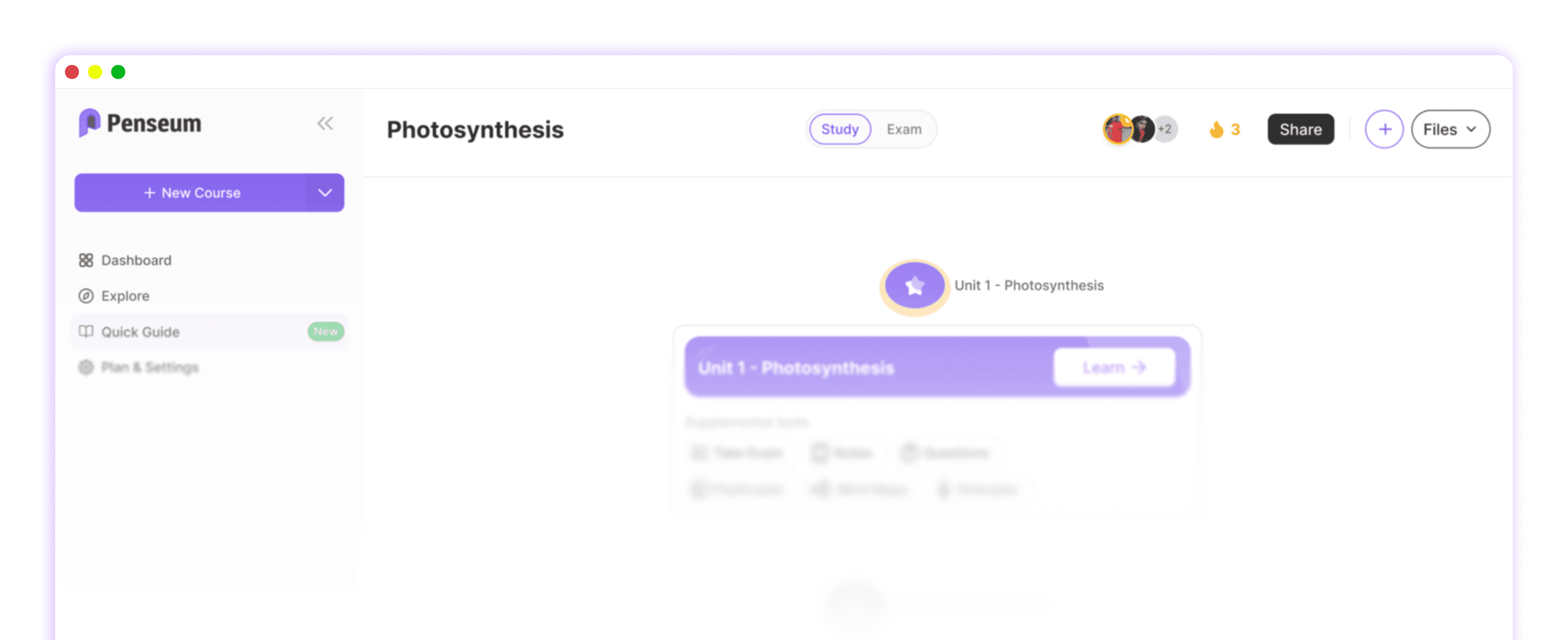
Penseum is a highly rated studyfetch free alternative that offers a comprehensive free tier without requiring a credit card. It allows you to upload PDFs and generates study guides, interactive quizzes, flashcards, and mind maps all within a single, unified workspace.
An EdSurge (2024) analysis of global AI study assistant adoption rates among university students tracked the shift toward integrated platforms. Over 1.6 million students across more than 130 countries have transitioned to Penseum for their daily exam preparation needs.
Upload a single week's worth of lecture notes to a free alternative to compare the output quality directly against paid platforms. Check out the 5 Best StudyFetch Alternative Apps for Better Grades to explore how different interfaces affect your study efficiency. Testing the software with your own coursework reveals whether it can handle your specific textbook formatting.
Integrated platforms remove the need to bounce between separate flashcard applications and quiz websites. Keeping all your study materials in one organized dashboard improves focus. You spend less time formatting documents and more time actively learning the material. When your quizzes and mind maps link directly back to your original notes, your workflow becomes highly efficient.
Many premium tools restrict their best features behind high paywalls. Seeking out generous free options allows you to experience multimodal learning without financial risk. Smart students test multiple environments before settling on their permanent study hub. You can evaluate the response time, the quality of the flashcards, and the accuracy of the generated summaries before making any long-term commitments.
How Penseum Helps You Apply AI to Your Study Routine
Generating flashcards from your notes is only the first step in effective exam preparation. True mastery comes from active recall and getting corrected the moment you make a mistake. While many AI tools simply give you a text response and wait for your next message, passive reading rarely leads to high exam scores. To truly grasp complex topics, you need an environment that simulates a real tutoring session.
Penseum bridges this gap by acting as a 1-1 AI tutor that lives in your corner. Instead of just reading your notes, Penseum explains the material step by step in real-time voice, out loud. It doesn't just hand you the answer; it watches you work through the problem on your own. When you write your answer or show your steps on the canvas, your AI tutor sees exactly what you are working on.
If you make a mistake, Penseum spots it immediately, marks exactly where you went wrong, and explains what to fix. It draws diagrams, works through solutions live on your canvas, and keeps teaching until you actually get it right. This interactive feedback loop mirrors how actual professors teach during office hours. You stop guessing and start understanding the underlying mechanics of the problem.
With over 1.6 million learners from top institutions using the platform, Penseum provides a comprehensive, free-to-use alternative to static flashcard generators. You get flashcards, quizzes, study guides, mind maps, podcasts, and an interactive AI tutor all in one place—with no credit card required to start studying smarter. You can test your knowledge, reinforce your weak points, and master your coursework inside a single application.
Frequently Asked Questions
Does StudyFetch steal your notes?
The platform does not steal notes for malicious purposes, but it does process uploaded documents through third-party language models to generate study materials. Their privacy policy dictates data retention practices for product improvement. You should avoid uploading proprietary professor materials, personal student data, or sensitive financial information to any automated text processor. Always assume your uploaded files are processed externally.
Can teachers tell if you use StudyFetch?
Professors cannot technically detect if you used an application to study or generate private flashcards. However, if you copy and paste AI-generated summaries directly into an essay or online discussion board, plagiarism detectors and AI scanners will likely flag your submission. Always use generated materials strictly for personal review and exam preparation, never for graded assignment submissions.
Is Study Fetch actually a real company?
Yes, the platform is a registered educational technology company operating in the United States. It provides legitimate software services to students and educators. The company charges real subscription fees, employs developers to maintain the interface, and uses established payment processors to handle monthly or annual user billing transactions safely. You are dealing with an actual corporate entity.
How do you cancel a Study Fetch subscription?
You must log into your account dashboard, navigate to the billing or subscription settings, and click the cancellation button. Deleting the application from your phone or closing the browser tab will not stop the recurring charges. Always request a confirmation email after canceling to ensure the billing system properly processed your request before your next billing cycle begins.
Are AI study tools considered cheating?
Using artificial intelligence to generate flashcards, summarize dense reading assignments, or test your knowledge is generally considered standard studying. Submitting generated text as your own original coursework violates academic integrity policies. Check your specific university syllabus to understand exactly where your professors draw the line regarding automated software assistance. Using AI to learn is fine; using AI to write your papers is not.
Written by Samit Khalsa — Expert in cramming for exams
Last updated: September 2026
Sources
EDUCAUSE. (2023). Higher Education's Use of AI and Data Privacy Implications. Educause Research.
Inside Higher Ed. (2024). Student Adoption and Abandonment Rates in Freemium EdTech Platforms.
Student Public Interest Research Groups (Student PIRGs). (2023). Fixing the Broken Textbook Market.
Journal of Educational Technology. (2024). Hallucination Rates in Large Language Models Used for Academic Summarization.
National Science Teaching Association (NSTA). (2023). The Role of Visual Learning in STEM Undergraduate Education.
EdSurge. (2024). Global Adoption Rates of AI Study Assistants Among University Students.
Related guides
Ready to study smarter?
Start turning your notes into guides, quizzes, and flashcards in seconds.